Zool 330: Integumentary and Circulatory System Exam
 Call Kai
 Learn
 Practice Test
 Spaced Repetition
 Match
 Flashcards
 Knowt Play
1/24

There's no tags or description
Looks like no tags are added yet.
25 Terms
How is blue coloration produced in vertebrates? In what ways is this different in ectotherms versus endotherms?
Blue coloration is usually a structural color
Ectothermal vertebrates: blue is formed from melanophores + iridophores which appear blue due to scattering of light
Endothermal vertebrates: blue is formed due to scattering of light due to hollow structures on feathers
What layer of skin is lost or severely reduced in amphibians? Why is this important?
The epidermis/stratum corneum is lost/severely reduced in reptiles
Allows for:
direct gas exchange
water absorption
keeping skin moist and reducing friction
List and briefly describe three protective specializations of the integument in reptiles.
Thick keratinized epidermis and scales
physical barrier and water retention
Dermal protective structures - provide protection
ex) osteoderm (bony plates)
Specialized surface features - enhance defense
ex) spines, scales, camouflage
What adaptations have formed that help amphibians with gas exchange through their skin?
Thin, moist skin that is also highly vascularized and gas-permeable
Describe 5 discrete examples of how the integument or structures formed from the integument can aid in protecting a vertebrate.
Stratum Corneum of Epidermis
creates a tough, waterproof barrier
Scales in Fish and Reptiles
cover body surface and protect against abrasion, predators, and drying out
Feathers in Birds
insulate and provide mechanical protection from environmental hazards and predators
Claws and Hooves
protect tips of digits from wear, punctures, and predators while also aiding in locomotion and defense
Hair or Fur
reduces heat loss and can shield skin from harmful sun radiation
What would happen if the stratum lucidum was lost?
Role of stratum lucidum: enhanced barrier, extra layer of defense.
Without the stratum lucidum, thick skin would behave more like thin skin: more sensitive, more permeable, and less mechanically resilient, especially in high‑stress areas like palms and soles.
List the 5 layers of the epidermis and describe the structure and function of each layer.
Epidermis
Stratum Corneum
Maintains integrity of skin and maintains moisture
Stratum Lucidum
Prevents friction between layers - present on thick but not thin skin
Stratum Granulosum
Nucleus lost and cells accumulate keratin and lipids
Pigment granules
Stratum Spinosum
Transitional layer
Cells change shape and keratin accumulates
Stratum Basale
Mitotic cell layer - where cells are replenished
List the 2 layers of the dermis and describe the structure and function of each layer.
Dermis
Stratum Spongiosum/Papillary Layer
Loose, irregular connective tissue
Function: strengthens epidermal-dermal junction
Stratum Compactum/Reticular Layer
Dense, regular connective tissue
Tight collagen fiber bundles
Function: provides elasticity
Describe the relationship between the dermis and epidermis. How does their overall structure and function compare?
Dermis and epidermis are closely linked during development - in the absence of one, the other is incapable of working
The epidermis is a cell‑dense, avascular barrier layer
The dermis is a fibrous, vascular support layer rich in structural proteins and sensory components
Describe the evolution of scales in fishes, beginning with the Chondrichthyes. In your answer, be sure to provide the correct name of the group that has each type of scale, the name of the type of scale(s) they have, and what layers make up those scales.
Fish scales evolved from heavy, multilayered scales (placoid, cosmoid, ganoid) toward lighter, more flexible cycloid and ctenoid scales, allowing greater mobility and swimming performance.
Explain the steps of development in mammalian hair. In your explanation, be sure to describe how epidermis and dermis interact.
Basal epidermis undergoes mitosis and creates placode
Dermal papilla forms then induces the ingrowth and organization of the follicle
Hair follicle continues to develop and sebaceous glands form off the follicle
The dermal papilla remains with the hair and the shaft breaks through the skin
Epidermis and Dermis interact via Reciprocal Induction : something that happens in the dermis causes something that happens to the epidermis (very cyclical cycle)
List the three types of blood vessels. Tell me the direction that blood flows through each and describe their structure. Finally, explain why each has that structure – i.e. how does structure relate to function in each type of vessel?
Arteries: blood flows away from heart; thicker middle/outer walls to deal with high blood pressure/speeds
Veins: blood flows to heart; thinner middle/outer walls because they don’t have to deal with high blood pressure; have valves to prevent backflow
Capillaries: lack middle/outer walls to minimize diffusion distance
How does the speed of blood flow compare between arteries, veins, and capillaries? Why does this pattern of speed change occur. In your explanation, be sure to refer to the continuity equation.
Arteries: fastest flow of blood; needed to quickly deliver oxygenated blood from the heart - smallest total area
Veins: intermediate speed of blood; needed to prevent backflow when blood is returned to the heart - moderate total area
Capillaries: slowest flow of blood; slowdown allows sufficient time for gas, nutrient, and waste exchange across the thin capillary walls - largest total area
Continuity Equation: A1v1=A2v2
A = total cross-sectional area
V = velocity of flow
Because blood is effectively incompressible, the volume flow rate must remain constant throughout the closed circulatory system. Therefore:
When total area decreases, velocity must increase.
When total area increases, velocity must decrease.
What is the difference between an atrium and a ventricle? When each contract, where does blood go? Which do you expect to be more muscular? Why?
Atrium: the upper chamber of the heart that receives blood returning to the heart; when an atrium contracts, it pushes blood into a ventricle
Ventricle: the lower chamber of the heart that pumps blood out of the heart; when a ventricle contracts, it sends blood to the lungs/gills or rest of the body
The ventricle is more muscular because it must generate enough pressure to move blood through the circulatory system
What is the difference between a single circulatory circuit vs a double circulatory circuit? Which vertebrate classes have each?
Single Circulatory System:
Blood leaving the heart goes to the respiratory organs (gills) then goes to the capillary beds and then back to the heart
In one complete circuit, the blood passes through the heart only once
Found in fish
Double Circulatory System:
Blood leaving the heart goes to the respiratory organs (lungs) then goes back to the heart, then to the capillary beds, then back to the heart a second time
In one complete circuit, the blood passes through the heart twice
Found in mammals, birds, etc.
Imagine you are a red blood cell of a fish. Describe the path that you would take through the body (no specific organ), beginning and ending with the ventricle. In your description, be sure to mention specific aortic arches, each of the major blood vessels, where capillary beds are, which respiratory structures you pass through and any chambers of the heart.
Ventricle
Bulbus Arteriosus
Ventral Aorta
Aortic Arches 6, 5, 4, 3, & 2 and through gills at 6 and 5
Gill Capillary Beds
Dorsal Aorta
Systemic Capillary Beds
Veins
Atrium
Ventricle
Imagine you are a red blood cell of a turtle. Describe the path that you would take through the body (no specific organ), beginning and ending with the ventricle. In your description, be sure to mention specific aortic arches, each of the major blood vessels, where capillary beds are, which respiratory structures you pass through and any chambers/structures of the heart.
Left Ventricle
Ventral Aorta
Pulmonary Circuit
Ventricle
Bulbus Arteriosus
Aortic Arch 4 (two sides)
Veins
Right Atrium
Right Ventricle
Imagine you are a red blood cell of a frog. Describe the path that you would take through the body to the kidneys, beginning and ending with the ventricle. In your description, be sure to mention specific aortic arches, each of the major blood vessels, where capillary beds are, which respiratory structures you pass through and any chambers of the heart.
Ventricle
Bulbus Arteriosus
Ventral Aorta
Aortic Arch 6
Pulmonary Circuit
Ventricle
Bulbus Arteriosus
Aortic Arch 4
Imagine you are a red blood cell of a kangaroo. Describe the path that you would take through the body to the stomach, beginning and ending with the right ventricle. In your description, be sure to mention specific aortic arches, each of the major blood vessels, where capillary beds are, which respiratory structures you pass through and any chambers of the heart.
Left Ventricle
Ventral Aorta
Arteries
Capillary Bed
Right Atrium
Right Ventricle
Pulmonary Artery
Lung Capillaries
Pulmonary Veins
Left Atrium
Left Ventricle
Imagine you are a red blood cell of a cardinal. Describe the path that you would take to and from the right wing, beginning and ending with the right ventricle. In your description, be sure to mention specific aortic arches, each of the major blood vessels, where capillary beds are, which respiratory structures you pass through and any chambers of the heart.
Left Ventricle
Ventral Aorta
Veins
Right Atrium
Right Ventricle
Pulmonary Circuit
Lungs
Pulmonary Veins
Left Atrium
Left Ventricle
Compare and contrast the advantages and disadvantages of the circulatory systems of fish, reptiles/amphibians, and birds/mammals. In your comparison, be sure to describe the differences in their circulatory systems and relate that to your explanations of advantages and disadvantages.
Fish
2-chambered heart w/single circulation
Advantage: simple and energy efficient
Disadvantage: blood pressure drops after passing through gills, limiting oxygen delivery
Amphibians/Some Reptiles
3-chambered heart w/double circulation
Advantage: higher blood pressure and more efficient oxygen delivery
Disadvantage: some mixing of oxygen-rich and oxygen-poor blood occurs in the ventricle making oxygen transport less efficient
Birds and Mammals
4-chambered heart w/double circulation
Advantage: most efficient oxygen delivery system
Disadvantage: more structurally complex and energetically costly to maintain
What are the 4 components of blood and what is the primary function of each?
Plasma (fluid):
92% water and 8% proteins, ions, and other dissolved molecules
transports nutrients, hormones, proteins, and waste products throughout the body
Erythrocytes (rbc):
increase oxygen-holding capacity of the blood
Leukocytes (wbc):
immune cells for defense
Platelets (pieces of cells):
clot blood to prevent excessive blood loss
Why do mammalian red blood cells lack a nucleus?
Mammalian red blood cells lack a nucleus to maximize hemoglobin content, enhance oxygen transport, and allow flexibility to pass through narrow capillaries.
Explain the sequence of aortic arch evolution from the “primitive condition” to a falcon. Be sure to discuss what happens to each of the representative species along the evolutionary path (i.e. discuss any and all species that evolved from branches that diverged from the main evolutionary line that leads to birds). Be sure to order your explanation in chronological (evolutionary) order.
Primitive 6 arches → Fish (gill arches) → Amphibians (lose arch V; arches III, IV, VI specialize) → Reptiles (both IV arches retained) → Birds/Falcon (retain right IV arch as the aortic arch, lose left IV arch).
The mammal lineage diverges from reptiles and instead retains the left IV arch.

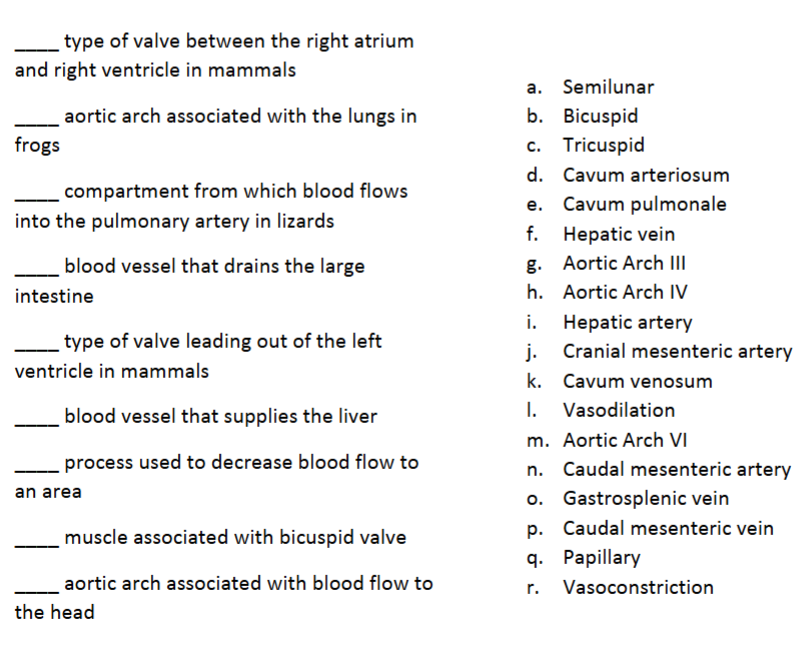
c - Tricuspid Valve
m - Aortic Arch VI
e - Cavum Pulmonale
p - Caudal Mesenteric Vein
a - Semilunar Valve
i - Hepatic Artery
r - Vasoconstriction
q - Papillary Muscle
g - Aortic Arch III