BIOC*3560 Part E: Membranes
 Call Kai
 Learn
 Practice Test
 Spaced Repetition
 Match
 Flashcards
 Knowt Play
1/211

There's no tags or description
Looks like no tags are added yet.
212 Terms
In a typical plasma membrane, what percentage is lipids?
~45%
In a typical plasma membrane, what percentage is protein?
~50%
In a typical plasma membrane, what percentage is carbohyrdates?
~5%
What percentage of a typical cell membrane is composed of the following:
a) lipids
b) proteins
c) carbohydrates
a) lipids *~45%*
b) proteins *~50%*
c) carbohydrates *~5%*
Membrane lipids are:
a) hydrophilic
b) hydrophobic
c) amphipathic
d) detergents
c) amphipathic
Most membrane lipids are ___________
a) cholesterol
b) glycolipids
c) phospholipids
d) sphingolipids
e) free fatty acids
c) phospholipids
List the four main glycerophospholipids
- phosphatidic acid
- phosphatidylethanolamine
- phosphatidylcholine
- phosphatidylserine
State the head group substituent of each of the following glycerophospholipids:
a) phosphatidic acid
b) phosphatidylethanolamine
c) phosphatidylcholine
d) phosphatidylserine
a) phosphatidic acid - *just a hydrogen (-H)*
b) phosphatidylethanolamine - *ethanolamine*
c) phosphatidylcholine - *choline*
d) phosphatidylserine- *serine*
What is the backbone in each of the following lipids?
a) glycerophospholipids
b) sphingolipids
a) glycerophospholipids - *glycerol*
b) sphingolipids - *sphingosine*
In phosphoglycerides (glycerophospholipids) the two fatty acids are connected to the glycerol backbone in a _________________________ linkage.
a) amide
b) ester
c) glycosidic
d) ionic
e) phosphodiester
b) ester
The head groups of phosphoglycerides (glycerophospholipids) are derived from...?
a) amines
b) amides
c) ketones
d) esters
e) alcohols
e) alcohols
The phosphoglyceride (glycerophospholipid) with ethanolamine for a head group substituent is called...?
phosphatidylethanolamine
The phosphoglyceride (glycerophospholipid) with serine for a head group substituent is called...?
phosphatidylserine
The phosphoglyceride (glycerophospholipid) with choline for a head group substituent is called...?
phosphatidylcholine
State the net charge of each of the following phosphoglycerides (glycerophospholipids) at ph 7:
a) phosphatidic acid
b) phosphatidylethanolamine
c) phosphatidylcholine
d) phosphatidylserine
a) phosphatidic acid *-2*
b) phosphatidylethanolamine *0*
c) phosphatidylcholine *0*
d) phosphatidylserine *-1*
Sphingolipids consist of ____ fatty acids connected to the backbone in a __________ link.
a) 2, amide
b) 2, ester
c) 1, amide
d) 1, ester
e) 2, glycosidic
c) 1, amide
Glycerophospholipids consist of ____ fatty acids connected to the backbone in a __________ link.
a) 2, amide
b) 2, ester
c) 1, amide
d) 1, ester
e) 2, glycosidic
b) 2, ester
List the two main sphingolipids
- ceramide
- sphingomyelin
State the head group substituent of each of the following sphingolipids:
a) ceramide
b) sphingomyelin
a) ceramide - *just a hydrogen (-H)*
b) sphingomyelin - *phosphocholine*
T/F: "Sphingolipids structurally resemble glycerolipids."
True
T/F: "Sphingolipids do not share structural similarities with glycerolipids."
False. Sphingolipids structurally resemble glycerolipids.
T/F: "Sphingolipids are similar in shape to glycerolipids."
True
T/F: "Sphingolipids and glycerolipids shapes are distinct from one another."
False, sphingolipids are similar in shape to glycerolipids
Which of the following lipids is part of ABO blood typing?
a) cholesterol
b) free fatty acids
c) glycerophospholipids
d) sphingolipids
e) glycosphingolipids
e) glycosphingolipids
Spingolipids with carbohydrate head groups are called...?
glycosphingolipids
What is the major animal cell sterol?
Cholesterol
What is the steroid nucleus?
A characteristic part of the structure of sterols.
It consists of four fused rings: three 6C rings + 1 5C ring.
The steroid nucleus is almost planar and is relatively rigid; the fused rings do not allow rotation about C-C bonds.
Cholesterol has a polar head group. What is it?
a simple alcohol group: -OH
Which of the following is not a structural feature of cholesterol?
a) -OH head group
b) 5C ring
c) 6C ring
d) alkyl side chain
e) glycerol backbone
e) glycerol backbone

Which of the following is NOT found in cell membranes?
a) triacylglycerols
b) glycerophospholipids
c) sphingolipids
d) galactolipids
e) sulfolipids
a) triacylglycerols
^storage lipid
A lipid is composed of *glycerol + 3 fatty acids*.
Which of the following best describes it?
a) triacylglycerol
b) glycerophospholipid
c) sphingolipid
d) galactolipid
e) glycosphingolipid
a) triacylglycerol
A lipid is composed of *glycerol + 2 fatty acids + phosphate + an alcohol-derived head group*.
Which of the following best describes it?
a) triacylglycerol
b) glycerophospholipid
c) sphingolipid
d) galactolipid
e) glycosphingolipid
b) glycerophospholipid
A lipid is composed of *sphingosine + 1 fatty acid + phosphate + choline*.
Which of the following best describes it?
a) triacylglycerol
b) glycerophospholipid
c) sphingolipid
d) galactolipid
e) glycosphingolipid
c) sphingolipid
A lipid is composed of *sphingosine + 1 fatty acid + mono-/oligosaccaride*.
Which of the following best describes it?
a) triacylglycerol
b) glycerophospholipid
c) sphingolipid
d) galactolipid
e) glycosphingolipid
e) glycosphingolipid
A lipid is composed of *glycerol + 2 fatty acids + mono-/disaccharide + sulphate*.
Which of the following best describes it?
a) triacylglycerol
b) glycerophospholipid
c) sphingolipid
d) galactolipid
e) glycosphingolipid
d) galactolipid
Membrane composition is dictated by ___________________?
function
T/F: "All cells in an organism have highly similar membrane compositions; however, there is variation between individuals."
False, different membrane types have different membrane compositions, within the same individual.
_______________________________ is a major lipids found in all membranes.
a) sphingolipids
b) phosphatidylcholine
c) cholesterol
d) cardiolipin
e) phosphatidylethanolamine
e) phosphatidylethanolamine
T/F: "'Minor lipids' are called minor lipids because of their relative unimportance."
False, it is because they are found in smaller quantities in cell membranes
Which of the following lipids is MOST abundant in the plasma membrane?
a) sphingolipids
b) phosphatidylcholine
c) cholesterol
d) cardiolipin
e) phosphatidylethanolamine
c) cholesterol
Where would a lipid monolayer form?
at the air-water interface:
the polar head groups interact with the aqueous solution, and the hydrophobic tails interact with the air

What type of molecules form micelles?
a) lipids w/ 1 acyl tail
b) lipids w/ 2 acyl tails
c) lipids w/ 3 acyl tails
d) detergents
e) 2 of the above
e) 2 of the above
[a) lipids w/ 1 acyl tail & d) detergents]
^the head group needs to be wider than the tail so the layer curves

In a micelle, which part of the lipids interact with the water?
polar head groups
In a lipid monolayer, which part of the lipids interact with the water?
polar head groups
What "shape" are lipids in a micelle?
cone-shaped
What "shape" are lipids in a lipid bilayer?
cylindrical
Which of the following is the basic matrix of all biological membranes?
a) lipid monolayers
b) lipid bilayers
c) micelles
d) liposomes
b) lipid bilayers
T/F: "Lipid bilayers are impermeable to ions and polar molecules."
True

T/F: "Unless they are part of a cell, lipid bilayers are permeable to ions/ polar molecules."
False, lipid bilayers are impermeable to ions and polar molecules

Which of the following has a center filled with aqueous solution?
a) lipid monolayers
b) liposomes
c) micelles
d) 2 of the above
e) none of the above
b) liposomes

Artificial __________ allow the study of membrane transporters.
a) lipid monolayers
b) micelles
c) lipid bilayers
d) liposomes
e) all off the above
d) liposomes
^vesicles

T/F: "A cell's plasma membrane is symmetrical."
False, proteins are "sided"-- outside is different from inside
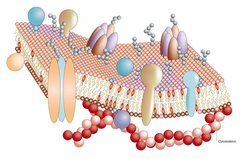
If a pH change or chelator (removes stabilizing Ca2+) releases a membrane protein, that means the protein is a(n):
a) peripheral protein
b) integral protein
c) lipid-anchored
a) peripheral protein

If detergent is needed to remove a membrane protein, that means the protein is a(n):
a) peripheral protein
b) integral protein
c) lipid-anchored protein
b) integral protein
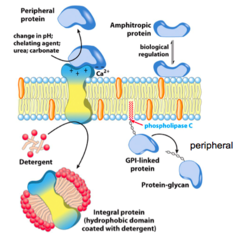
If a membrane protein is released when phospholipase is added, that means the protein is a(n):
a) peripheral protein
b) integral protein
c) lipid-anchored protein
c) lipid-anchored protein

State how you would remove each of the following proteins from a cell membrane:
a) peripheral protein
b) integral protein
c) lipid-anchored protein
a) peripheral protein - *pH change or chelator*
b) integral protein - *detergent*
c) lipid-anchored protein - *phospholipase*

How does a detergent remove an integral membrane protein from a cell membrane?
The detergent coats the hydrophobic domain of the intergral membrane protein -> stops it from interacting w/ other membrane lipids ∴ it comes loose

How would a pH change or a chelator cause a peripheral membrane protein to come off a cell membrane?
Peripheral membrane proteins have stabilizing Ca2+ interactions which are disrupted by changes in pH or chelators.
How do peripheral membrane proteins stay on cell membranes?
- interaction w/ polar head groups of membrane lipids
- electrostatic interactions
- hydrogen bonds
In terms of lipid-anchored proteins, state where on a protein each of the following lipid anchors would attach:
a) palmitoyl group
b) N-myristoyl group
c) farnesyl (or gerarylgeraryl) group
d) GPI anchor
a) palmitoyl group - *on internal Cys (or Ser)*
b) N-myristoyl group - *on N-terminal Gly*
c) farnesyl (or gerarylgeraryl) group - *on C-terminal Cys*
d) GPI anchor - *on carboxyl terminus*
Glycophorin A is a(n):
a) single-spanning transmembrane protein
b) multi-spanning transmembrane protein
c) lipid-anchored protein
d) peripheral membrane protein
a) single-spanning transmembrane protein
How many types of integral membrane proteins are there?
six
(type I, II, III, IV, V, VI)
What is a hydropathy plot? What is it used for?
Hydropathy plots allow for the visualization of hydrophobicity over the length of a peptide sequence.
A hydropathy scale which is based on the hydrophobic and hydrophilic properties of the 20 amino acids is used.
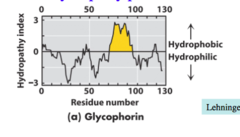
By looking at a hydropathy plot, how can you tell where a likely transmembrane domain is on a protein?
If > 20 successive residues have a high hydropathy index, possibly a transmembrane segment

Bacteriorhodopsin is a(n):
a) single spanning transmembrane protein
b) multi-spanning transmembrane protein
c) lipid-anchored protein
d) peripheral membrane protein
b) multi-spanning transmembrane protein
(has 7 transmembrane segments)

How many transmembrane segments does each of the following have?
a) glycophorin A
b) bacteriorhodopsin
a) glycophorin A - *1*
b) bacteriorhodopsin - *7*
T/F: "The extracellular loops of bacteriorhodopsin are short."
True

T/F: "The extracellular loops of bacteriorhodopsin are long and twisted."
False, they are short

T/F: "Bacteriorhodopsin is part of the G-protein coupled receptor family."
True
What are annular lipids?
Annular lipids represent a select set of lipids which preferentially bind or stick to the surface of membrane proteins in biological cells.
The word "annular" in general means"ring-shaped".

How do annular lipids interact with receptors?
The head groups of "annular"lipids interact with the *hydrophilic extracellular loops* of receptor proteins (e.g., of aquaporins).
The fatty acids tails interact with the *transmembrane helices*.
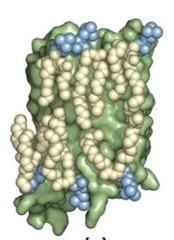
Give three examples of β-barrel integral membrane proteins.
- FepA
- OmpLA
- maltoporin

T/F: "Bacterial and mitochondrial outer membrane proteins are β-barrels."
True
Bacterial and mitochondrial outer membrane proteins are ____________
a) peripheral membrane proteins
b) all enzymes
c) β-barrels
d) all of the above
e) none of the above
c) β-barrels
T/F: "Hydrophobic strands that make up β-barrels don't show up on hydrophathy plots."
True, because hydropathy plots detect hydrophobic sections that are > 20 residues long, whereas β-barrel strands can be only 7 residues
What keeps the strands of β-barrels together?
backbone hydrogen bonds
Which amino acid residue(s) on transmembrane proteins are concentrated at the membrane interface (i.e., where the polar head groups meet the acyl chains)?
Tyrosine & Tryptophan

Where would an Arg residue likely be found on a transmembrane protein?
a) in the aqueous phase
b) at the membrane interface
c) in the hydrophobic region
a) in the aqueous phase
^Charged residues (Arg, Lys, Glu, Asp) are found almost exclusively in the aqueous phase
Where would a Lys residue likely be found on a transmembrane protein?
a) in the aqueous phase
b) at the membrane interface
c) in the hydrophobic region
a) in the aqueous phase
^Charged residues (Arg, Lys, Glu, Asp) are found almost exclusively in the aqueous phase
Where would a Glu residue likely be found on a transmembrane protein?
a) in the aqueous phase
b) at the membrane interface
c) in the hydrophobic region
a) in the aqueous phase
^Charged residues (Arg, Lys, Glu, Asp) are found almost exclusively in the aqueous phase
Where would an Asp residue likely be found on a transmembrane protein?
a) in the aqueous phase
b) at the membrane interface
c) in the hydrophobic region
a) in the aqueous phase
^Charged residues (Arg, Lys, Glu, Asp) are found almost exclusively in the aqueous phase
Where would a Tyr residue likely be found on a transmembrane protein?
a) in the aqueous phase
b) at the membrane interface
c) in the hydrophobic region
b) at the membrane interface
^Tyrosine and tryptophan residues are concentrated where the polar head groups meet the acyl chains

Where would a Trp residue likely be found on a transmembrane protein?
a) in the aqueous phase
b) at the membrane interface
c) in the hydrophobic region
b) at the membrane interface
^Tyrosine and tryptophan residues are concentrated where the polar head groups meet the acyl chains

All N-linked carbohydrates are linked through which monosaccharide and which amino acid(s)?
a) N-Acetylglucosamine & asparagine
b) N-Acetylglucosamine & aspartate
c) N- Acetylgalactosamine & asparagine
d) N- Acetylgalactosamine & aspartate
e) N- Acetylgalactosamine & serine/threonine
a) N-Acetylglucosamine & asparagine
^a.k.a. GlcNAc & Asn

Most O-linked carbohydrate covalent attachments to proteins involve a linkage between which monosaccharide and which amino acid(s)?
a) N-Acetylglucosamine & asparagine
b) N-Acetylglucosamine & serine/threonine
c) N- Acetylgalactosamine & asparagine
d) N- Acetylgalactosamine & aspartate
e) N- Acetylgalactosamine & serine/threonine
e) N- Acetylgalactosamine & serine/threonine
^a.k.a. GalNAc & Ser/Thr

List two functions of the sugar groups on glycoproteins and glycolipids.
- Contribute to cell surface recognition
- Function as receptors
T/F: "Membranes are largely static/ unchanging."
False, they are dynamic
T/F: "Membranes are very dynamic."
True
List three ways membrane are dynamic.
- They can *change shape* without loss of integrity or becoming leaky
- Fluid mosaic model (allows *lateral movement* and "Flipping/Flopping/Scrambling")
- Membranes usually bounce off each other, but *can fuse*
Which of the following is the physiological state of the lipid bilayer (cell membranes)?
a) gel
b) liquid ordered, Lo
c) liquid disordered, Ld
b) liquid ordered, Lo
What causes a lipid bilayer to change from the lipid ordered state (Lo) to the lipid disordered state (Ld)?
Heat --> increased heat produces thermal motion of side chains , which leads to the Lo -> Ld transition
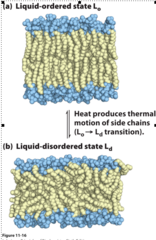
In which of the following lipid bilayer states are hydrocarbon chains in constant motion w/ no regular organization?
a) gel
b) liquid ordered, Lo
c) liquid disordered, Ld
d) none of the above
c) liquid disordered, Ld
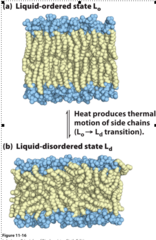
In which of the following lipid bilayer states is all motion of bilayer is constrained?
a) gel
b) liquid ordered, Lo
c) liquid disordered, Ld
d) none of the above
a) gel
Which of the following lipid bilayer states involves intermediate thermal motion of acyl chains and atoms?
a) gel
b) liquid ordered, Lo
c) liquid disordered, Ld
d) none of the above
b) liquid ordered, Lo
In which of the following lipid bilayer states are the lipids ordered in a paracrystalline state?
a) gel
b) liquid ordered, Lo
c) liquid disordered, Ld
d) none of the above
a) gel
Which lipid bilayer state is favoured by unsaturated & shorter chain fatty acids?
a) gel
b) liquid ordered, Lo
c) liquid disordered, Ld
d) none of the above
c) liquid disordered, Ld
Which of the following lipids pack well into liquid-ordered state?
a) saturated short chain fatty acids
b) saturated long chain fatty acids
c) unsaturated fatty acids
d) cholesterol
b) saturated long chain fatty acids
^ e.g., C16:0, C18:0
T/F: "Cells can regulate lipid composition."
True.
^Cells regulate lipid composition to achieve a constant membrane fluidity
Why do bacteria synthesize more unsaturated fatty acids and fewer saturated ones when cultured at low temperatures?
Because unsaturated fatty acids favour greater membrane fluidity, which combats the decreased membrane fluidity from the cold (cold => gel state)
In each of the following cases, would cholesterol increase or decrease membrane fluidity?
a) membrane w/ lots of long, saturated fatty acids
b) membrane w/ lots of unsaturated, cis fatty acids
c) membrane @ high temperature
d) membrane @ low temperature
a) membrane w/ lots of long, saturated fatty acids - *increases fluidity*
b) membrane w/ lots of unsaturated, cis fatty acids - *decreases fluidity*
c) membrane @ high temperature - *decreases fluidity*
d) membrane @ low temperature - *increases fluidity*