Metabolism and Energy Pathways
 Call Kai
 Learn
 Practice Test
 Spaced Repetition
 Match
 Flashcards
 Knowt Play
1/10

Earn XP
Description and Tags
Chapter 7: Energy Metabolism
11 Terms
metabolism
The sum total of all the chemical reactions that go on in living cells.
Energy metabolism includes all the reactions by which the body obtains and expends energy from food.

anabolism
Reactions in which small molecules are put together to build larger ones.
Anabolic reactions require energy.
catabolism
Reactions in which large molecules are broken down into smaller ones.
Catabolic reactions release energy.

The role of enzymes and coenzymes in metabolic reactions: Glycolysis
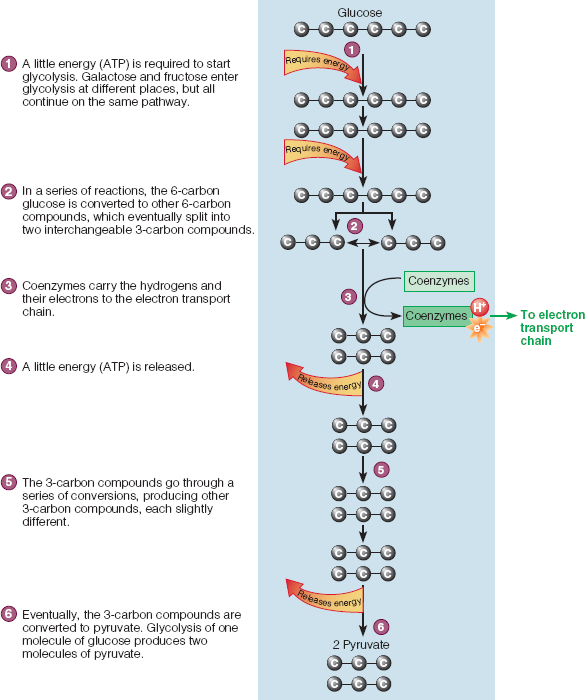
Glycolysis: Glucose-to-Pyruvate
Coenzymes carry hydrogen and their electrons to the electron transport chain

The role of enzymes and coenzymes in metabolic reactions: Anaerobic
Pyruvate-to-Lactate (Anaerobic)
rapid rate of glycolysis produces abundant pyruvate and releases hydrogen-carrying coenzymes more rapidly than the mitochondria. in exercise to continue at this intensity, pyruvate is converted to lactate and coenzymes are released, which allows glycolysis to continue
The role of enzymes and coenzymes in metabolic reactions: Aerobic
Pyruvate to Acetyl CoA (Aerobic)
Coenzymes carry hydrogen and their electrons to the electron transport chain
The role of enzymes and coenzymes in metabolic reactions: Liver
if needed, cells in the liver (and to some extent, the kidneys)
can make glucose again from pyruvate in a process similar to the reversal of glycolysis.
Making glucose requires energy, however, and different enzymes. Still, depending on the cell’s needs, glucose may go “down” to make pyruvate, or pyruvate may go “up” to make glucose.
glycolysis
glycolysis and the breakdown of glucose into pyruvate.
NOTE: The cell uses a little energy (−2 ATP) to begin the breakdown of glucose to pyruvate, but then it gains a little more energy (+4 ATP), for a small net gain (+ 2 ATP).
aerobic metabolism
energy expenditure proceeds at slower pace—as occurs when you jog around the track for an hour—pyruvate breaks down to acetyl CoA in an aerobic pathway.
Aerobic pathways produce energy slowly, but they can be sustained for a long time,
their total energy yield is greater.
requiring oxygen
anaerobic metabolism
When the body needs energy quickly—as occurs when you run a quarter mile as fast as you can—pyruvate is converted to lactate
The breakdown of glucose-to-pyruvate-to-lactate proceeds without oxygen—it is anaerobic
not requiring oxygen
Cori cycle, where lactate is produced and converted back into glucose.
Because muscle cells lack the enzyme to convert lactate to glucose,
lactate must first travel to the liver.
The process of converting lactate from the muscles to glucose in the liver that can be returned to the muscles is known as the Cori cycle.
Pyruvate is converted to lactate
By accepting the hydrogens, pyruvate becomes lactate , and the coenzymes are freed to return to glycolysis to pick up more hydrogens
