Module III – Linear Regression, Regularization, and Cross Validation
 Call Kai
 Learn
Learn Practice Test
 Spaced Repetition
 Match
Match Flashcards
 Knowt Play
1/20

There's no tags or description
Looks like no tags are added yet.
Name | Mastery | Learn | Test | Matching | Spaced | Call with Kai | Chat |
|---|
No analytics yet
Send a link to your students to track their progress
21 Terms
Machine learning taxonomy

Regression
kind of supervised learning
y = f(x,ϕ)
y
target variable
output variable, dependent variable, labels
scalar (i.e., a number)
can be continuous or discrete
x
input variable
aka descriptors, features, independent variables
can be continuous or discrete
vector (i.e., can be many values for each instance
f
model → typically choose linear model
ϕ
model parameters
often also called w or β
vector (i.e., can be many)
Types of Regression Models

Assumptions of Linear Regression

Linearity
relationship between independent and dependent variables is linear
change between each is proportional

Homoscedasticity
spread of errors should be relatively uniform, regardless of predictor value
residuals maintain constant variance across all independent variables

Linear Regression Model Form ****

Human learning
guessing
trying diff combos of phi0 and phi1 to find line of fit

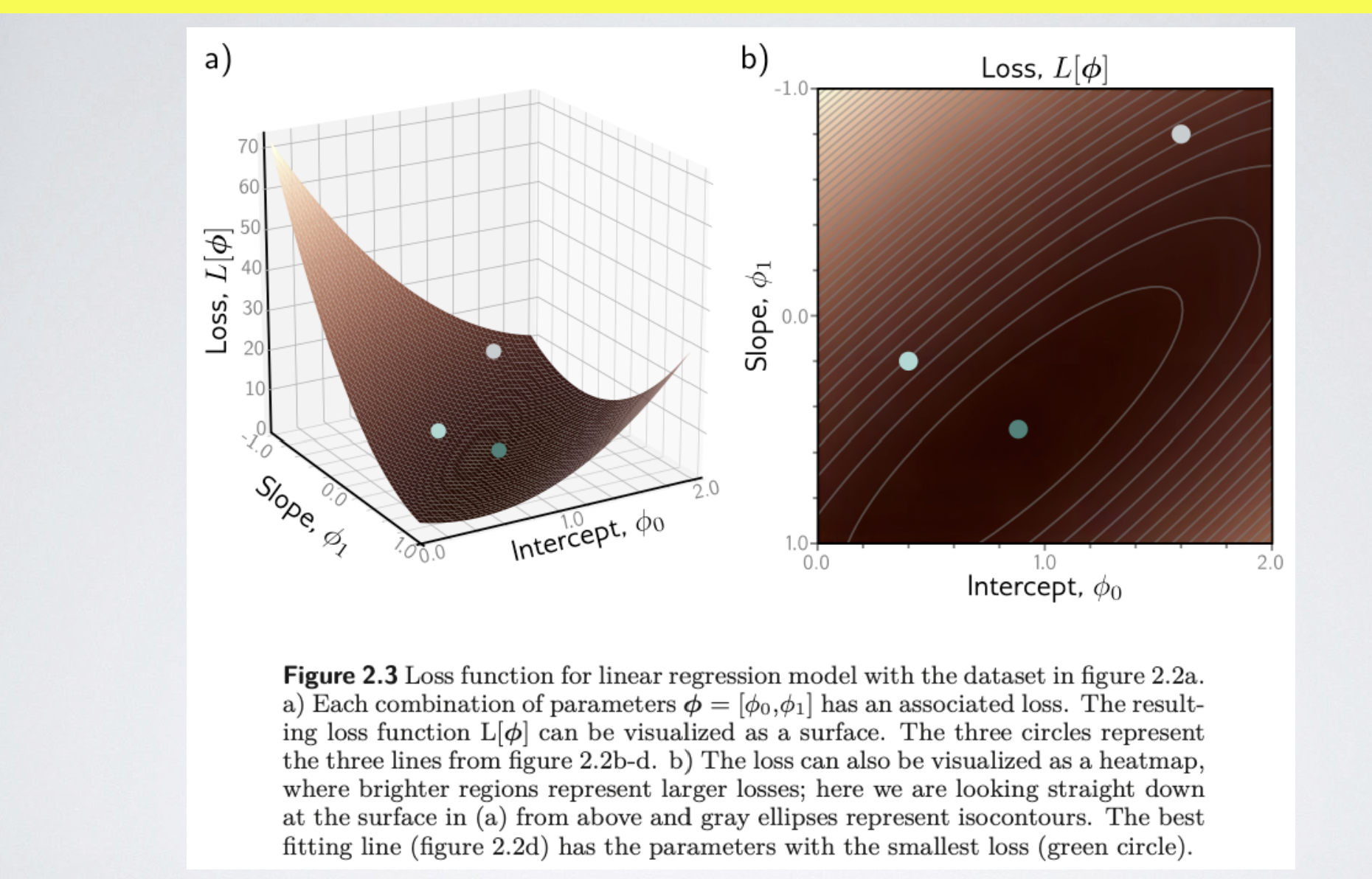
Loss Function
optimal parameters phi are those that minimize L(phi)
best model has minimal loss
sum of square error loss

gradient descent
optimization algorithm used to train machine learning models by minimizing errors by playing w phi0 and phi1 to map out loss surface
We ask the model to search for the values of phi that minimize L(phi)
One way to do this is by gradient descent on the loss surface.
linear regression w/ nonlinear features

choosing what features to use
Select features based on the data or the physics (e.g., a harmonic spring needs a quadratic term)
Try many features and pare down to those that decrease the loss the most
Trade-off model accuracy (low loss) and complexity (more features)
Check performance on new data to see how model performs? Use regularization or cross validation!
regularization
encourages a complex model to avoids over-fitting and find simpler solutions in the Goldilocks Zone
popular method is adding penalty term to cost function to punish large or non-zero coefficients
under-fitting
too simple to capture underlying pattern in data

optimal-fitting
just right number of parameters needed

over-fitting
model is too complex relative to training data available
high accuracy on training data but low accuracy on test data
train loss (MSE) low but validation loss (MSE) high!

regularized linear regression loss function
lamda (hyperparameter) is the strength of regularization (or punish the model)
view the regularized linear regression loss function as a generalization of our standard linear regression loss function
lamda controls the trade-off between fitting the data well (first term) and minimizing the size of the coefficients (second term)
For lamda =0 we recover the standard linear regression least squares loss. For lamda > 0 we apply a penalty that tends to shrink the coefficients to zero.
