Statistics ČZU

0.0(0)
Studied by 0 people
call kaiCall Kai
learnLearn
examPractice Test
spaced repetitionSpaced Repetition
heart puzzleMatch
flashcardsFlashcards
GameKnowt Play
Card Sorting

1/19

encourage image

There's no tags or description

Looks like no tags are added yet.

20 Terms

1
New cards

Arithmetic mean

Sum of all observed values, divided by the total count of observations.

<p>Sum of all observed values, divided by the total count of observations. </p>
2
New cards

Median

Middle observation after the data has been arranged in ascending or descending order.

<p>Middle observation after the data has been arranged in ascending or descending order. </p>
3
New cards

Mode

Category or value that occurs most frequently in a dataset.

<p>Category or value that occurs most frequently in a dataset. </p>
4
New cards

Sample variance

The average squared deviation of the observations from the sample mean
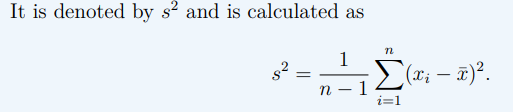
<p>The average squared deviation of the observations from the sample mean</p>
5
New cards

Standard deviation

Typical distance of observations from the mean. Basically square root of sample deviation.

<p>Typical distance of observations from the mean. Basically square root of sample deviation. </p>
6
New cards

Coefficient of variation

Variability relative to the mean. Measures how large the standard deviation is compared with the mean.

<p>Variability relative to the mean. Measures how large the standard deviation is compared with the mean.</p>
7
New cards

Quartiles

Instead of considering only the min and max values of a range, we identify values that separate the data into four approximately equal groups. These values are called quartiles.


<p>Instead of considering only the min and max values of a range, we identify values that separate the data into four approximately equal groups. These values are called <strong>quartiles</strong>.</p><p></p>
8
New cards

Interquartile range (IQR)

Measures how widely the middle 50% (Q2 and Q3) are spread. Unlike range, ignores low 25% and high 25% of the data. Less sensitive to extreme observations

<p>Measures how widely the middle 50% (Q2 and Q3) are spread. Unlike range, ignores low 25% and high 25% of the data. Less sensitive to extreme observations</p>
9
New cards
Arithmetic Mean: Uses all observations
Yes
10
New cards
Median: Uses all observations
No
11
New cards
Arithmetic Mean: Affected by extreme observations
Strongly
12
New cards
Median: Affected by extreme observations
Very little
13
New cards
Arithmetic Mean: Requires ordered data
No
14
New cards
Median: Requires ordered data
Yes
15
New cards
Arithmetic Mean: May not be an observed value
Yes
16
New cards
Median: May not be an observed value
Yes
17
New cards
Arithmetic Mean: Suitable for symmetric distributions
Excellent
18
New cards
Median: Suitable for symmetric distributions
Excellent
19
New cards
Arithmetic Mean: Suitable for skewed distributions
Sometimes misleading
20
New cards
Median: Suitable for skewed distributions
Usually preferred



