BIO 156 complex histology- EPITHELIAL TISSUE
 Call Kai
 Learn
 Practice Test
 Spaced Repetition
 Match
 Flashcards
 Knowt Play
1/40

There's no tags or description
Looks like no tags are added yet.
41 Terms
what are the 3 embryonic layers that epithelial cells develop from?
Ectoderm, Endoderm, and Mesoderm
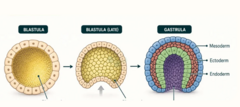
What structure develop from the ectoderm?
the skin, and parts of the mouth, nose and anus
what does the endoderm form?
the lining of the airways and most of the digestive system
what does the mesoderm form in the cardiovascular and lymphatic systems?
the lining of blood vessels and lymphatic vessels

what is the epithelium lining blood and lymphatic vessels called?
Endothelium
what does it mean that epithelial tissue is highly cellular?
it's cells are tightly packed together with little or no space between them.
what connects neighboring epithelial cells?
cell junctions
what is cell polarity in epithelial tissue?
the apical (exposed) and basal (bottom) surfaces have different structures and functions.
what is the function of the basal lamina?
it attaches to the epithelium and separates it from the underlying connective tissue.
what two layers form the basement membrane?
the basal lamina and the reticular lamina

on what surface do epithelial tissue face either or or liquids in the body?
on their apical or free surface
what is the space that is filled with air or liquids called?
the LUMEN
why are Epithelial tissues nearly completely avascular?
no blood cells cross the basement membrane to enter the tissue, and nutrients must come by diffusion or absorption from underlying tissues or the surface.
what is a main characteristic of surface epithelium?
it's ability to rapidly replacing damaged and dead cells.
general functions of epithelial tissue?
protection, absorption, filtration, excretion, secretion, sensory reception
one more time! what are the bottom and top edges called in epithelial tissue?
Basal surface is the bottom edge
Apical surface is the top edge
what is cell polarity in epithelial cells?
the apical and and basal surfaces have different distributions of organelles and membrane bound proteins
what are cilia in relation to epithelial tissue? and what supports them?
cilia are extensions of the apical cell membrane that are supported by microtubules.
what is the main function of cilia?
move back and forth to propel fluid and particles in one direction - important in clearing mucus from respiratory tract
what do cilia in the brains ventricles help circulate?
cerebrospinal fluid (CSF)
what is the function of the mucociliary in the airways?
it moves mucus containing trapped dust and pathogens upward toward the throat
what happens when mucus and trapped particles move toward the throat by cilia?
they are usually swallowed and enter the acidic environment of the stomach.
how are epithelial tissues classified?
by the shape of the cells and number of the cell layers formed.
what are the 6 types of epithelium?
simple squamous, simple cuboidal ,simple columnar, stratified squamous, stratified cuboidal, and stratified columnar.
what are the more specific 9 subclasses of epithelium?
stratified squamous cells have 2 subclasses, they can either be keratinized or non-keratinized, there are also two special linings that don't fit into the other categories called pseudostratified columnar (pseudo=false). and transitional.

what is pseudostratified columnar epithelium?
appears to have several layers due to nuclei are various depths; all cells are attached to the basement membrane in a single layer but some do not extend to the apical surface. this is why it "false" because it may look like its stratified but it isn't.
Simple Epithelial
its called simple because there is only one layer of cells, simple epithelia comes in either squamous, cuboidal or columnar

why is the shape of the cells in epithelial tissue important?
the shape of the cells reflects the functioning of the cells.
what is the function of simple epithelial tissue
it provides a smooth and protective surface, mesothelial cells are squamous epithelial cells that secrete a fluid that lubricates the mesothelium
where can simple squamous tissue be found
simple squamous epithelium is present where rapid passage of chemical compounds is observed. it can be found in the alveoli of lungs where gases diffuse, segments of kidney tubules, and the lining of capillaries.
what is the function of simple cuboidal cells and where can they be found?
they are active in the secretion and absorptions of molecules and can be seen in the lining of kidney tubules and in the ducts of glands.
what is the function of simple cuboidal tissue and where can it be found?
they are also active in the absorption and secretion of molecules. it can be found lining sections of the digestive system and parts of the female reproductive tract.
ciliated columnar epithelium
is simple columnar epithelial cells with cilia on their apical surfaces, these are found in the lining of the fallopian tubes and parts of the respiratory system. the beating of the cilia helps remove particular matter.
what does microvilli do in the instestine?
microvilli is present on the apical side facing the lumen where nutrients are located, it increases surface area of the epithelial cells thereby allowing high absorption of substances.
goblet cell
unicellular gland found in columnar epithelium that secretes mucous

stratified epithelial
stratified indicates that the tissue has more than one layer of cells.
-keratinized stratified squamous
-non-keratinized squamous
-stratified cuboidal
stratified columnar
Where is keratinized stratified squamous epithelium found?
the top layer may be filled with dead cells filled with keratin an example is skin and keratinized means it's dry. so the inside of the mouth would be non keratinized because it isn't dry.
what is the function of stratified cuboidal epithelium
it is the main tissue subclass of certain glands, especially those that secrete specialized substances like sweat, mammary and salivary glands.
Where can stratified columnar epithelium be found?
it is uncommon in the human body, but can be found in the male reproductive tract and found in the protective structure lining parts of the eyeball.
transitional epithelial tissue
it has gradual changes in the shapes of the apical cells as the bladder fills with urine. stretchy & variably shaped . lines the uterus bladder, part of the urethra. when there is no urine i the bladder the cells are cuboidal, as urine fills the bladder the cells transform to squamous.
final summary
In epithelial tissue, cells are closely packed with little or no extracellular matrix except for the basal lamina that separates the epithelium from underlying tissue. The main functions of epithelia are protection from the environment, coverage, secretion and excretion, absorption, and filtration. Cells are bound together by tight junctions that form an impermeable barrier. They can also be connected by gap junctions, which allow free exchange of soluble molecules between cells, and anchoring junctions, which attach cell to cell or cell to matrix. The different types of epithelial tissues are characterized by their cellular shapes and arrangements: squamous, cuboidal, or columnar epithelia. Single cell layers form simple epithelia, whereas stacked cells form stratified epithelia. Very few capillaries penetrate these tissues.