Genetics- MT 2- Lect 5 (09/30/2026)
 Call Kai
 Learn
 Practice Test
 Spaced Repetition
 Match
 Flashcards
 Knowt Play
1/94

There's no tags or description
Looks like no tags are added yet.
95 Terms
Does DNA replication need a promoter
NOOO it has origins of rep and primase
What are basal and transcription factors
idk she skimmed it if u dont know the answer later on search it up
they recruit the RNA polymerase and the DNA polymerase
How is the template strand read
3’-5’ direction
What are the diff termination signals
Rho-Independent (Intrinsic) Termination
Rho-Dependent Termination:
Promoter are upstream or downstream of genes
Upstream in both pro and eu
What are promoters
Docking sites for transcription factors to recruit RNA Polymerase
When does transcription start?
After RNA polymerase binds
Enhancer sequences can be far upstream and they
impact the timing and level of transcription
Can the enhancers do anything without activators
Usually no
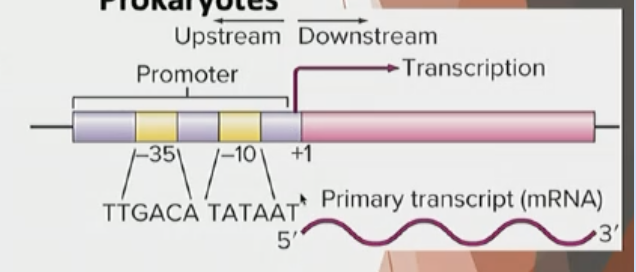
What are the key features in prokaryote promoters
-10 and -35 Regions (Prokaryotes)
-35 region: DNA sequence located approximately 35 nucleotides upstream of the transcription start site. Helps RNA polymerase recognize the promoter.
-10 region: DNA sequence located approximately 10 nucleotides upstream. Helps RNA polymerase bind and unwind the DNA.
+1 position: The first nucleotide that gets transcribed into RNA.
What are the key features in eukaryote promoters
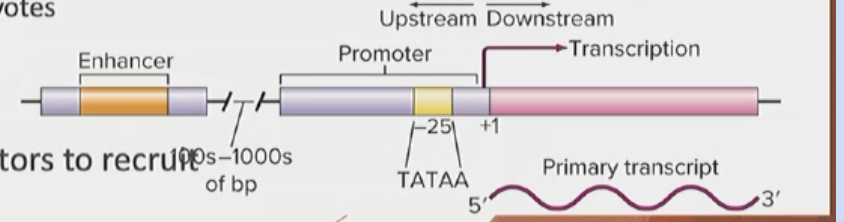
TATA box- at the -25 position important area for the transcription factors and basal to assemble which will then recruit our RNA polymerase
What is the +1
denotes where we will start synthesizing the transcript
Enhancers are x of genes
Upstream but also downstream
What are enhancers
docking sites for transcription factors to recruit RNA polymerase
RNA-like strand AKA
coding strand and non-template strand 5’-3’
Simultaneous transcription
A gene can be transcribed simultaneously by several RNA polymerases
Only the x strand is used to make mRNA
Template DNA
What way is the template DNA strand read
3’-5’ and copies via complementarity to create mRNA 5’-3’
Coding stand is complementary to…
the template stand but the T’s become u’s
Which end receives the nucleotide cap as its modification
5’- A modified guanine nucleotide with extra phosphate to help stabilize and help with recognition for ribosomes
Which end receives the 3’ end gets poly-A tail
50-250 Adenine nucleotides- both help protect mRNA from hydrolytic enzymes and nucleases and appear to facilitate export of mRNA so this happens before it is sent into the cytoplasm
Splicing
exons stay introns(intervening) leave
Random fact about restriction enzymes
All restriction enzymes are nucleases, but not all nucleases are restriction enzymes.
5’ UTR and 3’UTR
Untranslated regions
Are all expns translated
No but they ate all in the final mRNA strand
Splicosomes
Recognize splice sites- has catalytic function so proteins and rna can have catalytic function
Pre-mRNA
aka primary transcripts which then gets turned into mature RNA
How for spliceosomes know what to remove
specific nucleotide sequences in the pre-mRNA that mark where introns begin and end- there is a 5’ splice site and a 3’ splice site
How does the ribosome scan
5’-3’
What sets the reading frame
finding the start codon
Alternate splicing breaks the rule of one gene is equal to one product. Why?
Some genes can encode for more than one kind of polypeptide depending on exons- 100,00 proteins form 28,000 genes
Do prokaryotes have splicing
Yes but a little less
In prokaryotes can translation of mRNA begin before transcription is finished
yes which is why we can make polyribosomes where multiple ribosimes can translate a single mrna simoltaneously
Where else do we have translation
Mitochondria, chloroplast, Rough ER
look into dna methylation and aceltelation and lysene if she did not explain yet
What are the two things that need to match up of mRNA to get translated
tRNA needs the correct amino acid attached
tRNA anticodon must match the mRNA codon
also remember that we need a mechanism to uncompact the dna
How does the ribosome find aug
recognises 5’cap and keeps scanning till it finds aug but only for eukaryotes, for prokaryotes there is smt called Shine-Dalgarno sequence usually upstream of AUG as Prokaryotic mRNAs generally do not have a 5′ cap.
Anti codon is—— to the codon
complementary and antiparallel association so if mRNA is 5’ to 3’ then anti codon is 3’ -5’
How many common amino acids
20
Wobble effect
3rd nucleotide pairing is loose
trna have t or u
u
where do we have the wobble base
5’ end of trna
what is diff in each amino acids
R side chain
What site fills first
P and amino acids are connedcted from n-terminal to c-terminal
incoming tRNAs enter the A site, but the very FIRST tRNA
enters the P site instead
Where is the shortest polypeptide in the poly ribosomes
5’ end so moret below
what do scientists use it to figure out whether two mutations are in the SAME gene or DIFFERENT genes
complementation
What does studying mutant alleles allow?
Mapping of chromosomes
EX of studying mutant alleles
Eye color in Drosophila, drosophila have many diff phenotypes as thay have many shades of red- mutations cause them to be white
Complementation
Different genes mutated in the parents → Complementation → Normal offspring.
Same gene mutated in both parents → No complementation → Mutant offspring.
Mutations that do/do not complement each other are in a complementation group
Do Not
If wild type phenotype is restored
You have complementation
Complementation table
Group the negatives they will tell you which genes are on the same gene
How to think about it
Can you ever get x with y and have it positive (complement) No? then it is in the same complementation group and in the same gene
Complementation shows that
Mutations can be in diff genes or the same genes
If crossing over occurs between two mutations can wild type phenotype be restored
Yes but a very large sample size
Can a gene have crossing over within it
Yes and that could allow all the mutants to be isolated to one chromosome and the other does not have any mutations
Seymour Benzer (1950s)
T4 bacteriophage infects E-coli making a lot more viruses
Why was Seymour Benzer’s experiment important
It showed that recombination can happen between different positions WITHIN the same gene, not just between different genes.
Bacteriophage
virus that infects bacteria
Plaques
Clearings in a lawn of bacteria where 1 T4 has entered and spread to adjacent cells causing lysis of the e coli so they dead which leaves a zone without bacterial growth- the whole plate is bacteria that is not affected by the virus the specific circles we see are plaques infected with the virus
Wild type vs Mutant phenotype in E.coli for the bacteriophage T4 experiment system
rll= rapid lysis
rll- are the mutants and that results in larger plaques with a bigger better circular shape
rll+ are the wild type
Explain the bacteriophage T4 Experimental systems based on mutant vs wild and specific type of e coli strain
E.coli strain B allows the reproduction of viruses for both mutant and WT but K only allows rll+ to reproduce

Each bacteriophage is
monoploid, meaning it only has one copy of each gene
How can we get recombination with only one copy?
Dual infection- simultaneously infect bacteria with two diff bacteriophages- both chromosomes are injected into the ecoliu so recombination can occur
T4 bacteriophage experiment setup

When infecting e.coli B is this a genetic screen or selection
Answer: Genetic Screen
Why: Both wild-type (r+) and mutant (rII) phage strains can successfully infect, grow, and form plaques on E. coli B. Because both phenotypes survive, researchers must examine the individual plaques (distinguished by morphology) to identify mutants, which defines a screen rather than a selection
When infecting e.coli is this a genetic screen or selection
Answer: Genetic Selection
Why: Only wild-type (r+) or recombinant wild-type phages can grow and form plaques on this strain. The rII mutants cannot grow on E. coli K(λ). This conditions out the vast majority of the mutant population and allows only the rare desired recombinants to survive and form plaques, which defines a selection.
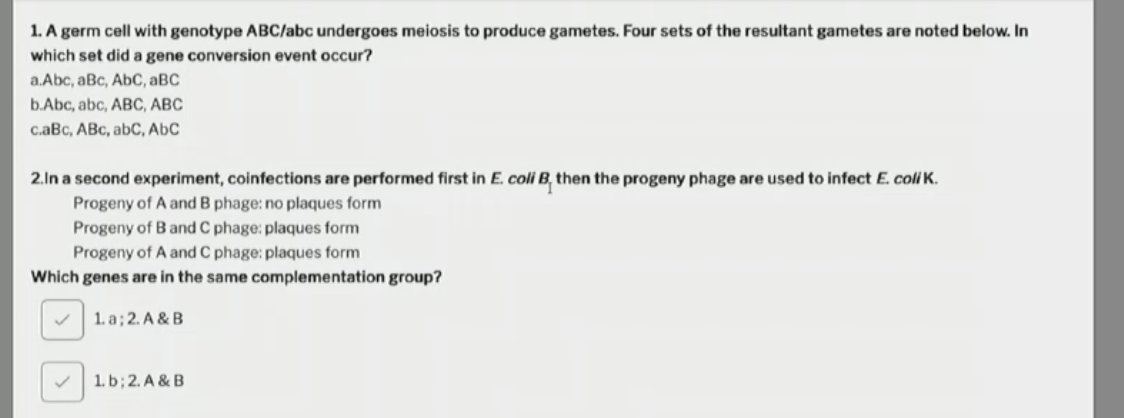
answer 2

What are the two outcomes after crossing the bacteriophage with an uncharacterized (a mutation whose exact location on the DNA is UNKNOWN) mutation and a known deletion
Wild type or no wild type
If no wild-type recombinants are produced…
the point mutation is likely INSIDE the deleted region or there are overlapping deletions
If wild-type recombinants are produced
the point mutation is OUTSIDE the deleted region on the other chromosome or the deletions are non-overlapping
Deletion Mapping
Allows you to figure out where mutations are because when the wild type can not be produced and is -/O that means that the location of that mutation is where the deletion is
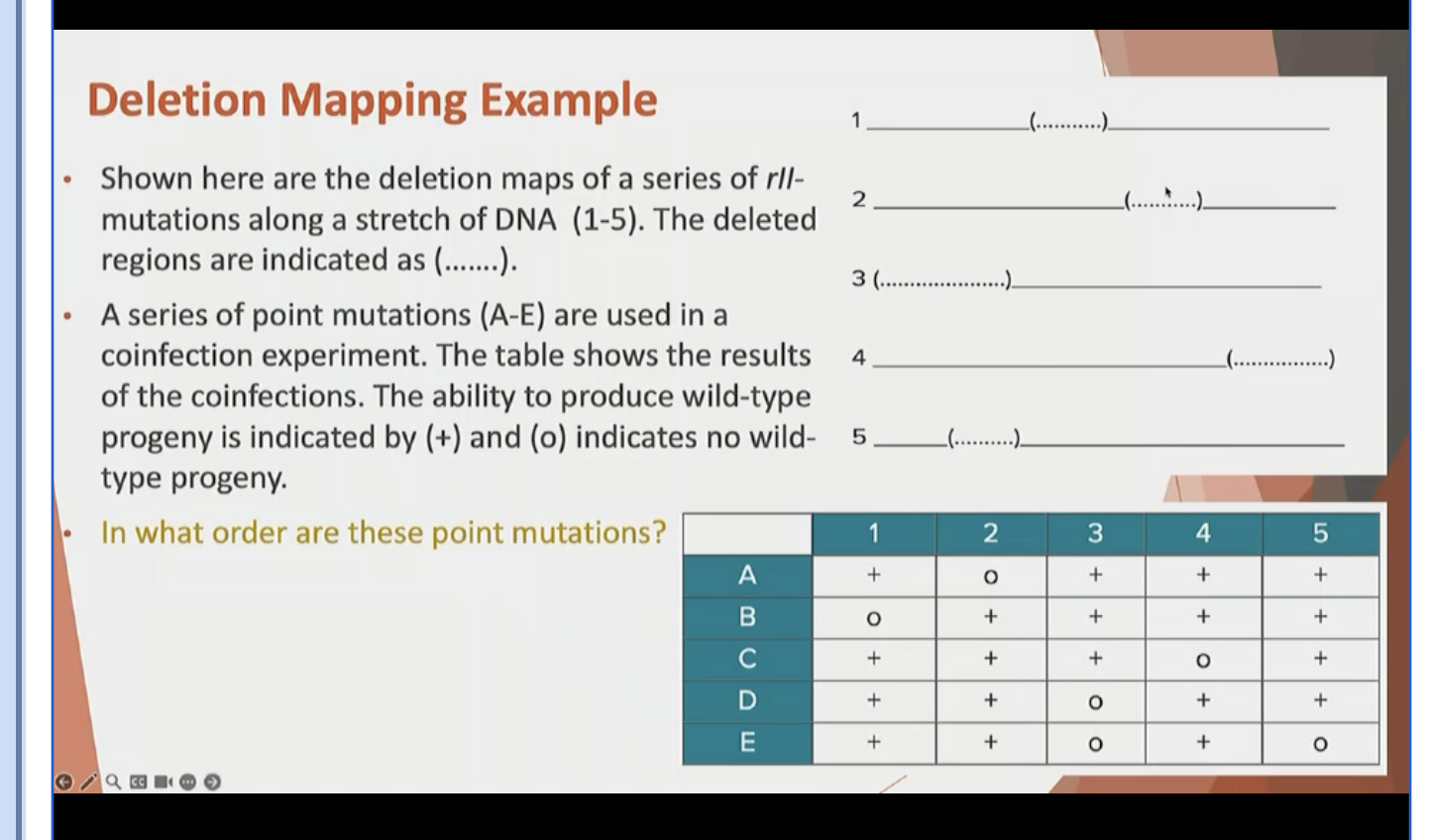
What is the order
D E B A C
Recombination frequency formula- genetic distance
we multiply by 2 because the mutant viruses die on the plate- add m.u. at the end

how to get physical map recomb frequency from genetic recomb frequency
multiply m.u. with 113 base pairs ending unit is bp
Benzer’s Conclusions
Mutations can be single nucleotides\
A gene is a continuous linear sequence of nucleotide pairs
Nucleotide sequences composing two genes are seperate and distinct
Hotspots
Sites where mutation occurs spontaneously more often than other sites are called hotspots
Does complementation restore function or genetic sequence
complementation restores function, not genetic sequence
Benzer’s Complementation Experiement
• Complementation experiment: E. coli K was co-infected with two different rII− mutant phage and saw whether cells lysed (complementation) or not (no complementation)
The purpose was to determine which mutations were in the same gene.
Benzer’s Recombination Experiment
Recombination experiment: E. coli B was co-infected with two phages with different mutations in the same gene. rII− mutants can grow in this host where genomes can recombine.
Looked for whether progeny phages became rare rII+ recombinants able to grow on E. coli K.
Central Dogma of Biology
DNA inherited by a chromosome will dictate specific traits by serving as a template for protein sythesis
What affects phenotypes
Proteins
What leads to cell specialization
Gene expression- when they turn the genes on, if they turn it on and the level of genes and protein that is coming out of those transcribed genes- based on both transcription AND translation
Rll a and rll b vs Rll A1 and Rll A2
Rll A and Rll B are both types of rll- to see if the genes werecomplementary
Rll A1 and Rll A2 are both types of Rlla- used for seing if recomb occured
What is the difference in prokaryotes and eukaryotes with the mRNA
the rna transcripts is directly the mRNA in pro and has to be processed to become mRNA in eukaryotes
Transcription
RNA Polymerase- Pries the DNA strands apart and builds the RNA nucleotide strand
Having RNA polymerase removes the need for what
Primer (unlike DNA polymerase RNA polymerase can start a chain from scratch and no 3’end is needed) and helicase
RNA is ——- to the DNA template
Complementary
Is the newly transcribed RNA the same as the coding strand except the T becomes U?
Yes
tRNA structure
The long length is 3’ short length is 5’- anticodon antiparallel amino acists get attached to the 3’ ACC group
where are the epa sites
in the ribosomes- eject-polypeptide- acceptor
What is the reason we do not have just a ton of tRNAs
wobble position
polyribosomes
are only in bacteria multiple ribosomes can translate a single mrna while multiple rna polymerase can transcribe as well

simultaneous transcription
