Innovation, R&D and Business functions
 Call Kai
 Learn
 Practice Test
 Spaced Repetition
 Match
 Flashcards
 Knowt Play
1/55

There's no tags or description
Looks like no tags are added yet.
56 Terms
Resources
Resources → All assets, organizational processes, firm attributes controlled by a firm that enable the firm to implement strategies that
improve its efficiency and effectiveness (Barney, 2001)
Physical: Buildings, equipment, tools, weapons, etc.
Financial: Cash, budget commitments, etc.
Technological: Computers, software, databases, communications systems, etc.
Human: Physical, intellectual, emotional, etc.
Social: Relationships, networks, trust, norms, reputation, etc.
Organizational: Procedures, structures, management know-how, etc.
RBV and Competitive Advantage
Resource Based View → Resources as key to superior firm performance
VRIN → For resources to provide sustainable competitive advantage, they should be Valuable, Rare, Inimitable, Non-substitutable
Routines and Capabilities
Routines
Particular ways of behaving, as a result of repetition and reinforcement
communicating vision and purpose
recognizing others
modeling positivity and resilience
empowering others
What makes an organization different from another in how they carry out the same basic activity How company does it?
Capabilities
The capacity to deploy a combination of resources through collective organizational routines to achieve goals
What a company does? (e.g., inspiring leadership; agility and speed; customer focus; etc)
Dynamic Capabilities
Dynamic Capabilities → A firm’s ability to integrate, build, and reconfigure internal and external competences to address rapidly changing environments (Teece et al., 1997, p. 516)
Dynamic → Shifting character of the environment
Capabilities →Skills, processes, and routines that allow it to coordinate and deploy resources effectively
Sensing, Seizing, Reconfiguring
Examples: Netflix, iphone

Core Competencies
Resources and capabilities that comprise the strategic advantages of a business (Prahalad & Hamel, 1994) – What the company does best?
McDonald’s has standardization. It serves nine million pounds of French fries every day, and every one of them has precisely the same taste and texture
Apple has style. The beauty of its devices gives them an edge over its many competitors
Coca-Cola has brand power. Its globally recognized brand and secret formula create customer loyalty across generations
Hierarchical Classification

People
Human capital meets the VRIN criteria?
It refers to the skills and abilities of individuals or the stock of knowledge within an organization (Cabrera & Cabrera, 2005)
“Innovation has nothing to do with how many R&D dollars you have… it’s not about money. It’s about the people you have, how you’re led, and how much you get it.”
Why Practices?

Best Practices or Best Fit?
Universalistic perspective → “Best practices” contribute to performance regardless of the strategic goals of the organization -What practices work best for all firms?
Contingent perspective → Firms need to adapt their strategies according to the business environment - What practices work best for this firm in this situation?
How does a practice fall into each category? Examples?
Imagine you run a fast-growing AI startup and a 200-year-old family-owned brewery. Would you use the same recruitment and performance management practices for both?
3 Phases of Employment Management
Entry → Manage the entry of new employees, planning, job design
Performance → Manage employee performance, ensure that performance remains at the desired levels
Exit → High turnover rates are not favorable
Best Practices
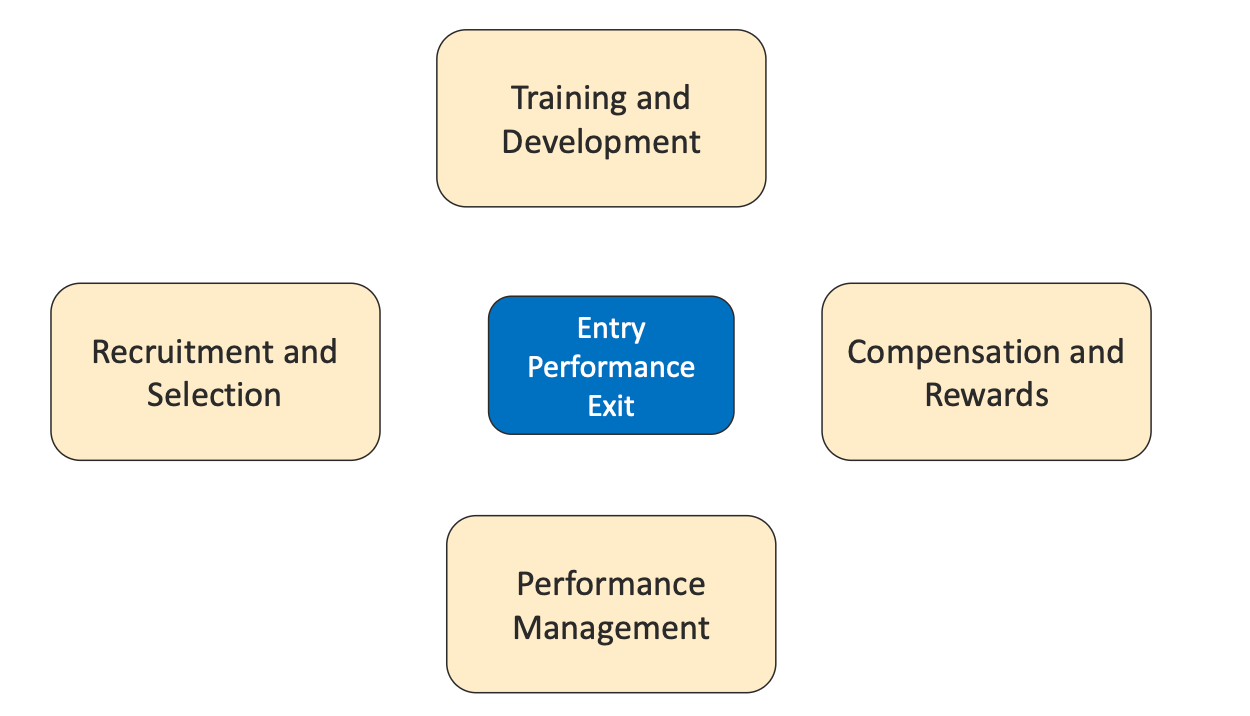
Recruitment and Selection
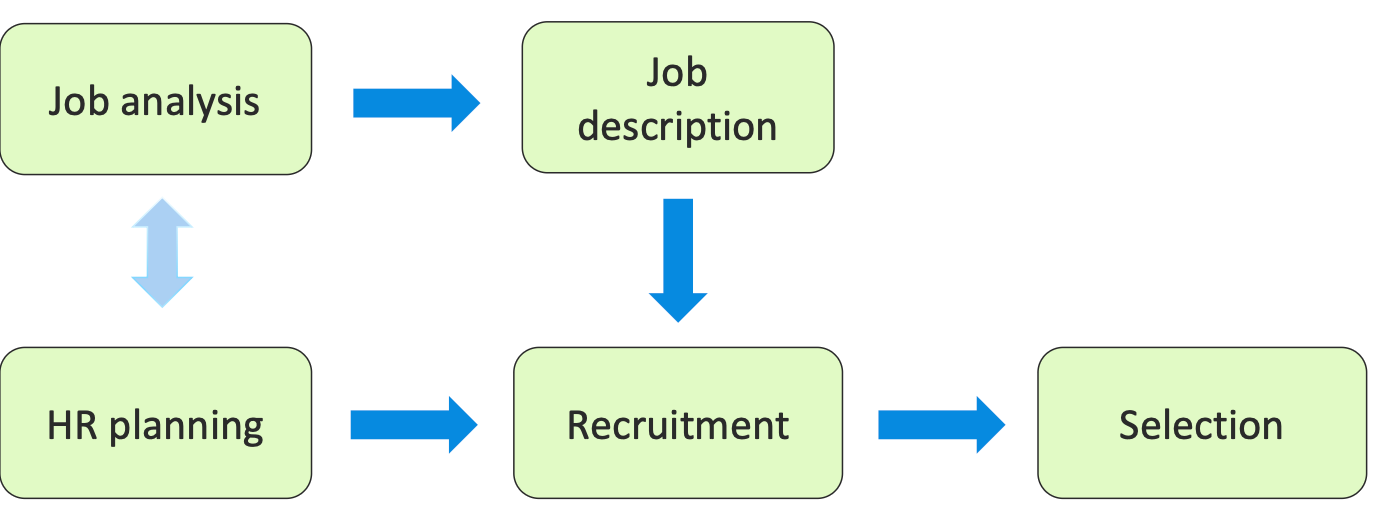
Recruitment
Depends on job type, specialization and hierarchy
Internal and External recruiting
Internal recruiting is a common practice in promotions
Company site, referrals, job boards, campus recruiting, etc.
Inbound/Outbound recruiting
Selection
Once candidates are found, selection starts
Interviews (behavioral, stress, competency-based, groups etc.)
Tests (personality, IQ, skills assessment, etc.)
Gamification strengthens employer branding
High-Tech Recruiting and Selection
Tech talent shortage
Focus on employee referrals
Skill-based and portfolio hiring
Investment in employer brand and candidate experience
Interviewer training
Performance driven recruiting culture (i.e., KPIs)
AI & automation in recruitment
Performance Management
“Continuous process of identifying, measuring, and developing the performance of individuals and teams and aligning performance with the strategic goals of the organization” (Aguinis, 2009b, p. 2)
Formal and informal process
Objective and subjective measures
Multiple evaluation sources (e.g., 360)
Biases (e.g., Halo/horns effect, recency)
High-Tech PM
Continuous feedback loops
Agile performance reviews
Peer & 360° Feedback Systems
Innovation and creativity indicators
Focus on team-level outputs
KPIs and Metrics (e.g., time to code)

Training and Development
Investment or cost?
On-boarding, promotional, continuous
Knowledge, skills, attitudes – upskilling vs reskilling
On the job
coaching
mentoring
job rotation
employee relations
internship
Off the job
case studies
simulations
role playing
lectures-seminars
business games
High-Tech Training
Hard/soft skills training – ‘writing a code is not enough’
Focus on speed, flexibility and collaboration
Microlearning
Self-paced
Emphasis on managers
Metrics (e.g., user rate, dropout rate)
Compensation and Rewards
Financial
Monetary and non-monetary rewards
Employee stock options plan - equity
Benefits
Non-monetary
Recognition
Social rewards
Non-monetary benefits
E-compensation systems decrease costs, errors, and time (Dulebohn & Marler, 2005)
Employee self-service systems (ESS)
AI Applications in HRM
AI applications
HR/workforce analytics
HR decision making
Recruiting
Objective appraisal
Data-driven pay
AI-powered sourcing and screening
Chatbots answer candidate queries, schedule interviews
AI recommends personalized training modules for each employee
Auto-generating job descriptions based on organizational templates
Automating payroll calculations
Internal AI job boards auto-matching employees to vacancies
AI tracks productivity metrics and provides dashboards
Predictive models flag employees at risk of leaving
Collective intelligence
AI-HI working togetherAI employment and skills
Realization skills
Utilization skills
Maintenance skills
Barriers to adoption
Ethical constraints
Privacy concerns
Data quality, etc
Augmentation vs Automation
Innovation Systems
System → A set of interrelated components working together for a common purpose
Innovation systems → Structured networks where interdependent actors collaborate to create and apply knowledge
Components/ actors: Firms, universities, public agencies
Collaboration: Links between components, feedback
Institutions: Rules which regulate the interactions
E.g: Through LEGO Ideas, fans submit designs, and winning ones become real products LEGO + fans + toy designers + licensing partners (e.g., Disney, Star Wars) form an innovation system
Types of Innovation Systems
National → A network of institutions, actors, and relationships within a country that together create, diffuse, and apply new knowledge and technology
Regional → The same idea, but at the level of a region instead of a whole country - the local network of firms, universities, and government working together to innovate
Global → Innovation increasingly happens through networks that cross national borders

Open Innovation
A means to value co-creation (Chesbrough, 2003)
It is a business management model for innovation that promotes collaboration with people and organizations outside the company
Organization doesn’t just rely on its own internal knowledge, but also uses multiple external sources to drive innovation

Open vs Closed Innovation
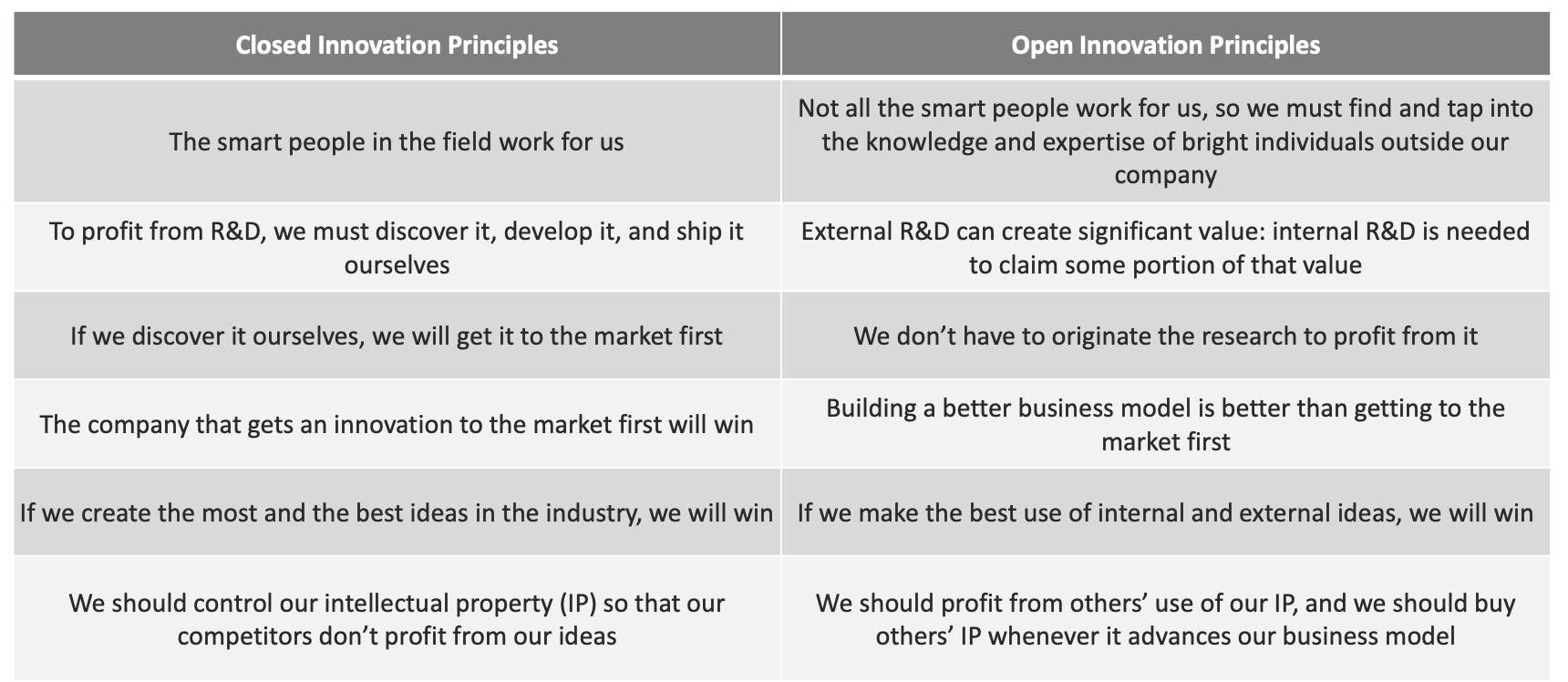
Why Open Innovation?
Reduce costs of R&D and market entry
Reduce risk by sharing it with partners
Reduce time to develop and launch products
Promote shared learning & collaboration
Access external talent and ideas
Enter new markets faster
Spark new business models
Increase in sales
Brand awareness
Open Innovation Challenges

Inside-out and Outside-in
Outside-in → The normal focus of open innovation process, where a focal company brings in third parties to support an innovation process
Inside-out → Where a focal company decides to let go of some of its innovation projects and allow outside companies or individuals to exploit this in-house work

Strategic Alliances
Cooperative agreement between two or more organizations that remain independent while working collaboratively to achieve mutual goals
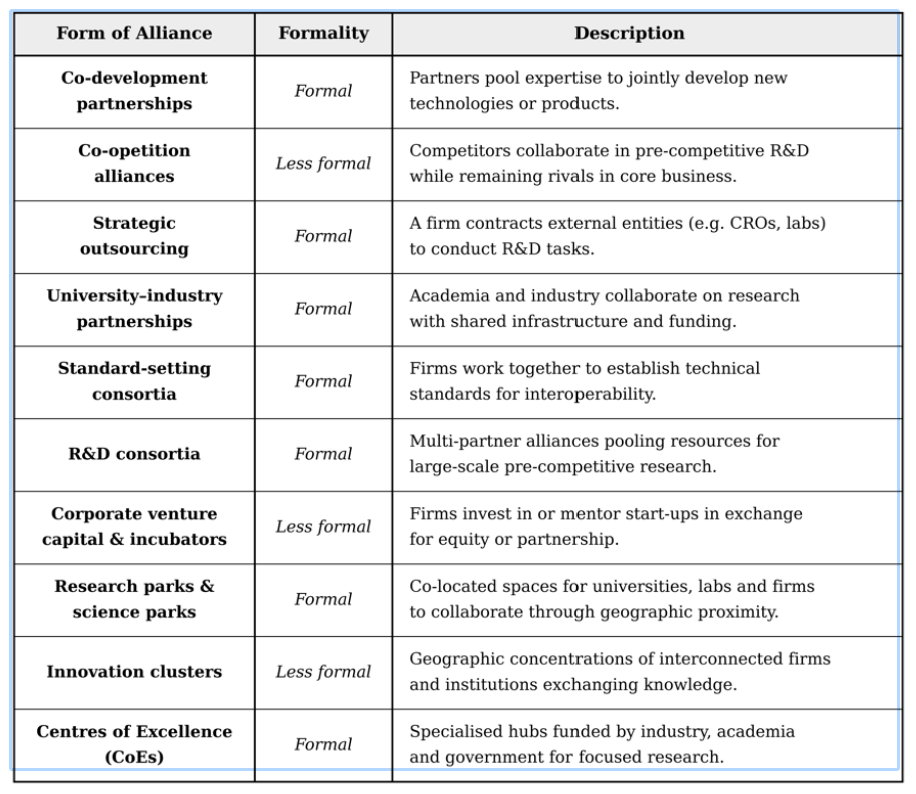
Strategic Alliance and Venture

Crowdsourcing
Individual, organization, or company solicits contributions from a large, diverse, and often online group through an open call
The crowd
Participants who contribute to completing the crowdsourced task
The crowdsourced task
The activity assigned to the crowd by the crowdsourcer
The crowdsourcer
The individual or organization initiating the crowdsourcing effort
The crowdsourcing platform
The intermediary between the crowdsourcer and the crowd
User innovation and Co-creation
Licensing
A company allows others to use its intellectual property (IP), brand, technology, or design in exchange for fees or royalties
Why companies use licensing:
Earn revenue from existing IP
Expand brand reach without high costs
Enter new markets quickly through local partners
Outsourcing
An agreement in which one company hires another company to be responsible for a planned or existing activity that is or could be done internally, and sometimes involves transferring employees and assets from one firm to another
Why companies outsource:
Reduce costs
Access specialized skills
Focus on core business
Increase speed and flexibility
Resource Based View of the firm?
Resources
All assets, capabilities, organizational processes, firm attributes, information, knowledge, etc. controlled by a firm that enable the firm to conceive of and implement strategies that improve its efficiency and effectiveness’ (Barney 1991: 101)
Three types: Physical, Human and Organizational
Competitive Advantage
When a firm is implementing a value creating strategy not simultaneously being implemented by any current or potential competitors’ (Barney 1991: 102).
Resources should Valuable, Rare, Inimitable, Non-substitutable
What is a network?
A set of actors connected by ties
Actors/Nodes
Individuals
Teams, organizations, etc.
Ties/Links
Knowledge, trust, team, sit by, dislike, etc.
Alliance, customer, investment, et
Uncovering networks in an organization
formal
informal
Individuals within a firm
The strength of weak ties
It is the people with whom we are the least connected who offer us the most opportunities.
R&D and innovation funnel

Open innovation ←→ closed

R&D Intensity
Refers to the ratio of R&D expenditure relative to total revenues , directly influences the volume and quality of ideas entering the funnel.
Driven by industry-specific factors.
Higher intensity = more allocated resources.
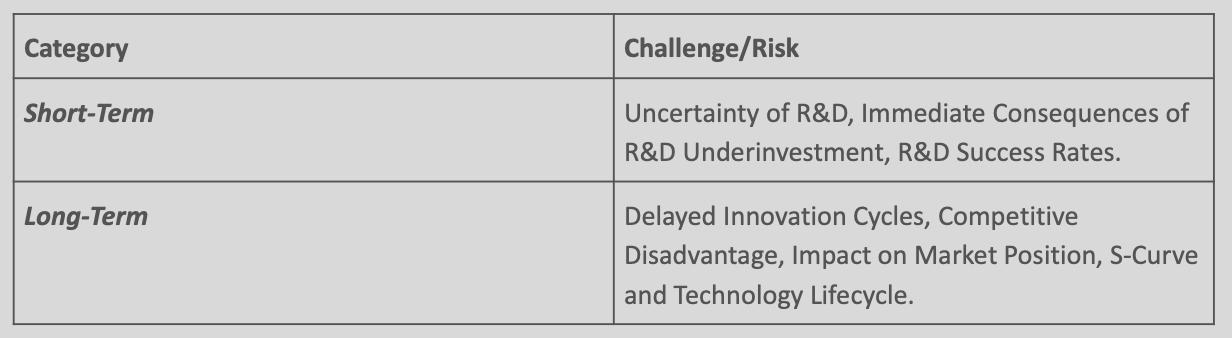
Risks of R&D Investment
Overinvestment drains resources needlessly.
Underinvestment limits innovation outputs.
Misallocation delays innovation cycles.
R&D short term long term
Common Causes of R&D Delays
Intra-organizational
poor project management practices
insufficient human resources
weak planning and scheduling processes
Extra-organisational
market and regulatory conditions
supply chain and contractor issues
economic factors
Intellectual Property (IP) and innovation
IP grants legal rights to protect innovations.
Includes patents, trademarks, copyrights, trade secrets.
Secures innovations and supports firm strategy.
Creates barriers against competitor entry.
Project and portfolio management principles applied to innovation

Project Management
Identifying requirements
Establishing clear and achievable objectives
Balance triple constraint of scope (what will be achieved), time (how long it will take) and cost (how much it will cost)
Adapting to expectations of stakeholders (later addition)
Types of Projects
Complicated → Many different activities need to be completed but
in general know in advance what needs to be done and how long it
will takeComplex → Not even clear what activities need to be done (unknowables), how long each will take, and what implications are
following completion of a particular activity
Types of Uncertainty
Technical → How to develop the science for a particular project?
Market → How will the market respond?
Resource → Time, people, money needed for the project?
Organizational → Out-sourcing some parts; co-locating a team?
Project Liminality, Liminal Space
Temporality → People are team members for a limited time period only
Ambiguity → Liminal space is a risky place with opportunities to
create something truly novelFreedom → People are free from structural and institutional
constraints and obligationsCommunity → You share the experience with your team members
only. It can create a divide with those ‘on the outside’
What is a reason why projects may be effective ways to organize innovation processes?
Projects enable organizations to be more flexible and have consistent communication.
Projects Not Always The Answer
Outcome of projects not always easily accepted by those who have
not been involved in a particular projectProject management seems especially difficult in contexts of
complexity in science, technology or regulatory environmentProject management methodologies still have a symbolic role (to
legitimize and indicate progress)
Agile method
While traditional project planning (sometimes described as waterfall method) may be difficult in complex and even complicated projects.
New methods have been developed to try and take account of the uncertainty – agile methods.
Many different variants (e.g., Scrum, Kanban) of agile but all share same idea.
Definition of Business Intelligence (BI)
BI refers to the processes, technologies and tools used to transform raw data into meaningful insights. It plays a crucial role in decision-making by offering a real-time, comprehensive view of business operations. BI systems aggregate data from diverse sources, such as internal databases, customer interactions and external market data, to uncover patterns and trends.
Business intelligence in innovation management
What motivates people (see movie on Brightspace)
What is motivation?
Motivation (from Latin movere = to move) is a major
determinant of our behavior;
Motives may be innate (drives) or acquired (learned)
= dispositions vs. situational factorsgold collar workers
What Motivates people?
Autonomy
Mastery
Purpose
Leadership
Leadership is defined as the process by which an individual influences others in ways that help attain group or organizational goals
What makes leadership an elusive concept?
Leadership is primarily in the eye of the beholder.
It is easier to believe in leadership than to proof it.
There is no denying the fact that we have a tendency to
overestimate the importance of leaders.Unfortunately, there are not many good examples of
leadership in practice
Gold collar workers
Highly trained professionals, specialized engineers are assets that are not only hard to obtain and difficult to keep but also hard to manage in today’s distributed international work environments