Module 11 endocrine glands
 Call Kai
 Learn
 Practice Test
 Spaced Repetition
 Match
 Flashcards
 Knowt Play
1/72

There's no tags or description
Looks like no tags are added yet.
73 Terms
endocrine system
-major communicating system in the body
-produces slow acting, but long term responses
-uses chemical messengers called hormones

functions of the endocrine system
-involved in a diverse array of processes but major processes include
=reproduction
=growth and development
=chemical homeostasis
=cellular metabolism
=mobilization of body defenses
glands
exocrine and endocrine
exocrine gland
carry substances to body surface using ducts
endocrine gland
-lack ducts and release hormones into the surrounding ECF to be taken up by the blood stream
=hypothalamus
=pancreas
=gonads and placenta
=pituitary gland
=thyroid gland
=parathyroid gland
=adrenal gland
glandular secretion
autocrine, paracrine, hormones
autocrine
exerts effects on the same cells they are secreted by

paracrine
act locally but within the same tissue

hormones
long distance chemical messengers through bloodstream

hormone classifications
amino acid based
steroids
eicosanoids
amino acid based hormones
includes most hormones, variable in size usually as peptides, water soluble and cannot pass lipid bilayer
steroids
synthesized from cholesterol, includes gonadal and adrenocortical hormones, lipid soluble and can pass lipid bilayer
eicosanoids
lipid based that act as paracrine and autocrine
hormone action
-hormones must have a receptor (can be intra or extracellular)
-hormones can act on a cell in a variety of ways
=alter plasma membrane permeability
=stimulate synthesis of enzymes or proteins
=activate or deactivate enzymes
=induce secretory activity
=stimulate mitosis
ultimobrachial body
-paired cell masses in non-mammalian vertebrates (except cyclostomes)
-secrete calcitonin
-is incorporated into thyroid gland (parafollicular) in mammals
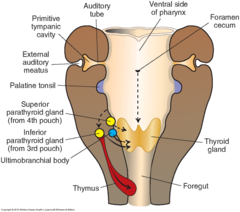
thyroid gland
-subpharyngeal gland in amphioxus
-secretes thyroxine (T4) and triiodothyronine (T3) which are iodine based hormones
-secretes calcitonin from parafollicular cells outside of the follicle (inhibits osteoclast activity; lowers blood Ca2+ levels)
-permissive hormones: allow cells to respond more readily to other hormones
-functions include:
=elevation of oxygen consumption (endotherms);only at certain temps in ectotherms
=increased basal metabolic rate
=regulates tissue growth and development
=metamorphosis
=maintains blood pressure
=molting
=reproductive maturity
=

parathyroid gland
-in close association with thyroid
-Chief cells: parahormone (parathyroid hormone; raises blood Ca2+ levels)
-Oxyphil cells (mammals only): unknown function


adrenal gland
-on top of kideny
-two separate sources
=adrenocortical tissue: corticosteroid hormones
=chromaffin tissue: catecholamines (norepinephrine and epinephrine)
-teleost's: chromaffin tissue remains separate; corpuscles of Stannius release stanniocalcin (lower blood calcium levels)
adrenal gland layers
capsule > zona glomerulosa > zona fasciculata > zona reticulata > adrenal medulla


zona glomerulosa
superficial layer that produces mineralocorticoids (mineral balance; aldosterone; retention of sodium and water)

zona fasciculata
medial layer that produces metabolic corticoids called glucocorticoids (cortisol; stimulates gluconeogenesis and glycogen breakdown)

zona reticularis
produces gonadocorticoids (progestogens and androgens)
adrenal gland development
hypothalmus
-close interaction with pituitary
-anterior pituitary control
=hypothalamic hormones
-posterior pituitary control
=action potentials generated in hypothalmus
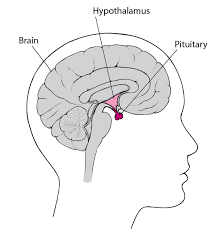
pituitary gland
-4 main parts
pars tuberalis
-outgrowth of pars distalis
-unknown function

pars distalis
-anterior pituitary
-composed of glandular tissue
-releases a variety of hormones
=growth hormones
=prolactin
=follicle stimulating hormones
=luteinizing hormones
=thyroid stimulating hormones
=adrenocorticotropin
-vascular connection via capillary plexus and hypophyseal portal veins

pars intermedia
-region adjacent to pars nervosa
-produces intermedin (MSH) in chondrichthyans, amphibians and reptiles
-poorly developed in primates and absent in birds and some mammals

pars nervosa
-mostly neural tissue
-releases neurohormones
-releases vasopressin (ADH) and oxytocin

pancreatic islets
-Brockmann bodies in fishes (isolated masses along GI accessory organs)
-tetrapod's inlets distributed evenly throughout pancreas
=beta cells: produce insulin (lowers blood glucose)
=alpha cells: produces glucagon (raises blood glucose)
=delta cells: produces somatostatin (inhibits secretion of insulin and glucagon)
=pancreatic polypeptide cells (PP cells): produce pancreatic polypeptides: (promotes flow of gastric juices)

pineal gland
-considered a vestige of median eye
-produces melatonin
Gi tract
-enteroendocrine cells release paracrines
=gastrin
=secretin
=enterogastrone
=cholecystokinin
=enterocrinin
kidneys
-juxtaglomerular cells release renin
-initiates the renin-angiotensin cycle

gonads
-ovary
=ovaries produce estrogen (granulosa cells) and progesterone (CL)
-testes
=testes produce testosterone (leydig cells)
adipose tissue
-releases leptin
heart
-cardiac muscle cells secrete ANP (atrial natriuetic peptide)
-reduces aldosterone secretion
-increases sodium excretion in kidneys
skin
-produces cholecalciferol which is converted to vitamin D3
-necessary for calcium absorption
thymus
-produces thymulin, thymopoitins, and thymosins which upregulate T-lymphocyte production
growth hormones
-adenohypophysis
-para distalis
prolactin adenohypophysis
-para distalis
thyrotropin
-adenohypophysis
-para distalis
follicle stimulating hormone
-adenohypophysis
-para distalis
luteninzing hormone
-adenohypophysis
-para distalis
corticotropin
-adenohypophysis
-para distalis
melanotropin
-adenohypophysis
-para intermedia
vasopressin
-neurons projecting to neurohypophysis from paraventricular and supraoptic nuclei of hypothalamus
oxytocin
-neurons projecting to neurohypophysis from paraventricular and supraoptic nuclei of hypothalamus
parathyroid hormone
-parathyroid
-chief cells
thyroxine
-thyroid
-principle cells
triiodothyronine
-thyroid
-principle cells
calcitonin
-thyroid
-parafollicular cells
aldosterone
-adrenal cortex
-zona glomerulosa
glucocorticoids
-adrenal cortex
-zona fasciculata, zona reticularis
androgens
-adrenal cortex
-zona reticularis
noreepinephrine
-adrenal medulla
-chromaffin cells
epinephrine
-adrenal medulla
-chromaffin cells
insulin
-pancreatic islets
-beta cells
glucagon
-pancreatic islets
-alpha cells
somatostatin
-pancreatic islets
-delta cells
pancreatic polypeptide
-pancreatic islets
-PP cells
cholecytokinin
-duodenum
-intestinal mucosa
secretin
-duodenum
-intestinal mucosa
testosterone
-testis
-interstitial cells
estradiol ovary
-ovary
theca interna, interstitial cells, granulosa cells possibly
progesterone
-ovary
-CL, theca interna
other follicular estragenic steroids in smaller amonds
-ovary
chorinic gonadotropin
-placenta
-syntrophoblast
estradiol
-placenta
-syntrophoblast
estriol
-placenta
-syntrophoblast
adrenal corticoids
-placenta
-syntrophoblast
placental lactogen
-placenta
-syntrophoblast
prolactin
-placenta
-syntrophoblast
ACTH- like substances
-placenta
-syntrophoblast