E&E 151 S Introductory Geology: Chapters 16.1 - 16.5 (Earthquakes Pt. 1) Visualization Study
 Call Kai
 Learn
Learn Practice Test
 Spaced Repetition
 Match
Match Flashcards
 Knowt Play
1/14

There's no tags or description
Looks like no tags are added yet.
Name | Mastery | Learn | Test | Matching | Spaced | Call with Kai | Chat |
|---|
No analytics yet
Send a link to your students to track their progress
15 Terms
Focus (Hypocenter)
The exact point within the Earth where seismic waves first originate and rupture begins.

Epicenter
The point on Earth's surface located directly above the focus.

Fault
The break or fracture between two rock masses where movement occurs.

Body Waves
Seismic waves that travel through Earth's interior and spread outward from the focus in all directions.

P Wave (Primary Wave)
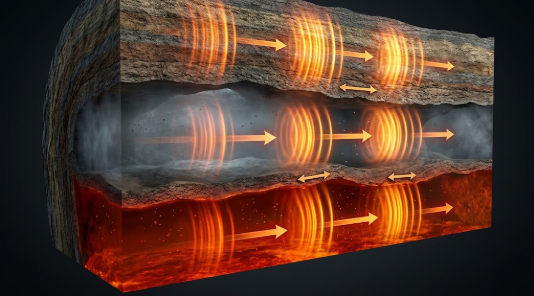
A very fast, compressional (longitudinal) body wave where rock vibrates parallel to the direction of wave propagation; it can pass through solid rock, gas, and liquid.
S Wave (Secondary Wave)
A slower, transverse body wave propagated by a shearing motion where rock vibrates perpendicular to wave propagation; it can only pass through solid rock.

Surface Waves
The slowest seismic waves that travel along Earth's surface away from the epicenter, causing the most property damage.

Love Waves
Surface waves with side-to-side horizontal movement perpendicular to the wave's direction, with no vertical displacement.

Rayleigh Waves
Surface waves that behave like rolling ocean waves, moving the ground in an elliptical path opposite to the wave's direction.

Travel-Time Curve
A graph plotting seismic-wave arrival time against distance, used to determine the distance to an earthquake using the time interval between the first P and S wave arrivals.

Benioff Zones (Wadati-Benioff Zones)
Inclined zones of seismic activity that begin at oceanic trenches and slope landward and downward into the Earth at 30° to 60° angles, where essentially all intermediate and deep-focus earthquakes occur.

Scarp
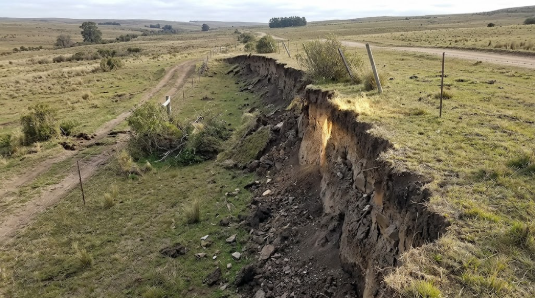
A low cliff formed by the trace of a fault on Earth's surface after permanent land displacement.
Sag Ponds
New lakes created by ground breakage that affects the hydrosphere.

Brittle Behavior
The tendency of rocks to break, which typically occurs near Earth's surface.

Ductile Materials
The behavior of deep rocks subjected to high temperatures and pressures, causing them to flow or bend rather than break.
