bchs 3304 exam 3 flashcards
 Call Kai
 Learn
 Practice Test
 Spaced Repetition
 Match
 Flashcards
 Knowt Play
1/116

There's no tags or description
Looks like no tags are added yet.
117 Terms
enzymes are powerful biological _____. rate accelerations by enzymes are often far greater than those by synthetic or inorganic ones. like all catalysts, enzymes increase _________ rates, lowering reaction __________ ____________. enzymes do NOT affect the ________ of reactions, or the equilibrium ratio
catalysts, reaction, activation energy (barriers), equilibria
__________ __________ depends on the integrity of the native protein conformation
catalytic activity
true or false: some enzymes require additional chemical components, such as cofactors
true
includes coenzymes and 1+ inorganic ions, like Fe2+, Mg2+, Mn2+, or Zn2+
cofactors
complex organic or metalloorganic molecule that act as transient carriers of specific functional groups
coenzyme
know coenzymes as transient carriers of atoms or functional groups slide. B family vitamins very important to this
coenzyme or metal ion that is very tightly or covalently bound to the enzyme protein
prosthetic
complete catalytically active enzyme together with its bound coenzyme and/or metal ions
holoenzyme
the protein part of a holoenzyme
apoenzyme/apoprotein
which enzyme class is trypsin, kinase, and carbonic anhydrase in?
trypsin belongs to the ___________ class, as it cleaves the peptide bond and involves water
hydrolase
this class of enzymes transfer electrons (hydride ions or H atoms)
oxidoreductases
these enzymes oversee group transfer
transferases
these group of enzymes are responsible for hydrolysis and transfer functional groups to water
hydrolysis
responsible for the cleavage of C-C, C-O, C-N, or other bonds by elimination, leaving double bonds or rings or addition of groups to double bonds
lysases
transfer of groups within molecules to yield isomeric forms
isomerases
formation of C-C, C-S, C-O, and C-N bonds by condensation reactions coupled to Cleavage of tap or similar cofactors
ligase
movement of molecules or ions across membranes or within membranes
translocases
carbon ic anhydrase belongs to what class of enzymes?
lyases
kinase belongs to which class of enzymes?
transferases
provides a specific environment in which a given reaction can occur more rapidly
active site
the molecule that is bound to the active site and acted upon by the enzyme
substrate
starting point for either the forward or reverse reaction
ground state
the point/high energy state at which decay to substrate or product are equally likely
transition state
the Gibbs free energy change of a reaction measured under defined physiological conditions rather than standard chemical conditions
biochemical standard state free energy change
what is the standard state in biochemistry?
pH = 7, temperature = 298.15 (25 degrees C)
pressure = 1atm
reactants and products have initial concentration of 1
water concentration is treated as a constant (~55.5M) and concentrated from the equilibrium expression
magnesium ions buffered at 1mM
reaction equilibria are linked to the standard free energy change for the reaction, ∆G’º, while reaction ____ are related to the linked activation energy
standard free energy change, rates
define ∆G’º in terms of R, T, and K
∆G’º = -RTlnKeq
catalysts ____ the activation energy and _____ the reaction rate
lower, increase
true or false: catalysts affect reaction equilibria
false
which of the following are true about enzymes?
A. enzymes that that catalyst S → P also catalyze P → S
B. enzymes accelerate interconversion of S and P
C. enzymes are not used up in the process
D. the equilibrium point is unaffected
E. all of the above are true about enzymes
E. all of the above
multi-step reactions have _________-__________ steps, where if one step is much slower than all the rest, this step is said to be the ____________-________/determining step
rate-limiting, rate-limiting
which step in a reaction has the highest activation energy?
the rate-determining step
step in which the reaction with the highest activation energy determines the overall reaction rate
rate-limiting step
any species on the reaction pathway that has a finite chemical lifetime. for example, ES and EP complexes
reaction intermediate
the relationship between the rate constant k and the activation energy is __________ and _________
inverse, exponential (or vice versa)
reaction in which the rate depends on the concentration of 2 different compounds or the reaction is between 2 molecules of the same compound. k has units of M-1s-1. the rate equations is V = k[S1][S2]
second order reactions
If a first-order reaction for the unimolar reaction S —> P has a rate constant k of 0.05s-1, how is this interpreted qualitatively?
A. C. 0.05% of the available S will be converted to P in 1 second.
B. 5% of the available S will be converted to P in 1 second.
C. 0.05% of the available P will be converted to S in 1 second.
D. 5% of the available P will be converted to S in 1 second.
B. 5% of the available S will be converted to P in 1 second
reaction in which rate only depends on concentration of S. k has units s-1
first order reaction
the rate of a reaction is determined by what 2 things?
reactant(s) concentration and the rate constant, k
for a unimolar reaction S→P, rate equation can be written as…? (first order)
V = k[S], where v = velocity or rate of reaction and s= concentration of substrate
given the equation: k = (kT/h) * e^(-∆G+-/RT), describe the relationship between k (not bold) and activation energy ∆G+-
the relationship is inverse and exponential. the smaller activation energy gets, the larger the rate constant (meaning the faster the reaction proceeds)
which of the following is true regarding binding energy?
A. energy derived from a non covalent enzyme-substrate interaction.
B. it is mediated by hydrogen bonds, ionic interactions, and the hydrophobic effect.
C. it is a major source of free energy used by enzymes to lower activation energy.
D. all of the following are true regarding binding energy
D. all of the following are true regarding binding energy
the ______ ______ ___________ hypothesis states that enzymes are structurally complementary to their substrates
lock and key
true or false: enzymes must be complementary to the reaction transition state, as the full complement of interactions is formed only when the substrate reaches the transition state
true
How does the concept of “induced fit” support the current theory of substrate-enzyme interaction?
A. Enzyme structure is rigid, allowing for competition for the active site and easy ejection of the final product.
B. Enzyme conformational changes demonstrate feedback regulation of the enzyme and the ability to “turn off” activity.
C. Having a rigid structure allows the enzyme to bind the substrate and stabilize the ES complex.
D. Enzyme conformation changes allow additional stabilizing interactions with the transition state and enhance the activity.
D. Enzyme conformation changes allow additional stabilizing interactions with the transition state and enhance the activity.
Two concepts explain the ___________ power of enzymes:
Enzymes bind most tightly to the ____________ _________ of the catalyzed reaction, using binding energy to lower the __________ ____________.
Enzyme active sites are organized by evolution to facilitate multiple mechanisms of chemical catalysis ______________
catalytic, transition state, activation barrier, simultaneously
the sum of the unfavorable and favorable _________ ___________ results in a lower ____ activation energy
binding energy, net
what drives enzymatic catalysis?
weak binding interactions between the enzyme and the substrate
which of the following is NOT included in barrier to reaction?
A. entropy of molecules in a solution
B. solvation shelf hydrogen-bonded water
C. distortion of substrates
D. need for proper alignment of catalytic functional groups on the substrate
D. need for proper alignment of catalytic functional groups on the substrate.
This is not needed. If the option was “need for proper alignment of catalytic functional groups on the enzyme,” this WOULD be needed,
large restriction in the relative motions of the two substrates that are to react
entropy reduction
what helps constrain substrates int he proper orientation to react?
binding energy
replacement of the solvation shell of structured water around the substrate with weak bonds between substrate and enzyme. it replaces most or all hydrogen bonds between the substrate and H2O
desolvation
true or false: substrates must undergo distortion (electron redistribution) to react, causing a favorable free energy change.
false. it causes an unfavorable free energy change
what helps account thermodynamically for the unfavorable free energy change caused by substrate distortion?
binding energy
true or false: enzymes can increase the rate of reactions by 10^5 to 10^17 fold
true
mechanism by which the enzyme itself undergoes a conformational change when he substrate binds, induced by multiple weak interactions with the substrate. this enhances catalytic properties
induced fit
Which statement about enzymes is false?
A. They lower the activation energy of a reaction.
B. They alter the overall thermodynamics of a reaction.
C. A substantial amount of their catalytic power results from
binding of the substrate(s) through weak interactions.
D. They increase the rates of reactions by 10^5-fold to 10^17-fold.
B. they alter the overall thermodynamics of a reaction
lecture 17
in this process, protons are transferred between an enzyme and a substrate or intermediate.
acid base catalysisin
in ______ acid base catalysis, only H+ or OH- ions present in water are used. meanwhile, in _____ acid base catalysis, it is mediated by weak acids or bases other than water
specific, general
true or false: amino acids can be present in acid base catalysis as either electron donors or acceptors
true
Which amino acid might be expected to have the LEAST effect on the function of an enzyme if it replaces a Glu residue in the enzyme?
A. Gly
B. Lys
C. His
D. Asp
D. Asp
which of the following are false of covalent catalysis?
A. occurs when a transient covalent bond forms between the enzyme and the substrate.
B. only results when the new pathway has a lower activation than the uncatalyzed pathway.
C. every new step must be faster than the uncatalyzed reaction
D. none of the above
D. none of the above
covalent catalysis (nucleophile attacks electrophile) occurs in a vast number of enzymes and is related to what property?
basicity
how does a Schiff base form in covalent catalysis?
an amine reacts with an aldehyde or ketone

Which statement is NOT associated with covalent catalysis by enzymes?
A. When the reaction is complete, the enzyme returns to its original state.
B. It never involves coenzymes.
C. A transient covalent bond is formed between the enzyme and the substrate.
D. A new pathway from substrate(s) to product(s) is formed that is faster than the uncatalyzed reaction.
B. It never involves coenzymes
which of the following is true of metal ion catalysis?
A. it helps orient the substrate for a reaction
B. stabilizes charged reaction transition states
C. Mediates oxidation-reduction reactions by reversible changes in the metal ion’s oxidation state
D. Required by nearly 1/3rd of all enzymes
E. All of the above are true of metal ion catalysis
F. None of the above are true of metal ion catalysis
E. all of the above
the active site of human carbonic anhydrase consists of a single _______ ion (2+ oxidation state) tetrahedrally bonded to imidazole nitrogens of 3 invariant _______ residues (His94, 96, and 119).
Zn, histidine
the ____ ion binds to the substrate, directing, stabilizing, and shielding it, and converts between HCO3 and CO2
Zn
which of the following are false regarding carbonic anhydrase reaction?
A. converts between CO2 AND HCO2
B. HO- is stabilized by Zn2+ where it nucleophilically attacks CO2
C. water molecule completes the process
D. none of the above are false regarding carbonic anhydrase
A. converts between CO2 and HCO2. It converts between CO2 and HCO3
whats the advantage of using a metal ion over a proton in a carbonic anhydrase reaction?
it significantly lowers water pKa while maintaining a highly concentrated nucleophile at physiological pH
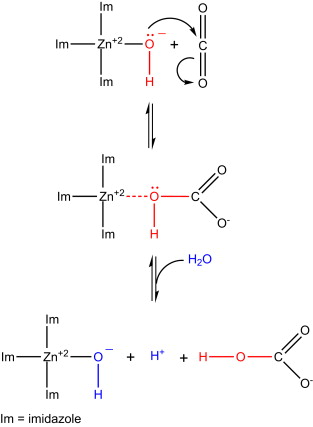
this image describes what reaction?
carbonic anhydrase reaction
the discipline focused on determining the rate of a reaction and how it changes in response to changes in experimental parameters
enzyme kinetics
initial transient period during which the enzyme-substrate complex builds up (ES)
pre-steady state
period during which the enzyme-substrate complex [ES] and all other intermediates remain constant
steady state
the traditional analysis of reaction rates
steady-state kinetics
enzyme catalyzed reactions happen mostly in what state?
steady state
how do you find the initial rate/initial velocity of an enzyme catalyzed reaction? what is significant about it?
it is the tangent of the curve at t=0. it reflects a steady state

After you mix a substrate and enzyme together, there is an initial transient period, the pre–steady state. What happens during the pre–steady state?
A. [Et] decreases until it reaches a constant level.
B. [S] decreases until it reaches a constant level.
C. [P] increases until it reaches a constant level.
D. [ES] increases until it reaches a constant level.
D. [ES] increases until it reaches a constant level
for enzymes obeying the Michaelis-Menten relationship, a plot of 1/V0 versus 1/S yields a…?
straight line

how can the Michaelis-Menten equation be standardized in terms of y=mx+b?
1/V0 = (Km/(Vmax * [S])) + 1/Vmax. This is exactly in y = mx + b form. 1/Vmax = y-intercept
Using the Michaelis-Menten equation, Km = [S] when V0 = ?
0.5Vmax
given a Michaelis-Menten plot, how can Vmax be found?
it is the horizontal asymptote of the graph

this states that Vmax is observed when virtually all the enzyme is present as the ES (enzyme-substrate) complex. due to this, further increases in [S] have no effect on the rate, and a plateau is created
saturation effect
the relationship between the substrate concentration and reaction rate can be expressed using which equation?
Michaelis-Menten equation
what is the michaelis-menten equation for rate?
V0 = Vmax/Km+[S], where V0 = initial velocity, Vmax = maximum velocity, Km is Michaelis constant, and [S] is the initial substrate concentration
which of the following points do not accurately describe the general theory of enzyme action proposed by Michaelis and Menten?
A. In the first step, enzyme and substrate combine to form a complex in a fast, completely reversible step
B. In the second step, the complex breaks down to yield the free enzyme and the reaction product in a slower step
C. Since the first step is rate limiting, the overall rate is proportional to [ES]
D. all of these align with the general theory
C. Since the first step is rate limiting, the overall rate is proportional to [ES]. The second step is rate limiting, not the first

V0 (initial velocity) is determined by the breakdown of the ______ to form product, which is determined by the ______ (same thing).
Fill in the blank, then give the appropriate equation to describe this relationship
[ES] (enzyme-substrate complex). V0 =k2[ES]
true or false: because you have significantly more substrate than total enzyme concentration, the amount of substrate bound by the enzyme at any given time is negligible compared to the total [S]
true
the assumption that the rate of the formation of ES is equal to the rate of its breakdown
steady-state assumption
what is the equation for the Michaelis-Menten constant, Km?
Km = (k1 + k2)/k1
lecture 19, skipping 18 to take a break from the math
determine if each of the following statements are true or false:
a competitive inhibitor has no effect on Vmax or Km
an uncompetitive inhibitor turns apparent Vmax into Vmax/a’ and Km into Km/a’
A mixed inhibitor turns apparent Vmax into Vmax/a’ and Km into aKm/a’
(a = alpha)
all are true
these bind covalently with or destroy a functional group on an enzyme that is essential for the enzyme’s activity, or form a highly stable non covalent association
irreversible inhibitor
these undergo the first few steps until it is converted into a compound that is irreversibly combined with the enzyme. this is a class of irreversible inhibitors
suicide inactivators
stable molecules designed to resemble transition states. they are another form of irreversible inhibitor and bind to the enzyme more tightly than the substrate binds to the ES complex
transition-state analogs
the chymotripsin mechanism involves the acylation and deacylation of what amino acid residue?
serine (SER)
an enzyme that catalyzes the hydrolytic cleavage of peptide bonds. ex: bovine pancreatic chymotripsin
protease
in the _____ phase of the chymotripsin mechanism, the peptide bond is cleaved and an ester linkage is formed between the peptide carbonyl carbon and the enzyme
in the _____ phase, the ester linkage is hydrolyzed and the nonacylated enzyme is regenerated
acylation, deacylation