Lec 3

0.0(0)
Studied by 0 people
call kaiCall Kai
learnLearn
examPractice Test
spaced repetitionSpaced Repetition
heart puzzleMatch
flashcardsFlashcards
GameKnowt Play
Card Sorting

1/81

encourage image

There's no tags or description

Looks like no tags are added yet.

Last updated 3:10 AM on 10/1/26
Name
Mastery
Learn
Test
Matching
Spaced
Call with Kai
Chat

No analytics yet

Send a link to your students to track their progress

82 Terms

1
New cards

What is the driver of energy on Earth?

  • radiation from the sun

  • Sun is primary source of energy 

    • In form of radiation (form of energy that travels in a form of wave (electromagnetic wave)) 


2
New cards

What is radiation?

  • Energy comes in waves and diff types of radiation 

    • Radiation: electromagnetic radiation that comes in based on wavelength onto the earth 

      • Most Shortwave radiation because sun in hot (ex: UV radiation) 

      • Also some visible spectrum, infrared spectrum 

    • Sun is pushing energy for processes 

  • Traveling of radiation doesn't require any matter -> radiation from sun can travel large space to get to Earth 


3
New cards

What are the main drivers of spatial and temporal variation of the energy received from the Sun?

  • Seasons

  • Latitude

  • Clouds

  • Surface characteristics (ie reflectance)


4
New cards

How do seasons impact spatial and temporal variation of energy from the sun?

  • Tilted and spinning Earth with orbit 

  • Diff seasons -> more or less input of solar energy  

  • Orbit: 

    • Sun closer to Earth -> more radiation will reach with less distance (more energy hitting Earth) 


5
New cards

How does latitude impact spatial and temporal variation of energy from the sun?

  • How sun strike Earth 

    • 90 degree angle -> more energy absorbed by earth 

    • Shallow angle -> reflected more to space -> less energy absorbed 

  • Equator: more direct pathway for sun 

  • Pole: 24 hr of light during summer, 24hr darkness in winter 


6
New cards

How do clouds impact spatial and temporal variation of energy from the sun?

  • Cloudy day: not as much solar radiation 

  • Clear: lots of solar radiation 

  • Clouds can separate energy -> less reaches Earth 


7
New cards

How does the surface impact spatial and temporal variation of energy from the sun?

  • Color of surface, texture -> influences how much energy is absorbed to Earth's surface 

  • More energy reflected -> less energy absorbed 


8
New cards

What is Planck’s law?

  • the wavelength of the energy emitted by a surface decreases as its temperature increases

  • Energy comes in waves 

    • When waves are closer together = shorter  

      • Hotter (lambda is smaller) -> the shorter the wavelength the hotter it is 

    • Waves farther apart = longer waves 


9
New cards

What does a hotter surface mean?

  • The hotter the surface -> the shorter the wave length at which the emission of energy happens 

    • Ex: sun is hot -> emitting energy at shorter wave lengths than the energy the Earth is emitting 


10
New cards

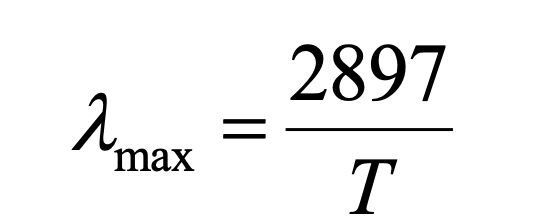
What is Wien’s displacement law?

  • calculates the wavelength at which maximum energy radiation occurs, given a specific surface temperature.

  • Calculate at what wavelength the object has a max radiation emission 


<ul><li><p>calculates the wavelength at which maximum energy radiation occurs, given a specific surface temperature.</p></li><li><p><span style="background-color: inherit; line-height: 19.55px; color: windowtext;">Calculate at what wavelength the object has a max radiation emission</span><span style="line-height: 19.55px; color: windowtext;">&nbsp;</span></p></li><li><p></p><img src="https://assets.knowt.com/user-attachments/7ce6d8f1-199f-4c45-b963-8678192f279e.png" data-width="50%" data-align="center" style="display: block; width: 50%; margin-left: auto; margin-right: auto;"></li></ul><p></p>
11
New cards

What is a wavelength?

  • When object emits radiation -> spectrum of radiation with many diff wave lengths 

    • Wien 

      • All bodies emit energy in a spectrum  


<ul><li><p><span style="background-color: inherit; line-height: 19.55px; color: windowtext;">When object emits radiation -&gt; spectrum of radiation with many diff wave lengths</span><span style="line-height: 19.55px; color: windowtext;">&nbsp;</span></p><ul><li><p class="Paragraph SCXO123170917 BCX0" style="text-align: left;"><span style="background-color: inherit; line-height: 19.55px; color: windowtext;">Wien</span><span style="line-height: 19.55px; color: windowtext;">&nbsp;</span></p><ul><li><p class="Paragraph SCXO123170917 BCX0" style="text-align: left;"><span style="background-color: inherit; line-height: 19.55px; color: windowtext;">All bodies emit energy in a spectrum&nbsp;</span><span style="line-height: 19.55px; color: windowtext;">&nbsp;</span></p></li></ul></li></ul></li></ul><p></p>
12
New cards

What is a wavelengths max energy radiation?

  • Lots of other wavelengths, but wavelength max is the most dominant/frequent

    • (highest energy wavelength in this spectrum of emission) 

  • Seen the most in the middle -> wavelength being predicted as max emission by Wien 

  • Emissions happening at other wave lengths , but weins predicts wavelengths associated with peak of bell curve 


<ul><li><p><span style="background-color: inherit; line-height: 19.55px; color: windowtext;">Lots of other wavelengths, but wavelength max is the most dominant/frequent </span></p><ul><li><p><span style="background-color: inherit; line-height: 19.55px; color: windowtext;">(highest energy wavelength in this spectrum of emission)</span><span style="line-height: 19.55px; color: windowtext;">&nbsp;</span></p></li></ul></li><li><p><span style="background-color: inherit; line-height: 19.55px; color: windowtext;">Seen the most in the middle -&gt; wavelength being predicted as max emission by Wien</span><span style="line-height: 19.55px; color: windowtext;">&nbsp;</span></p></li><li><p class="Paragraph SCXO257526605 BCX0" style="text-align: left;"><span style="background-color: inherit; line-height: 19.55px; color: windowtext;">Emissions happening at other wave lengths , but weins predicts wavelengths associated with peak of bell curve</span><span style="line-height: 19.55px; color: windowtext;">&nbsp;</span></p></li></ul><p></p>
13
New cards
term image
  • Average is 6000 K 

  • 2897/6000 = 0.5 weirdMm  

    • Wavelength of max emission  


14
New cards

What are the parts of the electromagnetic spectrum?

  • Infrared longer  

    • Eye cannot process it 

  • UV shorter 

    • Eye cannot see it 

  • Visible spectrum  

    • Reds are longer 

    • Violets are shorter 


15
New cards

Where is the un on the electromagnetic spectrum?

  • Sun 0.5 is in the UV -> blue green visible -> can see the light 

    • Most things that drive Earth for energy sense is UV and infrared 

  • Short and long wave length are relative -> relation is referring to Earth and sun radiation 


<ul><li><p><span style="background-color: inherit; line-height: 19.55px; color: windowtext;">Sun 0.5 is in the UV -&gt; blue green visible -&gt; can see the light</span><span style="line-height: 19.55px; color: windowtext;">&nbsp;</span></p><ul><li><p class="Paragraph SCXO106148846 BCX0" style="text-align: left;"><span style="background-color: inherit; line-height: 19.55px; color: windowtext;">Most things that drive Earth for energy sense is UV and infrared</span><span style="line-height: 19.55px; color: windowtext;">&nbsp;</span></p></li></ul></li><li><p class="Paragraph SCXO106148846 BCX0" style="text-align: left;"><span style="background-color: inherit; line-height: 19.55px; color: windowtext;">Short and long wave length are relative -&gt; relation is referring to Earth and sun radiation</span><span style="line-height: 19.55px; color: windowtext;">&nbsp;</span></p></li></ul><p></p>
16
New cards

What is insolation?

  • Insolation is energy received from the Sun (INcoming SOLar radiATION).

  • Insolation is “shortwave” radiation

    • All insolation is shortwave radiation 

    • Only the sun radiation is shortwave 


17
New cards

What are shortwave radiation inputs?

  • Ultraviolet light (UV) shorter

    • shorter

  • Visible light

  • Near-infrared wavelengths

    • longer

  • Mostly UV 

  • All three types together = solar radiation 

    • All short though because they all are from the sun 


18
New cards
<p></p>


  • 2897/290 = 10 mm 

    • More in the infrared area 

    • 290 – 273.15  

  • Higher wavelength = lower energy 

  • 10 nm is in infrared range -> cannot see any visible light 


19
New cards

What is energy taken by the Earth?

  • Insolation that is not reflected by the Earth’ s surface is absorbed.

  • Constantly getting short wave radiation from sun towards Earths surface 

    • Most getting reflected, but some are absorbed at surface 


20
New cards

What happens when the Earth absorbs energy?

  • Once this shortwave radiation is absorbed, it may later be emitted as an energy output.

  • Earth emits energy according to its own temp 

    • Reflectance goes off with the same energy 

    • When absorbed 

      • Earth is cooler -> emitted at a much longer wavelength 

  • Absorbed energy is being used earth surface to heat it up 

    • Energy not reflected back to space 

  • Energy absorbed will be emitted back into space, but now long wave 

    • Go back to weins law 

    • Earth is much cooler than sun -> T is smaller -> longer wavelength radiation


21
New cards

Sun energy vs Earth energy

  • Sun Energy = emits shortwave

  • Earth Energy = emits longwave


<ul><li><p>Sun Energy = emits shortwave </p></li><li><p>Earth Energy = emits longwave</p></li></ul><p></p>
22
New cards

What waves come into Earth?

  • Waves go up and down at higher frequency than long waves 

  • Short coming in  

    • Most is caught up in clouds, space,  

    • About half from sun is being absorbed by Earths surface 

  • Sun puts in short 

    • Some is reflected to space 

    • Some is absorbed 

    • Some hits clouds (gas particles) -> reflected back to space 

    • Some hit gases in atmosphere


<ul><li><p><span style="background-color: inherit; line-height: 19.55px; color: windowtext;">Waves go up and down at higher frequency than long waves</span><span style="line-height: 19.55px; color: windowtext;">&nbsp;</span></p></li><li><p class="Paragraph SCXO214683669 BCX0" style="text-align: left;"><span style="background-color: inherit; line-height: 19.55px; color: windowtext;">Short coming in&nbsp;</span><span style="line-height: 19.55px; color: windowtext;">&nbsp;</span></p><ul><li><p class="Paragraph SCXO214683669 BCX0" style="text-align: left;"><span style="background-color: inherit; line-height: 19.55px; color: windowtext;">Most is caught up in clouds, space,&nbsp;</span><span style="line-height: 19.55px; color: windowtext;">&nbsp;</span></p></li><li><p class="Paragraph SCXO214683669 BCX0" style="text-align: left;"><span style="background-color: inherit; line-height: 19.55px; color: windowtext;">About half from sun is being absorbed by Earths surface</span><span style="line-height: 19.55px; color: windowtext;">&nbsp;</span></p></li></ul></li><li><p class="Paragraph SCXO214683669 BCX0" style="text-align: left;"><span style="background-color: inherit; line-height: 19.55px; color: windowtext;">Sun puts in short</span><span style="line-height: 19.55px; color: windowtext;">&nbsp;</span></p><ul><li><p class="Paragraph SCXO188247566 BCX0" style="text-align: left;"><span style="background-color: inherit; line-height: 19.55px; color: windowtext;">Some is reflected to space</span><span style="line-height: 19.55px; color: windowtext;">&nbsp;</span></p></li><li><p class="Paragraph SCXO188247566 BCX0" style="text-align: left;"><span style="background-color: inherit; line-height: 19.55px; color: windowtext;">Some is absorbed</span><span style="line-height: 19.55px; color: windowtext;">&nbsp;</span></p></li><li><p class="Paragraph SCXO188247566 BCX0" style="text-align: left;"><span style="background-color: inherit; line-height: 19.55px; color: windowtext;">Some hits clouds (gas particles) -&gt; reflected back to space</span><span style="line-height: 19.55px; color: windowtext;">&nbsp;</span></p></li><li><p class="Paragraph SCXO188247566 BCX0" style="text-align: left;"><span style="background-color: inherit; line-height: 19.55px; color: windowtext;">Some hit gases in atmosphere</span></p></li></ul></li></ul><p></p>
23
New cards

What happens to waves that hit clouds?

  • Photon hits particles -> reflected in all directions -> some of the photons are reflected back to space and some are reflected to surface of Earth (diffuse radiation form the sun)  

    • Less intense, but is incoming radiation from sun to Earth 


<ul><li><p><span style="background-color: inherit; line-height: 19.55px; color: windowtext;">Photon hits particles -&gt; reflected in all directions -&gt; some of the photons are reflected back to space and some are reflected to surface of Earth (diffuse radiation form the sun)&nbsp;</span><span style="line-height: 19.55px; color: windowtext;">&nbsp;</span></p><ul><li><p class="Paragraph SCXO188247566 BCX0" style="text-align: left;"><span style="background-color: inherit; line-height: 19.55px; color: windowtext;">Less intense, but is incoming radiation from sun to Earth</span><span style="line-height: 19.55px; color: windowtext;">&nbsp;</span></p></li></ul></li></ul><p></p>
24
New cards

What happens to waves that hit gases in the atmosphere?

  • Gases in atmosphere (ex: water vapor, CO2 (global warming)) 

    • More GHG in atmos -> gases absorb some long wave -> some gases emit back to space 

    • Some of the gases point them back down Earth  

      • Waves emitted back towards Earth are based according to their temp 

      • Gas temp is cooler -> emits long wave back to Earth surface 

      • Creates trapping of energy in the near surface -> Greenhouse effect 


<ul><li><p><span style="background-color: inherit; line-height: 19.55px; color: windowtext;">Gases in atmosphere (ex: water vapor, CO2 (global warming))</span><span style="line-height: 19.55px; color: windowtext;">&nbsp;</span></p><ul><li><p class="Paragraph SCXO179938150 BCX0" style="text-align: left;"><span style="background-color: inherit; line-height: 19.55px; color: windowtext;">More GHG in atmos -&gt; gases absorb some long wave -&gt; some gases emit back to space</span><span style="line-height: 19.55px; color: windowtext;">&nbsp;</span></p></li><li><p class="Paragraph SCXO179938150 BCX0" style="text-align: left;"><span style="background-color: inherit; line-height: 19.55px; color: windowtext;">Some of the gases point them back down Earth&nbsp;</span><span style="line-height: 19.55px; color: windowtext;">&nbsp;</span></p><ul><li><p class="Paragraph SCXO179938150 BCX0" style="text-align: left;"><span style="background-color: inherit; line-height: 19.55px; color: windowtext;">Waves emitted back towards Earth are based according to their temp</span><span style="line-height: 19.55px; color: windowtext;">&nbsp;</span></p></li><li><p class="Paragraph SCXO179938150 BCX0" style="text-align: left;"><span style="background-color: inherit; line-height: 19.55px; color: windowtext;">Gas temp is cooler -&gt; emits long wave back to Earth surface</span><span style="line-height: 19.55px; color: windowtext;">&nbsp;</span></p></li><li><p class="Paragraph SCXO179938150 BCX0" style="text-align: left;"><span style="background-color: inherit; line-height: 19.55px; color: windowtext;">Creates trapping of energy in the near surface -&gt; Greenhouse effect</span><span style="line-height: 19.55px; color: windowtext;">&nbsp;</span></p></li></ul></li></ul></li></ul><p></p>
25
New cards

What happens to the waves absorbed by the Earth?

  • Half absorbed -> Earth starts to emit energy back towards space as long energy 

  • Warm earth will emit LW radiation back to atmosphere 

    • Some of LW goes to space 

    • Most is absorbed by GHG in atmos 


<ul><li><p><span style="background-color: inherit; line-height: 19.55px; color: windowtext;">Half absorbed -&gt; Earth starts to emit energy back towards space as long energy</span><span style="line-height: 19.55px; color: windowtext;">&nbsp;</span></p></li><li><p><span style="background-color: inherit; line-height: 19.55px; color: windowtext;">Warm earth will emit LW radiation back to atmosphere</span><span style="line-height: 19.55px; color: windowtext;">&nbsp;</span></p><ul><li><p class="Paragraph SCXO130740821 BCX0" style="text-align: left;"><span style="background-color: inherit; line-height: 19.55px; color: windowtext;">Some of LW goes to space</span><span style="line-height: 19.55px; color: windowtext;">&nbsp;</span></p></li><li><p class="Paragraph SCXO130740821 BCX0" style="text-align: left;"><span style="background-color: inherit; line-height: 19.55px; color: windowtext;">Most is absorbed by GHG in atmos</span><span style="line-height: 19.55px; color: windowtext;">&nbsp;</span></p></li></ul></li></ul><p></p>
26
New cards

What causes global climate change?

  • Global climate change: positive feedback mechanisms of the greenhouse effect (acceleration, more trapping of energy)  

  • Need greenhouse effect for Earth to be habitable  

    • But acceleration of greenhouse effect is causing climate change 

  • GHG warms up -> reemit back towards Earth -> traps most of the energy near surface of Earth -> keeps it warm and livable = greenhouse effect 

  • Global climate warming is not because of greenhouse effect 

    • Human activity release excess GHG -> more energy trapped near surface -> temp increase more 


<ul><li><p><span style="background-color: inherit; line-height: 19.55px; color: windowtext;">Global climate change: positive feedback mechanisms of the greenhouse effect (acceleration, more trapping of energy)</span><span style="line-height: 19.55px; color: windowtext;">&nbsp;&nbsp;</span></p></li><li><p class="Paragraph SCXO177676847 BCX0" style="text-align: left;"><span style="background-color: inherit; line-height: 19.55px; color: windowtext;">Need greenhouse effect for Earth to be habitable&nbsp;</span><span style="line-height: 19.55px; color: windowtext;">&nbsp;</span></p><ul><li><p class="Paragraph SCXO177676847 BCX0" style="text-align: left;"><span style="background-color: inherit; line-height: 19.55px; color: windowtext;">But acceleration of greenhouse effect is causing climate change</span><span style="line-height: 19.55px; color: windowtext;">&nbsp;</span></p></li></ul></li><li><p class="Paragraph SCXO177676847 BCX0" style="text-align: left;"><span style="background-color: inherit; line-height: 19.55px; color: windowtext;">GHG warms up -&gt; reemit back towards Earth -&gt; traps most of the energy near surface of Earth -&gt; keeps it warm and livable = greenhouse effect</span><span style="line-height: 19.55px; color: windowtext;">&nbsp;</span></p></li><li><p class="Paragraph SCXO67957478 BCX0" style="text-align: left;"><span style="background-color: inherit; line-height: 19.55px; color: windowtext;">Global climate warming is not because of greenhouse effect</span><span style="line-height: 19.55px; color: windowtext;">&nbsp;</span></p><ul><li><p class="Paragraph SCXO67957478 BCX0" style="text-align: left;"><span style="background-color: inherit; line-height: 19.55px; color: windowtext;">Human activity release excess GHG -&gt; more energy trapped near surface -&gt; temp increase more</span><span style="line-height: 19.55px; color: windowtext;">&nbsp;</span></p></li></ul></li></ul><p></p>
27
New cards

What is Stefan-Boltzmann Law

  • describes the RATE at which energy is emitted from a substance

  • Wats per meter square of energy emission  

    • Watt: joule (energy ) per second -> gets a rate  

    • J/s -> makes Qr a rate instead of a value 

    • How quickly a body can emit energy 

  • How much of that energy is coming onto or how much energy is emitted a meter square area 


<ul><li><p>describes the RATE at which energy is emitted from a substance</p></li><li><p><span style="background-color: inherit; line-height: 19.55px; color: windowtext;">Wats per meter square of energy emission&nbsp;</span><span style="line-height: 19.55px; color: windowtext;">&nbsp;</span></p><ul><li><p class="Paragraph SCXO250470599 BCX0" style="text-align: left;"><span style="background-color: inherit; line-height: 19.55px; color: windowtext;">Watt: joule (energy ) per second -&gt; gets a rate&nbsp;</span><span style="line-height: 19.55px; color: windowtext;">&nbsp;</span></p></li><li><p class="Paragraph SCXO250470599 BCX0" style="text-align: left;"><span style="background-color: inherit; line-height: 19.55px; color: windowtext;">J/s -&gt; makes Qr a rate instead of a value</span><span style="line-height: 19.55px; color: windowtext;">&nbsp;</span></p></li><li><p class="Paragraph SCXO250470599 BCX0" style="text-align: left;"><span style="background-color: inherit; line-height: 19.55px; color: windowtext;">How quickly a body can emit energy</span><span style="line-height: 19.55px; color: windowtext;">&nbsp;</span></p></li></ul></li><li><p class="Paragraph SCXO250470599 BCX0" style="text-align: left;"><span style="background-color: inherit; line-height: 19.55px; color: windowtext;">How much of that energy is coming onto or how much energy is emitted a meter square area</span><span style="line-height: 19.55px; color: windowtext;">&nbsp;</span></p></li></ul><p></p>
28
New cards

What is emissivity?

  • How effectively a object can emit thermoradiation (energy) 

  • Effiency of energy emission 

  • Only thing in our system as perfect emitter of energy (black body) = Sun  

    • Emissivity of 1.0 = perfect emitting substance 

      • Object has ability to emit thermoradiation 

      • Everything else not: ex: water has 0.95 

    • The Earth has less etc (lec dude said the Earth also is a black body??) 


29
New cards

What is the solar constant?

  • The sun’s energy arrives at the outer edge of the atmosphere at an average rate of: 1.74 x 10^17 W

    • total energy

  • This, divided by the area of the earth (1.28 x 10^14 m^2 ) is 1367 W m^-2 = solar constant (Isc)

  • Isc = 1367 W m ^-2

    • At every scale meter -> energy received from the sun is 1367 Watt in one second 

<ul><li><p>The sun’s energy arrives at the outer edge of the atmosphere at an average rate of: 1.74 x 10^17 W</p><ul><li><p>total energy</p></li></ul></li><li><p>This, divided by the area of the earth (1.28 x 10^14 m^2 ) is 1367 W m^-2  = solar constant (Isc)</p></li><li><p>Isc = 1367 W m ^-2</p><ul><li><p><span style="background-color: inherit; line-height: 19.55px; color: windowtext;">At every scale meter -&gt; energy received from the sun is 1367 Watt in one second</span><span style="line-height: 19.55px; color: windowtext;">&nbsp;</span></p></li></ul></li></ul><p></p>
30
New cards

How does Isc vary?

  • Only average at surface  

    • At center -> more energy 

    • At edge -> less energy 


31
New cards

What is true of energy coming into the Earth and exiting it?

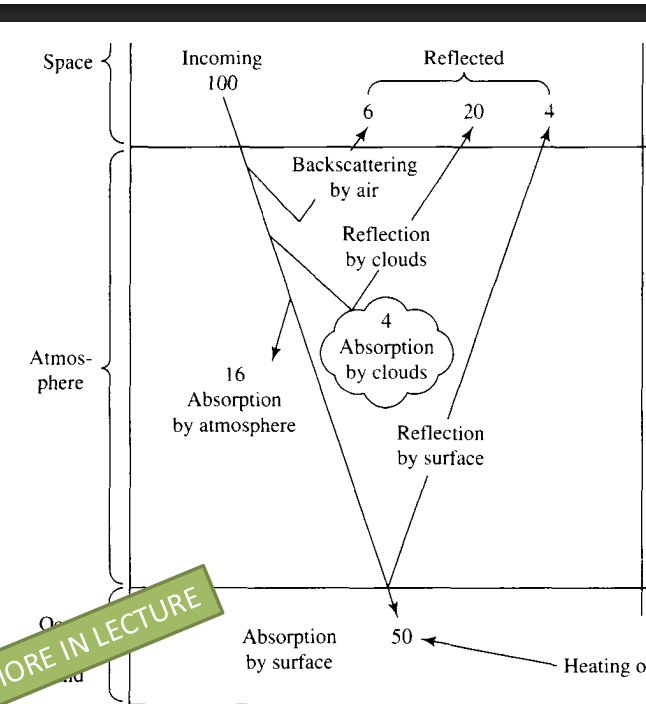
  • 100 = 100 % of solar constant  

    • = sum of reflected and outgoing radiation from the Earth 

      • 6+20+4+6+38+ 26 = balance of energy 

    • Outgoing energy includes energy being used by life 

  • Incoming and outgoing energy is equal 


<ul><li><p><span style="background-color: inherit; line-height: 19.55px; color: windowtext;">100 = 100 % of solar constant&nbsp;</span><span style="line-height: 19.55px; color: windowtext;">&nbsp;</span></p><ul><li><p class="Paragraph SCXO76946931 BCX0" style="text-align: left;"><span style="background-color: inherit; line-height: 19.55px; color: windowtext;">= sum of reflected and outgoing radiation from the Earth</span><span style="line-height: 19.55px; color: windowtext;">&nbsp;</span></p><ul><li><p class="Paragraph SCXO76946931 BCX0" style="text-align: left;"><span style="background-color: inherit; line-height: 19.55px; color: windowtext;">6+20+4+6+38+ 26 = balance of energy</span><span style="line-height: 19.55px; color: windowtext;">&nbsp;</span></p></li></ul></li><li><p class="Paragraph SCXO76946931 BCX0" style="text-align: left;"><span style="background-color: inherit; line-height: 19.55px; color: windowtext;">Outgoing energy includes energy being used by life</span><span style="line-height: 19.55px; color: windowtext;">&nbsp;</span></p></li></ul></li><li><p class="Paragraph SCXO76946931 BCX0" style="text-align: left;"><span style="background-color: inherit; line-height: 19.55px; color: windowtext;">Incoming and outgoing energy is equal</span><span style="line-height: 19.55px; color: windowtext;">&nbsp;</span></p></li></ul><p></p>
32
New cards

What happens to incoming radiation?

  • 100% incoming solar radiation -> partially reflected to space or backscattered to space 

    • Some is absorbed by clouds  

    • Some gases and particles by atmosphere 

    • About half strikes Earth 

  • 50% of incoming is absorbed by surface -> used to heat up Earths surface 


<ul><li><p><span style="background-color: inherit; line-height: 19.55px; color: windowtext;">100% incoming solar radiation -&gt; partially reflected to space or backscattered to space</span><span style="line-height: 19.55px; color: windowtext;">&nbsp;</span></p><ul><li><p class="Paragraph SCXO80959797 BCX0" style="text-align: left;"><span style="background-color: inherit; line-height: 19.55px; color: windowtext;">Some is absorbed by clouds&nbsp;</span><span style="line-height: 19.55px; color: windowtext;">&nbsp;</span></p></li><li><p class="Paragraph SCXO80959797 BCX0" style="text-align: left;"><span style="background-color: inherit; line-height: 19.55px; color: windowtext;">Some gases and particles by atmosphere</span><span style="line-height: 19.55px; color: windowtext;">&nbsp;</span></p></li><li><p class="Paragraph SCXO80959797 BCX0" style="text-align: left;"><span style="background-color: inherit; line-height: 19.55px; color: windowtext;">About half strikes Earth</span><span style="line-height: 19.55px; color: windowtext;">&nbsp;</span></p></li></ul></li><li><p class="Paragraph SCXO80959797 BCX0" style="text-align: left;"><span style="background-color: inherit; line-height: 19.55px; color: windowtext;">50% of incoming is absorbed by surface -&gt; used to heat up Earths surface</span><span style="line-height: 19.55px; color: windowtext;">&nbsp;</span></p></li></ul><p></p>
33
New cards

How much of the incoming radiation is reflected back to space?

  • How much energy is left at surface 

    • Reflected portion of incoming radiation is 30% (abt 30% of insolation is reflected back to space)  


<ul><li><p><span style="background-color: inherit; line-height: 19.55px; color: windowtext;">How much energy is left at surface</span><span style="line-height: 19.55px; color: windowtext;">&nbsp;</span></p><ul><li><p class="Paragraph SCXO180555807 BCX0" style="text-align: left;"><span style="background-color: inherit; line-height: 19.55px; color: windowtext;">Reflected portion of incoming radiation is 30% (abt 30% of insolation is reflected back to space)&nbsp;</span><span style="line-height: 19.55px; color: windowtext;">&nbsp;</span></p></li></ul></li></ul><p></p>
34
New cards

What would happen if the Earth kept accumulating energy?

  • If half of the energy kept accumulating energy -> the Eart would be too hot and explode 


<ul><li><p><span style="background-color: inherit; line-height: 19.55px; color: windowtext;">If half of the energy kept accumulating energy -&gt; the Eart would be too hot and explode</span><span style="line-height: 19.55px; color: windowtext;">&nbsp;</span></p></li><li><p></p></li></ul><p></p>
35
New cards

What happens after the Earth absorbed the energy?

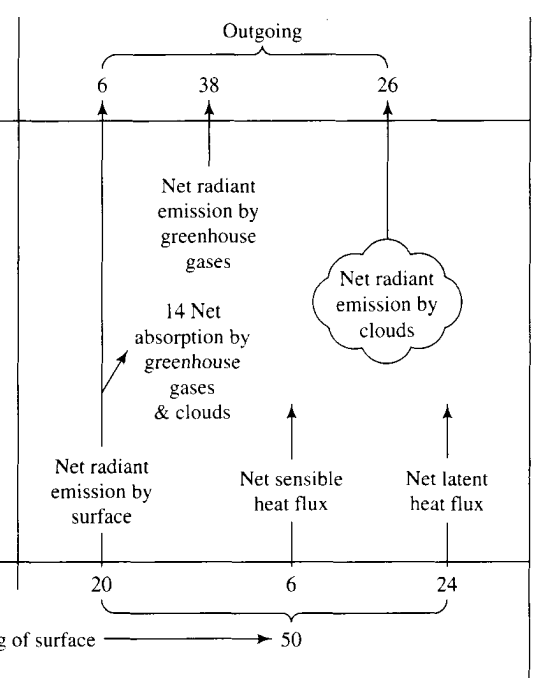
  • Warm earth surface remit LW back to atmos 

    • Some go to space directly 

    • Most absorbed by GHG 

      • Some absorbed by GHG go back to space 

      • Most remitted to surface of Earth (greenhouse effect) 

        • Net radiation emission by GHG by long wave 

    • Net sensible heat flux

    • net latent heat flux

  • Absorb radiant energy -> then gets used so Earth doesn’t continually heat up 


<ul><li><p class="Paragraph SCXO203831272 BCX0" style="text-align: left;"><span style="background-color: inherit; line-height: 19.55px; color: windowtext;">Warm earth surface remit LW back to atmos</span><span style="line-height: 19.55px; color: windowtext;">&nbsp;</span></p><ul><li><p class="Paragraph SCXO9992819 BCX0" style="text-align: left;"><span style="background-color: inherit; line-height: 19.55px; color: windowtext;">Some go to space directly</span><span style="line-height: 19.55px; color: windowtext;">&nbsp;</span></p></li><li><p class="Paragraph SCXO9992819 BCX0" style="text-align: left;"><span style="background-color: inherit; line-height: 19.55px; color: windowtext;">Most absorbed by GHG</span><span style="line-height: 19.55px; color: windowtext;">&nbsp;</span></p><ul><li><p class="Paragraph SCXO9992819 BCX0" style="text-align: left;"><span style="background-color: inherit; line-height: 19.55px; color: windowtext;">Some absorbed by GHG go back to space</span><span style="line-height: 19.55px; color: windowtext;">&nbsp;</span></p></li><li><p class="Paragraph SCXO9992819 BCX0" style="text-align: left;"><span style="background-color: inherit; line-height: 19.55px; color: windowtext;">Most remitted to surface of Earth (greenhouse effect)</span><span style="line-height: 19.55px; color: windowtext;">&nbsp;</span></p><ul><li><p class="Paragraph SCXO9992819 BCX0" style="text-align: left;"><span style="background-color: inherit; line-height: 19.55px; color: windowtext;">Net radiation emission by GHG by long wave</span><span style="line-height: 19.55px; color: windowtext;">&nbsp;</span></p></li></ul></li></ul></li><li><p class="Paragraph SCXO9992819 BCX0" style="text-align: left;"><span style="line-height: 19.55px; color: windowtext;">Net sensible heat flux</span></p></li><li><p class="Paragraph SCXO9992819 BCX0" style="text-align: left;"><span style="line-height: 19.55px; color: windowtext;">net latent heat flux</span></p></li></ul></li><li><p class="Paragraph SCXO203831272 BCX0" style="text-align: left;"><span style="background-color: inherit; line-height: 19.55px; color: windowtext;">Absorb radiant energy -&gt; then gets used so Earth doesn’t continually heat up</span><span style="line-height: 19.55px; color: windowtext;">&nbsp;</span></p></li></ul><p></p>
36
New cards

What is net sensible heat flux?

  • Sensible heat flux keeps the temperature warm 

<ul><li><p><span style="background-color: inherit; line-height: 19.55px; color: windowtext;">Sensible heat flux keeps the temperature warm</span><span style="line-height: 19.55px; color: windowtext;">&nbsp;</span></p></li></ul><p></p>
37
New cards

What is latent heat flux?

  • Energies running hydrological cycle by breaking hydro bonds  

  • Most dominated heat emitted by Earth and used by hydro 

  • Used to evap water on Earth 

    • Absorb energy from air -> doesn't change temp of water, it breaks hydro bond -> water molecule is stretching -> evaporates 


<ul><li><p><span style="background-color: inherit; line-height: 19.55px; color: windowtext;">Energies running hydrological cycle by breaking hydro bonds&nbsp;</span><span style="line-height: 19.55px; color: windowtext;">&nbsp;</span></p></li><li><p><span style="background-color: inherit; line-height: 19.55px; color: windowtext;">Most dominated heat emitted by Earth and used by hydro</span><span style="line-height: 19.55px; color: windowtext;">&nbsp;</span></p></li><li><p class="Paragraph SCXO170994922 BCX0" style="text-align: left;"><span style="background-color: inherit; line-height: 19.55px; color: windowtext;">Used to evap water on Earth</span><span style="line-height: 19.55px; color: windowtext;">&nbsp;</span></p><ul><li><p class="Paragraph SCXO170994922 BCX0" style="text-align: left;"><span style="background-color: inherit; line-height: 19.55px; color: windowtext;">Absorb energy from air -&gt; doesn't change temp of water, it breaks hydro bond -&gt; water molecule is stretching -&gt; evaporates</span><span style="line-height: 19.55px; color: windowtext;">&nbsp;</span></p></li></ul></li></ul><p></p>
38
New cards

What is the dominant energy for hydro processes?

  • net sensible heat flux

  • latent heat flux


<ul><li><p>net sensible heat flux</p></li><li><p>latent heat flux</p></li></ul><p></p>
39
New cards

What is causing climate change?

  • Larger amount of net absorption by GHG -> little more energy that is being accumulated 


<ul><li><p><span style="background-color: inherit; line-height: 19.55px; color: windowtext;">Larger amount of net absorption by GHG -&gt; little more energy that is being accumulated</span><span style="line-height: 19.55px; color: windowtext;">&nbsp;</span></p></li></ul><p></p>
40
New cards

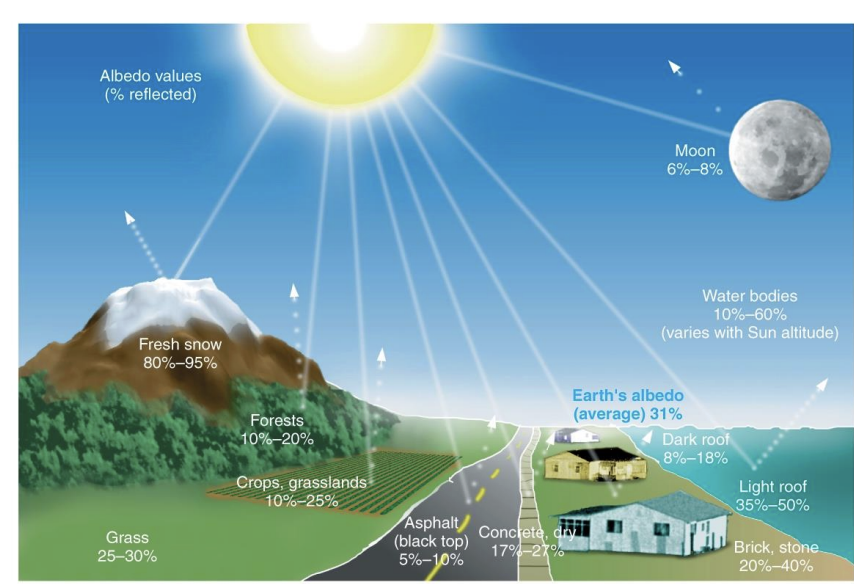
What is albedo?

  • Albedo: how much sunlight is reflected back to the atmosphere/space 


<ul><li><p><span style="background-color: inherit; line-height: 19.55px; color: windowtext;">Albedo: how much sunlight is reflected back to the atmosphere/space</span><span style="line-height: 19.55px; color: windowtext;">&nbsp;</span></p></li></ul><p></p>
41
New cards

What is reflection?

  • sunlight is being reflected directly from surface without changing wavelength 


42
New cards

What is remission?

  • solar radiation is already absorbed by an object -> temp change by the object -> the object remits LW back to space 

    • Wavelength of insolation has already changed 


43
New cards

What is the equation for albedo?

  • Kup: radiation reflected back to atmos 

  • Kdown: solar radiation from the sun 

  • K = shortwave radiation 


<ul><li><p><span style="background-color: inherit; line-height: 19.55px; color: windowtext;">Kup: radiation reflected back to atmos</span><span style="line-height: 19.55px; color: windowtext;">&nbsp;</span></p></li><li><p class="Paragraph SCXO76072003 BCX0" style="text-align: left;"><span style="background-color: inherit; line-height: 19.55px; color: windowtext;">Kdown: solar radiation from the sun</span><span style="line-height: 19.55px; color: windowtext;">&nbsp;</span></p></li><li><p class="Paragraph SCXO76072003 BCX0" style="text-align: left;"><span style="background-color: inherit; line-height: 19.55px; color: windowtext;">K = shortwave radiation</span><span style="line-height: 19.55px; color: windowtext;">&nbsp;</span></p></li></ul><p></p>
44
New cards

What affects albedo?

  • color of surface

  • How the sun strikes the surface (angle)

  • Roughness of surface


<ul><li><p>color of surface</p></li><li><p>How the sun strikes the surface (angle)</p></li><li><p>Roughness of surface</p></li></ul><p></p>
45
New cards

How does color impact albedo?

  • Fresh snow: 8—95% of insolation is reflected back to space 

    • High 

    • Light colored 

  • Asphalt: 5-10% -> absorb most of the sunlight 

    • Darker 

    • Less albedo 


<ul><li><p><span style="background-color: inherit; line-height: 19.55px; color: windowtext;">Fresh snow: 8—95% of insolation is reflected back to space</span><span style="line-height: 19.55px; color: windowtext;">&nbsp;</span></p><ul><li><p class="Paragraph SCXO111892545 BCX0" style="text-align: left;"><span style="background-color: inherit; line-height: 19.55px; color: windowtext;">High</span><span style="line-height: 19.55px; color: windowtext;">&nbsp;</span></p></li><li><p class="Paragraph SCXO111892545 BCX0" style="text-align: left;"><span style="background-color: inherit; line-height: 19.55px; color: windowtext;">Light colored</span><span style="line-height: 19.55px; color: windowtext;">&nbsp;</span></p></li></ul></li><li><p class="Paragraph SCXO111892545 BCX0" style="text-align: left;"><span style="background-color: inherit; line-height: 19.55px; color: windowtext;">Asphalt: 5-10% -&gt; absorb most of the sunlight</span><span style="line-height: 19.55px; color: windowtext;">&nbsp;</span></p><ul><li><p class="Paragraph SCXO111892545 BCX0" style="text-align: left;"><span style="background-color: inherit; line-height: 19.55px; color: windowtext;">Darker</span><span style="line-height: 19.55px; color: windowtext;">&nbsp;</span></p></li><li><p class="Paragraph SCXO111892545 BCX0" style="text-align: left;"><span style="background-color: inherit; line-height: 19.55px; color: windowtext;">Less albedo</span><span style="line-height: 19.55px; color: windowtext;">&nbsp;</span></p></li></ul></li></ul><p></p>
46
New cards

How does the angle impact albedo?

  • Hit equator -> steeper angle  

    • Stone will sink 

    • Absorb more energy -> Less albedo 

  • Polar area -> weaker angle (smaller angle) 

    • More reflected -> More albedo 

    • Ex: skipping rocks 


<ul><li><p><span style="background-color: inherit; line-height: 19.55px; color: windowtext;">Hit equator -&gt; steeper angle&nbsp;</span><span style="line-height: 19.55px; color: windowtext;">&nbsp;</span></p><ul><li><p class="Paragraph SCXO48533456 BCX0" style="text-align: left;"><span style="background-color: inherit; line-height: 19.55px; color: windowtext;">Stone will sink</span><span style="line-height: 19.55px; color: windowtext;">&nbsp;</span></p></li><li><p class="Paragraph SCXO48533456 BCX0" style="text-align: left;"><span style="background-color: inherit; line-height: 19.55px; color: windowtext;">Absorb more energy -&gt; Less albedo</span><span style="line-height: 19.55px; color: windowtext;">&nbsp;</span></p></li></ul></li><li><p class="Paragraph SCXO48533456 BCX0" style="text-align: left;"><span style="background-color: inherit; line-height: 19.55px; color: windowtext;">Polar area -&gt; weaker angle (smaller angle)</span><span style="line-height: 19.55px; color: windowtext;">&nbsp;</span></p><ul><li><p class="Paragraph SCXO48533456 BCX0" style="text-align: left;"><span style="background-color: inherit; line-height: 19.55px; color: windowtext;">More reflected -&gt; More albedo</span><span style="line-height: 19.55px; color: windowtext;">&nbsp;</span></p></li><li><p class="Paragraph SCXO48533456 BCX0" style="text-align: left;"><span style="background-color: inherit; line-height: 19.55px; color: windowtext;">Ex: skipping rocks</span><span style="line-height: 19.55px; color: windowtext;">&nbsp;</span></p></li></ul></li></ul><p></p>
47
New cards

How does the roughness of the surface impact albedo?

  • Snow/icy -> very smooth -> all light reflected to one direction  

    • Predictable  

    • Albedo higher 

  • Rough snow (grass) 

    • Incoming sunlight reflected to diff direction -> reduce how much sunlight reflected to atmos -> smaller albedo  

<ul><li><p><span style="background-color: inherit; line-height: 19.55px; color: windowtext;">Snow/icy -&gt; very smooth -&gt; all light reflected to one direction&nbsp;</span><span style="line-height: 19.55px; color: windowtext;">&nbsp;</span></p><ul><li><p class="Paragraph SCXO15753868 BCX0" style="text-align: left;"><span style="background-color: inherit; line-height: 19.55px; color: windowtext;">Predictable&nbsp;</span><span style="line-height: 19.55px; color: windowtext;">&nbsp;</span></p></li><li><p class="Paragraph SCXO15753868 BCX0" style="text-align: left;"><span style="background-color: inherit; line-height: 19.55px; color: windowtext;">Albedo higher</span><span style="line-height: 19.55px; color: windowtext;">&nbsp;</span></p></li></ul></li><li><p class="Paragraph SCXO15753868 BCX0" style="text-align: left;"><span style="background-color: inherit; line-height: 19.55px; color: windowtext;">Rough snow (grass)</span><span style="line-height: 19.55px; color: windowtext;">&nbsp;</span></p><ul><li><p class="Paragraph SCXO15753868 BCX0" style="text-align: left;"><span style="background-color: inherit; line-height: 19.55px; color: windowtext;">Incoming sunlight reflected to diff direction -&gt; reduce how much sunlight reflected to atmos -&gt; smaller albedo&nbsp;</span><span style="line-height: 19.55px; color: windowtext;">&nbsp;</span></p></li></ul></li></ul><p></p>
48
New cards

What is albedo’s short wave radiation?

  • Albedo is shortwave radiation ONLY

  • Albedo: Outgoing wavelength same as incoming wavelength

  • Not albedo: Outgoing wavelength different from incoming wavelength

    • ex: the outgoing longwave radiation that is emitted (not reflected) from a surface is not part of albedo


<ul><li><p>Albedo is shortwave radiation ONLY</p></li><li><p>Albedo: Outgoing wavelength same as incoming wavelength</p></li><li><p>Not albedo: Outgoing wavelength different from incoming wavelength</p><ul><li><p>ex: the outgoing longwave radiation that is emitted (not reflected) from a surface is not part of albedo</p></li></ul></li></ul><p></p>
49
New cards
<p>How to measure albedo? </p>

How to measure albedo?


<p></p>
50
New cards

What device measures albedo?

  • Albedo meter 

    • Both sensors are connected to own reading  

    • Upward 

      • Receive downward radiation 

    • Downward 

      • Receive upward radiation from ground 

      • Smaller than upward 

        • Albedo has to Be less or equal to 1 

        • Less than incoming radiation 


<ul><li><p><span style="background-color: inherit; line-height: 19.55px; color: windowtext;">Albedo meter</span><span style="line-height: 19.55px; color: windowtext;">&nbsp;</span></p><ul><li><p class="Paragraph SCXO127181718 BCX0" style="text-align: left;"><span style="background-color: inherit; line-height: 19.55px; color: windowtext;">Both sensors are connected to own reading&nbsp;</span><span style="line-height: 19.55px; color: windowtext;">&nbsp;</span></p></li><li><p class="Paragraph SCXO127181718 BCX0" style="text-align: left;"><span style="background-color: inherit; line-height: 19.55px; color: windowtext;">Upward</span><span style="line-height: 19.55px; color: windowtext;">&nbsp;</span></p><ul><li><p class="Paragraph SCXO127181718 BCX0" style="text-align: left;"><span style="background-color: inherit; line-height: 19.55px; color: windowtext;">Receive downward radiation</span><span style="line-height: 19.55px; color: windowtext;">&nbsp;</span></p></li></ul></li><li><p class="Paragraph SCXO127181718 BCX0" style="text-align: left;"><span style="background-color: inherit; line-height: 19.55px; color: windowtext;">Downward</span><span style="line-height: 19.55px; color: windowtext;">&nbsp;</span></p><ul><li><p class="Paragraph SCXO127181718 BCX0" style="text-align: left;"><span style="background-color: inherit; line-height: 19.55px; color: windowtext;">Receive upward radiation from ground</span><span style="line-height: 19.55px; color: windowtext;">&nbsp;</span></p></li><li><p class="Paragraph SCXO127181718 BCX0" style="text-align: left;"><span style="background-color: inherit; line-height: 19.55px; color: windowtext;">Smaller than upward</span><span style="line-height: 19.55px; color: windowtext;">&nbsp;</span></p><ul><li><p class="Paragraph SCXO127181718 BCX0" style="text-align: left;"><span style="background-color: inherit; line-height: 19.55px; color: windowtext;">Albedo has to Be less or equal to 1</span><span style="line-height: 19.55px; color: windowtext;">&nbsp;</span></p></li><li><p class="Paragraph SCXO127181718 BCX0" style="text-align: left;"><span style="background-color: inherit; line-height: 19.55px; color: windowtext;">Less than incoming radiation</span><span style="line-height: 19.55px; color: windowtext;">&nbsp;</span></p></li></ul></li></ul></li></ul></li></ul><p></p>
51
New cards

What is the radiation balance (Q*) equations?

  • How much energy is available for hydrological processes 

    • SW and LW –> no other processes 

  • Balance = net coming in and net going out 

    • Short wave coming in and out 

    • Long also coming and out 


<ul><li><p><span style="background-color: inherit; line-height: 19.55px; color: windowtext;">How much energy is available for hydrological processes</span><span style="line-height: 19.55px; color: windowtext;">&nbsp;</span></p><ul><li><p class="Paragraph SCXO219208881 BCX0" style="text-align: left;"><span style="background-color: inherit; line-height: 19.55px; color: windowtext;">SW and LW –&gt; no other processes</span><span style="line-height: 19.55px; color: windowtext;">&nbsp;</span></p></li></ul></li><li><p class="Paragraph SCXO219208881 BCX0" style="text-align: left;"><span style="background-color: inherit; line-height: 19.55px; color: windowtext;">Balance = net coming in and net going out</span><span style="line-height: 19.55px; color: windowtext;">&nbsp;</span></p><ul><li><p class="Paragraph SCXO219208881 BCX0" style="text-align: left;"><span style="background-color: inherit; line-height: 19.55px; color: windowtext;">Short wave coming in and out</span><span style="line-height: 19.55px; color: windowtext;">&nbsp;</span></p></li><li><p class="Paragraph SCXO219208881 BCX0" style="text-align: left;"><span style="background-color: inherit; line-height: 19.55px; color: windowtext;">Long also coming and out</span><span style="line-height: 19.55px; color: windowtext;">&nbsp;</span></p></li></ul></li></ul><p></p>
52
New cards

What is K*?

  • Net short wave

  • incoming – how much reflect out to space via albedo 


53
New cards

What is L*?

  • Net long wave (L*) 

    • Coming out (temp of earth, stefen bolz equation, Emison of longwave radiation from cool earth) 

    • Coming in – coming out 

    • Coming in 

      • Only source is function of GHG 

      • Radiation being absorbed from GHG and then remitted back towards surface of Earth 

    • Emission coming back towards earth – emission going out 


<ul><li><p><span style="background-color: inherit; line-height: 19.55px; color: windowtext;">Net long wave (L*)</span><span style="line-height: 19.55px; color: windowtext;">&nbsp;</span></p><ul><li><p class="Paragraph SCXO27610919 BCX0" style="text-align: left;"><span style="background-color: inherit; line-height: 19.55px; color: windowtext;">Coming out (temp of earth, stefen bolz equation, Emison of longwave radiation from cool earth)</span><span style="line-height: 19.55px; color: windowtext;">&nbsp;</span></p></li><li><p class="Paragraph SCXO27610919 BCX0" style="text-align: left;"><span style="background-color: inherit; line-height: 19.55px; color: windowtext;">Coming in – coming out</span><span style="line-height: 19.55px; color: windowtext;">&nbsp;</span></p></li><li><p class="Paragraph SCXO27610919 BCX0" style="text-align: left;"><span style="background-color: inherit; line-height: 19.55px; color: windowtext;">Coming in</span><span style="line-height: 19.55px; color: windowtext;">&nbsp;</span></p><ul><li><p class="Paragraph SCXO27610919 BCX0" style="text-align: left;"><span style="background-color: inherit; line-height: 19.55px; color: windowtext;">Only source is function of GHG</span><span style="line-height: 19.55px; color: windowtext;">&nbsp;</span></p></li><li><p class="Paragraph SCXO27610919 BCX0" style="text-align: left;"><span style="background-color: inherit; line-height: 19.55px; color: windowtext;">Radiation being absorbed from GHG and then remitted back towards surface of Earth</span><span style="line-height: 19.55px; color: windowtext;">&nbsp;</span></p></li></ul></li><li><p class="Paragraph SCXO27610919 BCX0" style="text-align: left;"><span style="background-color: inherit; line-height: 19.55px; color: windowtext;">Emission coming back towards earth – emission going out</span><span style="line-height: 19.55px; color: windowtext;">&nbsp;</span></p></li></ul></li></ul><p></p>
54
New cards

What does K equal?

  • K = aK 

    • Outgoing short wave = albedo(incoming short wave) 


55
New cards

What is net radiation (Q*)?

  • Net short wave + net long wave = net radiation (Q*) 

    • Wats per meter squared  

    • Q= (Kdown – Kup) + (Ldown – L up) 

      • If Q is negative -> losing energy from Earth 

        • Usually at night because of no solar input -> no ouptut 

          • Only LW from Earth and gases 

          • K= 0 at night - (Greater Lup than Ldown) -> negative 


<ul><li><p><span style="background-color: inherit; line-height: 19.55px; color: windowtext;">Net short wave + net long wave = net radiation (Q*)</span><span style="line-height: 19.55px; color: windowtext;">&nbsp;</span></p><ul><li><p class="Paragraph SCXO184659855 BCX0" style="text-align: left;"><span style="background-color: inherit; line-height: 19.55px; color: windowtext;">Wats per meter squared&nbsp;</span><span style="line-height: 19.55px; color: windowtext;">&nbsp;</span></p></li><li><p class="Paragraph SCXO184659855 BCX0" style="text-align: left;"><span style="background-color: inherit; line-height: 19.55px; color: windowtext;">Q= (Kdown – Kup) + (Ldown – L up)</span><span style="line-height: 19.55px; color: windowtext;">&nbsp;</span></p><ul><li><p class="Paragraph SCXO184659855 BCX0" style="text-align: left;"><span style="background-color: inherit; line-height: 19.55px; color: windowtext;">If Q is negative -&gt; losing energy from Earth</span><span style="line-height: 19.55px; color: windowtext;">&nbsp;</span></p><ul><li><p class="Paragraph SCXO184659855 BCX0" style="text-align: left;"><span style="background-color: inherit; line-height: 19.55px; color: windowtext;">Usually at night because of no solar input -&gt; no ouptut</span><span style="line-height: 19.55px; color: windowtext;">&nbsp;</span></p><ul><li><p class="Paragraph SCXO184659855 BCX0" style="text-align: left;"><span style="background-color: inherit; line-height: 19.55px; color: windowtext;">Only LW from Earth and gases</span><span style="line-height: 19.55px; color: windowtext;">&nbsp;</span></p></li><li><p class="Paragraph SCXO184659855 BCX0" style="text-align: left;"><span style="background-color: inherit; line-height: 19.55px; color: windowtext;">K= 0 at night - (Greater Lup than Ldown) -&gt; negative</span><span style="line-height: 19.55px; color: windowtext;">&nbsp;</span></p></li></ul></li></ul></li></ul></li></ul></li></ul><p></p>
56
New cards

What is Q* when Kdown= 200 W m^2, K up = 50 W m^2 , Ldown = 50, and Lup =70?

  • Kdown= 200 W m^2 

  • K up = 50 W m^2 

  • 200 – 50 = 150 W m^2 of solar radiation input at certain time of day 


  • Ldown (from GHG to surface) = 50 

  • Lup (Earth to atmos) = 70 

  • Q* = 150 + -20 = 130 

    • During point at the day -> net energy balance of 130 W m^2 -> earth is gaining energy  

      • Energy can be used to evaporate water, make you feel warmer 


<ul><li><p><span style="background-color: inherit; line-height: 19.55px; color: windowtext;">Kdown= 200 W m^2</span><span style="line-height: 19.55px; color: windowtext;">&nbsp;</span></p></li><li><p class="Paragraph SCXO209923982 BCX0" style="text-align: left;"><span style="background-color: inherit; line-height: 19.55px; color: windowtext;">K up = 50 W m^2</span><span style="line-height: 19.55px; color: windowtext;">&nbsp;</span></p></li><li><p class="Paragraph SCXO209923982 BCX0" style="text-align: left;"><span style="background-color: inherit; line-height: 19.55px; color: windowtext;">200 – 50 = 150 W m^2 of solar radiation input at certain time of day</span><span style="line-height: 19.55px; color: windowtext;">&nbsp;</span></p></li></ul><p class="Paragraph SCXO209923982 BCX0" style="text-align: left;"><span style="line-height: 19.55px; color: windowtext;">&nbsp;</span></p><ul><li><p class="Paragraph SCXO209923982 BCX0" style="text-align: left;"><span style="background-color: inherit; line-height: 19.55px; color: windowtext;">Ldown (from GHG to surface) = 50</span><span style="line-height: 19.55px; color: windowtext;">&nbsp;</span></p></li><li><p class="Paragraph SCXO209923982 BCX0" style="text-align: left;"><span style="background-color: inherit; line-height: 19.55px; color: windowtext;">Lup (Earth to atmos) = 70</span><span style="line-height: 19.55px; color: windowtext;">&nbsp;</span></p></li><li><p class="Paragraph SCXO209923982 BCX0" style="text-align: left;"><span style="background-color: inherit; line-height: 19.55px; color: windowtext;">Q* = 150 + -20 = 130</span><span style="line-height: 19.55px; color: windowtext;">&nbsp;</span></p><ul><li><p class="Paragraph SCXO209923982 BCX0" style="text-align: left;"><span style="background-color: inherit; line-height: 19.55px; color: windowtext;">During point at the day -&gt; net energy balance of 130 W m^2 -&gt; earth is gaining energy&nbsp;</span><span style="line-height: 19.55px; color: windowtext;">&nbsp;</span></p><ul><li><p class="Paragraph SCXO209923982 BCX0" style="text-align: left;"><span style="background-color: inherit; line-height: 19.55px; color: windowtext;">Energy can be used to evaporate water, make you feel warmer</span><span style="line-height: 19.55px; color: windowtext;">&nbsp;</span></p></li></ul></li></ul></li></ul><p></p>
57
New cards

How does incoming short waves look throughout 24hrs?

  • Short wave peak at noon -> no short wave received at surface in at night (0 watts per m squared) (yellow) 

    • Insolation (also including those reflected by to space) 

    • Kdown (SWdown)= insolation 

    • Peaks at noon and decrease until evening 

    • No solar radiation at night  


<ul><li><p><span style="background-color: inherit; line-height: 19.55px; color: windowtext;">Short wave peak at noon -&gt; no short wave received at surface in at night (0 watts per m squared) (yellow)</span><span style="line-height: 19.55px; color: windowtext;">&nbsp;</span></p><ul><li><p class="Paragraph SCXO176244557 BCX0" style="text-align: left;"><span style="background-color: inherit; line-height: 19.55px; color: windowtext;">Insolation (also including those reflected by to space)</span><span style="line-height: 19.55px; color: windowtext;">&nbsp;</span></p></li><li><p class="Paragraph SCXO176244557 BCX0" style="text-align: left;"><span style="background-color: inherit; line-height: 19.55px; color: windowtext;">Kdown (SWdown)= insolation</span><span style="line-height: 19.55px; color: windowtext;">&nbsp;</span></p></li><li><p class="Paragraph SCXO176244557 BCX0" style="text-align: left;"><span style="background-color: inherit; line-height: 19.55px; color: windowtext;">Peaks at noon and decrease until evening</span><span style="line-height: 19.55px; color: windowtext;">&nbsp;</span></p></li><li><p class="Paragraph SCXO176244557 BCX0" style="text-align: left;"><span style="background-color: inherit; line-height: 19.55px; color: windowtext;">No solar radiation at night&nbsp;</span><span style="line-height: 19.55px; color: windowtext;">&nbsp;</span></p></li></ul></li></ul><p></p>
58
New cards

How does outgoing short waves look throughout 24hrs?

  • Shortwave coming out is smaller proportion of SW (red) (Kup) 

    • Also zero at night 

    • Function of albedo  

    • Relatively predictable in relation to SW coming in  

    • Shortwave reflected by surface back to atmos/space 

    • No input -> no reflection (only in day time) 

      • Negative =  direction 

        • Losing energy from earth and going into atmos 

        • As it gets deeper -> energy that Earth is losing increases 


<ul><li><p><span style="background-color: inherit; line-height: 19.55px; color: windowtext;">Shortwave coming out is smaller proportion of SW (red) (Kup)</span><span style="line-height: 19.55px; color: windowtext;">&nbsp;</span></p><ul><li><p class="Paragraph SCXO160289017 BCX0" style="text-align: left;"><span style="background-color: inherit; line-height: 19.55px; color: windowtext;">Also zero at night</span><span style="line-height: 19.55px; color: windowtext;">&nbsp;</span></p></li><li><p class="Paragraph SCXO160289017 BCX0" style="text-align: left;"><span style="background-color: inherit; line-height: 19.55px; color: windowtext;">Function of albedo&nbsp;</span><span style="line-height: 19.55px; color: windowtext;">&nbsp;</span></p></li><li><p class="Paragraph SCXO160289017 BCX0" style="text-align: left;"><span style="background-color: inherit; line-height: 19.55px; color: windowtext;">Relatively predictable in relation to SW coming in&nbsp;</span><span style="line-height: 19.55px; color: windowtext;">&nbsp;</span></p></li><li><p class="Paragraph SCXO160289017 BCX0" style="text-align: left;"><span style="background-color: inherit; line-height: 19.55px; color: windowtext;">Shortwave reflected by surface back to atmos/space</span><span style="line-height: 19.55px; color: windowtext;">&nbsp;</span></p></li><li><p class="Paragraph SCXO160289017 BCX0" style="text-align: left;"><span style="background-color: inherit; line-height: 19.55px; color: windowtext;">No input -&gt; no reflection (only in day time)</span><span style="line-height: 19.55px; color: windowtext;">&nbsp;</span></p><ul><li><p class="Paragraph SCXO160289017 BCX0" style="text-align: left;"><span style="background-color: inherit; line-height: 19.55px; color: windowtext;">Negative =&nbsp; direction</span><span style="line-height: 19.55px; color: windowtext;">&nbsp;</span></p><ul><li><p class="Paragraph SCXO160289017 BCX0" style="text-align: left;"><span style="background-color: inherit; line-height: 19.55px; color: windowtext;">Losing energy from earth and going into atmos</span><span style="line-height: 19.55px; color: windowtext;">&nbsp;</span></p></li><li><p class="Paragraph SCXO160289017 BCX0" style="text-align: left;"><span style="background-color: inherit; line-height: 19.55px; color: windowtext;">As it gets deeper -&gt; energy that Earth is losing increases</span><span style="line-height: 19.55px; color: windowtext;">&nbsp;</span></p></li></ul></li></ul></li></ul></li></ul><p></p>
59
New cards

How does outgoing long waves look throughout 24hrs?

  • Long wave coming out (green) leaving Earth (green) 

    • Negative denotes direction that LW is coming form surface of Earth back towards space 

    • Less LW emitted at night because temp are lower with no incoming solar radiation  

    • min at afternoon when things get warmers 

    • At night -> amnt of outgoing LW goes down 

    • Noon: hotter -> surface heated up by sun -> more insolation -> more energy output from earth 

    • As K decrease -> LW are decreases 


<ul><li><p><span style="background-color: inherit; line-height: 19.55px; color: windowtext;">Long wave coming out (green) leaving Earth (green)</span><span style="line-height: 19.55px; color: windowtext;">&nbsp;</span></p><ul><li><p class="Paragraph SCXO262448018 BCX0" style="text-align: left;"><span style="background-color: inherit; line-height: 19.55px; color: windowtext;">Negative denotes direction that LW is coming form surface of Earth back towards space</span><span style="line-height: 19.55px; color: windowtext;">&nbsp;</span></p></li><li><p class="Paragraph SCXO262448018 BCX0" style="text-align: left;"><span style="background-color: inherit; line-height: 19.55px; color: windowtext;">Less LW emitted at night because temp are lower with no incoming solar radiation&nbsp;</span><span style="line-height: 19.55px; color: windowtext;">&nbsp;</span></p></li><li><p class="Paragraph SCXO262448018 BCX0" style="text-align: left;"><span style="background-color: inherit; line-height: 19.55px; color: windowtext;">min at afternoon when things get warmers</span><span style="line-height: 19.55px; color: windowtext;">&nbsp;</span></p></li><li><p class="Paragraph SCXO262448018 BCX0" style="text-align: left;"><span style="background-color: inherit; line-height: 19.55px; color: windowtext;">At night -&gt; amnt of outgoing LW goes down</span><span style="line-height: 19.55px; color: windowtext;">&nbsp;</span></p></li><li><p class="Paragraph SCXO262448018 BCX0" style="text-align: left;"><span style="background-color: inherit; line-height: 19.55px; color: windowtext;">Noon: hotter -&gt; surface heated up by sun -&gt; more insolation -&gt; more energy output from earth</span><span style="line-height: 19.55px; color: windowtext;">&nbsp;</span></p></li><li><p class="Paragraph SCXO262448018 BCX0" style="text-align: left;"><span style="background-color: inherit; line-height: 19.55px; color: windowtext;">As K decrease -&gt; LW are decreases</span><span style="line-height: 19.55px; color: windowtext;">&nbsp;</span></p></li></ul></li></ul><p></p>
60
New cards

How does incoming long waves look throughout 24hrs?

  • Incoming LW (blue)  

    • Stable at day 

    • bump at early night because of accumulation of energy as sun is getting ready to set/after it sets (increasing water vapour at sunset) 

    • Energy going back down to ground emitted by GHG 


<ul><li><p><span style="background-color: inherit; line-height: 19.55px; color: windowtext;">Incoming LW (blue)&nbsp;</span><span style="line-height: 19.55px; color: windowtext;">&nbsp;</span></p><ul><li><p class="Paragraph SCXO197491095 BCX0" style="text-align: left;"><span style="background-color: inherit; line-height: 19.55px; color: windowtext;">Stable at day</span><span style="line-height: 19.55px; color: windowtext;">&nbsp;</span></p></li><li><p class="Paragraph SCXO197491095 BCX0" style="text-align: left;"><span style="background-color: inherit; line-height: 19.55px; color: windowtext;">bump at early night because of accumulation of energy as sun is getting ready to set/after it sets (increasing water vapour at sunset)</span><span style="line-height: 19.55px; color: windowtext;">&nbsp;</span></p></li><li><p class="Paragraph SCXO197491095 BCX0" style="text-align: left;"><span style="background-color: inherit; line-height: 19.55px; color: windowtext;">Energy going back down to ground emitted by GHG</span><span style="line-height: 19.55px; color: windowtext;">&nbsp;</span></p></li></ul></li></ul><p></p>
61
New cards

How does net radiation look throughout 24hrs?

  • Net radiation (orange) = Q*

    • Follows incoming SW 

      • Short income radiation, insolation, incoming Sw all the same?? 

    • Rate becomes negative (loosing overall net radiation) at night 

      • Loss of LW radiation more than incoming LW at night 

    • Day time increases and peaks at noon  

    • During night: No insolation, but has some LW output  

      • LW output from Earth is greater than the LW down emitted from GHG 

        • Lose some energy during night time until sunrise 

      • With accelerated Greenhouse effect 

        • More GHG -> More LW remmited back to surface -> origin line can be higher than zero -> energy is not losing any energy -> its trapping more energy on surface -> temp inc more  


<ul><li><p><span style="background-color: inherit; line-height: 19.55px; color: windowtext;">Net radiation (orange)</span><span style="line-height: 19.55px; color: windowtext;">&nbsp;= Q*</span></p><ul><li><p class="Paragraph SCXO3679978 BCX0" style="text-align: left;"><span style="background-color: inherit; line-height: 19.55px; color: windowtext;">Follows incoming SW</span><span style="line-height: 19.55px; color: windowtext;">&nbsp;</span></p><ul><li><p class="Paragraph SCXO3679978 BCX0" style="text-align: left;"><span style="background-color: inherit; line-height: 19.55px; color: windowtext;">Short income radiation, insolation, incoming Sw all the same??</span><span style="line-height: 19.55px; color: windowtext;">&nbsp;</span></p></li></ul></li><li><p class="Paragraph SCXO3679978 BCX0" style="text-align: left;"><span style="background-color: inherit; line-height: 19.55px; color: windowtext;">Rate becomes negative (loosing overall net radiation) at night</span><span style="line-height: 19.55px; color: windowtext;">&nbsp;</span></p><ul><li><p class="Paragraph SCXO3679978 BCX0" style="text-align: left;"><span style="background-color: inherit; line-height: 19.55px; color: windowtext;">Loss of LW radiation more than incoming LW at night</span><span style="line-height: 19.55px; color: windowtext;">&nbsp;</span></p></li></ul></li><li><p class="Paragraph SCXO3679978 BCX0" style="text-align: left;"><span style="background-color: inherit; line-height: 19.55px; color: windowtext;">Day time increases and peaks at noon&nbsp;</span><span style="line-height: 19.55px; color: windowtext;">&nbsp;</span></p></li><li><p class="Paragraph SCXO3679978 BCX0" style="text-align: left;"><span style="background-color: inherit; line-height: 19.55px; color: windowtext;">During night: No insolation, but has some LW output&nbsp;</span><span style="line-height: 19.55px; color: windowtext;">&nbsp;</span></p><ul><li><p class="Paragraph SCXO3679978 BCX0" style="text-align: left;"><span style="background-color: inherit; line-height: 19.55px; color: windowtext;">LW output from Earth is greater than the LW down emitted from GHG</span><span style="line-height: 19.55px; color: windowtext;">&nbsp;</span></p><ul><li><p class="Paragraph SCXO3679978 BCX0" style="text-align: left;"><span style="background-color: inherit; line-height: 19.55px; color: windowtext;">Lose some energy during night time until sunrise</span><span style="line-height: 19.55px; color: windowtext;">&nbsp;</span></p></li></ul></li><li><p class="Paragraph SCXO3679978 BCX0" style="text-align: left;"><span style="background-color: inherit; line-height: 19.55px; color: windowtext;">With accelerated Greenhouse effect</span><span style="line-height: 19.55px; color: windowtext;">&nbsp;</span></p><ul><li><p class="Paragraph SCXO3679978 BCX0" style="text-align: left;"><span style="background-color: inherit; line-height: 19.55px; color: windowtext;">More GHG -&gt; More LW remmited back to surface -&gt; origin line can be higher than zero -&gt; energy is not losing any energy -&gt; its trapping more energy on surface -&gt; temp inc more&nbsp;</span><span style="line-height: 19.55px; color: windowtext;">&nbsp;</span></p></li></ul></li></ul></li></ul></li></ul><p></p>
62
New cards

How is energy mostly used?

  • Losses at night are not equal to gains at day 

    • Energy is used mostly in sensible and latent energy ??


63
New cards

What can happen to the Q*?

  • Q* is the net amount of energy at the earth’s surface → this energy can be “transferred” or moved by several processes.

    • Q* can be transferred, used, or moved around  

      • Ex: by wind 

  • By:

    • Conduction

    • Convection

    • Advection


64
New cards

What is conduction?

  • molecule-to-molecule transfer of heat diffusing within a substance (i.e., coffee warmth to the outside of a cup) (only solids)

  • Energy moved around in conduction  

  • Movement caused by molecule to molecule of object 

    • Internal vibration causes the vibration in other object  

    • Vibration of molecule -> inc temp of object but actual subject doesn't move 

    • Heat only conduced by vibration of molecules 

  • Ex: wavy hand  

    • Hand doesn't change location, just the movement  

    • This is the  molecule  

  • Ex: coffee 

    • Coffee is liquid, mug is solid 

    • Liquid heat transferred to solid 

      • Liquid didn't change location -> still feel heat on outside of mug 

        • Only molecule change inside of the solid 

        • Liquid did not move outside mug 


65
New cards

What is convection?

  • liquid or gas

  • Convection: transport of heat by the vertical movement of a liquid or gas (i.e., warm air rising)

    • Vertical movement of the actual subject 

    • Heating up water on stove -> heat source from bottom and heat moving conduction into pot -> reaches water -> bottom water heats up and is convected up towards the upper parts of water -> circular motion of convection -> boiling where things are rising and falling 

    • Ex: wavy hand 

      • Hand is moving and changing location  


66
New cards

What is advection?

  • Advection: transport of heat by the movement of a liquid or gas, dominantly horizontal (i.e., winds moving from sea to land)

    • Horizontal movement of the subject 

    • Winds move energy horiz from one place to another 


67
New cards

What energy heat transfers dominate hydro processes?

  • Convention and conduction dominate hydo processes 


68
New cards

How is net radiation expended from a surface?

  • Surplus of energy (net gain of energy) some are radiantly put back in atmosphere are LW 

  • Energy emitted from Earth (one path way lost or GHG and back down, other pathway used for water) 

  • 3 pathways

    • LE (latent heat of evaporation).

      • Latent heat flux

    • H (sensible heat)

      • sensible heat flux

    • Ground energy flux (ground heating or cooling)


69
New cards

What is LE (latent heat of evaporation)?


  • This expenditure DOMINATES on earth in general and DEFINITELY when there is water present.

  • Latent energy flux 

    • Energy stored in water vapor as it evaporates -> dominates on Earth and over water surface 

    • Latent heat of evap 

      • Lots of energy needed 

      • Doesn't change temp  

        • Only used to change the phase of water 

    • Much more than the others 

    • Most complex concept in hydro 


70
New cards

What is sensible heat flux?

  • back and forth transfer between air and surface via convection and conduction within materials.

  • Energy we can feel or sense 

  • Measure with thermo 


71
New cards

What is Ground energy flux (ground heating or cooling)?

  • Energy flowing into and out of ground via conduction

  • Energy flowing into or out of the ground via conduction 

  • Some energy go deeper into the ground -> some energy go back up to surface 


72
New cards

What pathway is Q* mostly used for?

  • Q* is used mostly by latent, sensible -> some will go deeper in the ground (doesn't change water phase, just goes deeper) 

    • Back and forth cycling below the ground 


73
New cards

How do Net Radiation (Q*) and the Expenditure of Net Radiation Relate?

  • Q* = how much energy is available for use 

  • Energy is going to these three processes -> balance used by hydro processes (mostly LE) 


<ul><li><p><span style="background-color: inherit; line-height: 19.55px; color: windowtext;">Q* = how much energy is available for use</span><span style="line-height: 19.55px; color: windowtext;">&nbsp;</span></p></li><li><p class="Paragraph SCXO68255624 BCX0" style="text-align: left;"><span style="background-color: inherit; line-height: 19.55px; color: windowtext;">Energy is going to these three processes -&gt; balance used by hydro processes (mostly LE)</span><span style="line-height: 19.55px; color: windowtext;">&nbsp;</span></p></li></ul><p></p>
74
New cards

What happens during the day?

  • Incoming solar radiation and outgoing (K) going towards the earth 

    • Albedo -> shorter amounts going out as short wave 

  • Long wave coming in and LW going out 


  • Right 

    • Accumulation of energy 

    • Energy is being pushed into ground and being expended towards sensible and latent heat flux to try to evaporate water 


<ul><li><p><span style="background-color: inherit; line-height: 19.55px; color: windowtext;">Incoming solar radiation and outgoing (K) going towards the earth</span><span style="line-height: 19.55px; color: windowtext;">&nbsp;</span></p><ul><li><p class="Paragraph SCXO252009345 BCX0" style="text-align: left;"><span style="background-color: inherit; line-height: 19.55px; color: windowtext;">Albedo -&gt; shorter amounts going out as short wave</span><span style="line-height: 19.55px; color: windowtext;">&nbsp;</span></p></li></ul></li><li><p class="Paragraph SCXO252009345 BCX0" style="text-align: left;"><span style="background-color: inherit; line-height: 19.55px; color: windowtext;">Long wave coming in and LW going out</span><span style="line-height: 19.55px; color: windowtext;">&nbsp;</span></p></li></ul><p class="Paragraph SCXO252009345 BCX0" style="text-align: left;"><span style="line-height: 19.55px; color: windowtext;">&nbsp;</span></p><ul><li><p class="Paragraph SCXO252009345 BCX0" style="text-align: left;"><span style="background-color: inherit; line-height: 19.55px; color: windowtext;">Right</span><span style="line-height: 19.55px; color: windowtext;">&nbsp;</span></p><ul><li><p class="Paragraph SCXO252009345 BCX0" style="text-align: left;"><span style="background-color: inherit; line-height: 19.55px; color: windowtext;">Accumulation of energy</span><span style="line-height: 19.55px; color: windowtext;">&nbsp;</span></p></li><li><p class="Paragraph SCXO252009345 BCX0" style="text-align: left;"><span style="background-color: inherit; line-height: 19.55px; color: windowtext;">Energy is being pushed into ground and being expended towards sensible and latent heat flux to try to evaporate water</span><span style="line-height: 19.55px; color: windowtext;">&nbsp;</span></p></li></ul></li></ul><p></p>
75
New cards

What happens during the night?

  • No incoming SR  

  • Dominated by LW roughly equal to each other 

    • Slightly more coming out than in 

  • Losing some energy 

    • Energy coming out of ground  

    • Tings are cooler -> sensible going down 

    • No longer breaking bonds, forming bonds (ex: dew and condensation) -> reversal of LE 


<ul><li><p><span style="background-color: inherit; line-height: 19.55px; color: windowtext;">No incoming SR&nbsp;</span><span style="line-height: 19.55px; color: windowtext;">&nbsp;</span></p></li><li><p class="Paragraph SCXO152920810 BCX0" style="text-align: left;"><span style="background-color: inherit; line-height: 19.55px; color: windowtext;">Dominated by LW roughly equal to each other</span><span style="line-height: 19.55px; color: windowtext;">&nbsp;</span></p><ul><li><p class="Paragraph SCXO152920810 BCX0" style="text-align: left;"><span style="background-color: inherit; line-height: 19.55px; color: windowtext;">Slightly more coming out than in</span><span style="line-height: 19.55px; color: windowtext;">&nbsp;</span></p></li></ul></li><li><p class="Paragraph SCXO152920810 BCX0" style="text-align: left;"><span style="background-color: inherit; line-height: 19.55px; color: windowtext;">Losing some energy</span><span style="line-height: 19.55px; color: windowtext;">&nbsp;</span></p><ul><li><p class="Paragraph SCXO152920810 BCX0" style="text-align: left;"><span style="background-color: inherit; line-height: 19.55px; color: windowtext;">Energy coming out of ground&nbsp;</span><span style="line-height: 19.55px; color: windowtext;">&nbsp;</span></p></li><li><p class="Paragraph SCXO152920810 BCX0" style="text-align: left;"><span style="background-color: inherit; line-height: 19.55px; color: windowtext;">Tings are cooler -&gt; sensible going down</span><span style="line-height: 19.55px; color: windowtext;">&nbsp;</span></p></li><li><p class="Paragraph SCXO152920810 BCX0" style="text-align: left;"><span style="background-color: inherit; line-height: 19.55px; color: windowtext;">No longer breaking bonds, forming bonds (ex: dew and condensation) -&gt; reversal of LE</span><span style="line-height: 19.55px; color: windowtext;">&nbsp;</span></p></li></ul></li></ul><p></p>
76
New cards

What happens when there is water available at the surface?

  • If there is water available at surface that can be evaporated -> large amnt of energy available will go towards evaporation -> less energy available for sensible -> not feel as warm 

  • In the desert (left) 

    • Almost no energy towards LE -> has to be expended mostly through sensible and some ground 


<ul><li><p><span style="background-color: inherit; line-height: 19.55px; color: windowtext;">If there is water available at surface that can be evaporated -&gt; large amnt of energy available will go towards evaporation -&gt; less energy available for sensible -&gt; not feel as warm</span><span style="line-height: 19.55px; color: windowtext;">&nbsp;</span></p></li><li><p><span style="background-color: inherit; line-height: 19.55px; color: windowtext;">In the desert (left)</span><span style="line-height: 19.55px; color: windowtext;">&nbsp;</span></p><ul><li><p class="Paragraph SCXO39998429 BCX0" style="text-align: left;"><span style="background-color: inherit; line-height: 19.55px; color: windowtext;">Almost no energy towards LE -&gt; has to be expended mostly through sensible and some ground</span><span style="line-height: 19.55px; color: windowtext;">&nbsp;</span></p></li></ul></li></ul><p></p>
77
New cards

What happens when there’s little water available on the surface?

  • Not lots of water available at surface -> no energy given into breaking hydrogen bonds of water  (LE) ->. Most goes towards sensible heat flux -> feel warmer 

  • Right image (more water) 

    • Very high LE -> most is going to LE and little to sensible and some to G 


<ul><li><p><span style="background-color: inherit; line-height: 19.55px; color: windowtext;">Not lots of water available at surface -&gt; no energy given into breaking hydrogen bonds of water&nbsp; (LE) -&gt;. Most goes towards sensible heat flux -&gt; feel warmer</span><span style="line-height: 19.55px; color: windowtext;">&nbsp;</span></p></li><li><p><span style="background-color: inherit; line-height: 19.55px; color: windowtext;">Right image (more water)</span><span style="line-height: 19.55px; color: windowtext;">&nbsp;</span></p><ul><li><p class="Paragraph SCXO5065808 BCX0" style="text-align: left;"><span style="background-color: inherit; line-height: 19.55px; color: windowtext;">Very high LE -&gt; most is going to LE and little to sensible and some to G</span><span style="line-height: 19.55px; color: windowtext;">&nbsp;</span></p></li></ul></li></ul><p></p>
78
New cards

What is different between the desert and the oasis?

  • Both images have the same yellow line -> how energy is used is fundamentally different 

    • Why you feel warmer is desert with same radiation vs oasis with water  


<ul><li><p><span style="background-color: inherit; line-height: 19.55px; color: windowtext;">Both images have the same yellow line -&gt; how energy is used is fundamentally different</span><span style="line-height: 19.55px; color: windowtext;">&nbsp;</span></p><ul><li><p class="Paragraph SCXO38142922 BCX0" style="text-align: left;"><span style="background-color: inherit; line-height: 19.55px; color: windowtext;">Why you feel warmer is desert with same radiation vs oasis with water&nbsp;</span><span style="line-height: 19.55px; color: windowtext;">&nbsp;</span></p></li></ul></li></ul><p></p>
79
New cards

What does sweating do?

  • How sweating makes you feel cooler 

    • Water on surface of skin -> energy hitting you from sun goes into latent energy and  less for sensible heat flux 


80
New cards

What is the Bowen ratio?

  • Energy partitioning between the dominant heat fluxes may be described by the Bowen Ratio

  • Sensible heat flux energy over the latent heat flux 


<ul><li><p>Energy partitioning between the dominant heat fluxes may be described by the Bowen Ratio</p></li><li><p><span style="background-color: inherit; line-height: 19.55px; color: windowtext;">Sensible heat flux energy over the latent heat flux</span><span style="line-height: 19.55px; color: windowtext;">&nbsp;</span></p></li></ul><p></p>
81
New cards

What happens when B>1?

  • B>1 -> more energy is going to making you warm than evaporating water 

    • Sensible > latent -> more energy in air is used to change temp (hotter or colder) 

    • Where less water is available 


82
New cards

What happens when B<1?

  • B<1 more energy going to evap water than making you warm 

    • More latent than sensible  

      • More energy to changing water phase than temp 

    • More water