ENTM Lec 3 Internal Morphology

0.0(0)
Studied by 0 people
call kaiCall Kai
learnLearn
examPractice Test
spaced repetitionSpaced Repetition
heart puzzleMatch
flashcardsFlashcards
GameKnowt Play
Card Sorting

1/26

encourage image

There's no tags or description

Looks like no tags are added yet.

Last updated 4:19 PM on 10/15/26
Name
Mastery
Learn
Test
Matching
Spaced
Call with Kai
Chat

No analytics yet

Send a link to your students to track their progress

27 Terms

1
New cards

what does the digestive system consist of

Mouth, foregut, midgut, malpighian tubules, hindgut, anūs


The diet influences the structure & function

<p>Mouth, foregut, midgut, malpighian tubules, hindgut, anūs</p><p></p><p>The diet influences the structure &amp; function</p>
2
New cards

What does the foregut have

  • Mouth

  • Pharynx

    • suction cup for liquid sucking bugs

    • tube for chewing

    • throat essentially

  • Oesophagus

    • tube connecting the pharynx to the crop

  • Crop

    • Storage area

  • Salivary gland

    • where digestive enzymes come in to play

  • Proventriculus

    • Grinding organ


<ul><li><p>Mouth</p></li><li><p>Pharynx</p><ul><li><p>suction cup for liquid sucking bugs</p></li><li><p>tube for chewing</p></li><li><p>throat essentially</p></li></ul></li><li><p>Oesophagus</p><ul><li><p>tube connecting the pharynx to the crop</p></li></ul></li><li><p>Crop</p><ul><li><p>Storage area</p></li></ul></li><li><p>Salivary gland</p><ul><li><p>where digestive enzymes come in to play</p></li></ul></li><li><p>Proventriculus </p><ul><li><p>Grinding organ</p></li></ul></li></ul><p></p>
3
New cards

what does the midgut have

  • Gastric caecum

    • Projects forward & encircles the gut

  • Ventriculus

    • small intestine

    • responsible for absorption of nutrients

  • Peritrophic membrane

    • protective sleeve & chemical filter that surrounds the ball of food
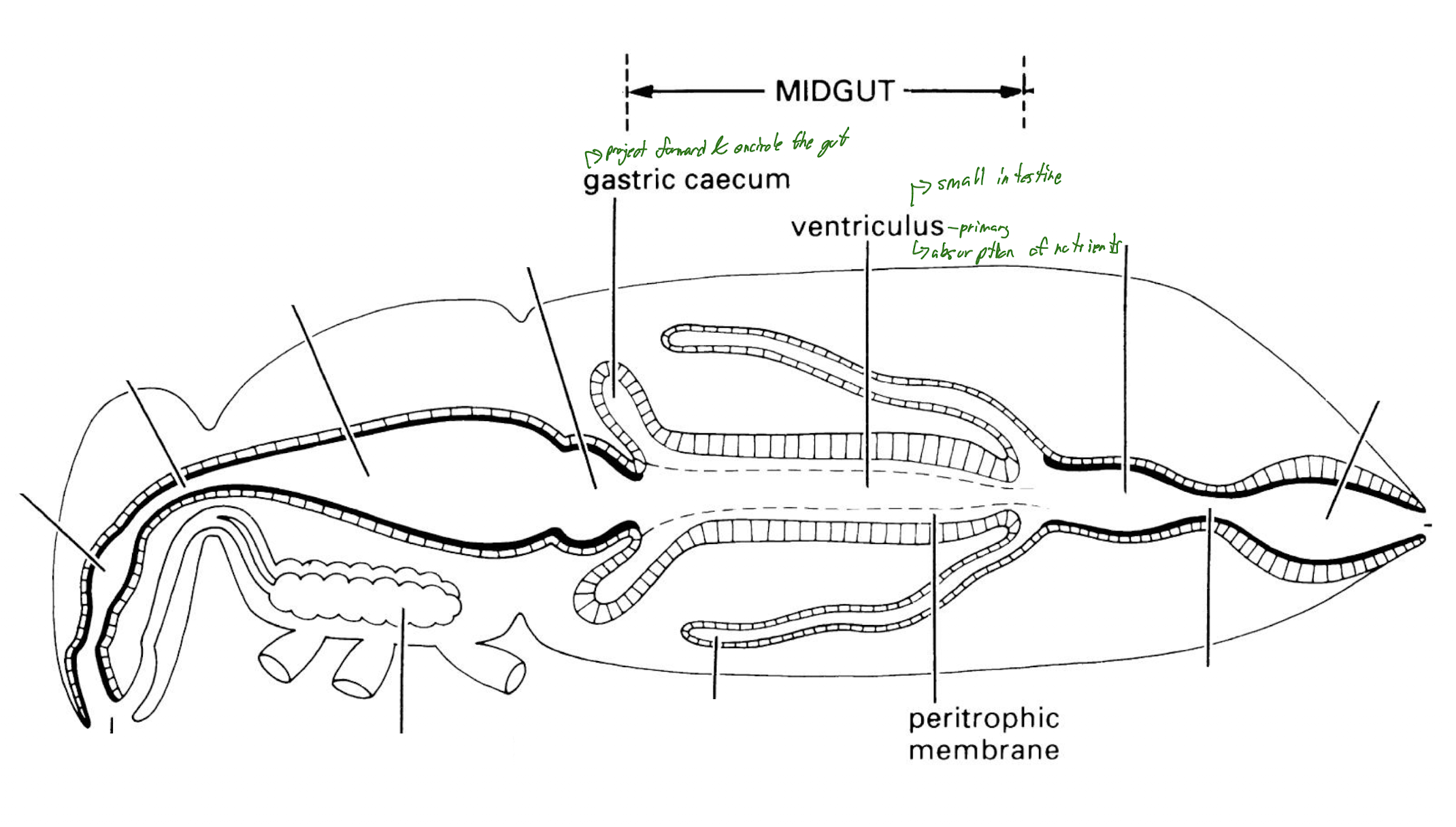

<ul><li><p>Gastric caecum</p><ul><li><p>Projects forward &amp; encircles the gut</p></li></ul></li><li><p>Ventriculus</p><ul><li><p>small intestine</p></li><li><p>responsible for absorption of nutrients</p></li></ul></li><li><p>Peritrophic membrane</p><ul><li><p>protective sleeve &amp; chemical filter that surrounds the ball of food</p></li></ul></li></ul><p></p>
4
New cards

what does the hindgut have

It is the excretory system

  • Ileum

    • The reabsorption of water & salts

  • Rectum

    • The waste holder, absorbs more water

  • Anüs

    • Solid fecal pallet ejection

  • Colon

    • where the fecal accumulates

  • Malpighian tubule

    • Controls movement

    • spaghetti like floating in body

    • fills the body cavity & moves waste to hindgut


5
New cards

What is the repiratory system responsible for

  1. Movement of oxygen to all tissues in the body

  2. Removal of CO2


The respiratory system of insects is separate from the circulatory system

6
New cards

How does the respiratory system work

Through gas exchange through series of air-filled tubes & sacs (tracheal system)

  • Tracheoles

    • where the oxygen is delivered

  • Air sacs

    • Kind of like lungs

    • Oxygen reservoirs

    • Ventilation

  • Tracheae

    • Responsible for delivering oxygen directly to the body’s tissues & removing CO2 waste

  • Spiracles

    • Valved external openings to air filled tubes

    • Can occur on thorax or abdomen


<p>Through gas exchange through series of air-filled tubes &amp; sacs (tracheal system)</p><ul><li><p>Tracheoles</p><ul><li><p>where the oxygen is delivered </p></li></ul></li><li><p>Air sacs</p><ul><li><p>Kind of like lungs</p></li><li><p>Oxygen reservoirs</p></li><li><p>Ventilation</p></li></ul></li><li><p>Tracheae</p><ul><li><p>Responsible for delivering oxygen directly to the body’s tissues &amp; removing CO<sub>2</sub> waste</p></li></ul></li></ul><ul><li><p>Spiracles</p><ul><li><p>Valved external openings to air filled tubes</p></li><li><p>Can occur on thorax or abdomen</p></li></ul></li></ul><p></p>
7
New cards

How does body side affect the respiratory system?

  • Small insects rely on passive diffusion & physical activity

  • Large insects require active ventilation of the tracheal system


8
New cards

What is the circulatory system in an insect

Open system, hemolymph (blood) flows freely within the body & is in direct contact with all internal body tissues & organs

9
New cards

What is the circulatory system responsible for

  • Nutrients, hormone & waste transport

  • Thermoregulation

  • Defense

  • Molting

  • Movement


10
New cards

What is hemolymph

  • insect version of blood

  • it is made of 90% plasma where the remaining is composed of hemocytes

    • Hemocytes is the human equivalent to white blood cells

    • clotting (sealing a wound)

    • phagocytosis (cell eatinf, hunt down bacteria)

    • encapsulation of foreign bodies (parasitic defense)


11
New cards

What is the circulatory system composed of

Dorsal heart(dorsal vessel) + abdominal pumping to aid circulation

<p>Dorsal heart(dorsal vessel) + abdominal pumping to aid circulation</p>
12
New cards

What are the characteristics of the male reproductive system

  • paired testes

    • generating sperm

  • testicular tube

    • where the sperm is matured

  • vas deferens

    • where mature sperm is moved

  • accessory gland

    • keeps sperm healthy & adds protection to give to females

  • seminal vesicle

    • temporary holding tank where sperm is stored

  • ejaculatory duct

    • where the left & right side meet & channels the packed sperm

  • intermittent organ

    • the pp essentially,

  • gonopore

    • the opening of the tip


<ul><li><p>paired testes</p><ul><li><p>generating sperm</p></li></ul></li><li><p>testicular tube</p><ul><li><p>where the sperm is matured</p></li></ul></li><li><p>vas deferens</p><ul><li><p>where mature sperm is moved</p></li></ul></li><li><p>accessory gland</p><ul><li><p>keeps sperm healthy &amp; adds protection to give to females</p></li></ul></li><li><p>seminal vesicle</p><ul><li><p>temporary holding tank where sperm is stored </p></li></ul></li><li><p>ejaculatory duct</p><ul><li><p>where the left &amp; right side meet &amp; channels the packed sperm</p></li></ul></li><li><p>intermittent organ</p><ul><li><p>the pp essentially,</p></li></ul></li><li><p>gonopore</p><ul><li><p>the opening of the tip</p></li></ul></li></ul><p></p>
13
New cards

What are the characteristics of the female reproductive system

  • paired ovaries

    • where eggs are generated

  • ovariole

    • eggs travel down these tubes slowly growing bigger

  • mature oocyte

    • where fully developed unfertilized egg sits, waiting to be released

  • lateral oviduct

    • the pipes that catch eggs

  • common oviduct

    • where the left & right pipes converge

  • spermatheca

    • where male sperm is kept alive waiting for a fertilized egg

  • spermathecal gland

    • pumps nutrient to the spermatheca to keep stored sperm healthy

  • accessory gland

    • coat the eggs with protective coating

  • gonopore

    • the pipe connecting the common oviduct & the genital chamber

  • genital chamber

    • the vagina where mating takes place

  • vulva

    • opening where the eggs are laid


<ul><li><p>paired ovaries</p><ul><li><p>where eggs are generated</p></li></ul></li></ul><ul><li><p>ovariole</p><ul><li><p>eggs travel down these tubes slowly growing bigger</p></li></ul></li><li><p>mature oocyte</p><ul><li><p>where fully developed unfertilized egg sits, waiting to be released</p></li></ul></li><li><p>lateral oviduct</p><ul><li><p>the pipes that catch eggs</p></li></ul></li><li><p>common oviduct</p><ul><li><p>where the left &amp; right pipes converge</p></li></ul></li><li><p>spermatheca</p><ul><li><p>where male sperm is kept alive waiting for a fertilized egg</p></li></ul></li><li><p>spermathecal gland</p><ul><li><p>pumps nutrient to the spermatheca to keep stored sperm healthy</p></li></ul></li><li><p>accessory gland</p><ul><li><p>coat the eggs with protective coating</p></li></ul></li><li><p>gonopore</p><ul><li><p>the pipe connecting the common oviduct &amp; the genital chamber</p></li></ul></li><li><p>genital chamber</p><ul><li><p>the vagina where mating takes place</p></li></ul></li><li><p>vulva</p><ul><li><p>opening where the eggs are laid</p></li></ul></li></ul><p></p>
14
New cards

What is the endocrine system

network of glands & tissues that produce hormones

  • hormones

    • produced in neuronal, neuroglandular,glandular centers & in some organs

    • hormones reach their targert tissue by transport in the hemolymph


15
New cards

What is the endocrine system composed of

  • brain

    • coordinating the nervous & endocrine system

  • neurosecretory cells of brain

    • located inside the brain tissue, this makes major master hormones

  • corpus cariacum

    • storage warehouse for hormones waiting to be pumped into the blood

  • Corpus allatum

    • produce juvenile hormone (youth potion) keeping insect in it’s larval stage when it sheds skin

  • neurosecretory cells of subesophageal ganglion

    • nerve tissue that secrete hormones that regulate diapause (hibernation/arrested development)

  • prothoracic gland

    • pumps out ecdysone (molting hormone), tells body that it’s time to shed it’s own shell & build a new one

  • Neurosecretory Cells of Ventral Nerve Cord

    • insect spinal cord, this ‘highwa'y’ releases hormones to control local muscle movement, water balance, & heartbeat

  • ovary

    • communicates with the reproductive organs to signal when the bug is mature enough to start developing & laying eggs
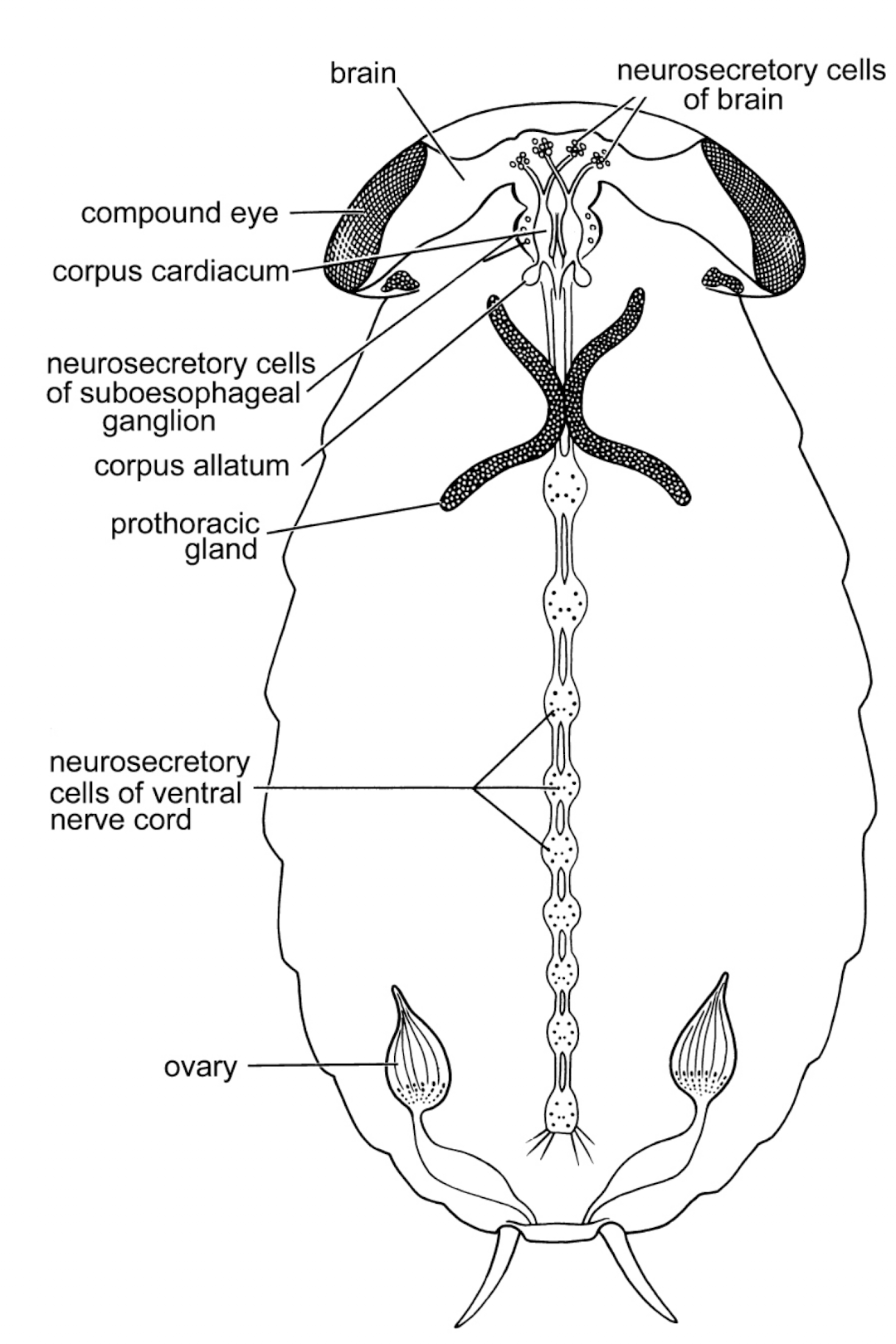

<ul><li><p>brain</p><ul><li><p>coordinating the nervous &amp; endocrine system</p></li></ul></li><li><p>neurosecretory cells of brain</p><ul><li><p>located inside the brain tissue, this makes major master hormones</p></li></ul></li><li><p>corpus cariacum</p><ul><li><p>storage warehouse for hormones waiting to be pumped into the blood</p></li></ul></li><li><p>Corpus allatum</p><ul><li><p>produce juvenile hormone (youth potion) keeping insect in it’s larval stage when it sheds skin</p></li></ul></li><li><p>neurosecretory cells of subesophageal ganglion</p><ul><li><p>nerve tissue that secrete hormones that regulate diapause (hibernation/arrested development)</p></li></ul></li><li><p>prothoracic gland</p><ul><li><p>pumps out ecdysone (molting hormone), tells body that it’s time to shed it’s own shell &amp; build a new one</p></li></ul></li><li><p>Neurosecretory Cells of Ventral Nerve Cord</p><ul><li><p>insect spinal cord, this ‘highwa'y’ releases hormones to control local muscle movement, water balance, &amp; heartbeat</p></li></ul></li><li><p>ovary</p><ul><li><p>communicates with the reproductive organs to signal when the bug is mature enough to start developing &amp; laying eggs</p></li></ul></li></ul><p></p>
16
New cards

What are the hormone types

  • Ecdysteroids

    • steroids with molt-promoting activity, produced by prothoracic glands

  • Juvenile hormones

    • play a diversity of roles in development & physiology, produced by corpora allata

  • Neurohormones

    • regulators of many aspects of development, homeostasis, metabolism, & reproduction, produced by corpora cardiacta & neurosecretary cells


17
New cards

What is the nervous system?

Central nervous system with a dorsal brain linked to a ventral nerve cord

18
New cards
19
New cards
20
New cards
21
New cards
22
New cards
23
New cards
24
New cards
25
New cards
26
New cards
27
New cards



