Audit MCQ Ch. 1/Notes
 Call Kai
 Learn
 Practice Test
 Spaced Repetition
 Match
 Flashcards
 Knowt Play
1/48

There's no tags or description
Looks like no tags are added yet.
49 Terms
During an audit of an entity's stockholders' equity accounts, the auditor determines whether there are restrictions on retained earnings resulting from loans, agreements, or state law. This audit procedure most likely is intended to verify management's assertion of
a. Existence or occurrence.
b. Completeness.
c. Valuation or allocation.
d. Presentation and disclosure.
d. Presentation and disclosure.
Which of the following would be considered an assurance engagement?
a. Giving an opinion on a prize promoter’s claims about the amount of sweepstakes prizes awarded in the past.
b. Giving an opinion on the conformity of the financial statements of a university with generally accepted accounting principles.
c. Giving an opinion on the fair presentation of a newspaper’s circulation data.
d. Giving assurance about the average drive length achieved by golfers with a client’s golf balls.
e. All of the above
e. All of the above
It is always a good idea for auditors to begin an audit with the professional skepticism characterized by the assumption that
a. A potential conflict of interest always exists between the auditor and the management of the enterprise under audit.
b. In audits of financial statements, the auditor acts exclusively in the capacity of an auditor. c. The professional status of the independent auditor imposes commensurate professional obligations.
d. Financial statements and financial data are verifiable.
a. A potential conflict of interest always exists between the auditor and the management of the enterprise under audit.
In an attestation engagement, a CPA practitioner is engaged to a. Compile a company’s financial forecast based on management’s assumptions without expressing any form of assurance.
b. Prepare a written report containing a conclusion about the reliability of a management assertion.
c. Prepare a tax return using information the CPA has not audited or reviewed.
d. Give expert testimony in court on particular facts in a corporate income tax controversy
b. Prepare a written report containing a conclusion about the reliability of a management assertion.
A determination of cost savings obtained by outsourcing cafeteria services is most likely to be an objective of
a. Environmental auditing.
b. Financial auditing.
c. Compliance auditing.
d. Operational auditing.
d. Operational auditing.
The primary difference between operational auditing and financial auditing is that in operational auditing
a. The operational auditor is not concerned with whether the audited activity is generating information in compliance with financial accounting standards.
b. The operational auditor is seeking to help management use resources in the most effective manner possible.
c. The operational auditor starts with the financial statements of an activity being audited and works backward to the basic processes involved in producing them.
d. The operational auditor can use analytical skills and tools that are not necessary in financial auditing.
b. The operational auditor is seeking to help management use resources in the most effective manner possible.
According to the AICPA, the purpose of an audit of financial statements is to
a. Enhance the degree of confidence that intended users can place in the financial statements.
b. Express an opinion on the fairness with which they present financial position, results of operations, and cash flows in conformity with accounting standards promulgated by the Financial Accounting Standards Board.
c. Express an opinion on the fairness with which they present financial position, results of operations, and cash flows in conformity with accounting standards promulgated by the U.S. Securities and Exchange Commission.
d. Obtain systematic and objective evidence about financial assertions and report the results to interested users.
a. Enhance the degree of confidence that intended users can place in the financial statements.
Bankers who are processing loan applications from companies seeking large loans will probably ask for financial statements audited by an independent CPA because
a. Financial statements are too complex for the bankers to analyze themselves.
b. They are too far away from company headquarters to perform accounting and auditing themselves.
c. The consequences of making a bad loan are very undesirable.
d. They generally see a potential conflict of interest between company managers who want to get loans and the bank’s needs for reliable financial statements.
d. They generally see a potential conflict of interest between company managers who want to get loans and the bank’s needs for reliable financial statements.
The Sarbanes–Oxley Act of 2002 prohibits public accounting firms from providing which of the following services to an audit client?
a. Bookkeeping services.
b. Internal auditing services.
c. Valuation services.
d. All of the above.
d. All of the above.
when auditing the accounts receivable account on the balance sheet, an auditor's procedures most likely would focus primarily on management's assertion of
a. Existence.
b. Completeness.
c. Presentation and disclosure.
d. Rights and obligations.
a. Existence.
In auditing the accrued liabilities account on the Balance Sheet, an auditor's procedures most likely would focus primarily on management's assertion of
a. Existence or occurrence.
b. Completeness.
c. Presentation and disclosure.
d. Valuation or allocation
b. Completeness.
Independent auditors of financial statements perform audits that reduce
a. Business risks faced by investors.
b. Information risk faced by investors.
c. Complexity of financial statements.
d. Timeliness of financial statements.
b. Information risk faced by investors.
The primary objective of compliance auditing is to
a. Give an opinion on financial statements.
b. Develop a basis for a report on internal control.
c. Perform a study of effective and efficient use of resources.
d. Determine whether client personnel are following laws, rules, regulations, and policies.
d. Determine whether client personnel are following laws, rules, regulations, and policies.
Which of the following is a reason to obtain professional certification?
a. Certification provides credibility that an individual is technically competent.
b. Certification often is a necessary condition for advancement and promotion within a professional services firm.
c. Obtaining certification if often monetarily rewarded by an individual's employer.
d. All of the above.
d. All of the above.
What requirements are usually necessary to become licensed as a certified public accountant?
a. Successful completion of the Uniform CPA Examination.
b. Experience in the accounting field.
c. Education.
d. All of the above.
d. All of the above.
The organization primarily responsible for ensuring that public officials are using public funds efficiently, economically, and effectively is the
a. Governmental Internal Audit Agency (GIAA).
b. Central Internal Auditors (CIA).
c. Securities and Exchange Commission (SEC).
d. Government Accountability Office (GAO).
d. Government Accountability Office (GAO).
Performance audits usually include [two answers]
a. Financial audits.
b. Economy and efficiency audits.
c. Compliance audits.
d. Program audits.
b. Economy and efficiency audits.
d. Program audits.
The objective in an auditor’s review of credit ratings of a client’s customers is to obtain evidence related to management’s assertion about
a. Completeness.
b. Existence.
c. Valuation or allocation.
d. Rights and obligations.
e. Occurrence.
c. Valuation or allocation.
Jones, CPA, is planning the audit of Rhonda’s Company. Rhonda verbally asserts to Jones that all expenses for the year have been recorded in the accounts. Rhonda’s representation in this regard
a. Is sufficient evidence for Jones to conclude that the completeness assertion is supported for expenses.
b. Can enable Jones to minimize the work on the gathering of evidence to support Rhonda’s completeness assertion.
c. Should be disregarded because it is not in writing.
d. Is not considered a sufficient basis for Jones to conclude that all expenses have been recorded.
d. Is not considered a sufficient basis for Jones to conclude that all expenses have been recorded.
The risk to investors that a company’s financial statements may be materially misleading is called
a. Client acceptance risk.
b. Information risk.
c. Moral hazard.
d. Business risk.
b. Information risk.
When auditing merchandise inventory at year-end, the auditor performs audit procedures to ensure that all goods purchased before year-end are received before the physical inventory count. This audit procedure provides assurance about which management assertion?
a. Cutoff.
b. Existence.
c. Valuation or allocation.
d. Rights and obligations.
e. Occurrence.
a. Cutoff.
When auditing merchandise inventory at year-end, the auditor performs audit procedures to obtain evidence that no goods held on consignment are included in the client’s ending inventory balance. This audit procedure provides assurance about which management assertion?
a. Completeness.
b. Existence.
c. Valuation or allocation.
d. Rights and obligations.
e. Occurrence.
d. Rights and obligations.
When an auditor reviews additions to the equipment (fixed asset) account to make sure that fixed assets are not overstated, she wants to obtain evidence as to management’s assertion regarding
a. Completeness.
b. Existence.
c. Valuation or allocation.
d. Rights and obligations.
e. Occurrence.
b. Existence.
An auditor selected items for test counts from the client's warehouse during the physical inventory observation. The auditor then traced these test counts into the detailed inventory listing that agreed to the financial statements. This procedure most likely provided evidence concerning management's assertion of
a. Rights and obligations.
b. Completeness.
c. Existence.
d. Valuation.
b. Completeness.
The Sarbanes–Oxley Act of 2002 generally prohibits public accounting firms from
a. Acting in a managerial decision-making role for an audit client.
b. Auditing the firm’s own work on an audit client.
c. Providing tax consulting to an audit client without audit committee approval.
d. All of the above.
d. All of the above.
Substantial equivalency refers to
a. An auditor’s tendency not to believe management’s assertions without sufficient corroboration.
b. Providing consulting work for another firm’s audit client in exchange for the other firm’s providing consulting services to one of your clients.
c. The waiving of certification exam parts for an individual holding an equivalent certification from another professional organization.
d. Permitting a CPA to practice in another state without having to obtain a license in that state.
d. Permitting a CPA to practice in another state without having to obtain a license in that state.
Which of the following best describes the relationship between auditing and attestation engagements?
a. Auditing is a subset of attestation engagements that focuses on the certification of financial statements.
b. Attestation is a subset of auditing that provides lower assurance than that provided by an audit engagement.
c. Auditing is a subset of attestation engagements that focuses on providing clients with advice and decision support.
d. Attestation is a subset of auditing that improves the quality of information or its context for decision makers.
a. Auditing is a subset of attestation engagements that focuses on the certification of financial statements.
Which of the following audit procedures probably would provide the most reliable evidence related to the entity’s assertion of rights and obligations for the inventory account?
a. Trace test counts noted during physical count to the summarization of quantities.
b. Inspect agreements for evidence of inventory held on consignment.
c. Select the last few shipping advices used before the physical count and determine whether the shipments were recorded as sales.
d. Inspect the open purchase order file for significant commitments to consider for disclosure.
b. Inspect agreements for evidence of inventory held on consignment.
During an audit of a company’s cash balance on a company with operations in only one country, the auditor is most concerned with which management assertion?
a. Existence.
b. Rights and obligations.
c. Valuation or allocation.
d. Occurrence.
a. Existence.
When auditing an investment in a publicly traded company, an auditor most likely would seek to conduct which audit procedure to help satisfy the valuation assertion?
a. Inspect the stock certificates evidencing the investment.
b. Examine the audited financial statements of the investee company.
c. Review the broker’s advice or canceled check for the investment’s acquisition.
d. Obtain market quotations from The Wall Street Journal or another independent source
d. Obtain market quotations from The Wall Street Journal or another independent source
Cutoff tests designed to detect valid sales that occurred before the end of the year but have been recorded in the subsequent year would provide assurance about management’s assertion of
a. Presentation and disclosure.
b. Completeness.
c. Rights and obligations.
d. Existence.
b. Completeness.
An auditor's purpose in auditing the information contained in the pension footnote most likely is to obtain evidence concerning management's assertion about
a. Rights and obligations.
b. Existence.
c. Presentation and disclosure.
d. Valuation.
c. Presentation and disclosure.
Which of the following best describes the focus of the following engagements?
Auditing Engagement
Attestation Engagement
Assurance Engagement
Consulting Services Engagement
Auditing Engagement (Financial Statements)
Attestation Engagement (Financial Information)
Assurance Engagement (Any Information)
Consulting Services Engagement (Advice and decision support)
Chapter 1: AUDITING AND ASSURANCE SERVICES
Week 1: Understand how auditors work to keep the capital market safe and secure for the investors.
Auditing is a systematic process objectively obtaining and evaluating evidence regarding assertions about economic actions and events to ascertain the degree of correspondence between the assertions and established criteria and communicating the results to interested users.
Shareholders vs Stakeholders
Example: El Real Text Mex Company
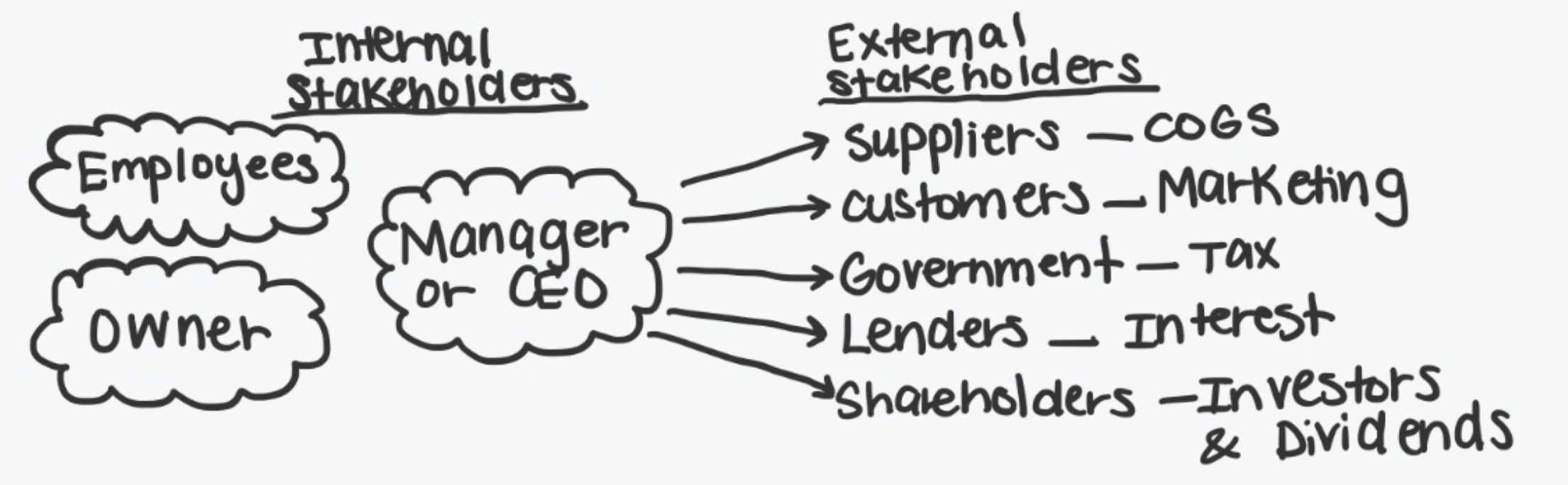
Stakeholders: parties that can either affect or be affected by the business.
If you were a stakeholders, what would be main risks?
Risks faced by stakeholders and demand for audit
Business Risk:
-The probability that an entity fails to meet it’s objectives (ex: no profit)
Information Risk:
-The probability that the information provided by an entity is false or misleading
-Information asymmetry between managers and other stakeholders
-Today’s information: more complex and demanded by more remote users.
What can help reduce information risk? Auditing
Risks faced by stakeholders and demand for Audit
- Independent 3rd party assessment of the information
-Demand for this assessment comes from both information users and producers management
-Stakeholders demand for reliable information
Managers demand for financing
Ex: organic foods, Diamond Rings
Systems of Investor Protection:
picture
CEO Chief Executive Officer → Chief Financial Officer (CFO)
Stages of Auditing:
Obtain or retain engagement
Engagement Planning (chapter 3-5)
Examine Audit Evidence (chapter 6-11)
Reporting (chapter 14)
Services Broader than Audits-Attestation and Assurance
1.Attestation: a practitioner assesses and reports on “subject matter, or an assertion about subject matter that is the responsibility of another party”.
Some Financial Attestation Engagements
-Financial statement audits
-Financial forecasts and projections
-Examination of Management Discussion and Analysis
-Prospective financial Information
-Some non-financial attestation engagements
-Effectiveness of Internal control systems
-Compliance with environmental regulations
-Sustainability reporting engagements
Assurance (final report not required Independent professional service that improve the quality for decision makers
Examples include:
-Academy or it’s context for decision makers
-Academy award, vote counts, MLB Hall of Fame voter verification
-XBRL Reporting
-Information risk assessment
-Customer satisfaction surveys
-Internal audit outsourcing
-Fraud and illegal acts prevention and detterence
-Cyber risk assessment and assurance
Management Assertions
1.PCAOB Assertions about events and transactions
2.Assertions about account balances
3.Assertions about presentation and footnote disclosures
4.Key Questions
Existence or Occurence:
occurrence and cutoff
Evidence
Occurrence
Do the assets listed really exist?
Did the recorded sale transactions really occur? In the proper period?
Completeness
Completeness and cutoff
Existence
Completeness
Were all transactions required? Are transaction included in the proper period?
Valuation or Allocation:
Completeness
Completeness
Accuracy and Valuation and Allocation
Are the balance sheet accounts valued correctly?
Are the transactions accurately recorded?
Are expenses allocated to the period(s) that were benefited
Rights and Obligations
Rights and Obligations
Rights and obligations
Accuracy Valuation and Allocation
Does the company really own the assets?
Are legal responsibilities to day the liabilities identified
Presentation and Disclosure
Classification
Classification and Understandability
Were all transactions recorded in the correct amounts?
Are the disclosures understandable to users?
Management Assertions
Existence: is if the money of assets divide by liabilities recorded on balance sheet actually exist. Is it possible that some of the recorded assets/liabilities don’t exist?
Occurence: is the money of sales divide by expenses recorded on Income Statement actually occurred. Is it possible that some of the recorded sales or expenses did not occur?
Completeness: (All existing) Assets / Liabilities or (ALL) sales / Expenses (that occurred) are completely recorded on Balance Sheet (B/S) or Income Statement (I/S).
Is it really? is it possible that some of the assets/ liabilities or sales/expenses were ommitted (not recorded)
cutoff: sales or expenses recorded in this year actually occurred this year. Sales or expenses that occurred this year were recorded in this year
(Ex: Occurrence and completeness)
Valuation and Allocation: (or Accuracy): $ Recorded on Balance sheet or Income statement is correctly valuated
Rights and Obligations: (Classification): Current vs. Non-current, Selling General and Administration vs. Manufacturing cost, following disclosure rules.
The primary responsibility for a company’s financial statements rests with both the management and the auditor.
The objective is an auditors review of credit ratings of a clients customers is to obtain evidence related to managements assertion about completeness of accounts receivable
Professional Skeptism:
Management Assertions and professional Skepticism: refers to an auditors questioning mindset towards representation made by management and evidential matter gathered
-Inquiry alone is enever enough. The auditor must obtain sufficient corroborative evidence'
-Unusual financial trends need investigation
-Documents are always checked for authenticity or possible alteration
-Ask questions, get answers, then verify the answers
-Must be skeptical because a potential conflict of interest group exists between the auditor and the client
Public Accounting
Lines of services:
-Assurance services
-Financial Statement Audit, Attestation, Assurance, Compilations (prepping Financial Statements) from client’s books
-Tax Service
-Consulting and Advisory services
Other kinds of engagement:
-Internal Auditor
-Reviews of Internal control systems to ensure compliance with company policies, plans and procedures
-Compliance with laws and regulation
-Governmental auditing
-U.S. Government and accountability office (GAO) internal Auditors
-IRS auditors, Bank examiners