exam three (conceptual)
 Call Kai
 Learn
 Practice Test
 Spaced Repetition
 Match
 Flashcards
 Knowt Play
1/7

There's no tags or description
Looks like no tags are added yet.
Name | Mastery | Learn | Test | Matching | Spaced | Call with Kai | Chat |
|---|
No analytics yet
Send a link to your students to track their progress
8 Terms

aldehyde (overarching term)

ketone (overarching term)

acetone (type of ketone)
two bond angles are equal due to symmetry

acetaldehyde (type of aldehyde)
all bond angles differ slightly
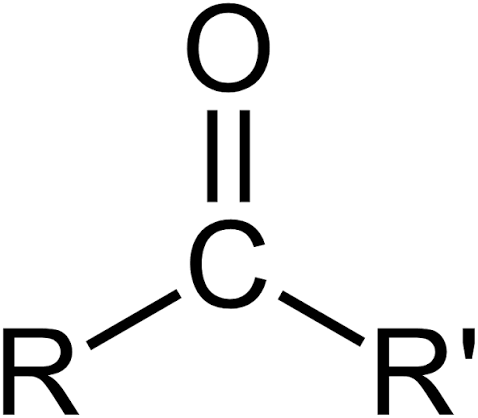
state the properties as well.
carbonyl group
geometry:
the carbonyl group in aldehyde and ketone are planar.
bond angles are ~120°, but are not identical bc the molecules aren’t symmetrical. (if both R groups are the same, then two bond angles are equal).
polarity, resonance, and reactivity of carbonyl groups
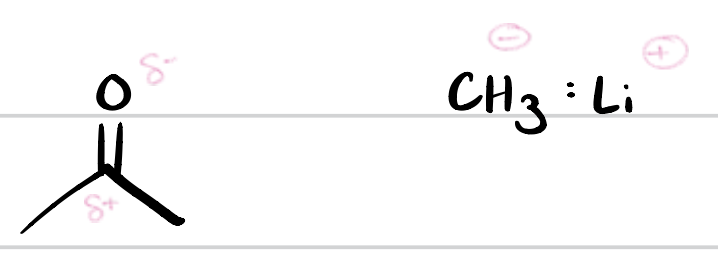
C=O is strongly polarized because Oxygen withdraws electron density from Carbon.
carboxyl is very electrophilic, so it’ll react with nucleophiles.

organometallic reagents
compounds containing Carbon associated with a metal (Li, Mg, Cu).
carbon attached to a metal behaves as though it has sufficient negative charge
is carbon electrophilic or nucleophilic?
Depends on circumstances:
carbonyl carbon (C=O): → δ+ → electrophilic
organometallic reagents: substantial negative charge → nucleophilic