Quiz 4 - chapter 21 concept questions
 Call Kai
 Learn
 Practice Test
 Spaced Repetition
 Match
 Flashcards
 Knowt Play
1/27

There's no tags or description
Looks like no tags are added yet.
28 Terms
Does the apical membrane of a collecting duct cell have more water pores when vasopressin is present or when it is absent?
More water pores when vasopressin is present.
If someone inherits a vasopressin V2 receptor deficiency will their urine be dilute or concentrated?
If vasopressin receptors are lacking, the urine is dilute.
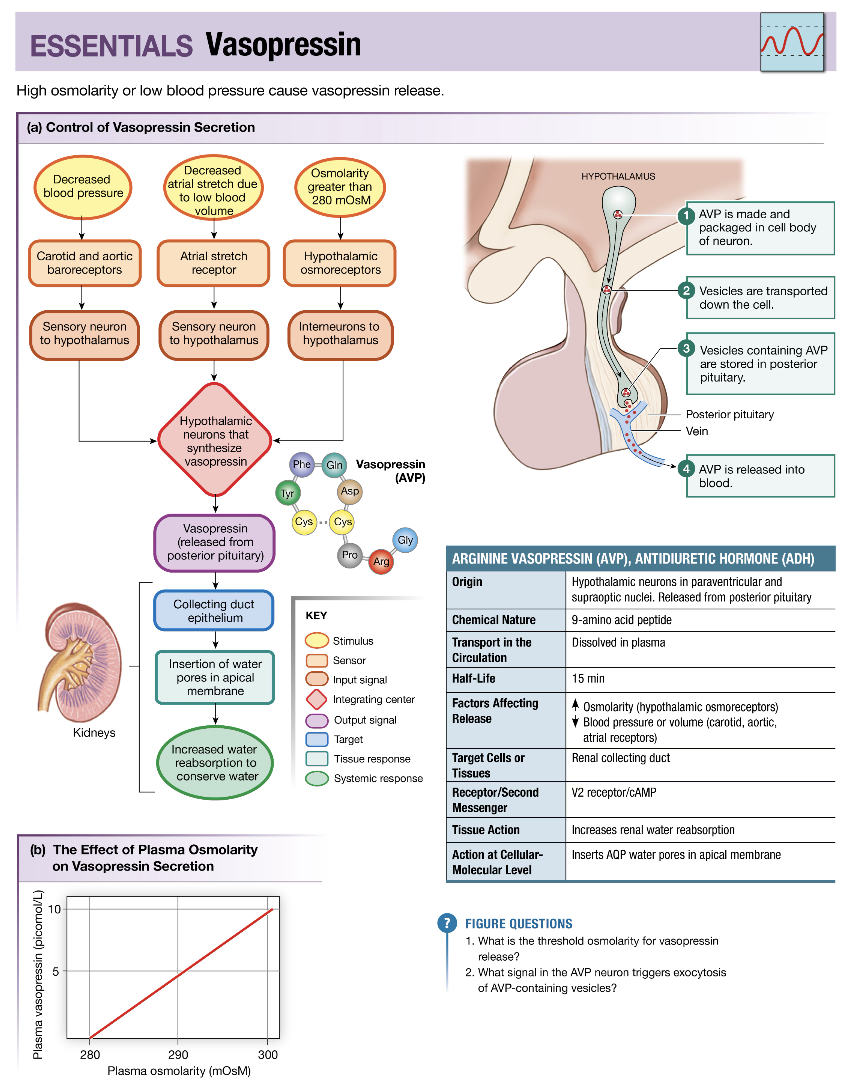
What is the threshold osmolarity for vasopressin release?
Threshold is 280 mOsM.

What signal in the AVP neuron triggers exocytosis of AVP-containing vesicles?
An action potential arriving at the axon terminal initiates exocytosis.
A scientist monitoring the activity of osmoreceptors notices that infusion of hyperosmotic saline (NaCl) causes increased firing of the osmoreceptors. Infusion of hyperosmotic urea (a penetrating solute) [Section 5.1] had no effect on the firing rate. If osmoreceptors fire only when cell volume decreases, explain why hyperosmotic urea did not affect them.
Hyperosmotic NaCl is hypertonic and shrinks the osmoreceptors, but hyperosmotic urea is hypotonic and causes them to swell. Because only cell shrinkage causes firing, osmoreceptors exposed to urea do not fire.
If vasopressin increases water reabsorption by the nephron, would vasopressin secretion be increased or decreased with dehydration?
Vasopressin levels would increase with dehydration.
Experiments suggest that there are peripheral osmoreceptors in the lumen of the upper digestive tract and in the hepatic portal vein [Fig. 15.1]. What is the adaptive significance of osmoreceptors in these locations?
Osmoreceptors in the lumen of the digestive tract and hepatic portal vein would sense high-osmolarity food or drink that has been ingested and absorbed before it reaches the general circulation. This would allow an anticipatory, or feed-forward, secretion of vasopressin to conserve body water.

In diabetes, if filtered blood glucose exceeds the renal threshold for glucose reabsorption, glucose is excreted in the urine. This may not seem like a big deal, but any additional solute that remains in the lumen forces additional water to be excreted, causing osmotic diuresis and polyuria (excessive urination). Solve the problem below to see for yourself how this happens.
The drawing represents the nephron of a person. The osmolarities given for points A, B, and C represent the osmolarity of the tubule fluid at those points.
Assume:
150 mosmoles/day of non-glucose solutes enter the distal tubule at point A,
the solute amount does not change as the solutes move through the nephron into the urine, and
maximal vasopressin is present.
In one day, what volume of fluid passes the following points?
A _______________________
B _______________________
C ______________________
A. =1.5 L, B = 0.5 L, C = 0.125 L
Now suppose this person suddenly develops type 1 diabetes. Plasma glucose concentration increases to 500 mg glucose/100 mL plasma and remains steady for a 24-hour period. What effect does this have on urine output? Follow the steps below to answer this question.
If GFR is 100 mL plasma/min, how many grams of glucose filter in a day?
720g/day filtered (Remember to convert from minutes to 1 day.)
If the tubule transport maximum (Tm) for glucose is 350 mg glucose reabsorbed/min, how many grams of glucose will be reabsorbed in a day?
504 g/day reabsorbed
How many grams of glucose will leave in the urine in a day? How many milliosmoles of glucose is this? (The molecular weight of glucose is 180 g/mole. For glucose, 1 mole=1 osmole.)
216 g glucose/day excreted (filtered minus reabsorbed equals excreted).
1 mole glucose/180 g × 216 g/day × 1 osmole/mole=1.2 osmoles/day excreted
If the urine concentration is 1200 mOsM, what additional volume of urine will be excreted with the glucose in a day?
1200 mosmol/ ? L = 1200 mOsmM. This is 1 liter of additional volume excreted.
Explain why patients taking a loop diuretic that inhibits solute reabsorption excrete greater-than-normal volumes of urine.
Solutes that remain in the lumen when the NKCC symporter is inhibited create an osmotic diuresis, forcing water to remain in the lumen with the solutes and increasing urine volume.
Loop diuretics that inhibit the NKCC symporter are sometimes called “potassium-wasting” diuretics. Explain why people who are on loop diuretics must increase their dietary K+ intake.
Inhibiting the NKCC symporter leaves K+ in the tubule lumen, where it is likely to be excreted, thus increasing urinary K+ loss.

Map the cardiovascular reflex pathway represented by the red dot.

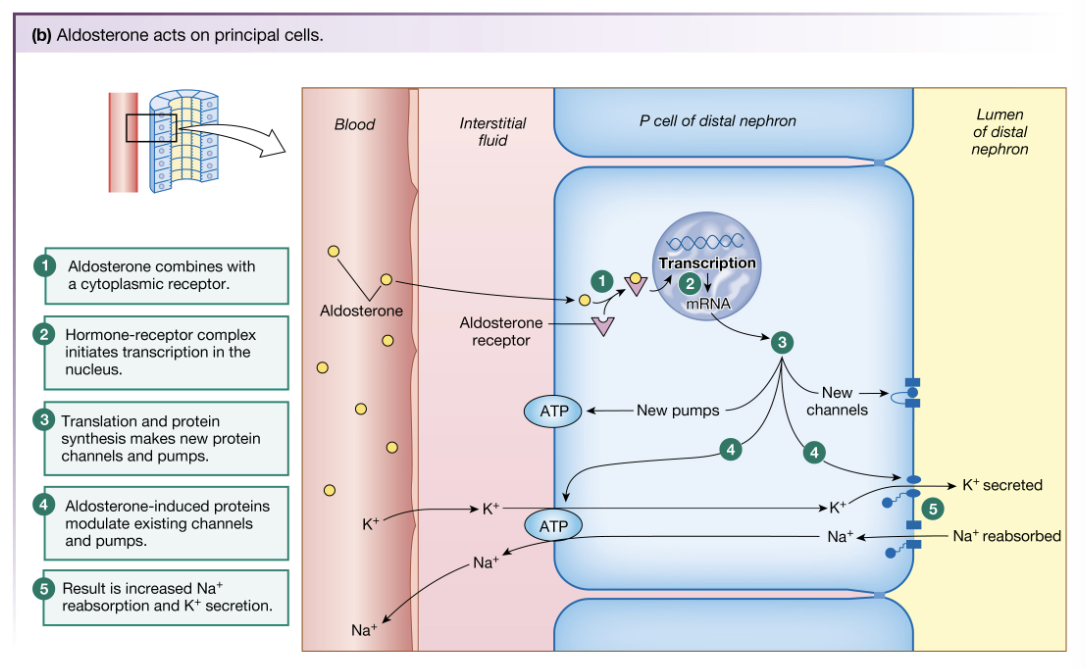
In Figure 21.9b, what forces cause Na+and K+to cross the apical membrane?
Na+ and K+ are moving down their electrochemical gradients.
If a person experiences hyperkalemia, what happens to resting membrane potential and the excitability of neurons and the myocardium?
In hyperkalemia, resting membrane potential depolarizes. Excitable tissues fire one action potential but may be unable to repolarize to fire a second one.
Laboratory values for ions may be reported as mg/L, mmol/L, or mEq/L. If normal plasma Na+ is 140 mmol/L, what is that concentration expressed as mEq/L? [Fig. 2.7].
For ions with a single charge, moles equal equivalents, so 140 mmol/L na+ = 140 mEq/L

Add efferent pathways and/or targets to the pathways marked with a red dot.
See Fig. 16.11b for the cardiovascular pathway; Fig. 21.9b for the target cell of aldosterone action; and Fig. 21.5c for the target cell of vasopressin.
A man comes to the doctor with high blood pressure. Tests show that he also has elevated plasma renin levels and atherosclerotic plaques that have nearly blocked blood flow through his renal arteries. How does decreased blood flow in his renal arteries cause elevated renin levels?
Atherosclerotic plaques block blood flow, which decreases pressure in the afferent arteriole and decreases GFR. Decreased pressure and decreased GFR stimulate renin release.
Map the pathways through which elevated renin causes high blood pressure in the man mentioned in Concept Check 11.
Renin secretion results in ANG II production. ANG II causes vasoconstriction, acts on medullary centers to increase blood pressure, increases ADH and aldosterone, and increases thirst, resulting in drinking and an increased fluid volume in the body. All these responses contribute to increased blood pressure.
Why is it more efficient to put ACE in the pulmonary vasculature than in the systemic vasculature?
All blood passes through the pulmonary blood vessels with each circuit. Unless ACE was in every systemic blood vessel, some blood might not be exposed to ACE.

Incorporate the thirst reflex into Figure 21.6.
On the right side of Fig. 21.6, interneurons also lead from hypothalamic osmoreceptors to the hypothalamic thirst centers.
Map the pathway that begins with renal artery stenosis and ends with hypertension.
Narrowing of the renal artery decreases blood flow into the kidney and decreases afferent arteriole blood pressure and GFR. The kidney interprets this as low systemic blood pressure and initiates the RAAS pathway to raise blood pressure. See Figure 21.10, starting at upper left.


Use the anatomical drawing to name the muscles of ventilation.
The muscles of inspiration are the diaphragm, external intercostals, scalenes, and sternocleidomastoid. Muscles of expiration are the abdominals and internal intercostals.
In equation 6, the amount of HCO3− present is increased at equilibrium. Why doesn’t this HCO3− act as a buffer and prevent acidosis from occurring?
The level increases as the reaction shifts to the right as a result of added CO2. Once a new equilibrium state is achieved, HCO3− cannot act as a buffer because the system is at equilibrium.
Why is ATP required for H+ secretion by the H+-K+ transporter but not for the Na+-H+ exchanger?
In the distal nephron, both H+ and K+ move against their concentration gradients, which requires ATP. In the proximal tubule, Na+ moves down its concentration gradient, providing the energy to push H+ against its gradient.
In hypokalemia, the intercalated cells of the distal nephron reabsorb K+ from the tubule lumen. What happens to blood pH as a result?
When intercalated cells reabsorb K+, they secrete H+ and therefore blood pH increases.