(5) Wheelchair Measurements
 Call Kai
 Learn
 Practice Test
 Spaced Repetition
 Match
 Flashcards
 Knowt Play
1/25

Earn XP
Description and Tags
10/12/2026
26 Terms
Three variables considered for wheelchairs
balance and postural control in sitting
ability to achieve neutral sitting posture
degree of postural support needed to achieve neutral posture
Process for obtaining wheelchair
Physician referral for w/c assessment → PT evaluation → ATP (assistive technology professional) evaluation
Wheelchair considerations
Home accessibility, caregiver needs, transportation, funding, and patient goals/desires
PT considerations:
endurance, physical abilities (MAT assessment), size & weight, diagnosis, cognition, pain/sensation, skin issues
5 Year Rule
Client must remain in same w/c for 5 years (or longer) unless they have a change in medical condition
Justification for w/c use
Wheelchair propulsion test
Timed propulsion over fixed distance
Count push strokes
Quality of propulsion
Document pain levels and pulse ox
Postural assessment
Environmental needs
Environmental Measurements
Must consider width of doorways, hallways, and other factors for w/c use
Chart - Parts of a Wheelchair

MAT (mechanical assessment tool) Evaluation
Purpose = determine if there are barriers to functional, comfortable, and upright seated posture
Postural assessment done in supine (gravity eliminated) and sitting
***Skin Integrity (current pressure ulcers, scar tissue)
Spine and pelvis mobility
***Orthopedic deformities (flexible? fixed?)
Abnormal tone
***Static and dynamic balance
Joint ROM must be adequate for seated posture
ROM and strength must be adequate for mode of drive control (manual? powered?)
Body measurements for w/c prescription
Tips for measurements
All measurements on firm, flat surface in the target posture
Use hard measuring tape (not one that can bend and wrap) to avoid measurement errors of increased circumference or length
All measurements should be taken straight across the body
Use measurement forms to take all necessary ones properly and document properly
Don’t forget excess tissue; measure in ideal posture that is realistic to have throughout the day
Don’t forget to look for limited hip ROM and tight HS; often culprits of poor pelvic position!
Chart - Necessary measurements
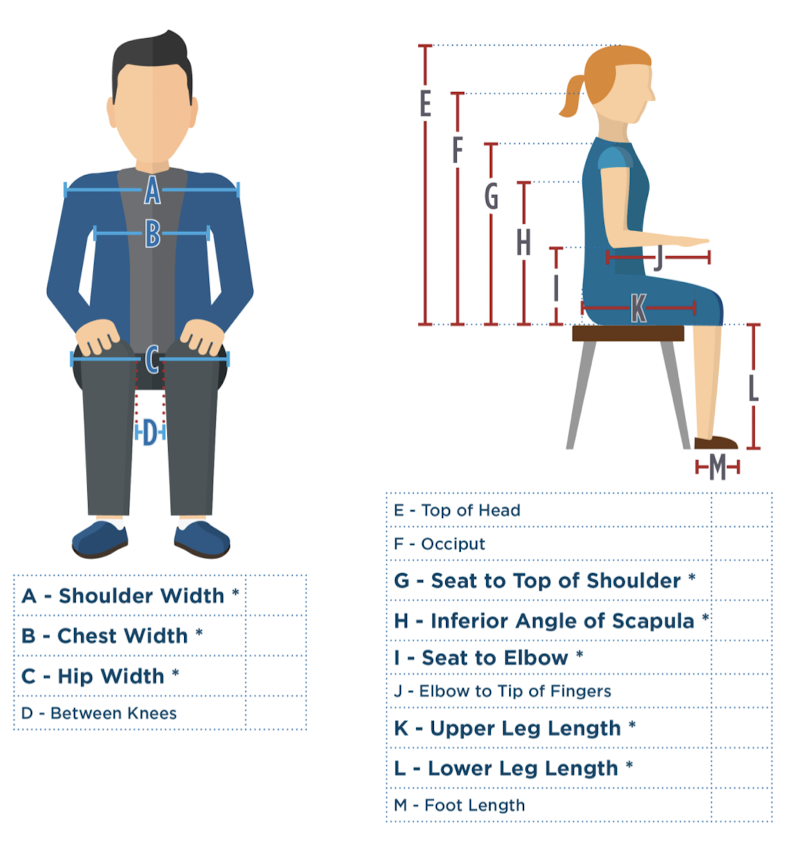
Seat Width
Seated, widest distance from hip to hip
Add ~2 inches to allow space between arm rest and each side of the hip
Considerations:
1 ¼ - 2 inches added = room for clothing (e.g. coats), prevents skin irritation between thighs and armrests
too wide = difficult to propel
avg. size = 18”
Seat Depth
Seated, distance along thigh from back of hip to the knee
Subtract ~1-2 inches to allow space between back of knee and wheelchair seat
Considerations:
too long = skin irritation and breakdown on back of knee, poor postural support
too short = less support under thighs and more pressure on buttocks
avg. size = 16”
Floor to Seat Height
Seated, distance from the fold in back of knees to bottom of heel
Add ~2 inches to allow room for footrests to clear the floor
Considerations:
too high
w/c difficult to fit under desks/tables
feet unable to touch floor when footrests removed
wheelchair more difficult to propel
incr. risk of tipping
too low = footrests hit the floor and increased buttocks pressure
standard height 18-19”
cushion may add 2-4” (need to know cushion height)
foot propulsion utilization (hemi-height)
Seat Back Height
Seated, distance from buttock to bottom of scapula
Add or subtract depending on needs for postural support, as a higher seat will offer more trunk support
In general, height must not interfere with shoulder movement
Considerations:
too high = poor upper trunk posture, limit shoulder ROM for propulsion
too short = poor posture, inadequate trunk support
cushion may add 2-4” (need to know cushion height)
Armrest Height
Seated, elbows bent to 90deg, distance from buttocks to tip of olecranon
Add 1” plus cushion height to allow for neutral shoulders
Considerations:
proper height for upright posture
too high = pressure on elbows, may cause shoulder impingement
too low = poor, leaning forward posture
Backrest Width
Seated, width of chest at level of top of backrest
Add 3/4”
Considerations:
too wide = interfere with shoulders, inadequate postural support
too narrow = skin irritation, discomfort
Camber
Angle of wheels in relation to vertical
Considerations:
more camber (greater angle from vertical) = upright stability, improved turning maneuverability
also protects hands as propelling through narrow doorways
too large = difficult to maneuver through tight spaces
implicated in adaptive sports
Center of Gravity - Axle Position
Position of axle in relation to seat of wheelchair
Considerations:
affects stability and manual propulsion
more posterior = increased stability, but difficulty reaching handrims for propulsion
more anterior = decreased stability, but easier to propel wheels and pop wheelie
in general, wheels placed in most forward position allowing user to easily propel without compromising stability
in-line with GHJ
axle backward = decr. tippiness
axle forward = incr. tippiness
amputee axle to accommodate CoG change (axle back)
axle heights: (changes elbow flexion angles)
lower axle for higher rear of seat to floor height for taller person
raise axle for lower rear/front of seat height (dump, access under tables)
Hanger Angle
Angle where footrest bars meet seat of wheelchair
Considerations:
smaller angle = more knee flexion, but easier to turn w/c
larger angle = less knee flexion, but forward instability (feet in front of w/c)
also requires more turning space
Propulsion Mechanics
Shoulder ~70º abducted
begins extended, IR
ends flexed, ER
Consider well-developed shoulder flexors, internal rotators and adductors with poorly developed external rotators and thoracoscapular muscles
Constant propulsion predisposes pt. to RTC impingement
Longer push strokes (greater contact angle) = more efficient, less likelihood of injury, fewer pushes needed
Pelvic Positioning
Assess for neutral, ant/post pelvic tilt, pelvic rotation, pelvic obliquity, windswept deformity
Importance:
pressure relief
postural issues
functional movement + reaching
core stability and positioning affects ability to use extremities efficiently
Postural Deformities; Flexible vs. Fixed?
May present with postural deformity from contractures with apparent scoliosis
Windswept deformity = scoliotic curve due to compensatory pelvic obliquity
Accommodate: often need to allow lower body rotation to achieve more functional upper body and face-forward positioning

Manual Wheelchairs
Temporary uses (TKA, THA, Fx)
Full time mobility (SCI, TBI, CP, SB)
Rigid/Folding
One-arm Drive (CVA, UE Amputee)
DME Wheelchairs (K0001-K0003)
Standard w/c in hospitals/nursing homes purchased in bulk for short term transportation needs
Most appropriate for use on firm, level surfaces; not for full-time or long-term use
Complex Rehabilitation Technology (CRT) K0005
Tilt-in-Space
Custom Manual w/c
0001 = standard manual
0002 = standard hemi-height manual
0003 = lightweight manual
0004 = high-strength lightweight manual
0005 = ultralight manual (higher-level complete/incomplete SCIs)
0006 = heavy-duty manual
0007 = extra heavy-duty manual
Power Wheelchair Drives
Mid-wheel = smallest turning radius
Rear-wheel = widest turning radius
Front-wheel = better front access