PhilScience Final
 Call Kai
 Learn
 Practice Test
 Spaced Repetition
 Match
 Flashcards
 Knowt Play
1/93

Earn XP
Description and Tags
94 Terms
Scientific Realism
A positive epistemic attitude towards the content of our best scientific theories, regarding both the observable and unobservable aspects of reality
3 Components of Scientific Realism
Metaphysical, semantic, epistemic
Metaphysical component of scientific realism
The world that is investigated by the sciences has a definite and mind-independent structure
Semantic component of scientific realism
We are to construe claims of our best scientific theories as 'literally' true; scientific theories have determinate truth-values and cannot be reinterpreted in a way that alters their logical form
Epistemic component of scientific realism
Scientific claims are true or approximately true, constituting real knowledge of both the observable and unobservable aspects of reality
Inference to the Best Explanation (IBE)
The hypothesis which best explains a set of observations (evidence) is likely true
Objections to IBE
- "Best" is subject to interpretation
- Can you really infer truth from the best explanation?
- How can you guarantee a good set of hypothesis to choose from?
No Miracles Argument (NMA)
Given the success of our current scientific theories, it is improbable that we came to these conclusions under some miraculous coincidence. Thus, under IBE it must be that our best theories are approximately true.
Objections to NMA
- Is SR the only explanation for science's success?
- Is this question begging? The anti-realist would not accept IBE in a way that licenses claims about truth
Defence of the NMA
Naturalistic strategy to understand success of science; we employ the very techniques of science (IBE) to explain its success
2 Objections to Scientific Realism
1. Pessimistic Meta Induction (PMI)
2. Underdetermination of Theory by Data
OBJECTION 1: Pessimistic Meta Induction (PMI)
Even when assuming some version of the "No Miracles" argument, scientific realism ought to be rejected...
1. Our current, empirically successful theories are approximately true.
2. If our current, successful theories are approximately true, then past theories cannot have been.
3. These false theories were, nonetheless, empirically successful [recall Laudman's list].
4. Thus, there is no explanatory connection between empirical success and approximate truth.
5. Thus, the "No Miracles" argument provides no warrant for the realist's claim that our current theories are approximately true.
6. Thus, we ought to reject scientific realism.
Criticisms of PMI (Psillos)
- Laudman's argument is based on a historical gambit (not all of the theories on his list were empirically successful)
- Divide Et Impera
OBJECTION 2: Underdetermination of Theory by Data
Multiple, competing theories can perfectly explain the exact same observable evidence, meaning data alone can't definitively prove one theory true over others, thus underdetermining theory choice.
1. Within scientific study, we can observe distinct and even conflicting theories (comprehensive scientific beliefs) that are equally consistent with the available evidence.
2. Because no additional evidence is available to favour one theory over the other, there can be empirically equivalent and incompatible theories.
3. However, scientific realism asserts that our observational evidence is what gives us good reason to believe any particular theory.
4. Therefore, scientific realism tells us to believe incompatible theories, given that the choice of which theory to believe is underdetermined by data.
Empirical Equivalence
Scientific theories are empirically equivalent just in case they have the same class of empirical/observational consequences
Empirical Consequences of a Theory
Predictions
How can we resist the underdetermination argument?
- Genuine cases only seem to arise in highly mathematical settings (i.e., Poincare's finite spherical world that is both Euclidean and non-Euclidean)
- Perhaps it is just an effect of our formalism -> there are ways to "force" theories to be empirically equivalent
- Laudan & Leplin: The relative degree of evidential support for theories is not fixed by empirical equivalence
a) There is other evidential support for a theory besides its class of empirical consequences;
b) A theory's empirical consequences can be true without proving the theory itself is true
If underdetermination is true, is scientific realism "dead in the water"?
No
Could appeal to theoretical virtues:
If T1 and T2 are underdetermined by data, perhaps T1 enjoys particular such virtues that T2 doesn't
Kuhn on Theory Choice and Value Judgement
We can use "value judgements" to select one paradigm over another
Kuhn's List of Values
1. Predictive accuracy
2. Internal consistency (inc. non ad-hoc)
3. External consistency
4. Broad scope/Unifying power
5. Simplicity
6. Fruitfulness/Fertility
How does the criteria for a good scientific theory operate according to Kuhn?
Like "values" and not "rules", since they are not meant to dictate the choice of each individual, but rather provide some sort of guidance in cases of conflict
Kuhn's criteria is imprecise, and potentially self-conflicting... is this problematic?
Not necessarily
Kuhn's "good company" argument: even if freedom of speech and property rights are imprecise and sometimes conflict, we still think they remain central to how society functions
Kuhn's Flexible Criteria
Even though their application may be ambiguous, values still specify for scientists:
- Factors they must consider when making a decision
- What they believe is and isn't relevant
- What they can legitimately be required to report as the basis of their decision
Thus, they allow us to make sense of scientific history (competing theories) -> give us a "decision process" that allows for rational disagreement
Aristotle's Episteme
Relates to scientific knowledge and understanding — a particularly distinguished sort of knowledge involving explanation
How can one have episteme of a fact?
One must
1. Know the cause/explanation (aitia) C of F .
2. Know that C is in fact the cause of F .
3. Know that F could not be otherwise.
What sort of truths can be scientifically known according to Aristotle?
Necessary truths
How can we acquire episteme?
Through a type of deductive argument known as a demonstration
For a syllogism to be a demonstration, its premises must (necessary/sufficient conditions) be...
1. True;
2. Primitive;
3. Immediate;
4. More familiar/better known than the conclusion;
5. Prior to the conclusion;
6. Explanatory of the conclusion
(6) Explanatory of the conclusion
The "middle term" of a demonstration must provide the cause (understood in his broad sense) relating the other terms in the premise
Give an example of (6) Explanatory of the conclusion
1. All nearby things don't twinkle.
2. All planets are nearby.
3. Thus, all planets don't twinkle
This is a demonstration because it shows "the reason why" (planets don't twinkle because they are near)
Give a anti-example of (6) Explanatory of the conclusion
1. All things that don't twinkle are nearby.
2. All planets don't twinkle.
3. All planets are nearby
This is not a demonstration because it merely shows "the fact that" (non-twinkling is not the cause of nearness)
(4) More familiar/better known than the conclusion
Universals, causes, essences are better known simpliciter ("to nature") but particulars (the conclusions of demonstrations) are better known to us. We induct on particulars to achieve some sort of knowledge of universals.
Scientific Explanations (Aristotle)
A distinguished subset of valid and sound deductive arguments (syllogisms)
Hempel-Oppenheim's DN Model of Explanation
To give an explanation of X is to show how to derive X from a logical argument. The conclusion is the explanandum, and the premises the explanans.
(P) Statement of the initial (antecedent) conditions
(P) Statement of relevant general laws
(C) Description of the empirical phenomenon to be explained
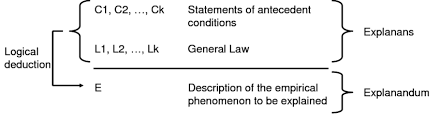
Explanandum
A singular sentence (no quantifiers) that describes what is to be explained
Explanans
The sentences that do the explaining. They must have true empirical content, and contain at least one general law.
Issues w/ DN Model of Explanation
- Are the conditions necessary?
- Are the conditions sufficient?
- Difficulty in distinguishing btw/ laws and accidental generalisations
Van Fraasaen's Pragmatic Model
Sees scientific explanations as context-dependent answers to specific "why-questions"
Causal-Mechanical Model
Scientific explanations reveal how a phenomenon fits into the world's causal structure, detailing the spatiotemporal continuous processes that transfer 'marks'
Issues w/ Causal-Mechanical Model
- What segment of causal history is relevant?
- Are the conditions for causal processes necessary?
- Should we view causation in this mechanistic manner?
- Counterfactual approach leads to cases of underdetermination since an event can have multiple causes
Distinctive features of Kitcher's Unificationist Model
1. Explanatory power must be assessed at a "global level", such that any particular derivation belongs to a set of other derivations that best systematises a set of scientific beliefs
2. Elucidate connection btw/ explanation and understanding through unification: minimise no. of patterns of derivation, maximise no. of conclusions derived
3. "Stringency"
How can we identify what explanatory store to use?
By examining K, the set of beliefs we hold, we can identify a range of beliefs and extract recurring argument patterns from them. We then apply a selection principle to determine which of these patterns constitutes the explanatory store.
Strevens' Kairetic Model
Explanations are causal stories focusing on what difference-makes in a process, extracting essential causal factors from complex webs to reveal why something happened
Given some event E and veridical causal model M, the explanatory kernel K is the most abstract model that generates M, entails E, and maximizes cohesion
Aim of Loewer's "Humean Supervenience"
To explore what HS is, and defend Lewis' account of laws in constructing a nomic HS...
Although Lewis-laws fall short of some philosophical expectations, they fulfill the roles science requires. Their metaphysics and epistemology are in far better shape than those of the main anti-Humean alternative.
Lewis' Humean Supervenience (contingent)
All states of affairs (facts; particularly those concerning fundamental laws) in the actual world supervene on perfectly natural properties/relations.
Lewis' Humean Supervenience (necessary)
All metaphysically possible states of affairs (facts; particularly those concerning fundamental laws) in the actual world supervene on perfectly natural properties/relations.
Challenge to Humean Supervenience (HS)
There are "nomic" concepts (laws, causation, chance) that don't supervene on the total distribution of perfectly natural properties
How can this challenge to HS be solved?
Show how to recover "reasonable" nomic concepts compatible w/ HS
Lewis-Laws
A theorem of the best system; expressed by deductive inferences in the form of true generalisations that efficiently encode a lot of information about the world
Loewer on L-Laws
Dretske aims to argue against the logical positvist idea that...
Laws are simply a distinguished class of universal truths, expressible as:
∀x(Fx → Gx)
Dretske's "Opacity Argument"
Laws aren't just true universal statements because laws possess an "opacity": you can't always substitute coextensive properties in a law without changing its truth-value.
(1) Functional Response to "Opacity Argument"
The difference between laws and universal truths is not intrinsic but functional: some universal truths count as laws because of the role they play within a scientific context.
In this sense, law = universal truth + X, where X is the special function a statement must serve to qualify as a law.
Thus, the opacity of laws reflects the epistemic conditions required for a universal statement to function as a law
What are common candidates for the special function X?
High confirmation, wide acceptance, explanatory power, deductive integration, and predictive success
(2) Universals Response to "Opacity Argument"
Perhaps "F" and "G" do not refer to predicate extensions but to the universal properties F-ness and G-ness. On this view, "It is a law that Fs are Gs" asserts a relation—F-ness # G-ness—via some unspecified connective. If so, laws differ intrinsically from universal truths.
What is Maudlin's aim in "A Modest Proposal Concerning Laws, Counterfactuals, and Explanation"?
To outline systematic connections between beliefs about laws and other beliefs (possibility, counterfactuals, explanation) by treating laws of nature as primitive in our ontology
Why is Maudlin under special pressure to clarify his view?
Because rival accounts (e.g., regularity and universals views) claim to explain the same phenomena.
What is Van Fraassen's Gold Spheres example?
Imagine that all the "best" systems of the world include the following regularities:
1. Newtonian mechanics and gravitation;
2. ∀x (S(x) ↔ G(x)) (all and only spheres are gold).
Van Fraassen challenges the idea that ∀x(S(x) ↔ G(x)) (a regularity of the best system of the world) should be classified as a law
What does the Gold Spheres example illustrate?
if we accept that "all and only spheres are gold "is a law, we cannot admit the initial conditions (Newtownian physics) as possible.
Only when we assume that Newton's laws are the only laws operating, can we then account fo the the sphericality of the gold.
Thus, our intuitions suggest no new laws need be invoked.
What does Maudlin say about Van Fraassen's challenge?
It demonstrates that the regularity account cannot capture the relationship between possibilities, counterfactuals, and explanations. Instead, an acceptable theory of laws must.
What kind of laws does Maudlin emphasise?
Dynamical laws governing temporal evolution that describe how physical states evolve through time.
What does Maudlin refer to these laws as?
FLOTEs - Fundamental Laws of Temporal Evolution
Cartwright's Ceteris Paribus (CP) Laws
- Laws don't hold universally, only under special conditions
- Special Sciences seem to only deal with CP laws (i.e., economics, biology)
- Cartwright argues that even laws of physics can be CP, claiming that we construct the conditions in which they are supposedly "universal"
What is Helen Longino's aim?
To question the existence of a sharp divide between "cognitive" and "non-cognitive" values in scientific inquiry by comparing two different sets of virtues (Kuhn & Feminist) and show that seemingly "cognitive" values are demonstrably political and context-dependent
Longino's Feminist List of Virtues
Accuracy, novelty, ontological heterogeneity, mutuality of interaction, applicability to current human needs, diffusion of power
Why are these virtues "feminist"? 2 Wrong Approaches
1. They express a "female orientation" of the world
- Not clear whether women are biologically/culturally inclined to feel this way
- Non-feminists have adopted these values
2. Women are more likely to value these bc/ they are outsiders to mainstream science
Why are these virtues "feminist"? Longino
Scientific inquiry guided by such virtues can reveal asymmetric power relations that conceal/suppress the activity of women
Compare: Traditional Virtues + Feminist Virtues
1. External Consistency & Novelty
- External consistency can perpetuate
the invisibility of gender
- Novelty, could have opposite effect
2. Simplicity & Ontological Heterogeneity
- Economic simplicity -> sociopolitical valence given patriarchal head of household
3. Fruitfulness & Diffusion of Power
Accoding to Okruhlik, what 2 main axes of import do feminist critiques of biology have?
1. Political: "determinist" or "essentialist" conceptions of gender have been used to "explain" or "justify" the socially subordinate role of women.
2. Epistemic: Biology is clearly a science in the sense that philosophers of science care about it. So, if one can demonstrate that gender ideology bleeds into the content of biology, then one has shown something significant about the "objectivity" of the sciences
Androcentricism
A perspective in which male concerns, male attitudes, and male practices are presented as "normal" or define what is significant and valued in a culture.
How does gender ideology influence science?
Ex: Cell Biology
- Theoretical assumptions about reproduction reflect social norms, causing researchers to ignore or misinterpret empirical evidence.
Ex: Sociobiology
- Androcentric interpretations of fixed data, e.g., evolutionary biology and anthropology, skew interpretations of evidence.
How do background assumptions and auxiliary hypotheses relate to social ideology?
They influence which hypotheses are tested, which evidence is deemed significant, and how falsification is handled.
Ex: Neuroanatomy
- Researchers resist abandoning biological explanations for gender differences in spatial/mathematical abilities, despite evidence to the contrary.
Ex: Primatology
- Male dominance assumptions influence experimental design and interpretation, neglecting alternative hypotheses.
Complementarity problem in medical sciences
Two sets of ideals are adopted, but only the male standard is treated as fully human.
Surreptitious standard problem in medical sciences
Male norms are claimed as universal, while female variables are treated as "nuisance variables."
Ex: the statements used to explain the female orgasm were based on data abt male orgasms
What are the 3 canonical feminist responses to androcentrism in science?
1. Feminist empiricism - correct biases while maintaining traditional empiricist methods.
2. Standpoint epistemology - knowledge is influenced by social position; marginalized perspectives can yield more objective insights.
3. Feminist postmodernism - science is socially constructed; objectivity is a myth.
Do these case studies show "science done badly" or that science is fundamentally androcentric?
This is debated; Okruhlik suggests social structures affect science content without completely undermining rational theory choice
What is the difference between the context of discovery and the context of justification in science?
Context of discovery: How hypotheses and theories are generated (social/psychological factors).
Context of justification: How hypotheses are tested and validated (ideally insulated from social biases).
How does Okruhlik view the effect of social factors on scientific rationality?
- Rational theory choice is possible despite bias
- Scientific methods alone cannot guarantee elimination of sexist or androcentric biases
- Social influences can shape the content of science even when choices among theories are rational
How does Okruhlik's view differ from Bloor's strong sociological view?
Okruhlik maintains that theory choice is comparative and rational, but social biases can still influence outcomes; she does not claim sociology fully determines theory choice
How to respond to Okruhlik's argument from a practical perspective?
1. Reduce the scope of models of rationality and claim that the objectivity of science is limited at best
2. Enlarge our model of rationality and accommodate the context of discovery
What is the main argument of Heather Douglas regarding values in science?
Douglas challenges the "value-free" standard, arguing that non-epistemic values are required in science, especially when dealing with inductive risk
Hempel's "Inductive Risk"
The chance of error in accepting or rejecting a scientific hypothesis:
- Accepting a false hypothesis.
- Rejecting a true hypothesis.
The consequences of these errors may require consideration of non-epistemic values.
How do non-epistemic and epistemic values play a role in evaluating hypotheses?
Non-epistemic values: When hypotheses lead to a "particular course of action" with non-epistemic effects
Epistemic values: When practical consequences are unclear; we must then be guided by the "goals of science"
What objection might be raised to Douglas's view of scientists using values?
Critics may argue it burdens scientists too much and that policymakers, not scientists, should make value-laden decisions.
How does Douglas respond to the objection about burdening scientists?
1. Scientists hold authority over policymakers in interpreting data
2. Inductive risk occurs deeply in scientific practice, not just at hypothesis selection
3. Science involves continuous interaction between theory and application; separating them is misleading (NOT DOUGLAS)
What are Longino's three "decision points" where non-epistemic values play a role?
1. Selection of research problems
2. Application of knowledge in society (e.g., technology)
3. Methodological constraints (e.g., selecting test subjects)
3 examples of internal stages of science where inductive risk affects decisions
1. Selecting methodology (e.g., statistical significance thresholds)
2. Gathering/characterising data (e.g., interpreting rat liver slides)
3. Interpreting data (e.g., assessing dioxin's carcinogenic effects)
How does Douglas justify using non-epistemic values in scientific reasoning?
When weighing inductive risk, the potential consequences of error include non epistemic effects, so non-epistemic values are normatively required for good reasoning.
Explain the tumor slide characterization example illustrating inductive risk
Pathologists disagreed on benign vs. malignant tumors. Two classification approaches illustrate inductive risk:
1. Classifying borderline cases as non-cancerous → reduces false positives, increases false negatives → underestimates cancer risk.
2. Classifying borderline cases as cancerous → increases false positives, reduces false negatives → overestimates cancer risk.
What is Cartwright's critique of fundamentalist views of scientific laws?
She rejects both downward reduction (everything reducible to fundamental laws) and cross-wise reduction. Laws true in idealised conditions do not automatically apply in real-world "inexact" contexts.
How does Cartwright view Newton's Second Law under ceteris paribus interpretation?
Laws apply under ideal conditions. In real-world cases, a concrete model is needed to make the law predictive. Without a model, the law may not apply.
What is the Neurath example, and what does it illustrate?
A 10 Euro note is swept away by wind. Mechanical laws cannot precisely predict its landing without an appropriate model. This shows the limits of applying universal laws.
Summarize Cartwright's position on universal laws
Contemporary scientific laws, if true, are mostly ceteris paribus. In the best cases, they describe natures, but there's no empirical basis for treating them as universal.
What is Cartwright's alternative to fundamentalism in science?
Laws are true for motions where causes are representable by familiar models. For other motions, laws are less predictive. Capacities, dispositions, or natures explain tendencies under ideal conditions.