Exam 3
 Call Kai
 Learn
 Practice Test
 Spaced Repetition
 Match
 Flashcards
 Knowt Play
1/50

There's no tags or description
Looks like no tags are added yet.
51 Terms
Experiments
What are the only things that can test causal claims
1) Covariance
2) Temporal precedence
3) internal validity
What are the three components of causal claims?
covariance
One component of causal claims that asks “are different levels of the IV associated with different scores on the DV?”
temporal precedence
one component of causal claims that ensures “the IV is manipulated before the DV is measured”
internal validity
one component of causal claims that rules out confounds
confounds
Third variables are for correlations whereas _________ are for experiments
comparison groups
In our in class experiment of shallow vs medium vs deep level of processing and words recalled, did we use control groups or comparison groups?
control group (water group)
If I had some people drink Sunny D, some people drink Tropicana, and some people drink water, did I use control groups or a comparison group?
True
True or False: Control or comparison groups count towards the total number of levels of our IV
Some things you can’t control for, so random assignment makes sure those variations are evenly spread out
Why would you use random assignment for some things instead of control variables for everything?
systematic variance
another variable fluctuates with levels of IV
systematic
Which type of variance can lead to a confound? Systematic or unsystematic variance?
unsystematic variance
another variable fluctuates across all levels of IV
confound
when another variable varies systematically with an IV
design confound
one of the 12 threats to internal validity that says experiment is designed so that another variable varies systematically with the IV
selection effect
one of the 12 threats to internal validity that says participant characteristics vary systematically with IV
control variables
What is the correction for design confounds?
random assignment or matched groups (dont rly need to know the details matched groups)
What is the correction for selection effects?
independent groups design (same as between-subjects design)
each participant is assigned to one level of IV
within groups design
each participant completes all levels of the IV
Because you need more participants for independent groups design
Why would an experimenter use within groups design instead of independent groups design?
1) posttest-only
2) pretest/posttest only
What are the two ways to conduct an independent groups design?
independent groups
Does this represent independent groups or within subjects design?
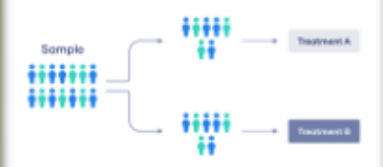
within subjects design
Does this represent independent groups or within subjects design?

posttest only
Is this posttest only or pretest/posttest
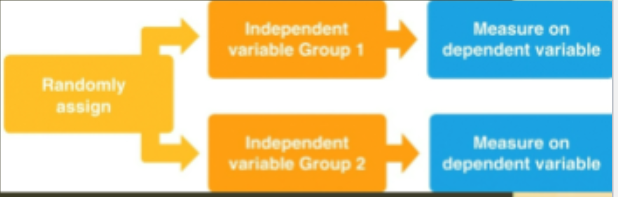
pretest/posttest
Is this posttest only or pretest/posttest

1) concurrent-measures
2) repeated-measures
What are the two ways to conduct within groups design?
concurrent-measures design
both levels of IV shown to participants at the exact same time
repeated-measures
experimenters randomly assign the order in which participants experience the levels of the IV
concurrent-measures
Is this concurrent-measures or repeated-measures

repeated-measures
Is this concurrent-measures or repeated-measures?

order effects
one of the 12 threats to internal validity that says exposure to one condition changes responses to a later condition
counterbalancing
the solution to order effects in within subjects design; the IV levels are presented to participants in different sequences
larger
The closer Cohen’s d is to 1, the smaller or larger the effect size?
smaller
The closer Cohen’s d is to 0, the smaller or larger the effect size?
internal validity
What is the most important validity for causal claims?
simple experiments
type of experiment with one way design, one IV
more complex type of experiment
The following research question requires a simple or more complex type of experiment?: “Does the effect of sleep on mood depend on the level of one’s stress?”
factorial designs
experiments with 2 or more IVs
factors
In a factorial design, what are IVs now called?
interaction effect
the influence of one IV on the DV changes depending on the level of another IV
main effect
the effect of one IV on the DV, averaging across levels of the other IV
ex: Did sleep affect mood (regardless of stress)?
Did stress affect mood (regardless of sleep)?
3 (number of factors = number of main effects)
How many main effects would you have for an experiment with 3 factors?
2 (number of factors = number of main effects)
How many main effects would you have for an experiment with 2 factors?
marginal means
what are the names for the means that we collect when finding main effects?
interaction effect
when the effect of an IV on the DV depends on the levels of the other IV
ex: Did the effect of sleep on mood depend on stress?
Did the effect of stress on mood depend on sleep?
asks: Is there a difference in differences?
maturation
one of the 12 threats to internal validity that says a measure changes spontaneously, or simply because time has passed
history
one of the 12 threats to internal validity that says a measure changes because of a specific external factor that affects most participants systematically
regression to the mean
one of the 12 threats to internal validity that says if a measure for our participants already starts at an extreme, this measure is naturally going to shift to be less extreme over time
include a comparison group
What is the correction for maturation, history, and regression to the mean?