5th,7th,8th CN
 Note
 Call Kai
 Learn
 Practice Test
 Spaced Repetition
 Match
 Flashcards
 Knowt Play
1/19

There's no tags or description
Looks like no tags are added yet.
20 Terms
What are the main functions of the trigeminal nerve?
Sensory: Provides sensation (pain, temperature, touch) to the face.
Motor: Controls biting and chewing.
What are the three divisions of the trigeminal nerve?
V1 (Ophthalmic): Sensation to forehead, upper eyelid, top of the nose.
V2 (Maxillary): Sensation to cheek and lower eyelid.
V3 (Mandibular): Sensation to lower lip and tongue, motor control for mastication.
What are the clinical manifestations of trigeminal nerve dysfunction?
Loss of pain/temperature sensation, trigeminal neuralgia (severe chronic pain triggered by mild facial stimulation), and herpes zoster (painful rash affecting the trigeminal nerve, common in older individuals).
Describe the anatomy of the trigeminal nerve nucleus.
Large nucleus extend thruout brainstem & upper cervical spinal cord.
Inc sensory nucleus in pontine tegmentum,
mesencephalic nucleus extending into midbrain,
spinal nucleus extending into medulla and spinal cord
motor nucleus in upper pons controlling mastication.
What is the pathway of the trigeminal nerve?
Passes over the petrous temporal bone.
Sensory branch runs to the Gasserian Ganglion in Meckel's Cave
After the ganglion = 3 branches (V1, V2, V3) emerge, with V3 containing the motor component.
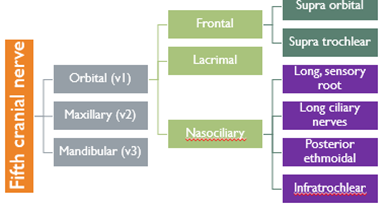
Describe the ophthalmic division (V1) of the trigeminal nerve.
Smallest branch, passes through the Superior Orbital Fissure. Divides into frontal (supplies forehead, upper lid, cornea), lacrimal (supplies lacrimal gland and conjunctiva), and nasociliary (supplies nasal cavity, iris, cornea) branches.
How is the sensory function of the trigeminal nerve clinically assessed?
Test light touch using a cotton wisp on forehead (V1), cheek (V2), and chin (V3). Test pain and temperature with a sharp object and cold tuning fork. Corneal reflex: Stimulating the cornea should trigger blinking.
How is the motor function of the trigeminal nerve assessed?
Test the masseter and temporalis muscles for strength and atrophy by palpating while the patient clenches their jaw. Test jaw jerk reflex for minimal jaw movement using a reflex hammer.
What are the main functions of the facial nerve 7th ?
Sensory: Taste from anterior 2/3 of the tongue.
Motor: Controls muscles of facial expression.
Parasympathetic: Innervates lacrimal glands (tears) and salivary glands.
What are the clinical manifestations of facial nerve dysfunction?
Facial paralysis, Bell's palsy (sudden onset facial paralysis on one side, caused by viral infection), and Ramsay Hunt Syndrome (herpes zoster infection affecting CN VII, causing facial paralysis and pain).
Describe the anatomy and pathway of the facial nerve.
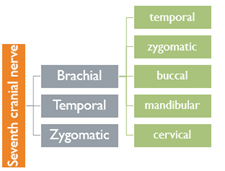
Nucleus located in the pons, dorsal and lateral to CN VI nucleus. Fascicular portion curls around CN VI, emerges between CN VI and CN VIII. Travels with nervus intermedius and CN VIII through internal auditory meatus, exits through stylomastoid foramen. Motor branches pass through parotid gland but do not innervate it.
How is the motor function of the facial nerve distributed?
Upper face (forehead, lids) innervated bilaterally by both contralateral and ipsilateral motor cortex. Lower face innervated only by the contralateral motor cortex.
How is the facial nerve clinically examined?
Inspect for facial asymmetry. Test muscle function: raise eyebrows, frown, close eyes tightly, smile, show teeth, puff cheeks. Check for sensory loss: test taste and stapedius reflex.
What are the differences between upper motor neuron (UMN) and lower motor neuron (LMN) lesions of the facial nerve?
LMN lesion: Affects all facial muscles ipsilateral to the lesion. UMN lesion: Affects only the lower face on the contralateral side, sparing forehead and eyelid muscles.
What are some other conditions associated with facial nerve dysfunction?
Crocodile Tears Syndrome, Blepharospasm, Hemifacial Spasm, Facial Myokymia.
What are the main functions of the vestibulocochlear nerve?
Sensory nerve responsible for hearing and balance. Vestibular nerve controls balance and spatial orientation. Cochlear nerve controls hearing.
What are the clinical manifestations of vestibulocochlear nerve dysfunction?
Hearing loss, vertigo, nystagmus, motion sickness, gaze-evoked tinnitus.
Describe the pathway of the vestibulocochlear nerve.
Vestibular and cochlear fibers enter the medulla oblongata.
Cochlear nerve ends at the organ of Corti, connecting to dorsal and ventral cochlear nuclei.
Vestibular nerve originates in vestibular ganglion in internal acoustic meatus.
Sensory endings found in semicircular canals, utricle, and saccule.
How is the vestibulocochlear nerve clinically assessed?
Hearing: Whisper numbers in each ear, test sound localization, use Rinne and Weber tests. Vestibular function: Test vestibular ocular reflex using Doll's Head maneuver.
What is an acoustic neuroma and how does it affect the vestibulocochlear nerve?
Acoustic neuroma (vestibular schwannoma) is a benign tumor affecting balance and hearing nerves, causing hearing loss, tinnitus, and imbalance. It typically occurs at the internal acoustic meatus and can also affect the facial nerve (CN VII) if large enough.