Medical Physics Midterm
 Call Kai
 Learn
Learn Practice Test
 Spaced Repetition
 Match
Match Flashcards
 Knowt Play
1/162

There's no tags or description
Looks like no tags are added yet.
Name | Mastery | Learn | Test | Matching | Spaced | Call with Kai | Chat |
|---|
No analytics yet
Send a link to your students to track their progress
163 Terms
What is the magnitude of the elementary charge?
e=1.602×10⁻¹⁹e
What does Coulomb's law describe?
The force between stationary electric charges
Who introduced the concept of the electric field?
Michael Faraday.
How is electric field defined?
Electric force per unit charge
In what direction do electric field lines point?
Away from positive charges and toward negative charges.
The electric field direction is defined using what type of test charge?
A positive test charge.
What produces magnetic fields?
Moving electric charges or electric currents
What does Faraday's law state?
A changing magnetic field induces an electric field
What is the magnetic force on a moving charge?

What is the total force felt by a charged particle in an electric and magnetic field

What produces electromagnetic radiation?
Accelerating electric charges.
The rate of energy transfer in an electromagnetic wave is described by ________
The pouting vector (s)

The rate of energy transfer in an electromagnetic wave points in the direction_________
That the wave propagates in
What fields are produced by stationary charges?
Electric fields only
What fields are produced by moving charges?
Magnetic fields
What was Maxwell's major prediction?
Electromagnetic waves travel at the speed of light.
How can we know there are only two types of electric charge?
When rubbed together, certain materials produce repeatable, observable forces of attraction and repulsion with each other.
Why does a balloon stick to your sweater after rubbing the two together?
The balloon receives extra electrons from the sweater's atoms, becoming charged.

Why must the test chargein the definition of the electric field be vanishingly small?
The test charge must be vanishingly small (essentially zero) so that it does not disturb the existing electric field.
Is the Earth's magnetic field parallel to the ground at all locations?
No. Like a bar magnet, the magnetic field lines enter and leave the Earth at the north and south poles.
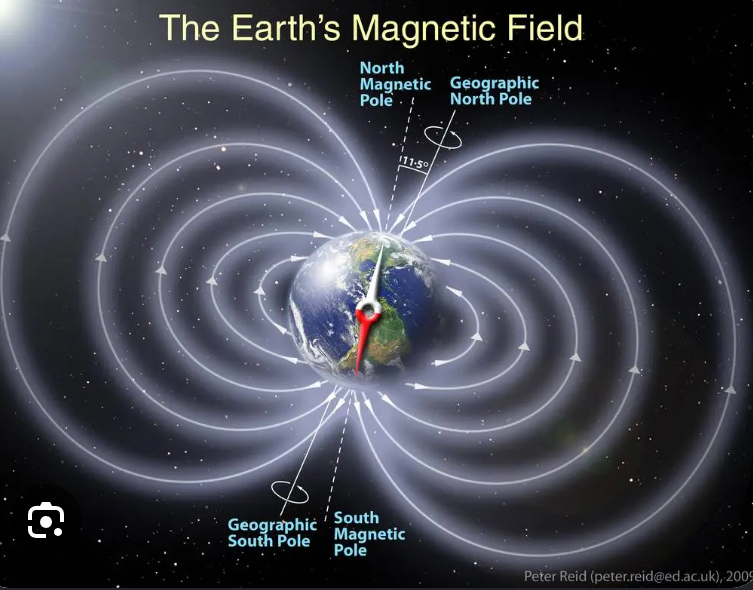
High-velocity charged particles can damage biological cells and are a component of radiation exposure in a variety of locations ranging from research facilities to natural background. Describe how you could use a magnetic field to shield yourself.
A protective magnetic field can change the course of charged particles, moving them away from working areas.
Why don't buildings block radio waves as completely as they do visible light?
The wavelength of radio waves can be comparable to the size of buildings; thus they can be diffracted around them.
Which type of electromagnetic wave is most often used for global internet communication?
Visible light (fiber optics)
What power is the prefix nano?
x10^-9

What power is the prefix mega?
x10^6
What power is the prefix giga?
x10^9
What power is the prefix milli?
x10^-3
The question: “Which of the following emfs has the highest photon energy” is equivalent to asking ________
Which of the emfs has the highest frequency
Order the different types of emfs from lowest to highest energy?
Radio → Micro → Infrared (IR) → Visible → UV → X-rays → Gamma rays

What does lambda max represent in weins law?
peak emission wavelength
ie. The wavelength at which a blackbody emits the mosts emf radiation
Based on wein’s law as the temperature of a blackbody increases, the wavelength at which the blackbody emits the mosts emf radiation _______
decreases

What does the stefan Boltzmann law state?
the total thermal energy (radiant power) emitted per unit surface area of a blackbody across all wavelengths is directly proportional to the fourth power of its absolute temperature
What does Planck's quantum hypothesis state?
energy is not emitted or absorbed continuously, but rather in discrete packets or bundles called quanta.
(a photon is an example of a quanta)
What was observed during the photoelectric effect?
The number of electrons ejected depends on the intensity(brightness), but not the frequency of the light
The intensity of light is a measure of?
The number of photons per second
What does the work function repersent?
The minimum amount of energy the photon needs to eject an electron from a surface of solid metal. (different metals have different work functions)
An electron in an atom jumps to a higher energy level when the atom _________
aborbs energy
When an electron jumps to a lower energy level the atom
emits energy
Explain what an emission spectra/absorption spectra are
Emission and absorption spectra represent the unique "atomic fingerprints" of elements, showing either the light released or the light absorbed when electrons jump between energy levels.
The kinetic energy of a partial moving through an electric field is giving by:
K=qV
(where V is the potential difference/voltage)
What is voltage?
Energy per unit charge (V=J/C)
What is the elementary mass and charge of an electron?
q = 1.602×10^-19 C, m = 9.109×10^-31 kg
What is an isotope?
Different atoms of the same element with different masses due to a different number of neutrons.
The rate of heat transfer to an object by radiation depends on the object's color. What color would be the most efficient ideal radiator and an ideal absorber of heat from electromagnetic radiation?
Deepest black |
Is visible light the only type of EM radiation that can cause the photoelectric effect?
No, any electromagnetic radiation of Higher energy can also cause the photoelectric effect.
Is the photoelectric effect a direct consequence of the wave character of EM radiation or of the particle character of EM radiation?
both
If you pick up and shake a piece of metal that has electrons in it that are free to move around as a electric current, no electrons fall out. Why?
You may be putting a huge amount of total energy into the object.
But that energy is spread over trillions upon trillions of atoms and electrons.
Each electron gets an extremely tiny amount of energy, nowhere near enough to overcome the work function.
T/F Electrons can only be removed from objects through rubbing via static electricity.
No, electrons can be removed by the photoelectric effect among other methods.
How did the Ruther ford experiment discredit the Thompson model of the atom
If the Thompson model was correct then most of the alpha particles that were shot through the metal should be deflected at small angles.
However in reality most particles past right through with no deflect while a few (that is the nucleus) were deflected at large angles.
Proving the existence of the nucleus
When an electron makes a transition from one stationary state to
another, the energy difference is given by:

When an electron makes a transition from one stationary state to
another the energy relased/abosrbed is in the form of _______
a single photon
The energy of a photon is given by:
E = hf
(thus the energy of a photon is proportional to it’s frequency)
What are the four quantum numbers?
n = energy level/ electron shell
l = Angular momentum quantum number
ml = Magnetic quantum number
ms = spin
Allowed values of the quantum number l?
0 - n-1
Allowed values of the quantum number ml?
-l … l
What are the subshells that correlate to each l value?
l = 0 → s
l = 1 → p
l = 2 → d
l = 3 → f
How man orbitals are in the s,p,d and f subshells?
s = 1 orbital
p = 3 orbitals
d = 5 orbitals
f = 7 orbitals
How many electrons per orbital?
2
What does z denote?
The atomic number of an element (number of protons)
In a neutral atom the atomic number (z) gives:
the number of electrons
In Bohr's theory of the hydrogen atom, if the electron moves from n=1 orbit to n=2 then
it needs an input of energy in the form of a photon
In the Bohr model of the hydrogen atom, the energy of electrons bound to their orbits are
negative with respect to the energy of an electron free and unbound to any atom.
In the Bohr model of the hydrogen atom, the energy of electrons bound to their orbits are given by:

How is the de Broglie wavelength of electrons related to the quantization of their orbits in atoms and molecules?
The de Broglie interpretation is a simple tool to help reconcile the "planetary orbit" view and the "particles are waves" view of electrons
The quantum number ml refers to what physical property?
The amount of angular momentum in the direction of an applied magnetic field
What causes a photon to be released from an atom?
an electron drops from a higher to a lower energy level
What is the energy of a photon?
E = hf
Why is there no 1p orbital?
For n = 1 L can only = 0
(Thus there is only a p subshell)
What is a characteristic x-ray?
A characteristic X-ray is an X-ray photon emitted when an electron from a higher energy shell falls into a vacancy in an inner shell of an atom. The photon's energy equals the difference between the two energy levels. It is called "characteristic" because each element produces X-rays with specific energies unique to that element.
How is a characteristic x-ray produced?
When an inner-shell electron is knocked out of the atom due to a highspeed electron striking the target atom.
What is a k-alpha x-ray?
An x-ray prodcued by the transtion of an electron from n=2 to n=1
What is a k-beta x-ray?
An x-ray produced when an electron transitions from n=3 to n=1.
Why are heavy elements used in x-ray tubes?
Their inner shell energy differences are large enough to produce x-rays.
(ie. the photon that gets emitted when an electron transitions from a higher to lower energy level has enough energy that it’s frequency is in the x-ray category)
What are the two sources of x-rays in an x-ray tube?
Chactersitic x-rays and Bremsstraglung
How are x-rays created basically?
Strong electric field accelerates electrons toward a high-Z anod, the electrons collide with anode atoms, knocking out inner-shell electrons of the atoms in the high-z metal.
When an inner electron from the inner shell is knocked out an electron from a higher orbital transitions to the inner shell to fill its place.
What does impact parameter (b) represent?
How far an electron fired at the high-z metal is from an atom of that metal.
When b » a
The electron will undergo a soft collision with the atom; only a small amount of energy will be transferred
to the orbital electrons
When b=a
the electron will undergo a hard collision with an orbital electron, and a large fraction of the kinetic energy will
be transferred
When b « a
the incident electron undergoes a radiative interaction with the nucleus: the electron will emit a photon with energy between zero and its initial kinetic energy.
What collision creates Bremsstrahlung radiation?
a « b
What collision creates characteristic x-rays?
a = b
When does the absorption of a photon occur in an atom?
Only when photon energy matches an energy level difference.
What is Rayleigh Scattering
When a photon changes direction slightly, no energy loss
What is Compton Scattering
Occurs when an x-ray photon collides with "free and stationary" orbital electron and the energy of the photon (hv) is much larger than electron binding energy. The photon is scattered at an angle (theta) with a new energy hv’.
What is a bigger problem for x-ray imaging compton or Rayleigh scattering?
Compton Scattering since in Rayleigh scattering the photon is only slightly deflected.
Compton Scattering is a ________ collsion
inelastic (energy is not conserved)
What is the probability of Rayleigh scattering?

What happens to the incident photon during the photoelectric effect?
Photon absorbed by tightly bound inner-shell electron after hitting the metal and a electron is ejected as a photoelectron with energy E_tr. (E_b is the binding energy)
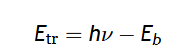
Probability of the photoelectric effect occurring?
Z³ / (hv)³
In general the probability of Rayleigh Scattering and the Photoelectric effect occurring ______ in higher z metals and _______ for photons of higher energy (hv).
In general the probability of Rayleigh Scattering and the Photoelectric effect occurring increases in higher z metals and decreases for photons of higher energy (hv).
Higher z-metals ________ x-rays
stop due to the photoelectric effect
What is the Auger Effect?
When an incident photon or electron knocks out inner-shell electron. A higher electron fills vacancy, but instead of emitting X-ray, energy transferred to another electron which is ejected (Auger electron)
What is pair production?
Occurs when a high energy photon hits the nucleus of an atom. When it hits it disappears completely, and in its place, two particles are created: an electron and a positron. (to balance out the electron).
The minimum photon energy required for pair production is _______

The minimum photon energy required for triplet production is _______

What is triplet production?
When pair production occurs in the field of an orbital electron, the
effect is referred to as triplet production since three particles are ejected the electron and its positron as well as the electron from the orbital.
Wen does the photoelectric effect vs compton scattering occur?
When the energy of the incident photon (hv) » the binding energy (E_b) compton scattering occurs
When hv = E_b the photoelectric effect occurs.
An electron transition within an atom that has sufficient energy change to create an X-ray would normally require the electron to end in which orbit?
n = 1
X-rays for for medical diagnostic procedures are produced by emitting electrons from a wire, and accelerating them with a high voltage until they collide with a metal target .
filament, anode
Why must the The glass enclosure of the X-ray tube contain a vacum?
Because otherwise the the electrons would hit and interact with the air molecules on the way from the cathode to the anode.