10th Grade Chemistry Unit 2: Atoms, Elements, & Periodic Table
 Call Kai
 Learn
 Practice Test
 Spaced Repetition
 Match
 Flashcards
 Knowt Play
1/45

There's no tags or description
Looks like no tags are added yet.
46 Terms

ATOM
Most basic/foundational form of all elements & matter
Composed of subatomic particles: protons, neutrons, & electrons
ALWAYS NEUTRAL
ELEMENT
118 of them
Pure substance that can’t be further broken down by ordinary chemical means
Made of atom(s)

PROTONS
POSITIVELY charged subatomic particles in an atom’s nucleus that determine which element something is

NEUTRONS
Uncharged subatomic particles in an atom’s nucleus that serve as a buffer between the nucleus’s protons to hold the nucleus together

ELECTRONS
NEGATIVELY charged & essentially MASSLESS subatomic particles
They exist unpredictably around the nucleus in orbitals
LOSS of them → Positive charge; GAIN of them → Negative charge

NUCLEUS
Very small but very dense core/center of an atom
Made up of protons & neutrons
Surrounded by electrons

DEMOCRITUS
Atomic Model: Atomos
“Atomos” Description: Indivisible, simplest form of matter that resembles the specific form/kind of matter it makes up by sharing its characteristics

DALTON
Atomic Model: Billiard Ball/Solid Sphere
“Billiard Ball/Solid Sphere” Description: Indivisible shape/form of all atoms that follows 5 postulates/rules
5 Postulates: 1) All elements have atoms. 2) Atoms of the same element are identical. 3) Atoms of different elements are different from each other. 4) Law of Definite Proportions. 5) Law of Conservation of Mass.
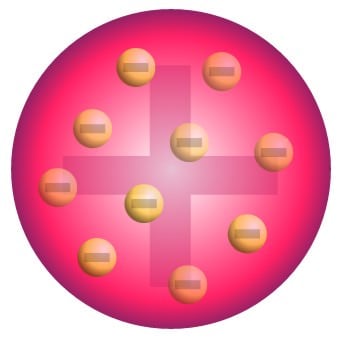
THOMSON
Atomic Model: Plum Pudding Model
“Plum Pudding Model” Description: Electrons randomly sprinkled in positively charged goo
Experiment: Cathode Ray Experiment
“Cathode Ray Experiment” Description: Charged gas in a sealed tube created a beam of light. When magnetic poles were held near this beam, it bent toward the positive north pole → Beam must be NEGATIVELY CHARGED. When electrode component was replaced w/different materials, negatively charged light beam still appeared → Negatively charged particles making up beam must exist in ALL MATTER. Negatively charged particles + existing in all matter = ELECTRONS

RUTHERFORD
Atomic Model: Vol. 1 Planetary Model
“Vol. 1 Planetary Model” Description: The nucleus is the small but dense center of an atom containing ONLY protons.
Experiment: Gold Foil Test
“Gold Foil Test” Description: A small opening on one of the faces of a steel cube faces a piece of gold foil surrounded by film. Inside the steel cube, alpha decay occurs. Positively charged alpha particles are spat out of the cube, through the small opening, straight at the piece of gold foil. Most of the time, upon striking the gold foil, the alpha particle’s trajectory will subtly change/angle itself. Sometimes, however, the alpha particle will rebound off the gold foil w/a drastic turn. The degree of the alpha particle’s trajectory change is interpreted from the stain that appears on the film after the alpha particle strikes it. Alpha particle’s POSITIVE charge being deflected/repelled → whatever alpha particle strikes in the gold foil is ALSO POSITIVELY CHARGED. Alpha particle only SOMETIMES striking the spot that elicits the drastic rebound → the concentrated positive-charge region is VERY SMALL, but VERY DENSE. Very small but very dense positively charged part of an atom? NUCLEUS!

CHADWICK
Atomic Model: Vol. 2 Planetary Model
“Vol. 2 Planetary Model” Description: The nucleus is the small but dense center of an atom containing protons AND NEUTRONS.
If protons were the only subatomic particle in the tightly packed nucleus, their repulsive force would tear the nucleus apart! → NEUTRONS must also exist in the nucleus to sit between protons, buffering their repulsive force.
If protons are the only subatomic particle in the nucleus, how come the nucleus’s mass is so high? → NEUTRONS must also exist in the nucleus to help contribute to the nucleus’s great mass.

BOHR
Atomic Model: Vol. 3 Planetary Model
“Vol. 3 Planetary Model” Description: The nucleus is the small but dense center of an atom containing protons and neutrons; IT IS SURROUNDED BY ORBITS UPON WHICH ELECTRONS OF DIFFERENT ENERGY LEVELS SIT.
Orbits/rings closer to the nucleus are the ones on which LOW-ENERGY electrons sit, the LOWEST energy electrons in a GROUNDED STATE sit on the orbit CLOSEST to the nucelus, and they have released energy to get here.
Orbits/rings further from the nucleus are the ones on which HIGH-ENERGY electrons sit; these electrons have absorbed energy and reached an EXCITED STATE.
By releasing and absorbing energy, electrons can jump from one orbit to another.
HEISENBERG
He used math to piece together the UNCERTAINTY PRINCIPLE
UNCERTAINTY PRINCIPLE
You can’t know an electron’s energy/speed and position at the same time
SCHRÖDINGER
Used math to calculate the likelihood of finding electrons in orbitals.
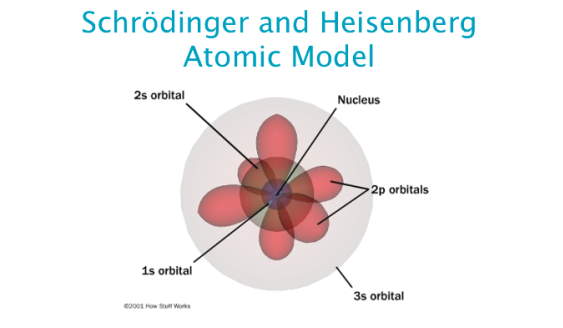
SCHRÖDINGER & HEISENBERG
Atomic Model: Quantum Mechanical Model
“Quantum Mechanical Model” Description: The nucleus is the small but dense center of an atom containing protons and neutrons; IT IS SURROUNDED BY ORBITALS THROUGHOUT WHICH ELECTRONS ARE LIKELY TO EXIST IN UNPREDICTABLE WAYS.
Because electrons can behave like particles AND waves, they’re behavior is not so predictable and neat as orbits from Bohr’s Planetary Model would have them be; instead, you can’t be too sure about their position if you know their energy level. And you can’t be too sure about their energy level if you know their position in an orbital.

ISOTOPE
A variant of an element w/a changed mass number & average atomic mass due to additional or missing neutron(s).

ATOMIC NUMBER (Z)
Number of protons in an element

MASS NUMBER (A)
Number of protons + Number of neutrons in an element
AVG. ATOMIC MASS/WEIGHT (amu)
Average of the masses of all an element’s isotopes using relative abundance % for calculations
DMITRI MENDELEEV
The guy who organized the modern and globally used periodic table of elements using atomic number, chemical properties, avg. atomic mass/weight, reactivity, number of valance electrons, etc.

PERIODIC TABLE
Compilation of the world’s 118 elements organized in rows, called periods/series, or in columns called families/groups.

IONS
Atoms or groups of atoms w/a positive or negative charge.

CATIONS
POSITIVELY-charged ions due to a LOSS of electrons

ANIONS
NEGATIVELY-charged ions due to a GAIN of electrons

METAL
80% of all elements on the periodic table exhibit the following traits: good conductivity, malleability, ductility, and luster.

CONDUCTIVE
Good at transferring heat & electricity

MALLEABLE
Able to be hammered into sheets

DUCTILE
Able to be pulled/coiled into wire
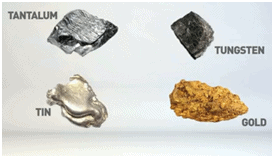
LUSTROUS
SHINY
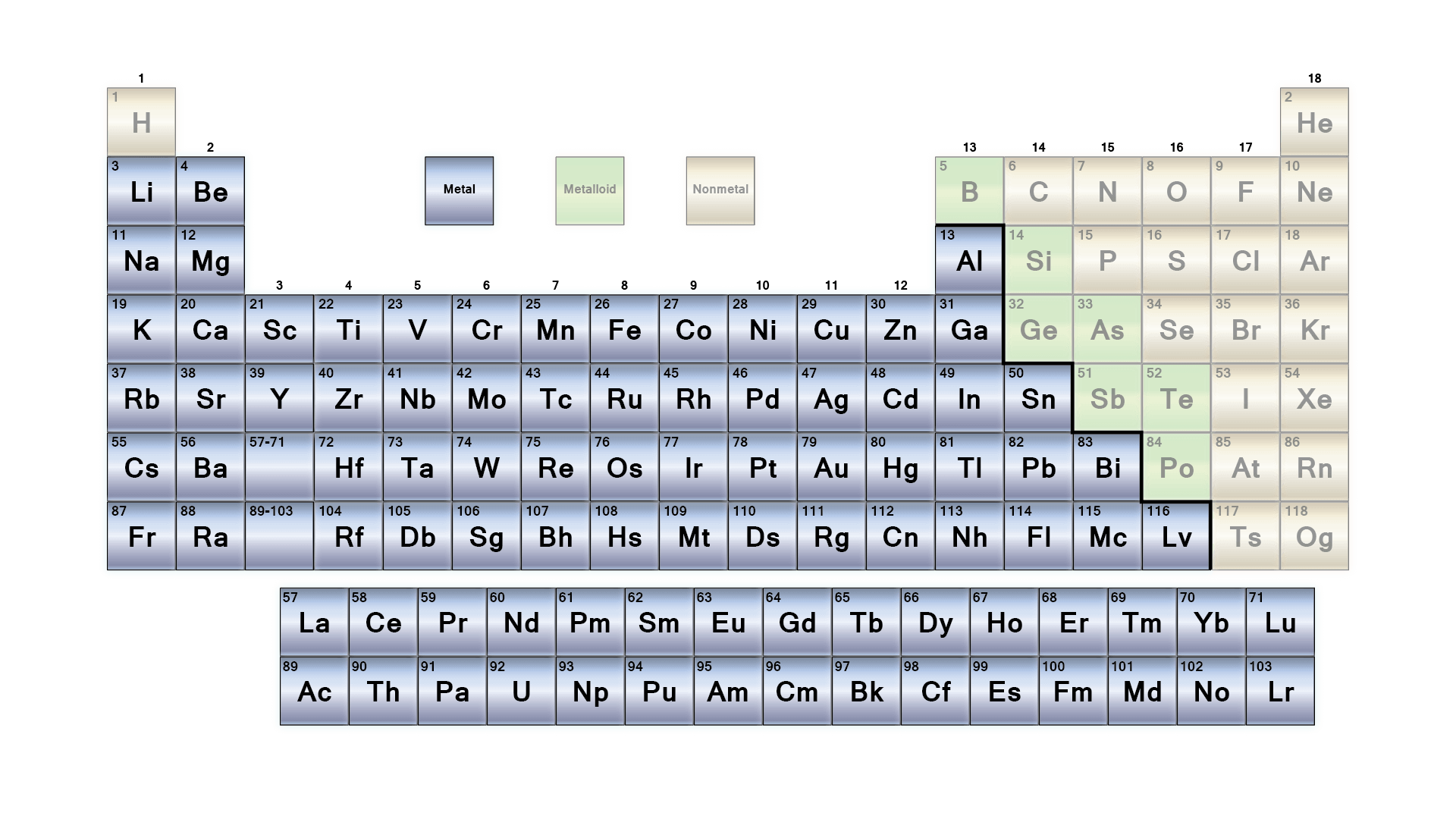
NON-METALS
Lack ALL the characteristics of a metal → LOW/BAD conductivity, brittle, & dull
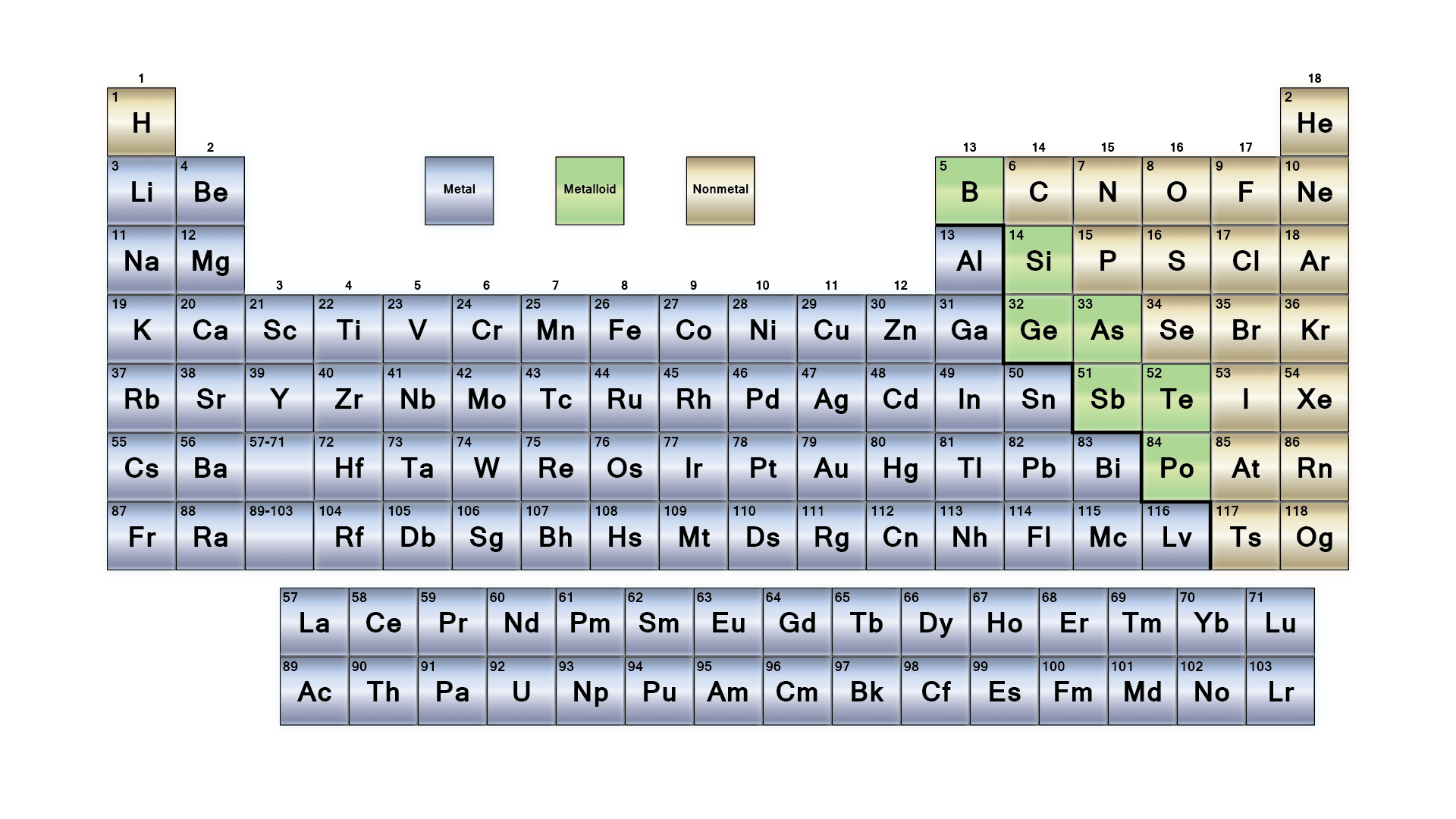
METALLOIDS/SEMI-METALS
7 or 8 elements on the periodic table that exhibit some of the traits of metals but not all of them

DIATOMIC ELEMENT
Element that naturally exists as a pair of twinning atoms
“Brincklhof”= Br, I, N, Cl, H, O, F

REPRESENTATIVE ELEMENTS
Elements that exhibit the full range of chemical properties.

TRANSITION ELEMENTS
Elements w/high melting pts, w/several oxidation states, make up colored compounds, and are paramagnetic.

STABLE
When the neutron:proton ratio is reasonable enough that the nucleus successfully holds itself together

RADIOACTIVE
A nucleus that is actively releasing gamma energy in order to relieve the inconvenient or iffy neutron:proton ratio.

FISSION
A bigger PARENT element decaying into smaller ones, a DAUGHTER element being among said smaller ones.

ALPHA DECAY
Parent Element = Alpha Particle + Daughter Element
The Alpha Particle is He-4, and the daughter element created as a result of this He-4’s release has a different mass number and obviously a different atomic number due to the Law of Conservation of Mass.

BETA DECAY
Parent Element = Beta Particle + Daughter Element
The Beta Particle is the electron part of a neutron that is massless and has negative charge.
A neutron had turned into a proton + an electron, which cancel to a neutron.
The additional proton increases the atomic number by 1 and the mass number remains UNCHANGED because protons and neutrons have about the same mass.

FUSION
Smaller elements combine to form bigger ones

GAMMA DECAY
All nuclear reactions emit gamma radiation to relieve instability/radioactivity of the nucleus.

POSITRON EMISSION
Nucleus w/too many protons turns one into a neutron → Mass number stays the same, but the atomic number decreases by one
A POSITRON and an ELECTRON NEUTRINO are yeeted out of the nucleus.

ELECTRON CAPTURE
Nucleus kidnaps an electron into the nucleus, where it hits a proton and turns into a neutron from the collision
Mass number stays the same, but the atomic number decreases by one
NUCLEOSYNTHESIS
Natural process that creates new atomic nuclei from protons and neutrons
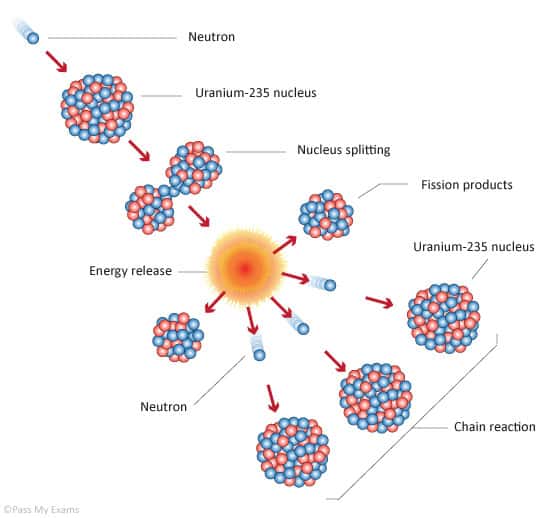
CHAIN REACTION
Initiate the self-sustaining sequence of chemical events by adding something to an already strained nucleus before letting the reaction to the rest.