Ch. 10 Behavioural Decision Theory
 Call Kai
 Learn
 Practice Test
 Spaced Repetition
 Match
 Flashcards
 Knowt Play
1/19

There's no tags or description
Looks like no tags are added yet.
20 Terms
expected utility theory
economic model explaining how people should think about risky decision in terms of gambles - suggests alternatives can be ranked from worst to best
gambles have to components: 1. probability, p and 2. value, v
the expected value (EV) of a gamble is (EV) = p x v
dominance principle of expected utility
alternative gambles can be ranked from best to worst in terms of expected value
A > B > C
transitivity principle of expected utility
preferences should be transitive
if you prefer A to B and B to C, then you must prefer A to C
invariance principle of expected utility
preference should remain invariant or stable, no matter how choices are described (framing)
cancellation principle of expected utility
the discarding of components that are shared by the prospective choices an focusing on the remaining unique features
simplifies the choice
behavioral decision theory
focuses on
risky decision making
decision making under uncertainty
to reduce uncertainty, consumers attempt to predict the future
unfortunately, the future is almost always uncertain
consumers predictions are often biased by:
framing effects
selective thinking
framing effects
preferences change when alternatives are described in terms of different frames or perspectives
the is in direct violation of the invariance principle
ie. administering a vaccine for an epidemic that is expected to kill 600 people, choice between two programs
program A: 100% chance that 200 people will be saved, or program B: 33% chance that all 600 will be saved, and 67% none will be saved
versus program A: 100% chance 400 people will die or program B: 33% chance that all 600 will be saved, and 67% none will be saved
more people choose A in the first framing, and B in the second
risk aversion vs risk seeking
people prefer the sure thing when problems are framed positively (saved lives
people prefer to take chances when problems are framed negatively (deaths)
this is a violation of the invariance principle, and makes people ignore the expected value (EV) of the options
expected utility theory and framing effects
expected utility theory cannot explain framing effects because they violate the invariance principle
perception is subjective and behaviour is often irrational
choice depends on:
positive vs negative framing
gains (saved loss, profits, price is less than expected)
loss (deaths, losses, price is more than expected)
reference points
reference points
you use points to book a flight, if you find out the person next to you paid $500 you’ll be happier than if you learned they paid $250
price you expect to pay for a beer at a local pub. vs at a hockey game, reference points based on the environment
prospect theory
descriptive model that helps explain systematic violations of the principles of rationality
demonstrates how people’s choices are not based on dollar values but on psychological values of outcomes
the psychological value depends on framing and reference points
three principles of prospect theory:
reference dependence
diminishing sensitivity
loss aversion
reference dependence
outcomes are judged against a neutral reference point
reference point can either be the status quo or an expectation
$18 seems like a lot to pay for a beer at a pub but not at a sports game
diminishing sensitivity
outcomes are weaker as distance from reference point increases
the subjective difference between $900 and $1000 seems smaller than the difference between $100 and $200
graph is curvilinear (concave for gaines and convex for losses)
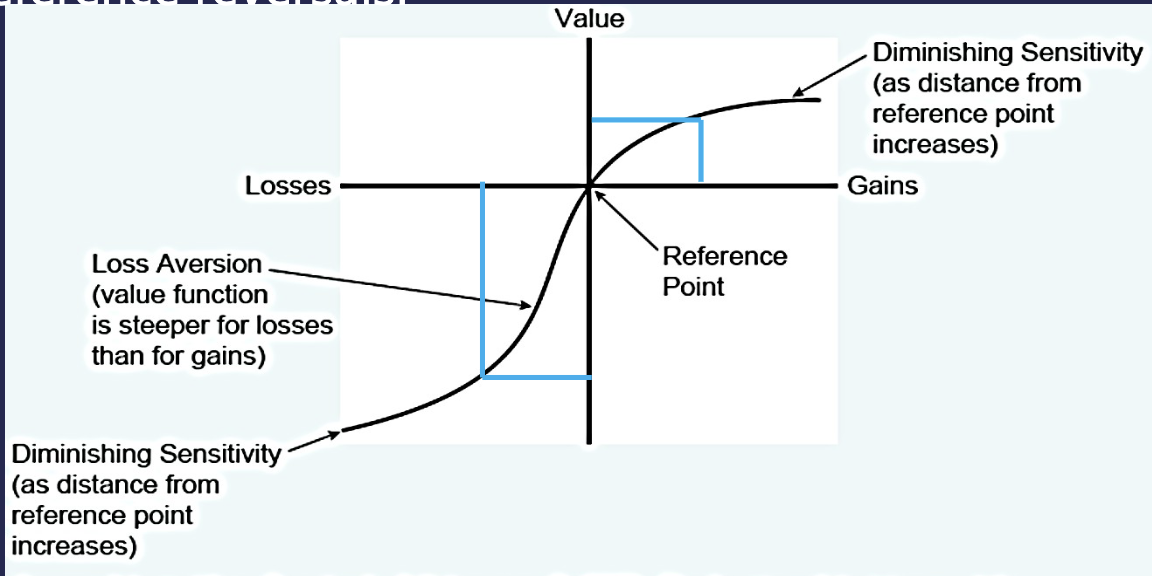
loss aversion
losses have a larger psychological effect than gains
losses are seen as threats and gains as opportunities
the pain from losing $100 is greater than the joy of winning $100
the slope is steeper for losses than gains at an equivalent distance from the reference point
nudge
a subtle aspect of the decision-making environment that helps people make better decisions
libertarian paternalism - people should have free choice, but choice options should be arranged in such a way that it helps people choose the best option
choice architects - decide how to frame, structure, and organize the choice options to help people make more informed decisions
endowment effect
the tendency to view a product as more valuable if one owns it
economic theories suggest that
willingness to accept (WTA) = willingness to pay (WTP)
but BTA tends to be higher than WTP due to loss aversion
WTA - selling an item is viewed as a loss of the item
WTP - buying an item is viewed as a gain of the item
examples: real estate, cars, etc. you will buy it at a lower price than you’d want to sell it for
sunk cost effect
costs that have already been incurred and cannot be recovered
as the amount of time or money invested in a project increases, people are more reluctant to give up the project, due to loss aversion
ie. a family has paid 40 for tickets to a game, it’s a snowstorm the day of the game, they go anyway but say that would have stayed home if the ticket were free
loss aversion and diminishing sensitivity
imply that you should
segregate gains
aggregate (combine) losses
many small gains are more pleasant than one large gain, and many small losses are more painful than one large loss
psychological accounting
people code or categorize their assets and costs in different mental accounts
people treat a tax refund, work bonus, or cash gifts as “free money” and blow it on luxury items or vacations
keeping $5000 in a low-interest saving account for a future vacation or house down payment while carrying a credit card balance at 20% interest, when it would be more beneficial to pay off the credit card
selective thinking (selective hypothesis testing, confirmation bias)
interpret ambiguous information as supportive of a preferred brand
focus selectively on supportive information
neglect unsupportive information
how a question is framed can influence whether the focus is on positive or negative features
asking to “choose” A or B, focus on positive attributes
asking to “reject” A or B, focus on negative attirbutes