AB2 Learning Objectives
 Call Kai
 Learn
Learn Practice Test
 Spaced Repetition
 Match
Match Flashcards
 Knowt Play
1/64

There's no tags or description
Looks like no tags are added yet.
Name | Mastery | Learn | Test | Matching | Spaced | Call with Kai | Chat |
|---|
No analytics yet
Send a link to your students to track their progress
65 Terms
Describe sources of cell injury with examples
External: UV and x-rays, temp extremes, chemicals and pollution, work and lifestyle, pathogens and infectious agents
Internal: aerobic respiration, proteolytic or oxidative enzymes (lysosomes), immune cells (neutrophils), reactive intermediates generated by metabolic pathways (endogenous like xanthine oxidase or exogenous like chemotherapies)
Consequences of macromolecular damage to macromolecule and cell function
Genetic modifications, protein aggregation, cell death, and structural and functional changes in the cell membrane
Autophagy process
Autophagy is an ancient defense mechanism against invading organisms. Microorganisms are engulfed and packaged into vacuoles (autophagosome), fused with a lysozyme, and destroyed by proteolytic cleavage and the autophagy pathway.
Explain how infection with pathogens can cause cell injury and damage due to the presence of pathogens
Bacterial Infection: bacteria compete with host for extracellular nutrients, bacterial metabolism impacts extracellular pH and compromises homeostasis, accumulation of waste products
Viral: Infection causes significant ER stress due to increased demand on protein synthesis
Explain how infection with pathogens can cause cell injury and damage from the immune systems attempt to resolve the infection
Antiviral defenses (interferon) restrict ER protein synthesis and shut down viral replication, which leads to accumulation of unfolded proteins and ER stress, activating the Unfolded protein response
Examples of pathogen strategies to overcome these protective pathways
prevent neutrophil respiratory burst by inhibiting NADPH oxidase activation
DNA damage repair pathways to detect and repair ROS damage bacterial DNA
Modulate ER function and autophagy
Dampen interferon activation of ER unfolded protein pathway
Bacterial chaperones to assist protein refolding
Have antioxidants and antioxidant enzymes to detoxify ROS
Reactive oxygen/nitrogen species
Unstable oxygen derivatives usually contain an unpaired electron. Important role in cell signaling, metabolism, gene expression, and host defense mechanisms. Highly reactive; steals electrons from other molecules.
Free radical
an unstable atom or molecule with at least one unpaired electron in its outer shell
Electrophile
an electron-deficient chemical species that accepts a pair of electrons from an electron-rich nucleophile to form a covalent bond
Oxidative damage
Radical lipid formation after attack from ROS and reactive molecules. Causes chain reaction of damage called lipid peroxidation where reactive lipids attack neighboring lipids to steal electrons
Lipid peroxidation
Chain reaction of damage where reactive lipids attack neighboring lipids to steal electrons
Protein adduct
complex formed when a reactive chemical species covalently binds to a protein
Protein aggregate
a collection of misfolded or unfolded proteins that stick together inside or outside the cell
Antioxidant
any substance that significantly delays or prevents the oxidation of crucial cellular molecules like DNA, proteins, and lipids by neutralizing harmful free radicals.
Chaperone (cell bio)
a group of proteins that help other proteins fold correctly, prevent them from clumping together, and assist with their movement or breakdown inside the cell
Heat shock protein
a family of stress-induced molecular chaperones found in all living cells that help maintain protein folding and prevent cellular damage
Proteasome
a large protein complex inside cells that breaks down unneeded, damaged, or misfolded proteins into small peptide pieces through proteolysis
Lysosome
a membrane-bound cell organelle that holds digestive enzymes to break down waste
Unfolded protein response
a cellular stress-signaling pathway activated by eukaryotic cells to manage the accumulation of unfolded or misfolded proteins in the lumen of the endoplasmic reticulum
Respiratory burst
a rapid, short-term increase in oxygen consumption by cells that produces large amounts of reactive oxygen species to kill engulfed pathogens
Types of cell death
Necrosis: hard and fast death caused by acute injury or excessive stress
Apoptosis: Programmed and controlled cell death that is important for many physiological processes
Compare and contrast the cellular phenotype of reversible vs irreversible cell damage

Contrast necrosis vs apoptosis
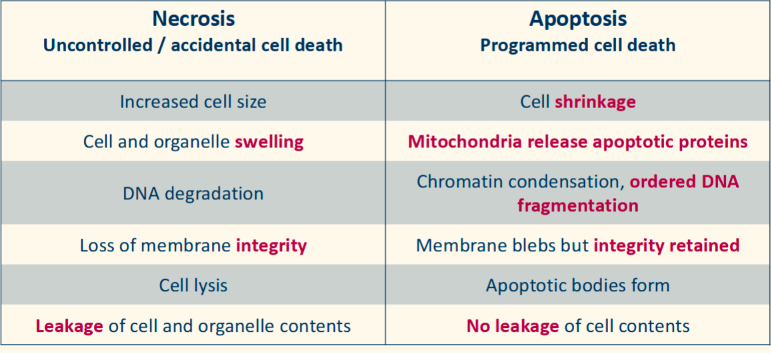
Importance of caspase cascades in apoptotic cell death
Start the apoptotic process using very specific enzymes then catalyse the widespread cleavage of proteins to kill the cell. Caspases are kept as inactive precursors to prevent unwated activation of cascade.
Similarities between intrinsic and extrinsic apoptotic pathways
Both cleave thousands of proteins and cell adhesions, shrink and bled, and irreversibly fragment DNA, nuclear envelope, and cytoskeleton. Both start after cytochrome C is released by the mitochondria which triggers formation of apoptosome and the start of apoptosis.
Differences between intrinsic and extrinsic apoptotic pathways
Extrinsic also has the death receptor that triggers the disc complex to gather enzymes together, releasing caspase 8 and beginning apoptosis
Role of immune system in clear up of apoptotic and necrotic cell death
Apoptopic cells attract phagocytes using soluble mediators and signals they are ready to be eaten using PS receptors.
Necrotic cells’ debris contains DAMPS which are recognized by the immune system, allowing for macrophages to locate and phagocytose the DAMPS and cell debris
Types and severity of damage that will elicit apoptotic cell death
Mainly preventative, removing potentially harmful cells. EX: eliminating auto-reactive B and T cells, T-cells with strong reaction to self antigens, interdigital remodeling
Types and severity of damage that will elicit necrotic cell death
Acute injury or excessive stress such as heat, irradiation, loss of oxygen, infection, etc. For extensively injured cells that are damaged beyond repair
Bleb
a spherical, blister-like bulge or protrusion of the plasma membrane caused by the localized decoupling of the cytoskeleton from the cell membrane
Karyohexis
fragmented nuclear DNA
Pyknosis
irregular and irreversible condensation of nuclear DNA
DAMPS
Damage-associated molecular patterns
Caspase
contain a cysteine at their active site and cleave proteins after aspartate residues
Initiator caspase
start the apoptotic process
Executioner caspase
catalyse the widespread cleavage of proteins to kill the cell
Cytochrome C
a small heme-containing protein found in the mitochondrial intermembrane space that shuttles electrons during cellular respiration and triggers cell death when released into the cytosol
Apoptosome
a large, wheel-shaped protein complex that forms inside a cell during the intrinsic pathway of programmed cell death
Bcl-2
Anti-apoptotic protein that prevents inappropriate release of cytochrome C from mitochondria
Bax and Bak
Pro-apoptotic proteins that punch pores in the mitochondrial membrane to the let cytochrome C escape
Phosphatidylserine
a major negatively charged phospholipid found mainly in the inner cytoplasmic leaflet of eukaryotic cell membranes
Neoplasia
The process of abnormal growth of a tissue into a mass
Tumour def
An abnormal growth of tissue into a mass. Can be benign or malignant
Cancer def
a malignant tumour which has the capacity for both local invasion and distant spread by the process of metastasis
Oncology def
a branch of medicine that specializes in the diagnosis and treatment of cancer
Carcinogens def
agents that promote cancer
Metastasis def
spread of cancer cells from the primary tumour to another part of the body
Oncogene def
mutated version of proto-oncogene which causes cells to grow and divide uncontrollably
Tumour suppressor gene
aka anti-oncogenes. a normal gene that encodes a protein to slow down cell division, repair DNA mistakes, or tell cells when to die through apoptosis
Features which distinguish between benign and malignant tumours

Describe what causes cancer
Cells have undergone genetic changes that allow them to be unresponsive to growth controls and expand beyond anatomical boundaries. Inherited mutations, multiple mutations, and acquired somatic mutations can all cause cancer.
Explain multistage progression and evolution of cancer
Initiation and promotion go very slowly while progression is a rapid onset that is hard to stop

Direct clinical consequences of neoplasia
compression of tissues and blood vessels
blockage of tubular structures
organ rupture
organ failure
haemorrhage
tumour emboli
Indirect clinical consequences of neoplasia
paraneoplastic syndromes
Classes of parasites
Protozoans, helminths, arthropods
Classes of helminths
Nematodes (roundworms), trematodes (flatworms), cestodes (tapeworms)
Classes of arthropods
insects, ticks, mites
Reproductive mechanisms in parasites
High production → low survival
Low production → high survival
Causes of overdispersed distribution of parasites
variability in host susceptibility/immune competence
most parasitic diseases are endemic so host populations consist of acquired immunity, poor immunity, and no immunity
environmental factors
Harms associated with parasites
pruritic stress (itching)
biting nuisance
acute inflammatory response
physical damage of host tissues and organs
competition for resources
transmission of other pathogens