Astronomy
0.0(0)
Studied by 0 people Call Kai
 Learn
Learn Practice Test
 Spaced Repetition
 Match
Match Flashcards
 Knowt Play
Card Sorting
1/62

Earn XP
Last updated 8:54 PM on 2/6/23
Name | Mastery | Learn | Test | Matching | Spaced | Call with Kai | Chat |
|---|
No analytics yet
Send a link to your students to track their progress
63 Terms
1
New cards
(3) A planet moves fastest when it is ___________________ to the Sun and slowest when it is ___________________ from the Sun.
closest; farthest
2
New cards
(3) Each ellipse has two foci. At one focus is the ______________________. At the other focus is ________________________.
Sun; nothing
3
New cards
(3) A planet with a period of 84 Earth years has an orbit that is _______________________ than a planet with an orbit of 1 Earth year.
much larger
4
New cards
(3) Suppose you are driving a car, and a coffee cup is on the seat beside you. Rank, in increasing order, the speed of the coffee cup in the reference frame of the following:
\
* An observer in an oncoming car
* You, the driver
* An astronaut on the International Space Station
* An observer on the side of the road
\
* An observer in an oncoming car
* You, the driver
* An astronaut on the International Space Station
* An observer on the side of the road
slowest to fastest
* You, the driver
* An observer on the side of the road
* An observer in an oncoming car
* An astronaut on the International Space Station
* You, the driver
* An observer on the side of the road
* An observer in an oncoming car
* An astronaut on the International Space Station
5
New cards
(3) Suppose you are transported to a planet with twice the mass of Earth, but the same radius of Earth. Your weight would __________ by a factor of __________.
increase; 2
6
New cards
(3) Place the following in order from largest to smallest semimajor axis:
\
* A planet with a period of 1 Earth year
* A planet with a period of 84 Earth days
* A planet with a period of 2 Earth years
* A planet with a period of 0.5 Earth year
\
* A planet with a period of 1 Earth year
* A planet with a period of 84 Earth days
* A planet with a period of 2 Earth years
* A planet with a period of 0.5 Earth year
largest to smallest
* A planet with a period of 2 Earth years
* A planet with a period of 1 Earth year
* A planet with a period of 0.5 Earth year
* A planet with a period of 84 Earth days
* A planet with a period of 2 Earth years
* A planet with a period of 1 Earth year
* A planet with a period of 0.5 Earth year
* A planet with a period of 84 Earth days
7
New cards
(3) The connection between gravity and orbits enables astronomers to measure the __________ of stars and planets.
masses
8
New cards
(3) What is the eccentricity of a circular orbit?
0
9
New cards
(3) A net force must be acting when an object?
* changes direction but not speed
* changes speed and direction
* changes speed but not direction
* accelerates
\
Acceleration can occur with a change in speed or direction
* changes speed and direction
* changes speed but not direction
* accelerates
\
Acceleration can occur with a change in speed or direction
10
New cards
(3) Imagine that you are floating on the International Space Station, tossing a bag of dried ice cream to a fellow astronaut. Which of the following are action-reaction pairs?
\
* Earth pulls on the space station; the space station pulls on Earth
* Earth pulls on the ice cream; the ice cream pushes on your fellow astronaut.
* You push on the ice cream; the ice cream pushes back on you
* Earth pulls on you; you pull on Earth
\
* Earth pulls on the space station; the space station pulls on Earth
* Earth pulls on the ice cream; the ice cream pushes on your fellow astronaut.
* You push on the ice cream; the ice cream pushes back on you
* Earth pulls on you; you pull on Earth
* Earth pulls on the space station; the space station pulls on Earth
* You push on the ice cream; the ice cream pushes back on you
* Earth pulls on you; you pull on Earth
* You push on the ice cream; the ice cream pushes back on you
* Earth pulls on you; you pull on Earth
11
New cards
(3) Imagine a planet moving in a perfectly circular orbit around the Sun. Is this planet experiencing acceleration?
Yes. It is changing its direction of motion all the time
12
New cards
(3) Suppose a piece of rock enters Earth’s atmosphere, traveling to your left as a bright streak in the sky. The rock explodes, and a piece of it goes in a direction opposite the motion of the original rock. In your reference frame,
the small piece travels to the right
13
New cards
(3) Suppose you read on the Web that a new planet has been found. Its average speed in its orbit is 33 kilometers per second (km/s). When it is closest to its star, it moves at 31 km/s, and when it is farthest from its star, it moves at 35 km/s. This story is in error because
Kepler’s second law says the planet must move fastest when it is closest, not when it is farthest away.
14
New cards
(3) Imagine that you are standing on the (airless) Moon, and you drop four objects, each the size of a bowling ball. Each is made of a different substance. One object is a pumpkin, and the others are made of Styrofoam, lead, or bubble wrap. In what order do they reach the ground?
None of the answers is correct; the objects all reach the ground at the same time.
15
New cards
(3) Suppose a planet has a mass 100 times greater than the mass of its moon. How does the force of the planet on the moon compare to the force of the moon on the planet?
Both forces have the same strength.
16
New cards
(3) When a ball is tossed in the air and reaches the top of its arc, which of the following quantities are zero?
* the velocity of the ball
* the speed of the ball
* the speed of the ball
17
New cards
(3) In the video, the loaded car accelerated less than the unloaded car when the same force was applied. This was noticeable because the loaded car
* was traveling less quickly after a little time had passed
* reached the end of the track more slowly
* reached the end of the track more slowly
18
New cards
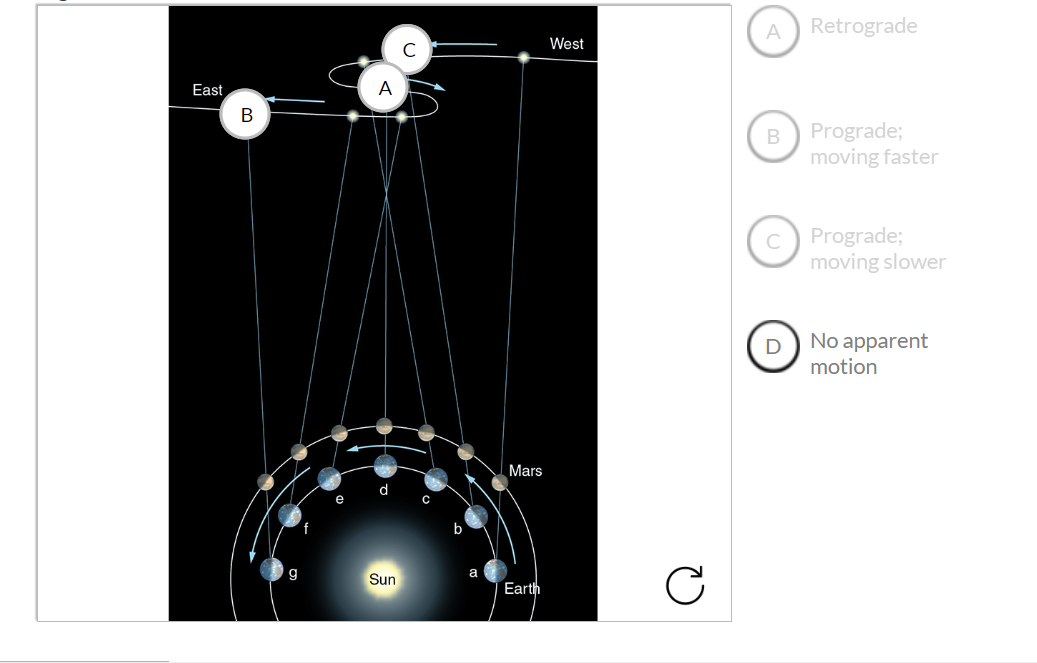
(3) Label each marked position of Mars with the phrase that most accurately describes its apparent motion in our sky against the background stars.
Left to right
B, A, C
B, A, C
19
New cards
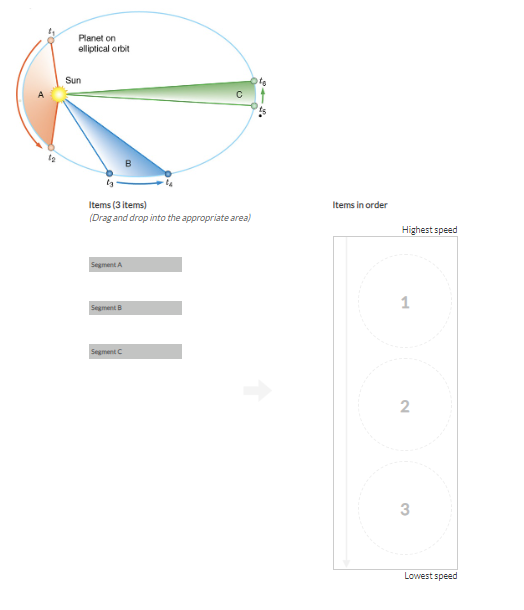
(3) The planet in the diagram shown is in an elliptical orbit around the Sun. Rank the average orbital speed of the planet at each shaded orbit segment. The areas in segments A, B, and C are equal.
Highest speed to lowest
* segment a
* segment b
* segment c
* segment a
* segment b
* segment c
20
New cards
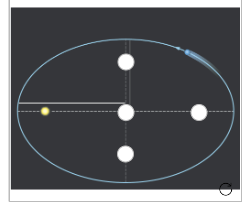
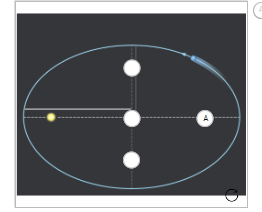
(3) The following diagram shows an elliptical orbit of a planet around a star. The star (Sun) is at a focal point of the ellipse. Determine where the second focal point is.
\
\
across from the first focal point
21
New cards
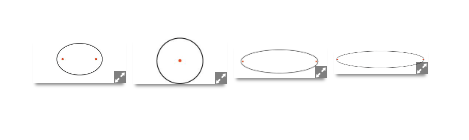
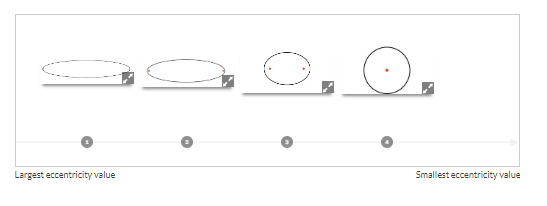
(3) Put these four shapes in order from largest to smallest eccentricity value.
22
New cards
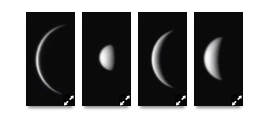
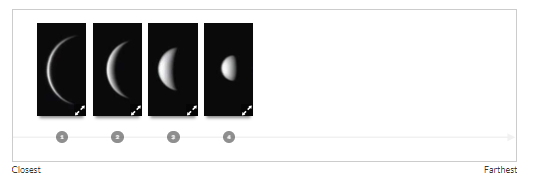
(3) Rank the distance of Venus from Earth, from closest to farthest, based on the images given.
23
New cards
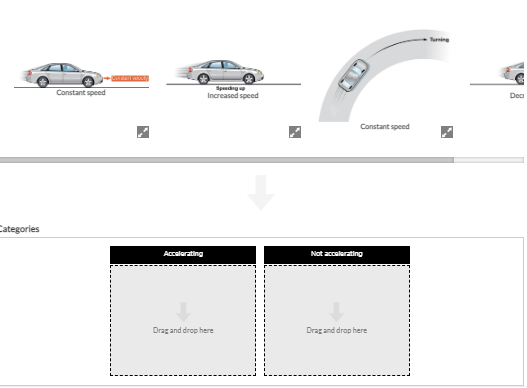
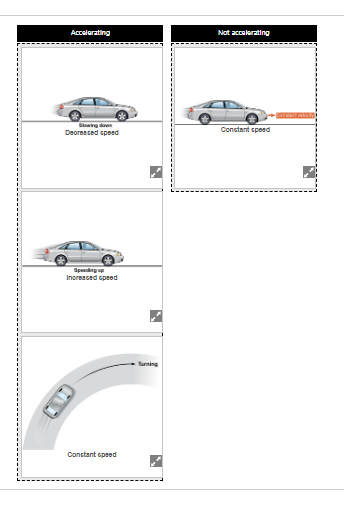
(3) Sort each scenario into the category indicating whether or not the car is accelerating.
24
New cards
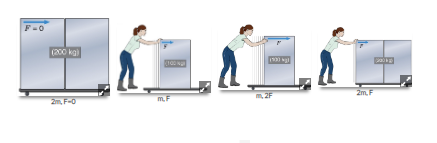
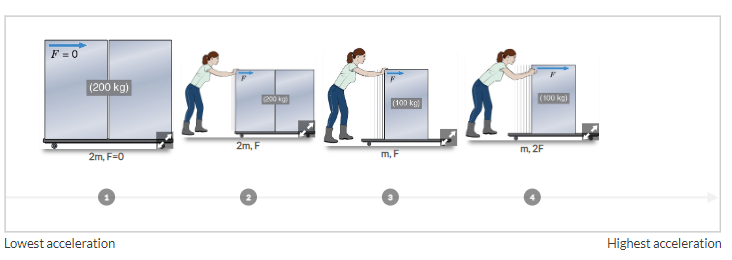
(3) Rank each object being pushed in order of increasing acceleration.
25
New cards
(3) Astronauts in a space shuttle can float while orbiting Earth. Why are these astronauts weightless?
They are falling around Earth at the same rate as the shuttle.
26
New cards
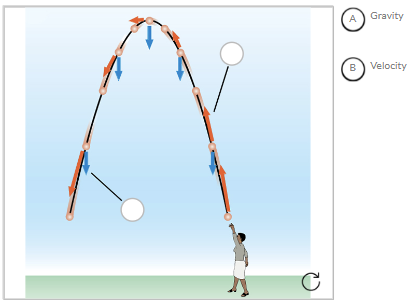
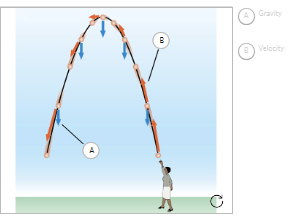
(3) In the following diagram, label the gravitational force and velocity on the corresponding vector arrows.
27
New cards
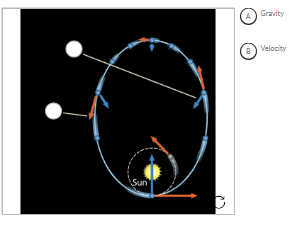
(3) In the following diagram, label the gravitational force and velocity on the corresponding vector arrows.
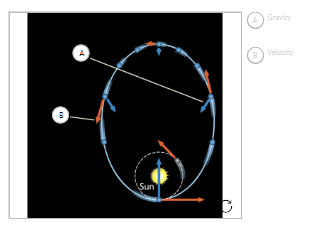
28
New cards
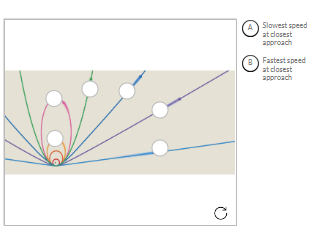
(3) Which of the selected orbits have the greatest and the lowest closest-approach speed?
unbound are the fastest
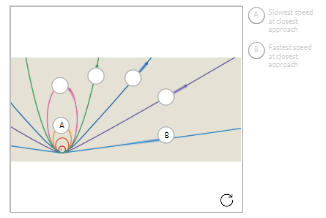
29
New cards
(3) Newton’s second law says that the acceleration (*a*) of an object depends on its mass (*m*) by the equation: \n \n
a=(F/m)
\n \n *F* is the force that is causing the object to accelerate. In the case of dropping objects from a height, the force that causes them to accelerate toward the Earth is gravity. If the acceleration of objects dropped from a height does not depend on the object’s mass (as shown by Galileo’s experiment), what does this imply about the force of gravity?
a=(F/m)
\n \n *F* is the force that is causing the object to accelerate. In the case of dropping objects from a height, the force that causes them to accelerate toward the Earth is gravity. If the acceleration of objects dropped from a height does not depend on the object’s mass (as shown by Galileo’s experiment), what does this imply about the force of gravity?
The force of gravity increases with increased mass.
30
New cards
(3) How does the heliocentric model explain the retrograde motion of Mars? *Tip: It may be helpful to review the interactive diagram from the previous question.*
The heliocentric model explains retrograde motion because Mars only appears to move backwards as Earth passes it in its orbit around the Sun.
31
New cards
(3) Newton developed a universal law of gravitation that can be used under most circumstances, not just for objects on the surface of the Earth. Here is the law: \n \n F=G((m1 m2)/r^2) where *G* is a constant. \n \n Think about what happens when you increase and decrease each of the variables in Newton’s equation for the gravitational force between two objects of mass *m*1 and *m*2, a distance *r* from one another. \n \n Given your results, what is the likely cause of Kepler’s observation that planets travel faster when they are closer to the Sun?
The force of gravity is stronger closer to the Sun.
32
New cards
(3) Watch the __AstroTour on Kepler's Laws__, focusing on Kepler’s third law of planetary motion. What is this law useful for?
Predicting planetary positions as a function of time.
33
New cards
(3) If you went to Mars, your weight would be ______ and your mass would be ______.
less; the same
34
New cards
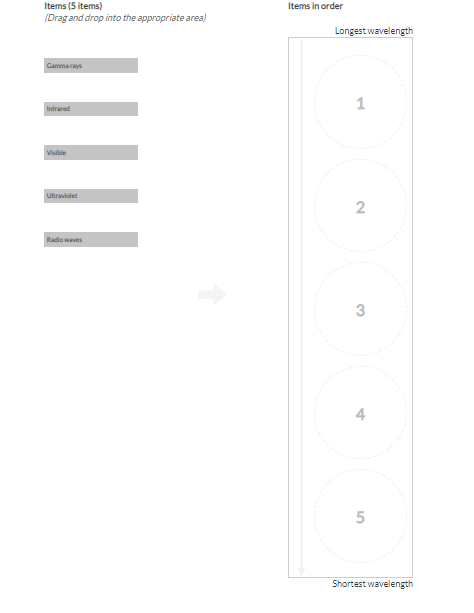
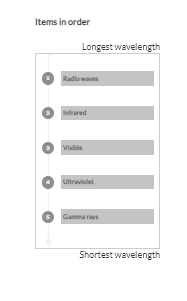
(4) Rank the following in order of decreasing wavelength.
35
New cards
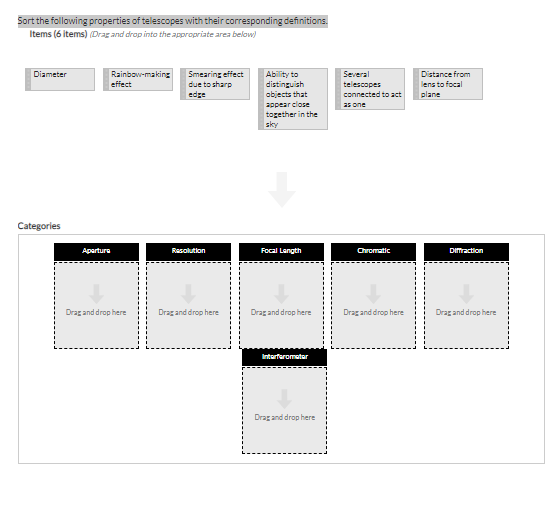
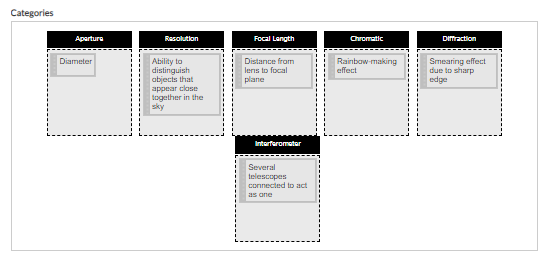
(4) Sort the following properties of telescopes with their corresponding definitions.
36
New cards
(4) Which of the statements below is **true** about the speed of light?
* As light travels, it carries energy from place to place
* The speed of light through a substance such as air or glass is less than 3 x 10^8 m/s
* The speed of light in a vacuum is a fundamental constant designated as “c”
* The speed of light through a substance such as air or glass is less than 3 x 10^8 m/s
* The speed of light in a vacuum is a fundamental constant designated as “c”
37
New cards
(4) A light wave does not require:
a medium
38
New cards
(4) The amplitude of a light wave is related to its:
brightness
39
New cards
(4) Which of the following can be observed from Earth’s surface?
* visible light
* radio waves
* radio waves
40
New cards
(4) Which of the following regions of the electromagnetic spectrum has the lowest-energy light?
radio
41
New cards
(4) The advantage of an interferometer is that
the resolution is dramatically increased.
42
New cards
(4) The angular resolution of a ground-based telescope is usually determined by
atmospheric seeing
43
New cards
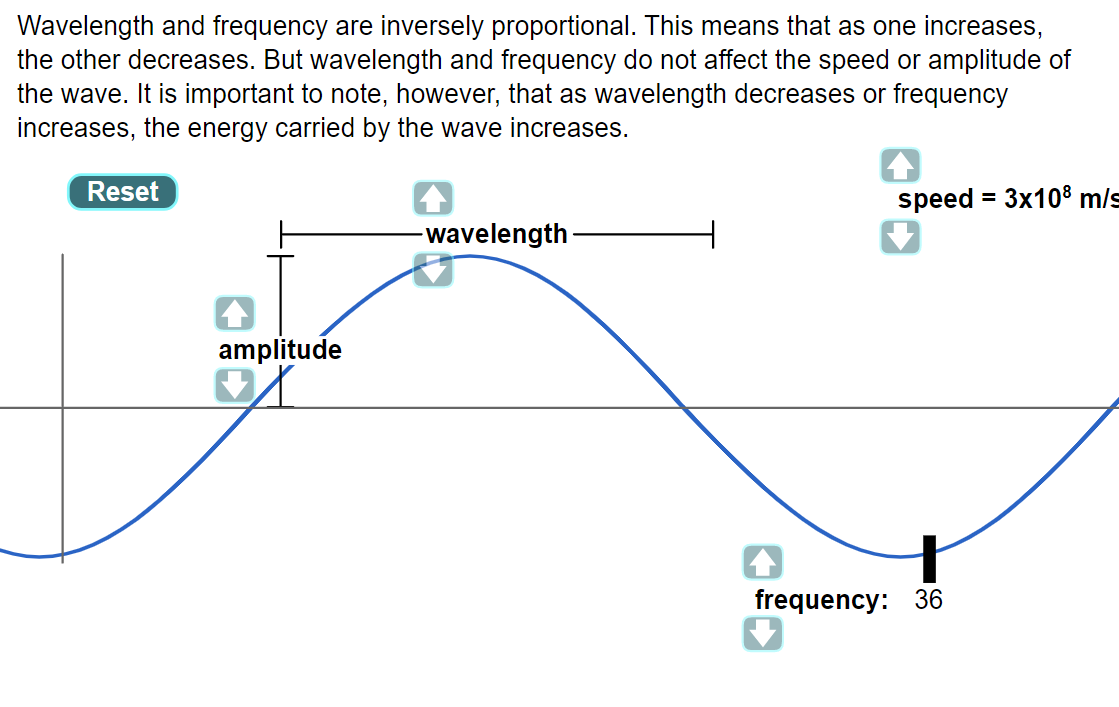
(4) Increase the wavelength, using the arrow key. What happens to the rate of the frequency counter?
The rate of the frequency counter decreases.
44
New cards
(4) Reset the simulation, and increase the frequency. Did the wavelength change in the expected way based on the relationship between wavelength and frequency?
Yes. The wavelength decreased as expected.
45
New cards
(4) Is the amplitude related to the wavelength or frequency?
The amplitude is not related to the wavelength or the frequency.
46
New cards
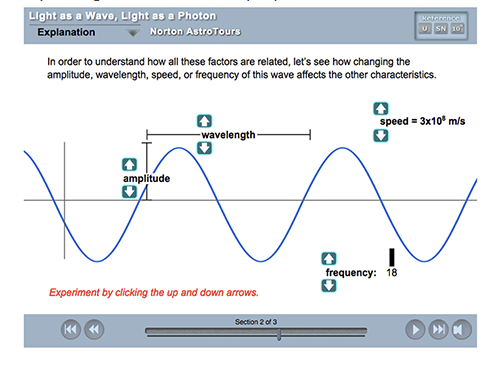
(4) Choose all of the effects that would automatically happen if the wavelength of light were *increased*.
* The frequency of the light would decrease
* The energy of the light would decrease
* The energy of the light would decrease
47
New cards
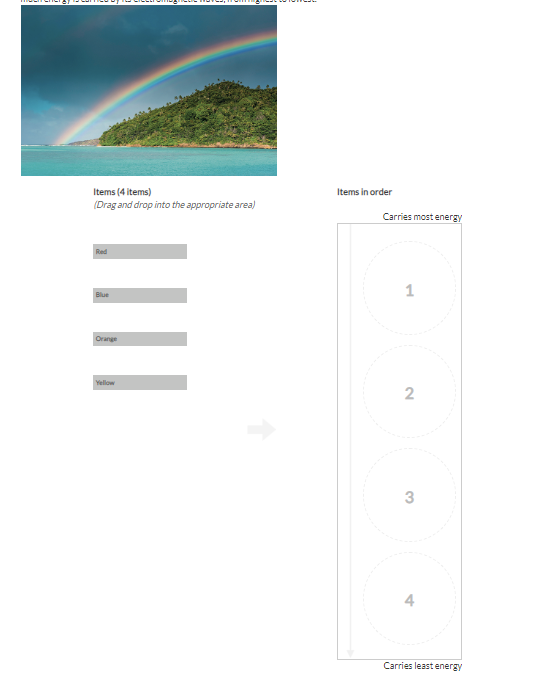
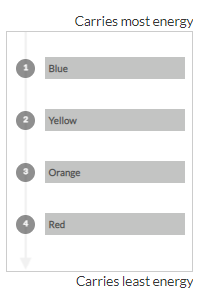
(4) The bright, colorful "stripes" of a rainbow such as the one shown here follow a particular order. Rank each color of the rainbow by how much energy is carried by its electromagnetic waves, from highest to lowest.
Most energy to least
* Blue
* Yellow
* Orange
* Red
* Blue
* Yellow
* Orange
* Red
48
New cards
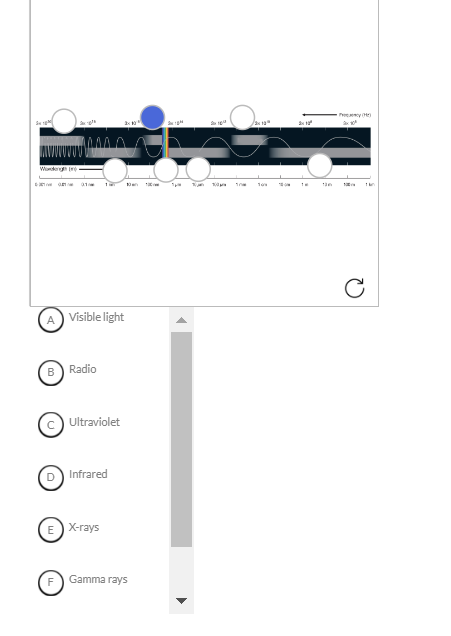
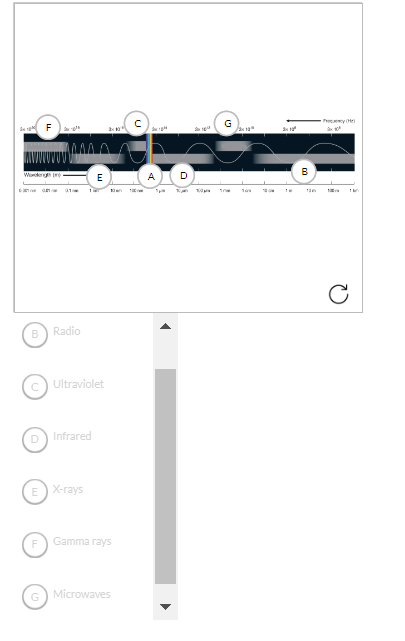
(4) Place the names of the types of radiation in their correct places in the EM spectrum. (You may have to scroll to see all options.)
Left to Right
* Gamma rays
* X-rays
* Ultraviolet
* Visible light
* Infrared
* Microwaves
* Radio
* Gamma rays
* X-rays
* Ultraviolet
* Visible light
* Infrared
* Microwaves
* Radio
49
New cards
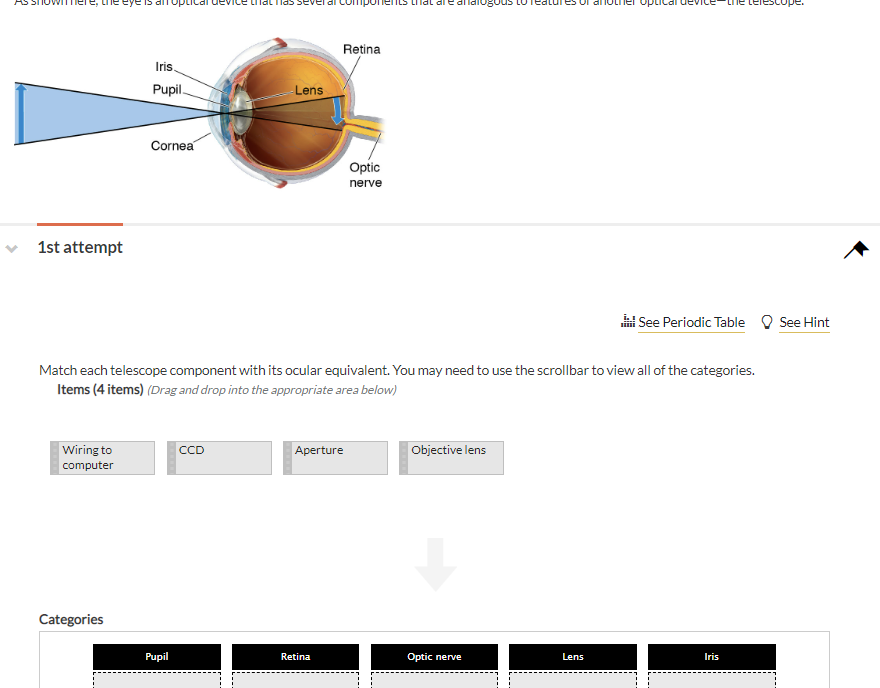
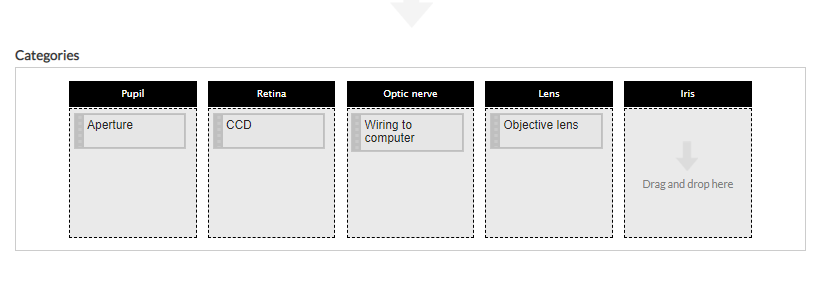
(4) Match each telescope component with its ocular equivalent. You may need to use the scrollbar to view all of the categories.
50
New cards
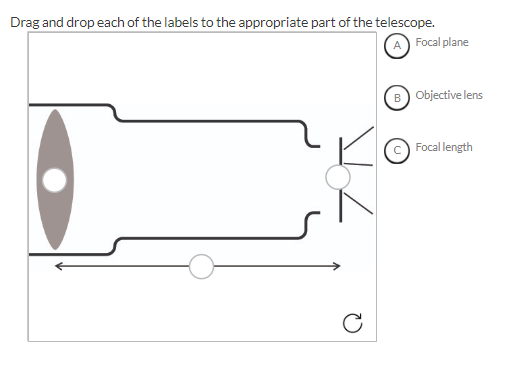
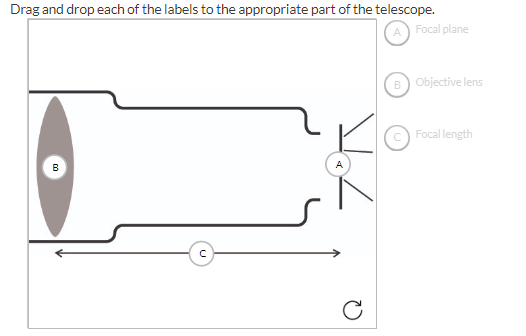
(4) Drag and drop each of the labels to the appropriate part of the telescope.
51
New cards
(4) Why is the Hubble Space Telescope in space instead of on the ground?
* It avoids atmospheric distortion
* It observes in the UV
* It observes in the UV
52
New cards
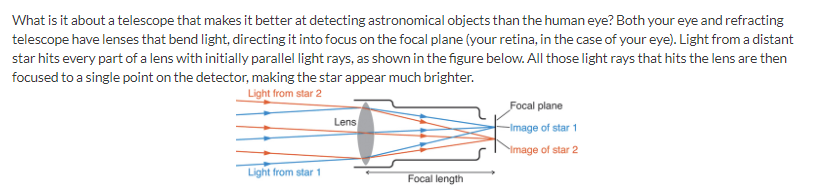
(4) Imagine *decreasing* the size of the lens in the figure above. Which choice below best describes what would happen?
Less total light from the source will hit the lens, making it appear fainter on the detector.
53
New cards
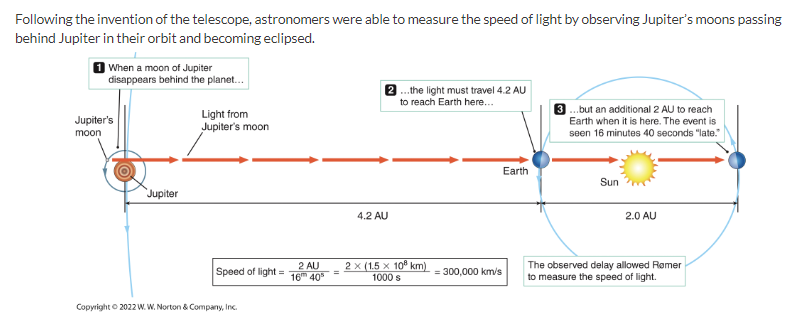
(4) Study the figure, which shows how someone on Earth can view Jupiter’s moon's eclipses when Earth is closer to or farther from Jupiter, and determine which of the following are correct.
* If light has infinite speed, an eclipse would be seen to happen at the same time regardless of how far away Earth is from Jupiter.
* If light has finite speed, it would take longer for it to travel from Jupiter to Earth when Earth is farther from Jupiter.
* If light has finite speed, it would take longer for it to travel from Jupiter to Earth when Earth is farther from Jupiter.
54
New cards
(4) Larger lenses in telescopes offer better resolution. Resolution is defined as the closest angular distance two objects can be apart from one another before their light merges together and they look like just one object. Therefore, *smaller* resolutions are *better* (closer objects can be separated). \n \n The resolution of the human eye is 1 arcminute, or 1/60th of a degree. If the light of two street lamps in the distance is separated by 0.5 arcminute, what will you see with your eyes?
A single light, with the combined brightness of each street lamp
55
New cards
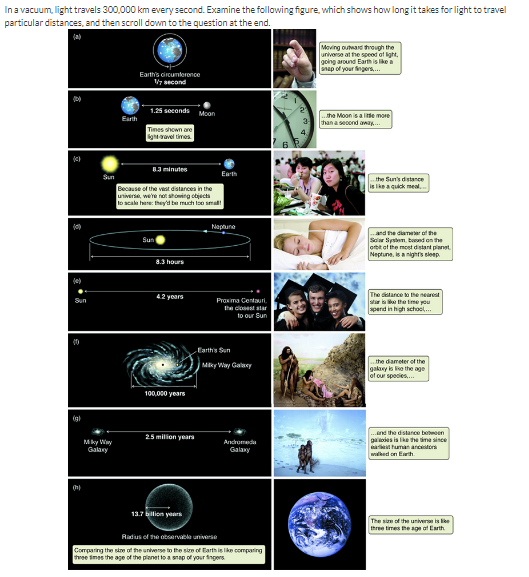
(4) Based on the time frames given in the above figure, which of the following are implications of the finite speed of light?
* There would be a noticeable delay in communications at the speed of light between Earth and astronauts on the Moon.
* When we gaze at the Andromeda Galaxy, we are looking back in time to the way it used to appear millions of years ago.
* If the light of the Sun were to suddenly extinguished, we wouldn’t notice it from Earth for over 8 minutes.
* When we gaze at the Andromeda Galaxy, we are looking back in time to the way it used to appear millions of years ago.
* If the light of the Sun were to suddenly extinguished, we wouldn’t notice it from Earth for over 8 minutes.
56
New cards
(4) When a telescope takes an image of an astronomical object, a shutter above the detector is opened to allow light to enter at the start of an exposure, and it is left open for a specified integration time. After the exposure is complete, the shutter closes and all the light that was gathered during that time is combined into a single image. \n The integration time of the human eye is about 0.1 second. \n \n If you had a telescope with the same-sized lens (and same focal length) as the human eye, what would be the benefit of taking an exposure of a steady light source with an integration time of 10 seconds?
The light source would appear brighter in the image.
57
New cards
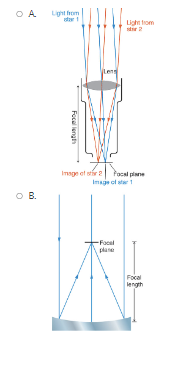
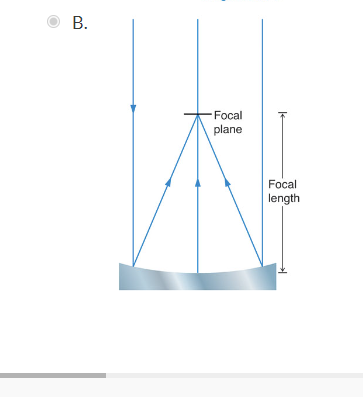
(4) Telescopes that use lenses to focus light are called *refracting telescopes*. Bigger is better, but there is a limit to how big a lens can get before gravity distorts its shape and it can no longer focus light properly. *Reflecting telescopes* use curved mirrors to focus light. Gravity will also distort a mirror’s shape if it gets too big. Since light passes through a lens, but bounces off a mirror, there is a fundamental difference in the way these two telescope types are designed. Mirrors are supported at the bottom, while lenses are supported at the sides by the tube surrounding them. \n \n Given that gravity pulls downward at every point on the lens or mirror, select the telescope type that can get larger (more massive) and still retain its shape.
58
New cards
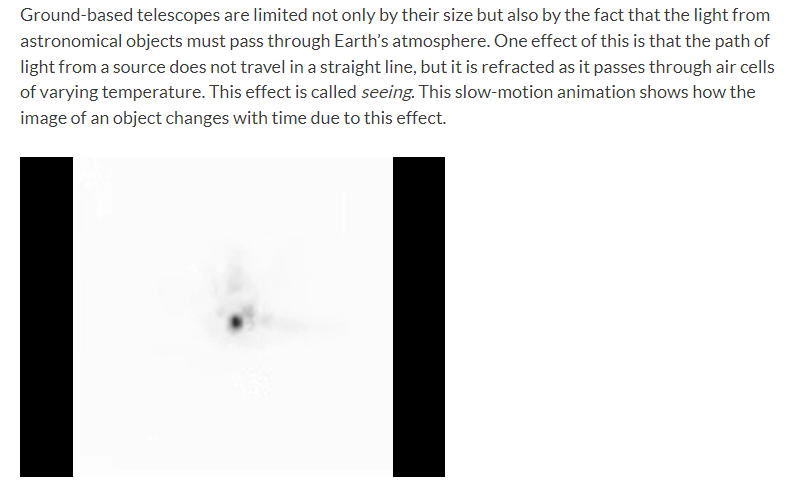
(4) If the integration time is long enough to collect the light from this entire animation, what effect would seeing have on the image of the object?
It would blur the light from the object, effectively increasing the angular resolution of the telescope (making the angular resolution better.)
59
New cards
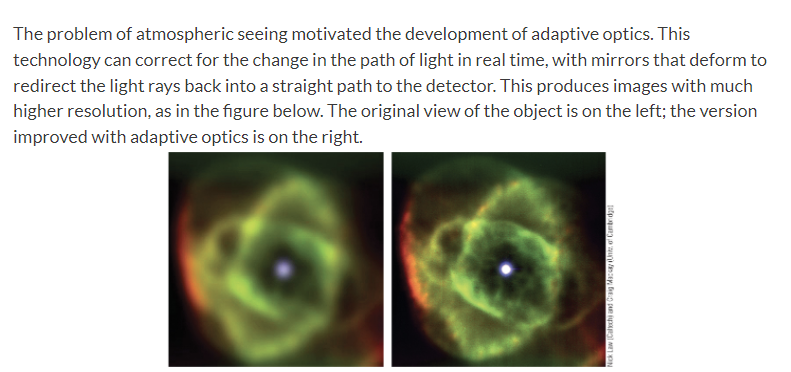
(4) Besides adding adaptive optics to a telescope, what else can be done to reduce the effects of seeing?
Put the telescope at a higher altitude (the height above sea level).
60
New cards
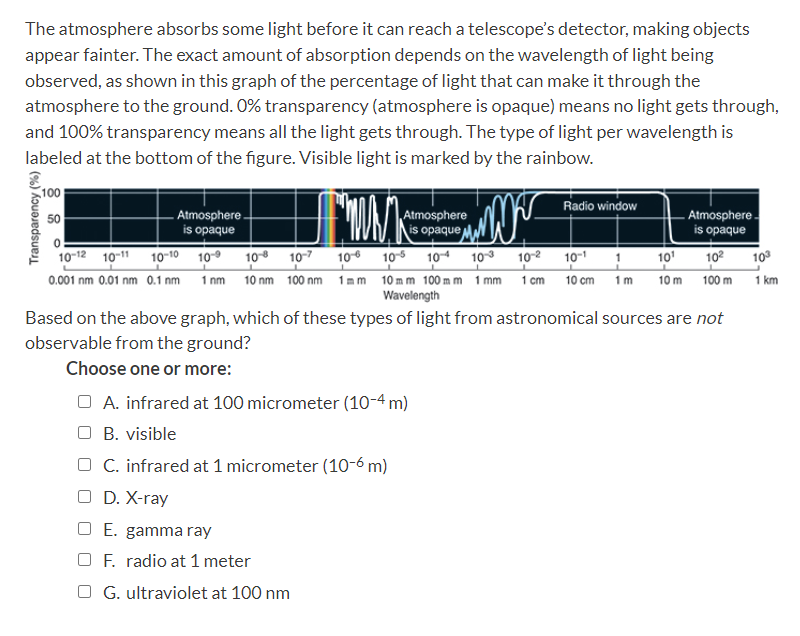
(4) Based on the above graph, which of these types of light from astronomical sources are *not* observable from the ground?
* infrared at 100 micrometer (10^-4m)
* X-ray
* gamma ray
* ultraviolet at 100nm
* X-ray
* gamma ray
* ultraviolet at 100nm
61
New cards
(4) The resolution of radio telescopes suffers greatly from the large wavelengths of the light they are observing. What can be done to a radio telescope to improve its angular resolution?
Make its dish bigger
62
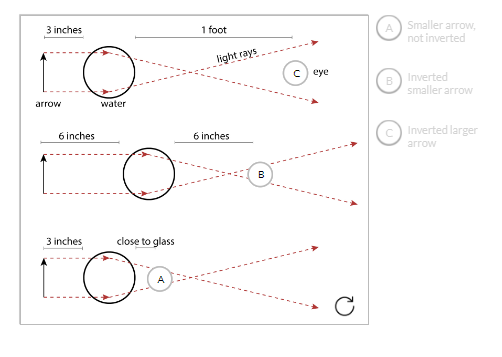
New cards
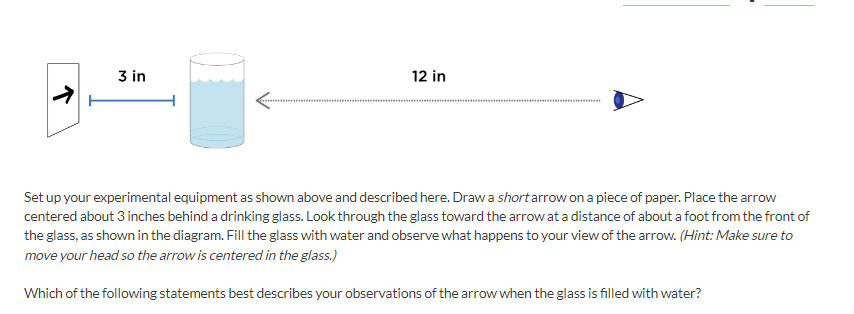
(4) Which of the following statements best describes your observations of the arrow when the glass is filled with water?
It appears larger, and its direction is inverted.
63
New cards
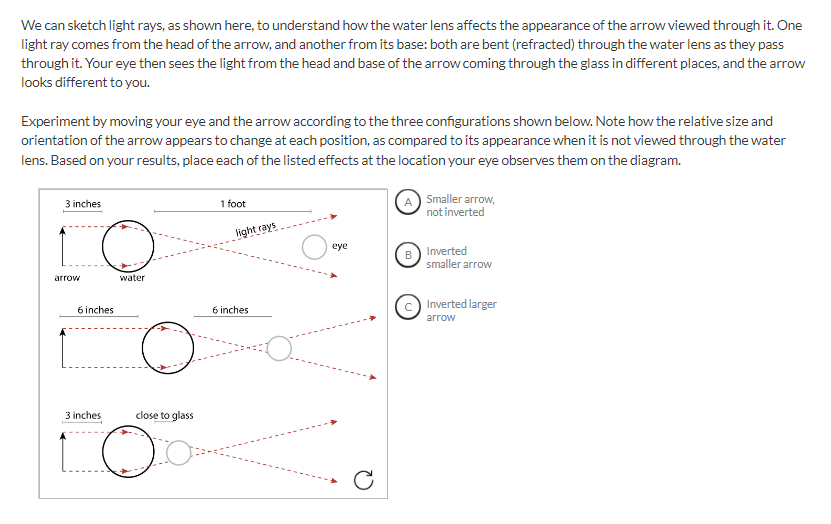
(4) Based on your results, place each of the listed effects at the location your eye observes them on the diagram.