Electricity and Magnetism (PHYSICS 3C)
 Call Kai
 Learn
Learn Practice Test
 Spaced Repetition
 Match
Match Flashcards
 Knowt Play
1/66

There's no tags or description
Looks like no tags are added yet.
Name | Mastery | Learn | Test | Matching | Spaced | Call with Kai | Chat |
|---|
No analytics yet
Send a link to your students to track their progress
67 Terms
Physics Principle
A general rule, law, definition, or key formula used to solve problems.
Empirical Science
A science where ideas must be proven true by repeated experiments.
Definition
An assigned meaning for a word or symbol (≡) that is always true with no assumptions needed.
Law
A rule describing what happens based on strong experiment proof, but it may have limits.
Theory
A tested explanation of why natural things happen that can make testable predictions.
Model
A simple mental picture or drawing used to help visualize a concept.
SPEC Format
A 4-step method (Summarize, Principles, Execute, Compare) for solving physics problems.
Summarize Step [S]
Drawing a labeled picture and listing the given values and what you need to find.
Principles Step [P]
Listing the names, equations, and rules for every principle you plan to use.
Execute Step [E]
Doing the step-by-step math to get from formulas to the final answer.
Compare Step [C]
Checking your answer using units, estimation, or logic to see if it makes sense.
Change (Δ)
The final value minus the initial value.
Coordinate System
A set of axes (x, y, z) and a choice for when time starts (t=0).
Reference Frame
A coordinate system plus the velocity and acceleration (speed and direction) of the person watching.
Inertial Reference Frame
A reference frame where the observer is not accelerating. In this frame, Newton's laws of motion hold true, and the observer experiences no net force.
Position (r vector)
A vector pointing from the origin to an object's location. The SI unit of position is meters
(m).
Velocity (v vector)
Velocity is the rate of change of the position vector over
the time elapsed (∆t = tf − ti). This means velocity is a
vector that points in the direction the object is moving (on
average) during the time interval ∆t. Its SI unit is meters per second (m/s).

Instantaneous speed
How fast an object is moving at a specific instant (the size of velocity).
Acceleration (a vector)
Acceleration is the rate of change of the velocity vector in
time. This means it points in the direction of CHANGE
in velocity. The SI unit of acceleration is meters per second squared. (m/s²)

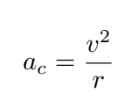
Centripetal Acceleration
The acceleration pointing toward the center of a circle that makes an object turn.
Force (F vector)
A push or pull on an object. Contact forces can only be exerted by something touching an object. Field forces are force of gravity and electromagnetic forces. The SI unit of force is the Newton (N).
Principle of Superposition
The net vector of a physical quantity at a given location
(for a single object) is the vector sum of each contribution
to the physical quantity at that location.

Net Force
The total combined sum of all forces acting on an object.

Equilibrium State
A state where an object has zero net force and zero net torque.

Equilibrium Position
A spot where an object stays completely still if you place it there.

Force of Gravity (Fg)
The downward pull of Earth on an object (Fg=mg).

Normal Force (Fn)
A push from a solid surface pressing straight out against an object touching it.

Newton's 2nd Law
The net force on an object is equal to the object’s mass
multiplied by the object’s acceleration.

Newton's 3rd Law
When two objects interact, they exert forces on one another that are equal in magnitude but opposite in direction.

System
A specific group of objects you choose to study for energy or momentum.
Total Energy (Etot)
The sum of all types of energy in a system.

Law of Conservation of Energy
Energy cannot be created or destroyed, only transferred or changed.

Kinetic Energy (KE)
Energy due to (the center of mass of an object) moving in a straight line.

Potential Energy (PE)
Stored energy based on an object's position or setup.
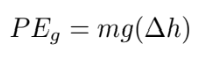
Gravitational Potential Energy (PEg)
Energy stored due to an object's height near Earth. When both the earth and an object are part of a system, the system has energy due to its configuration (the location of the two objects).
Power (P)
Power is the energy used (or work done) per unit time. The
SI unit of power is Watts (W).

Momentum (p)
Mass times velocity. The SI units of momentum are kgm/s

Electric Charge (q, Q)
A fundamental physical quantity of which there are two
types: positive and negative. Objects with the same type
of charge repel one another; objects with the opposite type
of charge attract one another.
Static Electricity
Charge transferred between objects by rubbing them together.
Neutral Object
An object with equal positive and negative charges overall (zero net charge).
Law of Conservation of Charge
Total charge in the universe never changes.

Proton
A positive charge found in the nucleus.
Neutron
A neutral charge found in the nucleus.
Electron
A negative charge usually found orbiting the nucleus.
Elementary Charge (e)
The smallest charge of a single proton or electron e = 1.602x10 − 19 C.
Ion
An atom that gained or lost electrons, giving it a charge.
Point Charge
An object whose spatial size is much smaller than other
distances in a problem or question.
Polar Object
A neutral object with charges unevenly spread out to opposite sides.
Free Electron
An electron that is loosely bound and can move around easily.
Conductor
A material which has many available charge carriers
(generally free electrons or ions). (ex. metal)
Insulator
A material which has very few free charge carriers. (ex. rubber and plastic)
Semiconductor
A material which has some free electrons (fewer than a conductor but more than an insulator). ex. silicon
Charging by Conduction
The process by which an object acquires a charge by coming
into contact with a charged object. This is accomplished
by transferring electrons between objects.
Induced Charge
Charge separated onto one side of an object. This occurs
when a second contact is placed near, but not touching, the
original object, causing electrons in the original object to
move.
Ground
The earth, or another object which has an essentially unlimited ability to absorb or supply electrons.
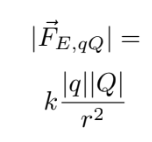
Coulomb's Law
The force, called “electrostatic force,” between two charged
point particles at rest. Coulomb’s Law assumes the charges are point charges and
therefore do not take up space.
Permittivity of Free Space (ε0)
A universal constant used in many equations of electromagnetism, including Coulomb’s Law (when written with 1/4πε0
instead of k).

Coulomb Constant (k)
The constant of proportionality in Coulomb’s Law, which
can also be written in terms of the permittivity of free space,
ε0.

Vector Field
A field is a mathematical quantity which has a value at
locations in space. Because vectors have both magnitude and direction,
a vector field is a collection of vectors.
Test Charge
A small charge, usually positive. This charge is so small
that the force it exerts does not significantly affect the
charges that create the field.
Electric Field (E vector)
The electric field is ”the force per unit charge.” If a charge
were located at P, the total electric force it would feel is
its charge (including sign) times the electric field vector.
An SI unit of electric field is N/C

Gravitational Field
The field created by an object with mass (such as the earth)
which is equal in magnitude to the force on an object per
unit mass.
Electric Field Lines
Lines showing the path and strength of an electric field, pointing away from positive and toward negative charges.
Electric Field of a Point Charge
The electric field at a location P due to charge Q that
is a distance r from a point charge Q has the magnitude
shown.

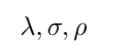
Charge Density
The charge per unit space. This can be charge per length
(often given the symbol lambda λ), charge per area (often
given the symbol sigma σ), or charge per unit volume (ρ).
Electric Field of a Plate
Electric field due to a single, large, uniform plate of chart.
The electric field is perpendicular to the plate, and points
away from a positive plate or towards a negative plate.

Electric Field Between Plates
Electric field between two large, oppositely-charged parallel
plates, which is perpendicular to the plates and points from
the positive plate toward the negative plate.
