biochem e2l4 enzyme mechanism (starts q8))
 Call Kai
 Learn
Learn Practice Test
 Spaced Repetition
 Match
Match Flashcards
 Knowt Play
1/26

There's no tags or description
Looks like no tags are added yet.
Name | Mastery | Learn | Test | Matching | Spaced | Call with Kai | Chat |
|---|
No analytics yet
Send a link to your students to track their progress
27 Terms
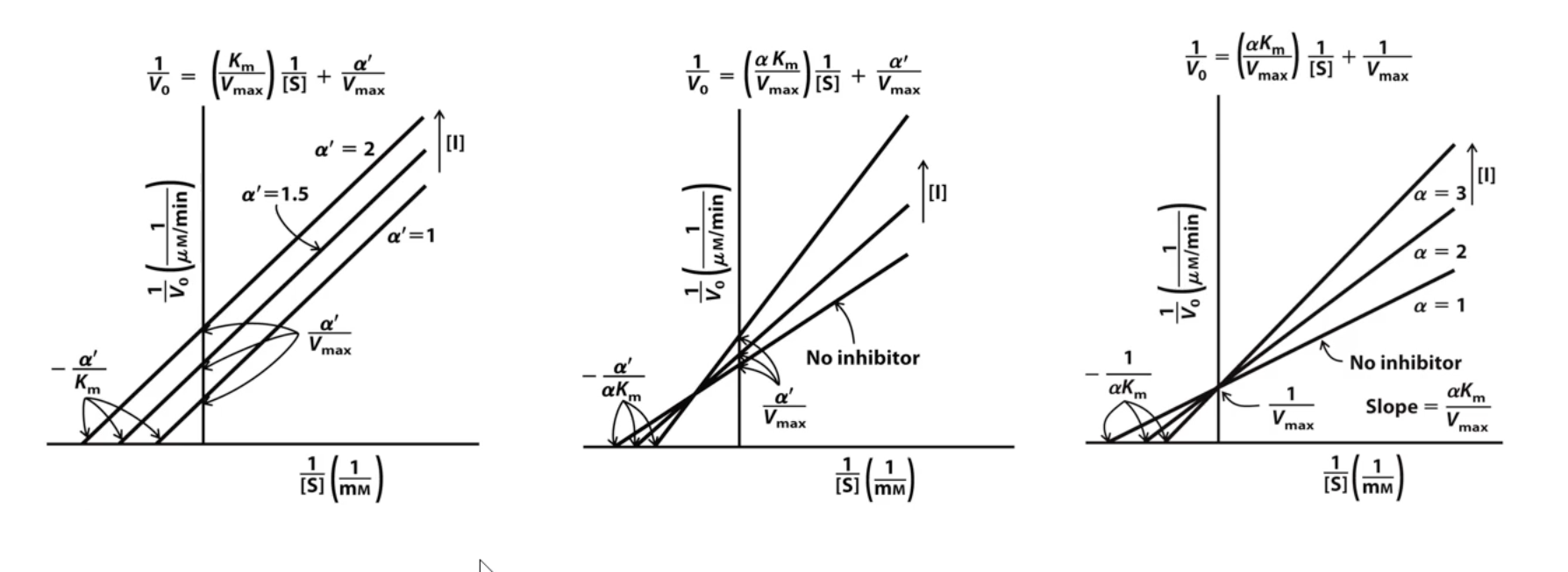
what type of inhibitor?

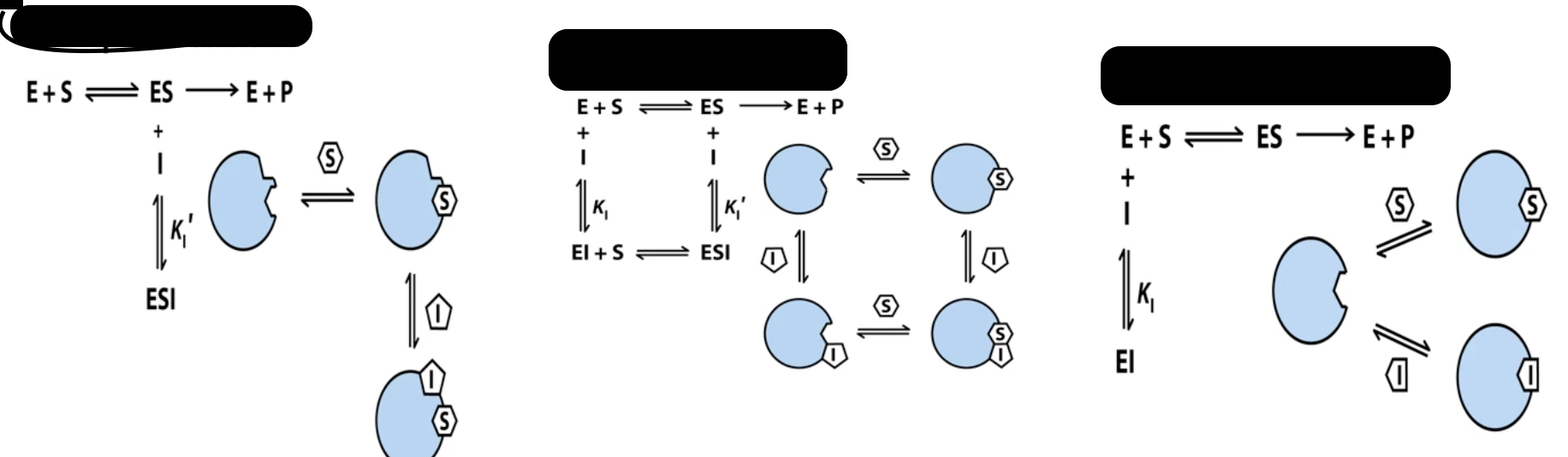
what type of inhibitor?
competitive v. uncompetitive v. mixed inhibitors:
what do they do
competitive = compete w substrate in substrate binding site
doesn’t change V max
uncompetitive = doesn’t compete in binding site but binds ES complex
no matter how much substrate you add you can’t overcome it
mixed = not competitive, don’t just bind ES complex
can bind ES complex and to the Enzyme w/o substrate
cannot overcome with additional substrate
affects both Km and Max


irreversible inhibitor:
suicide inhibitor
how medically relevant?
modify or destroy a catalytic functional group of an active site by covalent or extremely tight non covalent modification
potent poisons
type of irreversible inhibitor that binds like a substrate and is then acted upon by enzyme
at some point during catalysis converted into an irreversible inhibitor intermediate
suicide inhibitors medically important bc specific and become activated only when bound to enzyme (lower side effects)
is serine ionizable (acid/base reactions) under physiological conditions?
pH affect on enzyme activity
an AA reside that may participate in reaction catalyzed by pepsin (stomach protein is)
serine pka 13 or Glu pka 3?
normally no bc of pka but it is in enzyme reaction
enzyme activity pH dependent
glu pka 3 close to where it operates at
define a and a’
a = inhibitor binding to free enzyme → EI complex
competitive
a’ = inhibitor binding to ES complex → ESI
uncompetitive or mixed
serine proteases:
what are they
what is the prototypical one
catalyze the hydrolytic cleavage of peptide bonds
chymotrypsin
chymotrypsin:
structure
catalytic triad?
substrate binding pocket?
highest level protein structure?
chymotrypsinogen?
3 polypeptides (a, b, c chains) linked by disulfide bonds.
critical active site AA residues for catalytic reaction
His Ser Asp
hydrophobic = binds (Trp/Phe/Tyr) to position substrate for active site
zymogen (proenzyme) form before cleavage makes it chymotripsin
acylation then deacylation
chymotrypsin:
what does it do? 3 AAs?
what reaction does it catalyze
2 step mechanism
cleaves other proteins AFTER large hydrophobic/aromatic side chains (Trp/Phe/Tyr)
catalyzes peptide hydrolysis
2 steps
acylation then deacylation
3 steps how did scientists discover chymotrypsin had two step mech?
how did they identify active site residues
this protease cleaves peptide bonds but also slowly cleaves esters
product of ester cleavage reaction (p-nitrophenol) is yellow, used yellow pigment to track the reactions progress
saw a curve with both a pre-steady state burst phase in addition to a steady state phase, suggested it was a 2 step reaction
chemically labeled the specific residues in the active site

chymotrypsin 2 step mechanism?
what happens at each step?
what is water’s role?
fast step = acylation and release of p-NP
yellow product fast
slow step = water hydrolysis of acyl-enzyme intermediate (deacylation)
peptide bond breaking step
water directly attacks an acyl bond in an intermediate
water doesn’t attack the peptide bond of the substrate

what is histidine’s role
catalyses 2 acid base reactions
how is chymotrypsin reaction is a great example of 3 things:
general acid-base catalysis
transition state stabilization
covalent catalysis
involved in 2 acid-base reactions
4 parts chymotrypsin active site:
triad
oxyanion hole
glysine -
hydrophobic pocket
what are the jobs of Asp102 and His57
triad = Asp102, His57, Ser195
oxyanion hole
glysine = helps w/ hydrogen bonding
reaction cleaves peptide bond after aromatic group
hydrophobic pocket = where aromatic ring goes
to establish Ser195 as a strong nucleophile (O-)
chymotrypsin acylation phase:
starting products -(acylation)→ ending product
what happens (generally)
4 steps
E + protein -(acylation)→ ES complex
covalent catalysis forms an ester linkage that forms acyl enzyme and the peptide bond is broken
4 steps
Substrate binds active site: forms ES complex
His57 acts as general base and takes proton from Ser195 to establish Ser195 as a strong nucleophile (O-)
His 57+ stabilized by Asp102 carboxylate
H bonded chain makes Ser better n-phile
Nucleophilic attack:
Ser195-O- nucleophilic attack on C=O (covalent catalysis/ester linkage) to form short lived tetrahedral acyl-enzyme intermediate/transition state
substrate has short lived O- charge stabilized by H bonding w/ Ser195 and Gly193
H bond only occurs in this intermediate (TS stabilization)
removal of LG:
tetrahedral intermediate collapses reforming C=O and breaking peptide bond
His57 acts as an acid protonates N terminus of LG peptide so it can leave
product 1 (c-terminal half) is released
End:
acyl-enzyme remains (2nd transition state) = N terminal peptide is covalently bound to Ser195 via ester linkage
C term of substrate diffuses away
acid-base catalysis of His57 in acylation phase v deacylation phase
acylation
base to make See195 a good nucleophile (O-)
acid to protonate N on the LG 1 (C term half of substrate)
deacylation
base to make H20 good nucleophile (OH-0
acid to protonate Ser195 to release LG2 (N term half of substrate)
ES complex v acyl-enzyme intermediate
Gly193 role?
deacylation or acylation phase?
ES complex = double bonded O H bonded to Ser195
acyl-enzyme intermediate/TS= single bonded/neg charge O- stabilized by H bonding w/ Ser195 and Gly193 in the oxyanion hole
TS stabilization
acylation phase
chymotrypsin deacylation phase:
starting products -(acylation)→ ending product
what happens (generally)
4 steps
Acyl-enzyme -(hydrolysis)→ chymotrypsin
ester linkage of acyl-enzyme is hydrolyzed to regenerate original chymotrypsin
4 steps
Substrate binds:
H20 enters active site
Nucleophilic attack:
His57 acts as base and deporotonates H20
OH- nucleophilic attack on C=O (covalent catalysis/ester linkage)
anion hole stabilizes short-lived tetrahedral acyl-enzyme intermediate
remove LG
tetrahedra intermediate collapse
His57 acts as an acid protonates Ser195 (-OH) facilitates displacement
2nd product (n-terminal half) diffuses
End:
system reset, ready to accept new substrate
4 transition states
4 acid base reactions
2 covalent catalysis
differentiate b/t tetrahedral intermediate and acyl-enzyme intermediate
how are HIV proteases similar and 4 ways different than chymotrypsin?
similar
active site
water
complexes
cleave location
similar = cleaves proteases
active site = aspartate = aspartyl protease
water DOES directly attack peptide bond in HIV protease
no covalent enzyme-substrate complex
cleaves peptide bond b/t The and Pro AA pairs
HIV protease:
structure?
3 step mechanism (difference w/ chymotrypsin)
homodimer (2 same proteins in quad structure), each with 2 Asp25s at the active site
3 steps
substate binding:
hydrophobic pocket
nucleophilic attack:
General base catalysis: Asp25 (O-) takes H2O H+, OH- attacks carbonyl carbon
tetrahedral intermediate (transition state) with C-O- stabilized by H bonding w/ Asp 25s
(NO covalently attached intermediate, NO acyl-enzyme, NO oxyanion hole)
remove LG:
tetrahedral intermediate collapses to C=O (N term half released from 1 Asp25)
other Asp25 acts as acid protonates C term half
How do Anti-HIV protease inhibitors work
they’re transition state analogs (mimic HIV protease’s tetrahedral transition state)
OH mimics tetrahedral transition state O-
benzyl gorup fits hydrophobic pocket
Enolase:
how does it catalyze its reaction
3 parts active site
2 parts reaction
divalent cations = uses 2 Mg2+ cofactors
2 Mg2+, Lys345, Glu211
2 steps
Lys345 acts as general base and accepts substrate C2 proton
C2 made more acidic by adjacent carboxyl (C=O)
enolate intermediate C-O- charge stabilized by 2 Mg2+ (helps rearrange double bond)
remove LG:
Glu211 acts as general acid, protonates C-OH, and makes the -OH a better leaving group
LG = H2O
what is antibiotic target?
specifically?
how does cross-linking happen?
2 step reaction mechanism
transpeptidase?
why can we target peptidoglycan synthesis?
peptidoglycan synthesis
cell wall synthesis requires cross-linking of peptidoglycan molecules w/ each other
how
peptidoglycan chains linked via D-ala containing peptidecross bridges
transpeptidase carries out cross linking
cross linking mechanism
transpeptidase active site (Ser-OH) attachés carbonyl of peptide bond of a D-ala
cleaves a 2nd d-ala
covalent linkage b/t substate, peptidoglycan, and transpeptidase
peptide bond formation crosslinks 2 adjacent peptidoglycan chains (transpeptidase released)
peptidoglycan chain #2 rather than water does 2nd nucleophilic attack
transpeptidase = one peptide bond is replaced w/ another
because people have L-amino acids and D-ala is a D amino acid