Botany 1 Exam
 Call Kai
 Learn
Learn Practice Test
 Spaced Repetition
 Match
Match Flashcards
 Knowt Play
1/24

There's no tags or description
Looks like no tags are added yet.
Name | Mastery | Learn | Test | Matching | Spaced | Call with Kai | Chat |
|---|
No analytics yet
Send a link to your students to track their progress
25 Terms
4 classes of macromolecules
lipids
carbohydrates
proteins
nucleic acids
What are the four classes of macromolecules built on?
built on monomers to form polymers
Lipids: what they are, characteristics of them
fats and oils
waxes
sterols/ steroids
fatty acids
usually hydrophobic but can have some hydrophilic functional groups
fats: solid, packed relationship like in meats, shea butter
Oils: liquid loose relationship
Lipids: phospholipids
phospholipid membranes
have hydrophilic phosphate head
have hydrophobic carbon chain
waxes: cutin
seals plants form leaking water

Carbohydrates: what they are, characteristics of them
sugars
for every carbon there should be an oxygen (for a monomer)
large chain of glucose= starch (long term storage)
amylose takes apart starch backwards
alternation of alpha and beta linkages= cellulose (for structure)
dietary fiber, can’t digest (human), in cell walls
Proteins: what they are, characteristics
structure, anchoring, metabolic
energy, signaling, transcription/translation
structure level
primary, secondary, tertiary, quaternary
reaction group
what defines each amino acid
amino group
on end of each amino acid
Nucleic Acid
DNA, RNA
ATP
nuclei: site of RNA synthesis
Cells
be able to label all parts and define them
nuclei: site of RNA synthesis
ribosomes: translation, protein synthesis
Membrane: phospholipids
Primary Cell wall
Secondary Cell wall:
hemicellulose
lignin
stem, xylem cells
Plasmodesmata: connection b/w cells
Vacuole:
storage
hydrostatic pressure
Golgi
Cytoplasm
Rough ER vs Smooth ER
Plastids (chloro and others)
2 membranes, inner= Thylakeid
has its own chromosomes
Mitochondria
folds called cristae
2 membranes
has it owns chromosomes
cellular respiration
Prokaryote vs Eukaryote chromosome
circular chromosome
linear chromosome
Membrane of cells
made of phospholipids
fatty tail- 1 unsaturated for oily membrane to move around
phosphate heads interact with each other and the polar water
aquaporins: transport proteins through the membranes
Fluid Mosaic Model
composed of a lot of different components that move around and interact
moves large molecules through carrier and channel proteins
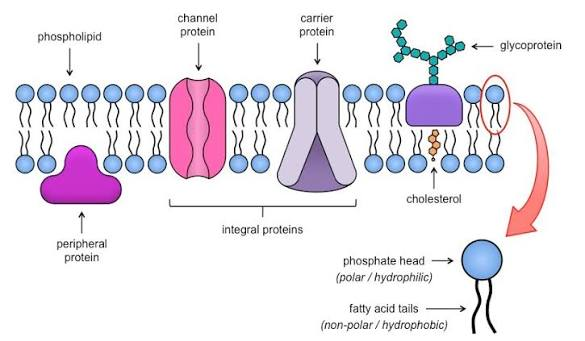
How are large molecules moved through a membrane?
Endocytosis
Exocytosis
Endosymbiotic Theory
Ancestral Eukaryote absorbed free living prokaryote which led to little battery in the eukaryote —> formed mitochondria in cell through symbiotic relationship
Secondary Endosymbiotic Theory
cyanobacteria + plastids were absorbed by an ancestral eukaryote that was already previously absorbed
Mitosis
asexual reproduction and growth
creates clones
Meiosis
sex cell formation
Prophase
chromosomes condense
nuclear membrane dissolves
spindle aparrates and attaches to centromeres

Metaphase