lec 23 viral genomes
 Call Kai
 Learn
 Practice Test
 Spaced Repetition
 Match
 Flashcards
 Knowt Play
1/5

There's no tags or description
Looks like no tags are added yet.
6 Terms
What did the Hershey-Chase experiment show about what specifies virus production?
Radioactive phosphorus (DNA) ended up inside the bacteria, while sulfur (protein) stayed outside.
So the nucleic acid, not the protein shell, specifies virus production — it is what creates new viruses.
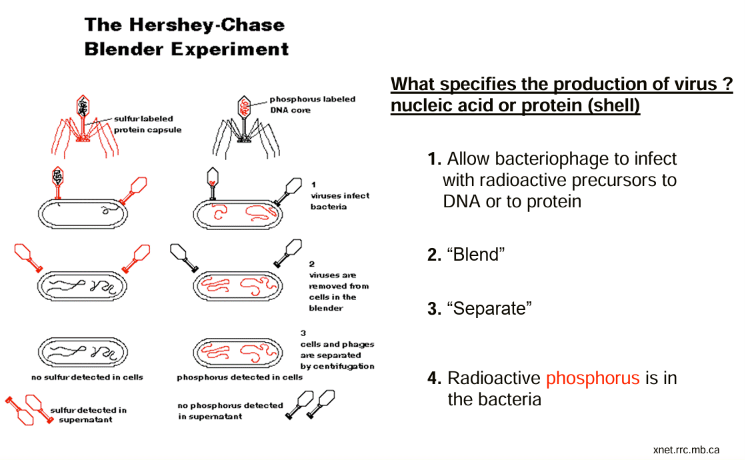
What are the steps to the Hershey-Chase experiment
Bacteriophage infects bacteria, using phage labelled with radioactive precursors to DNA (phosphorus) or to protein (sulfur).
"Blend": the mixture is blended to remove the viruses from the cells.
"Separate": cells and phage are separated by centrifugation.
Radioactive phosphorus is detected in the bacteria, and sulfur is detected on the outside
In the modern-day version of the Hershey-Chase experiment, how is the movement of the viral genome shown, and what does this prove?
Once infected, a cyanine dye that binds viral genomes moves from the bacteriophage into the host cell
this shows that the genome enters the host, proving the genome is the key
What is the Baltimore Classification Scheme? And what is the key concept?
sorts viruses into 7 groups by genome type… essentially 7 different ways to make mRNA
key concept: Every viral genome has to make mRNA, because host ribosomes read that mRNA, always in the 5' to 3' direction.
Why must every viral genome make mRNA?
Viruses don't have their own ribosomes, so they use the host cell's ribosomes to make viral proteins.
Ribosomes can only translate mRNA, and they can't read DNA or dsRNA directly.
So no matter what type of genome a virus has, it has to make mRNA that the host ribosomes can read (in the 5' to 3' direction).