Dr. Ryan - Respiration (lectures 3-5)
 Call Kai
 Learn
 Practice Test
 Spaced Repetition
 Match
 Flashcards
 Knowt Play
1/113

There's no tags or description
Looks like no tags are added yet.
114 Terms
what does panting do for dogs?
leads to an increased Vd/Vt ratio to allow for heat loss (idk if we need to know this tho)
what are the things we need to control breathing?
a process that generates basal breathing, a way for the body to sense changes in our blood, ways to sense physical changes in the body, and a way to respond to those changes
what do we detect when we are detecting metabolic changes in the body?
O2, CO2, acid (H+)
what are components involved in controlling breathing?
integrator (brain), sensor (chemoreceptors and mechanoreceptors) and effectors (respiratory muscles)
what does the brainstem do generally?
basic life functions, breathing, heart, etc
what are the areas of the brain that are involved in involuntary breathing?
pons, medulla oblongata
what parts of the brain are part of voluntary breathing control?
portions of the cerebrum an the limbic system
what does the cerebrum do?
consciously choose to breathe
what does the limbic system do?
emotional states
what are the parts of the medulla oblongata?
dorsal and ventral respiratory groups
what is the part of the pons dealing with respiration?
pontine respiratory group
T/F: the hypothalamus is in the limbic system
TRUE
what is the basal rhythm of breathing generated by?
medulla oblongata
what ist he basal rhythm of breathing adjusted by?
pons
what does the dorsal respiratory group do?
initiates inspiration and maintains duration inspiration
what does the ventral respiratory group do?
during normal and quiet breathing is inactive, but during exercise is activated by forceful inspiration, signals abs to contract and do more active expiration
what are parts of the pontine respiratory center?
pneumotaxic center and apneustic center
what does the pneumotaxic center do?
inhibis medullary inspiratory center, stops inspiring, effectively reduces respiratory depth (how deep we breathe)
what os the apneustic center?
stimulates the medullary centers and prolongs the inspiratory period
T/F: during passive respiration the ventral respiratory group is engaged
FALSE
what do muscles use to communicate with brain about breathing?
chemoreceptors and mechanoreceptors
what types of chemoreceptors does the blood have?
peripheral and central
what do chemoreceptors do?
monitor the chemical composition of arterial blood, detects changes in O2, CO2, H+
where are chemoreceptors in the heart?
carotid body and aorta
what do we do when O2 is too low?
breathe more
what do we do when Co2 levels are too high?
expire more
what does an increase in H+ do to the blood?
decreases the pH
what is characteristic of central chemoreceptors?
brain (medulla), detect more CO2 and H+, more sensitive to changes in CO2
what ia characteristic of peripheral chemoreceptors?
in the body, detects all the gases, the only chemoreceptors sensitive to changes in O2
T/F: central and peripheral chemoreceptors detect changes in O2
FALSE; only peripheral
what are glomus cells?
constantly sample nerves and sense increases in CO2, and decreases in O2 and pH, signals to the medulla to increase ventilation, fast response
what is the major driver of increased ventilation in mammals?
high pCO2
at what pressure do peripheral chemoreceptors respond to decreased O2?
60mmHg
what factors are responsible for driving ventilation?
peripheral chemoreceptors detecting CO2 and pH, unless O2 gets super low
how do central chemo receptors work?
CO2 increases in blood and this diffuses across the blood-brain barrier
interstitial fluid and cerebrospinal fluid surrounding medulla CO2 in (shifts to make more H+)
central chemoreceptors detect increased H+ and CO2
responding by increasing respiratory drive
T/F: H+ can cross the blood brain barrier
FALSE
what should happen when increased CO2 is sensed by peripheral chemoreceptors?
pco2 is elevated, the chemoreceptors sense this and central controllers in medulla stimulate ventilation, we breathe out more CO2 and normalize levels
what does hypoventilation mean?
reduced breathing
what happens to the blood gasses when there is hypoventilation?
increased CO2 and eventually decreased oxygen
what are stretch receptors?
detect when the lungs are overstretched and respond accordingly to decrease breathing
what are pulmonary iritant receptors?
detect if there are irritants in the lungs
what are J receptors?
juxta-capillary receptors, in alveolar intertitium, responds to pulmonary edema, chemicals, and stretch, can cause shallow breathing
what are muscle and joint proprioceptors?
role in stimulating the increase in ventilation during exercise
what is bulk flow?
respiratory tract from nose until alveolar membrane, gases move down pressure gradient, and all gases move together quickly
what is diffusion of gases?
across alvrolar membrane into blood, and from blood into tissues, gases move down concentration gradient and at different rates depending on individual concentrations, slower
what is the oxygen-hemeglobin dissociation curve?
graphic representation of the relationship between % of saturated O2 and the pressure of arterial O2
what is oxygen saturation?
SO2, the percent of hemeglobin molecules bound to O2
what is the partial pressure of oxygen?
PaO2, artterial blood gas, the concentration of dissolved O2 in arterial blood
what is daltons law?
the total pressure exerted by a mixture of gases is in the sum of the pressures exerted independently by each gas in the mixture
what is daltons law formula?
Ptotal = P1 + P2 + P3…
T/F: partial pressure of each gas is directly proportional to its percentage
TRUE
what do we need to know to calculate the partial pressure of each gas in a mixture?
the pressure of the container (Ptotal) and the percentage of that gas in the mixture
which gas is in the highest percentage just like in general?
nitrogen, 78%
what is O2s percentage in the atmosphere?
21%
what is FiO2?
the inspired fraction of O2, normally 21%
what is the total pressure of gases in like the normal atmosphere?
760mmHg
T/F: partial pressure has nothing to do with bulk flow
TRUE
what does it mean that air is humidified once we inspire?
we add water in gas form, which changes the partial pressures of other gases
what is PH2O in alveolar air?
47 mmHg
what is PO2 in alveolar air?
104 mmHg
what is PCO2 in alveolar air?
40 mmHg
how do gases move in diffusion?
gases move down concentration gradient
O2 movement in diffusion
higher PO2 in air vs the blood so O2 moves into the blood
carbon dioxide movement in diffusion
higher PCO2 in the blood vs the air, so CO2 moves into alveolus
why can we use partial pressures when talking about diffusion?
because partial pressure is directly related to the concentration of the gas
what is fricks principle?
the rate of gas transfer is directly proportional to the difference in partial pressures of the gas across the membrane AND the diffusing capacity of the membrane
what are factors impacting diffusion capacity of a membrane?
area and thickness of the membrane and solubility and molecular weight of the gas diffusion
does CO2 or O2 have a faster diffusion rate?
CO2
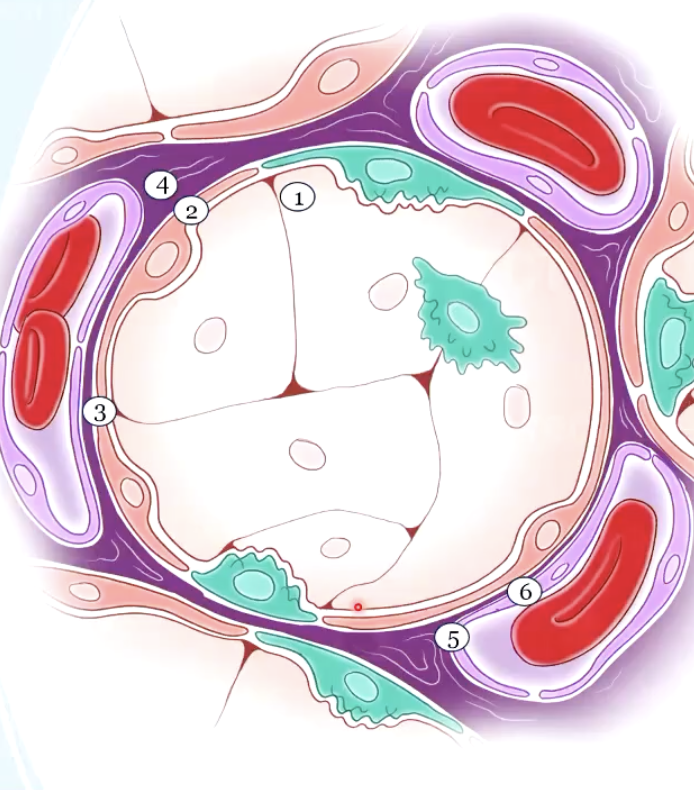
what is 1?
fluid layer

what is 2?
alveolar epithelium

what is 3?
epithelial basement membrane

what is 4?
narrow interstitial space

what is 5?
capillary basement membrane

what is 6?
capillary endothelium
what is part of the fluid layer?
surfactant from type 2 epithelial cells
what alveolar epithelium is for gas exchange?
type 1
what cell makes surfactant?
type 2 epithelial/alveolar cells

what are the green cells?
type 2 epithelium cells
how do we regenerate type 1 alveolar cells?
type 2 can proliferate and differentiate into type 1
T/F: in the pulmonary capillaries, the arterial pressures of O2 and CO2 DONT change as the blood moves past the alveolus
FALSE
what is PO2 in the blood after going past the alveolus?
100 mmHq
what is the partial pressure of CO2 in the blood after moving past the alveolus?
40 mmHg
what is the trigger point for chemoreceptors to signal that there is low oxygen?
60 mmHg (40% reduction)
where is the majority of our O2 in our blood?
98% in our hemoglobin
where is the extra 2% of O2 in our blood?
plasma, dissolved
what is a deoxyhemeglobin?
when oxygen is not bound
what is a oxyhemeglobin?
when O2 reversibly binds with hemeglobin
what is the structrue of hemoglobin?
4 hemeglobin chains, each chain has a single group (heme) with a ferrous iron atom in the middle (4 total), one or more Fe molecules in hemeglobin may reversibly bind O2,
T/F: each iron molecule binds 1 oxygen atom
FALSE (2 Os)
what is the positive allosteric effect of hemoglobin?
hemoglobin binds one oxygen molecule, the hemoglobin changes shape and this change in shape makes it easier for the O2 to bind next group
what is O2 carrying capacity?
the amount of O2 that can be transported in the blood of an animal
what does pp of O2 60 mmHg (when chemoreceptors go off) correspond to in SPO2?
90%
what does it mean if the curve shifts left?
hmg is saturated at a lower concentration of oxygen and this implies that hmg has a high affinity for oxygen, lower temperature
what does it mean that the curve has a right shift?
hmg is saturated at a higher concentration of O2, this implies that hmg how has a lower affinity for O2, higher temperature
where in the body would it be advantageous for hemoglobin hold onto the O2 tighter?
the lungs
where in the body would it be advantageous for hemeglobin have lower affinity to O2?
in the peripheral tissues
what is the bohr effect?
has a right shift of the curve occurs where there is higher PCo2 and/or lower blood pH where Hmg has a lower affinity for O2 so more O2 is released from RBC
what does cellular respiration generate as a by-product?
Co2
is PCO2 higher in the peripheral tissues or the blood?
the peripheral tissues
what is the direction that CO2 moves?
down the concentration gradient from higher concentrations in peripheral tissues to lower concentrations in blood