Exam 3 Psychology
 Call Kai
 Learn
 Practice Test
 Spaced Repetition
 Match
 Flashcards
 Knowt Play
1/110

There's no tags or description
Looks like no tags are added yet.
111 Terms
Attachment Styles
Secure & Insecure
Secure Attachment
When parents respond sensitively to them, reinforcing the infants’ confidence that their parents will provide support when needed
Develop stronger friendships with peers
More advanced emotional understanding and early conscience development
More positive self-concepts
Insecure Attachment
When care is inconsistent or neglectful
Avoidant
Anxious
Cultural Differences in Attachment
Parenting practices and cultural expectations shape how children respond to separation from caregivers.
U.S.:
About 60% of children show secure attachment.
Independence and emotional expression are encouraged.
Japan & Korea:
Fewer avoidant and more anxious attachments.
Cultural value: closeness and interdependence.
Mali (Dogon culture):
Very few avoidant infants; majority (69%) are securely attached.
Caregiver Sensitivity
The sensitive way in which caregivers respond to the needs of their infants
How can poverty and stress affect caregiver responsiveness?
Due to factors like postpartum depression and limited resources
4 Parenting Styles
Uninvolved
Permissive
Authoritarian
Authoritative
Family Stress Model
Financial difficulties are associated with parents’ depressed moods, which in turn lead to marital problems and poor parenting that contributes to poorer child adjustment
Peer Relationships
Foundational skills: how to initiate and maintain social interactions
Challenges: bullying, peer victimization
Adolescence: become focused on psychological intimacy
Social Referencing
One individual consults another’s emotional expressions to determine how to evaluate and respond to circumstances that are ambiguous or uncertain
Theory of Mind
Infants are aware at an early stage that peoplep have different mental states
This motivates them to try to figure out what others are feeling, intending, wanting, and thinking, and how these mental states affect their behavior
False-Belief Theory of Mind (ToM)
One’s ability to recognize that others have a belief that is different from their own
Cultural Differences:
Individualistic cultures (compared to collectivistic cultures):
Parents use more mental state talk
Leads to earlier development of false-belief ToM
Other factors delaying acquisition of false-belief ToM:
Family stressors and low socioeconomic status
Authoritarian parenting
Goodness of Fit:
The child’s tempermental qualities and characteristics of the environment
Biological Disposition + Experience = Personality
Elaboration, Extension & Refinement
Conscience
The cognitive, emotional, and social influences that cause young children to create and act consistently with internal standards of conduct
Effortful Control
Some children are temperamentally more capable of motivated self-regluation than others
Gender Schema
Young children learn about gender from parents, peers, and others in society, and develop their own conceptions of the attributes associated with maleness or femaleness
Cognitive Development
the development of thinking across the lifespan
Nature
Our biological endowmnet, the genes we receive from our parents
Nurture
The environments (social and physical) that influence our development
Does Cognitive Development progress thorugh distinct stages?
Development can be studied as continuous or discontinuous change
Piaget’s Stage Theory
Sensorimotor stage
Preoperatoinal reasoning stage
Concrete operatoinal reasoning stage
Formal operational reasoning stage
Sensorimotor stage
(birth to 2 years)
Children understand the world through their perception and interaction with the world
Cannot solve the object permanence task before about 9 months
Preopertational reasoning stage
(2 to 6 or 7 years)
Children can solve the object permanence problem and use symbolic-representation.
They are only able to focus on a single dimension and cannot solve the conservation task.
Concrete operational reasoning stage
(6 or 7 years to 11 or 12 years)
Children can solve the conservation task and think logically
However, they fail at thinking systematically and cannot solve the pendulum task
Formal operational reasoning stage
(11 or 12 years and throughout the rest of life)
Children can think systematically and hypothetically and can solve the pendulum task
This stage tends not to emerge without formal education and we do not necessarily need this type of thinking to function in day-to-day life
Phonemic awareness
Awareness of the component sounds within words
A crucial skill in learning to read.
Kindergartners’ performance on these tasks is the strongest predictor of reading achievement in third and fourth grade, even stronger than IQ or social class background
Mathematics
Numerical knowledge prior to entering school varies widely by socio-economic background.
Family engagement in playing board games such as Chutes and Ladders.
An experiment where children in low-income families played the game over two weeks, showed improved understanding of numerical concepts.
How Culture Shapes Cognition
According to Piaget and Vygotsky, children’s thinking develops through interaction with their cultural environment.
Cultural tools (e.g., an abacus in China) and social experiences influence how children learn concepts like numbers, categorization, and conservation.
Executive functioning
Including inhibitory control, cognitive flexibility, and working memory
Emotional regulation supports EF, cultures differ in how they teach emotional control
Strong EF also helps children overcome poverty-related learning gaps, especially when supported early in childhood
Cultural Differences in Executive Functioning
Chinese mothers value emotional inhibition and link parenting success to academic achievement
North American mothers emphasize emotional repression and individuality
These values help explain why Chinese preschoolers often show stronger EF skills measuring inhibitory control and cognitive flexibility
Strong EF also helps children overcome poverty-related learning gaps, especially when supported early in childhood
Adolescence
A developmental stage that has been defined as starting with puberty and ending with the transition to adulthood (approximately agers 10-20)
This stage is lengthening as individuals start puberty earlier and transition to adulthood later than in the past
Puberty today begins, on average, at age 10-11 yeras for girls and 11-12 years for boys
This average age of onset has decreased gradually over time since the 19th century by 3-4 months per decade
Physical changes during adolescence
For both boys and girls:
Growth spurt in height
Growth of pubic and underarm hair
Skin changes (e.g., pimples)
Boys: growth in facial hair and a deepening of voice
Girls: breast development, menstruating
These pubertal changes are driven by hormones
Cognitive changes during adolescence
A shift from concrete to more abstract and complex thinking
Improvements during early adolescence:
Attention
Memory
Processing speed
Metacognition
Changes in brain structure
Dopamine system
Increases in sensation-seeking and reward motivation
Prefrontal cortex
Increases self-regulation and future orientation
Adolescents are more prone to risky behaviors than are children or adults
Social changes during adolescence - Parents
Renegotiation of relationships
Independence
Autonomy
Distal morning by parents
Psychological control
Social changes during adolescence - Peers
Focus on intimate exchanegs of thoughts and feelings
Mixed sex peer groups
Adolescents within a peer group tend to be similar to one another in behavior and attitudes
Homophily
Influence
Peer Crowds in the US:
Common adolescent groups includes “athletes” and “brains”
As schools become more diverse, ethnicity-based crowds also form
Cultural Difference:
In China, friendships are shaped by academic achievement rather than crow identity
This reflects the high value on education and Confucian ideals about learning and effort
Deviant peer contagion
◦Peers reinforce problem behavior by laughing or showing other signs of approval that then increase the likelihood of future problem behavior
Negative peer pressure
Can lead adolescents to make riskier decisions or engage in more problematic behavior
Positive functions
Social support and companionship
Emergence of crowds
Characterized by shared reputations or images than actual interactions
Adolescent Friendships and Risky Behaviors
Adolescents tend to befriend those with similar values and behaviors
It’s unclear whether similarity comes from peer influence or friendship selection
Teens are more likely to take risks with friends than when alone
Influences on Risk-Taking:
Boys, especially those from low-income backgrounds, show stronger reward-seeking behavior
Cultural Differences in Adolescent Sexual Behaviors
Cultural values and norms strongly shape adolscents’ attitudes and behaviors towards sex
Restrictive cultures
Persmissive cultures
Semi-restrictive cultures
Gender double standards are common
Cultural expectations can cause underreporting or exaggeration of sexual behaviors
Restrictive cultures
e.g. East African, East Asian, South Asian, West Asian
Discourage premarital sex; Lower rates of sexual actviity
Permissive cultures
E.g. some South Pacific and Northern European
Encourage or expect sexual activity during adolescence; Higher rates of premarital sex
Semi-restrictive cultures
E.g., majority of U.S. culture
Prohibit premarital sex but rarely enforce the rule
Identity Formation
Marcia (1966) proposed four identity statuses:
Foreclosure
Identity diffusion
Moratorium
Identity Achievement
Foreclosure
Commits to an identity without exploring options
Identity diffusion
Neither explore nor commit to any identities
Moratorium
Actively exploring options but have not yet made commitments
Identity Achievement
Have explored different options and then made identity commitments
Identity Formation - Socioeconomic factors
Adolescents from lower-income families may experience identity foreclosure due to limited opportunity for exploration
Identity formation - Cultural factors
In interdependent cultures, youth are more likely to experience foreclosure due to family and social expectations
Ethnic and Racial Identity Development
Ethnic/racial identity is a key part of adolescent identity, especially in multicultural and migratory contexts
Patterns Cross Groups:
Bicultural Identity
Separation
Marginality
Bicultural Identity
E.g. Mexican American, Asian American, Turkish Dutch, and Pakistani British adolescents identify with both ethnic and majority cultures
Separation
African American adolescents — they are high on their racial identity but low on their majority-culture identity
Marginality
Native American adolescents — low identification with both their ethnic-group identity and their majority-culture identity
Aggression and Antisocial Behavior
Patterson’s (1982) early versus late starter model of the development of aggressive and antisocial behavior
Distinguishes youths whose antisocial behavior begins during childhood (early starters) versus adolescence (late starters).
Early starters are at greater risk for long-term antisocial behavior that extends into adulthood than are late starters.
Late starters who become antisocial during adolescence are theorized to experience poor parental monitoring and supervision.
Anxiety and Depression
Females have rates of anxiety that are about twice as high and rates of depression that are 1.5 to 3 times as high.
Rates for some disorders are markedly higher in adolescence than in childhood or adulthood.
Prevalence rates for specific phobias are about 5% in children and 3%–5% in adults but 16% in adolescents
Family adversity during childhood sets the stage for social and behavioral problems during adolescence.
Academic Achievement
Academic achievement during adolescence is predicted by:
Interpersonal factors (e.g., parental engagement in adolescents’ education)
Intrapersonal factors (e.g., intrinsic motivation)
Institutional factors (e. g., school quality)
Sets the stage for future educational and occupational opportunities.
Dropping out of school is the high risk of unemployment
Continuous distributions of personality traits
Personality traits reflect basic dimensions on which people differ
An important feature of personality traits is that they reflect continuous distributions rather than distinct personality types
Example: most people score somewhere in the middle of extraversion
Criteria for personality traits
Consistency
Stability
Individual differences
Lexical hypothesis
All important personality characteristics should be reflected in the language that we use to describe other people
Allport and Odbert took all personality descriptors found in the dictionary
Used factor analysis to determine whether a small number of dimensions underlie the diversity of words identified
Factor analysis
Statistical analysis of correlations among many variables to idenitfy closely related clusters of variables
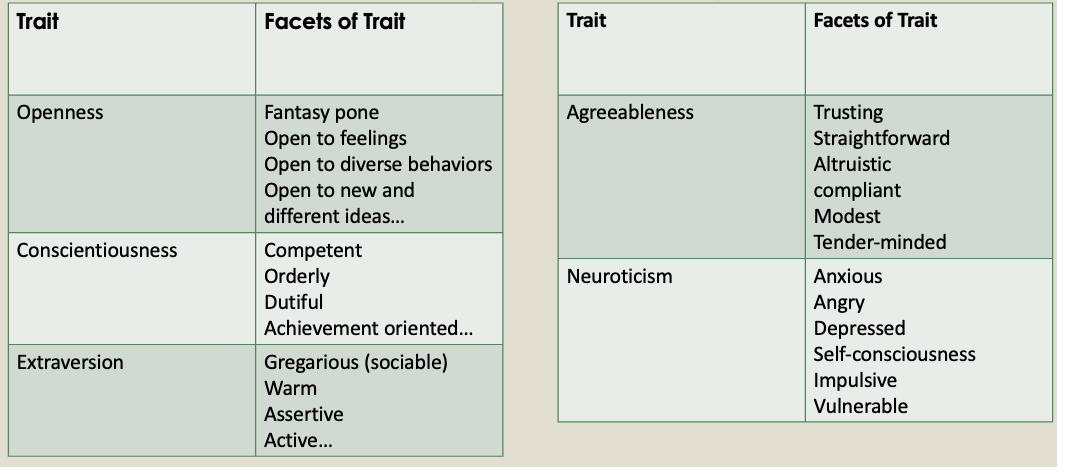
Five-factor model of personality (OCEAN)
O - Openness
C - Conscientiousness
E - Extraversion
A - Agreeableness
N- Neuroticism
O
Openness
The tendency to appreciate new art, ideas, values, feelings and behaviors
C
Conscientiousness
The tendency to be careful, on-time for appointments, to follow rules, and to be hardworking
E
Extraversion
The tendency to be talkative, sociable, and to enjoy others; the tendency to have a dominant style
A
Agreeableness
The tendency to agree and go along with others rather than to assert one’s own opinions and choices
N
Neuroticism
The tendency to frequently experience negative emotions such as anger, worry, and sadness, as well as being interpersonally sensitive.
Facets of personality traits
Other traits beyond the five-factor model
Hans Eysenck suggested that Extraversion and Neuroticism are most important.
Eysenck believed that by combining people’s standing on these two major traits, we could account for many of the differences in personality that we see in people.
HEXACO model
Similar to the Big Five
adds Honesty-Humility
Adds Honesty-Humility as a sixth dimension of personality
People high in this trait are sincere, fair, and modest, whereas those low in this trait are manipulative, narcissistic, and self-centered
Machiavellianism
Named after the famous political philosopher, Niccolo Machiavelli
Refers to individuals who manipulate the behavior of others, often through duplicity
Interested in money, power, and pragmatically use others in this quest
Need for Achievement
Want to accomplish a lot and set high standards of excellence for themselves
Able to work persistently and hard for distant goals
David McClelland argued that economic growth depends in part on citizens with high need for achievement
Need for Cognition
People high in need find it rewarding to understand things and are willing to use significant cognitive effort in this quest
Individuals enjoy learning, and process of trying to understand new things
Authoritarianism
Believe in strict social hierarchies in which they are totally obedient to those above them, expect complete obedience from their subordinates
Rigid in adherence to rules, the authoritarian personality is uncomfortable with uncertainty
Narcissism
Self-love that is so strong that it results in high levels of vanity, conceit, and selfishness
Often has problems feeling empathetic toward others and grateful to others
Optimism
Tendency to expect positive outcomes in the future
People who are optimistic expect good things to happen and often have more positive outcomes
Perhaps because they work harder to achieve them
Alexithymia
Inability to recognize and label emotions in oneself
Individual also has difficult time recognizing emotions in others, and often has difficulties in relationships
The person-situation debate on personality trait
Suggested that if one looks closely at people’s behavior across many different situations, the consistency is really not that impressive.
Pitted the power of personality against the power of situational factors as determinants of the behavior that people exhibit
A person’s behavior in one specific situation is not a good guide to how that person will behave in a very different specific situation.
Research shows that on average, the effect of the “situation” is about as large as that of personality traits.
However, it is also true that if psychologists assess a broad range of behaviors across many different situations, there are general tendencies that emerge.
Assessing Personality Differences Across Cultures
Self-report inventories faces cross-cultural issues
Words don’t always carry identical meanings; Cultures interpret numeric scales differently
Big Five structures appears remarkably consistent across cultures
Cultures differ in the importance and interpretation of each trait
Major depressive episode
Symptoms that co-occur for at least two weeks and cause significant distress or impairment in functioning
Core symptoms:
Feeling down or depressed
Experiencing anhedonia (loss of interest or pleasure in things that one typically enjoys)
Requires five or more of the following nine symptoms, including one or both of the first two symptoms, for most of the day, nearly every day:
depressed mood
diminished interest or plesaure in almost all activities
significant weight loss/gain
insomnia or hypersomnia
psychomotor agitation or retardation
fatigue or loss of energy
feeling worthless or excessive or inappropriate guilt
diminished ability to concentrate or indecisiveness
recurrent thoughts of death, suicidal ideation, or a suicide attempt
These symptoms cannot be caused by physiological effects of a substance or a general medical condition
Manic or hypomanic episode
Core criterion:
A distinct period of abnormally and persistently euphoric, expansive, or irritable mood and persistently increased goal-directed activity or energy
The mood disturbance must be present for one week or longer in mania
Four days or longer in hypomania
At least of the three following symptoms for euphoric mood:
inflated self-esteem or grandiosity
increased goal-directed activity or psychomotor agitation
reduced need for sleep
racing thoughts or flight of ideas
distractibility
increased talkativeness
excessive involvement in risky behaviors
Manic episodes
must last one week and are defined by a significant impairment in functioning
Hypomanic episodes
are shorter and not necessarily accompanied by impairmnet in functioning
Unipolar disorders
Two major types of unipolar disorders:
Major depressive disorder
Persistent depressive disorder
Major depressive disorder
One or more major depressive episodes, but no history of manic or hypomanic episodes
Persistent depressive disorder
Feeling depressed most of the day for more days than not, for at least two years
At least two of the following symptoms are required to meet criteria for PDD:
poor appetite or overeating
insomnia or hypersomnia
low energy or fatigue
low self-esteem
poor concentration or difficulty making decisions
feelings of hopelessness
To meet criteria for PDD, a person cannot be without symptoms for more than two months at a time
Bipolar mood disorders
There are three major types of BDs are described by the DSM-5:
Bipolar I Disorder (BD I)
Bipolar II Disorder
Cyclothymic disorder
Bipolar I Disorder (BD I)
Characterized by a single (or recurrent) manic episode
A depressive episode is not necessary but commonly present for the diagnosis of BD I
Bipolar II Disorder
Characterized by single (or recurrent) hypomanic episodes and depressive episodes
Cyclothymic disorder
Characterized by numerous and alternating periods of hypomania and depression, lasting at least two years
Must experience symptoms at least half the time with no more than two consecutive symptom-free months
Cause significant distress or impairment
Who develops depressive disorders
Major depressive disorder: 16.6% (lifetime)
Persistent depressive disorder: .5% (12-month)
Average age of onset: mid-20
A recurrent disorder
Approximately half of the people that experience a major depressive episode have a second episode
Women are more two to three times more likely to be diagnosed with major depressive episode
Higher prevalence rates of major depressive disorder:
Lower socioeconomic status (SES)
European Americans (than African Americans and Hispanic Americans)
The course of MDD for AAs is often more severe and less often treated than it is for EA
Who develops bipolar disorders
Lifetime prevalence: 4.4%
Bipolar Disorder I: 1%
Often occurs in conjunction with other psychiatric disorders such as anxiety or substance use
Rates of bipolar disorders among EA are similar to those found among AAs
Hispanic Americans and AA with a mood disorder were more likely to remain persistently ill than EA
AA tend to be underdiagnosed for bipolar disorders (and over-diagnosed for schizophrenia)
Adolescence is a significant risk period for bipolar disorders
Factors Implicated in the Development and Course of Depressive Disorders
Genetic/biological factors
Environmental factors increase the risk of major depressive disorder
Early adversity (e.g., childhood abuse)
Chronic stress (e.g., poverty)
Interpersonal factors (e.g., dissatisfaction with intimate relationships)
Pessimistic attributional style
They usually make internal rather than external, global rather than specific, and stable rather than unstable attributions to adverse experiences
Environmental factors
E.g., the loss of a close relationship
Social Zeitgeber Theory: stressors that disrupt sleep, or that disrupt the daily routines that entrain the biological clock (e.g. meal times) can trigger episode relapse
Positive events —> maninc symptoms
Treatments for Depressive Disorders
Medication
Monoamine oxidase inhibitors (MAOIs)
Tricyclics
Selective serotonin reuptake inhibitors (SSRIs)
Serotonin and norepinephrine reuptake inhibitors (SNRIs)
Biological Treatments
Electroconvulsive therapy (ECT)
Transcranial magnetic stimulation (TMS)
Deep brain stimulation
Psychosocial Treatments
Behavior therapy
Cognitive therapy
Interpersonal therapy
Short-term psychodynamic
Treatmentes for Bipolar Disorders
Mediation
Lithium
Carbamazepine
Valproate
Adjunctive Psychosocial Treatment
Interpersonal and social rhythm therapy
Address symptoms of sleep impairment (zeitgeber theory)
Develop and maintain a healthy balance of activity and stimulation
Anxiety
A negative mood state that is accompanied by bodily symptoms