Muscle Weakness, Atrophy, and Neuromuscular Impairment
 Call Kai
 Learn
 Practice Test
 Spaced Repetition
 Match
 Flashcards
 Knowt Play
1/18

There's no tags or description
Looks like no tags are added yet.
19 Terms
What is muscle activation determined by?
Alpha motor neurons originating from the ventral horn
Sources of convergent input acting on motor neurons include…``
Peripheral sensory receptors
Supraspinal structures
Cerebral cortex (Governor of motion)
Cerebellum (Initiates and refines movement along with brainstem)
Brainstem
____________ system regulates skeletal muscle function
Gamma motor neuron (fusimotor) system
Initiates, generates, and maintains force production
What is central activation failure?
Reduction in ability to actively recruit motor neurons
Motor neuron pool excitability (Spinal-reflexive excitability)
Reduction in the excitability of alpha motor neurons that innervate muscles around the joint after acute joint trauma
Presynaptic vs. postsynaptic inhibition (Unfinished flashcard)
Pre: Amount of excitatory
Post: Greater muscle deficit
Steps of muscle inhibition
Altered afferent information (Disruption in information due to deafferentation, pain, and swelling)
Reflexive muscle inhibition (Impairments to muscles)
Changes in somatosensory cortex processing (Impaired sensory processing)
Increased reliance on other cortical areas (Like using your eyes for balance)
Decreased descending motor output (Decreased muscle function overall)

Types of muscle inhibition
Arthrogenic: Sensory nerve in the joint capsule impairs a muscle from contracting. Happens due to injury
Autogenic: Strong contraction of muscle leads to relaxation of same muscle. Mechanism for PNF stretching, happens from GTO
Reciprocal: Contraction of muscle on one side leads to relaxation of muscle on the other side (Biceps contraction relaxes tricep)
Recurrent: Affects smooth, coordinated motion like walking
What sequelae (aftereffects of injury) relate to muscle inhibition?
Effusion: Synovial fluid builds up in knee capsule
Protective mechanism to limit further tissue damage
Hyperexcitation of joint mechanoreceptors, especially low-threshold and slow-adapting
Pain
Inhibits muscle activation. Minimizing pain enhances muscle activation
Pain is not required to experience muscle inhibition
Therapeutic exercise should be mostly pain free
Inflammation
Same mechanoreceptor sensitivity as effusion as well as nociceptors
Inhibition from this can be chemical (peripheral sensitization) or mechanical (edematous swelling)
Laxity
Since integrity of joint tissue is directly disrupted, muscle inhibition follows
Receptor damage
Most vulnerable to damage after capsuloligamentous injury
Ensemble coding
Deafferentiation
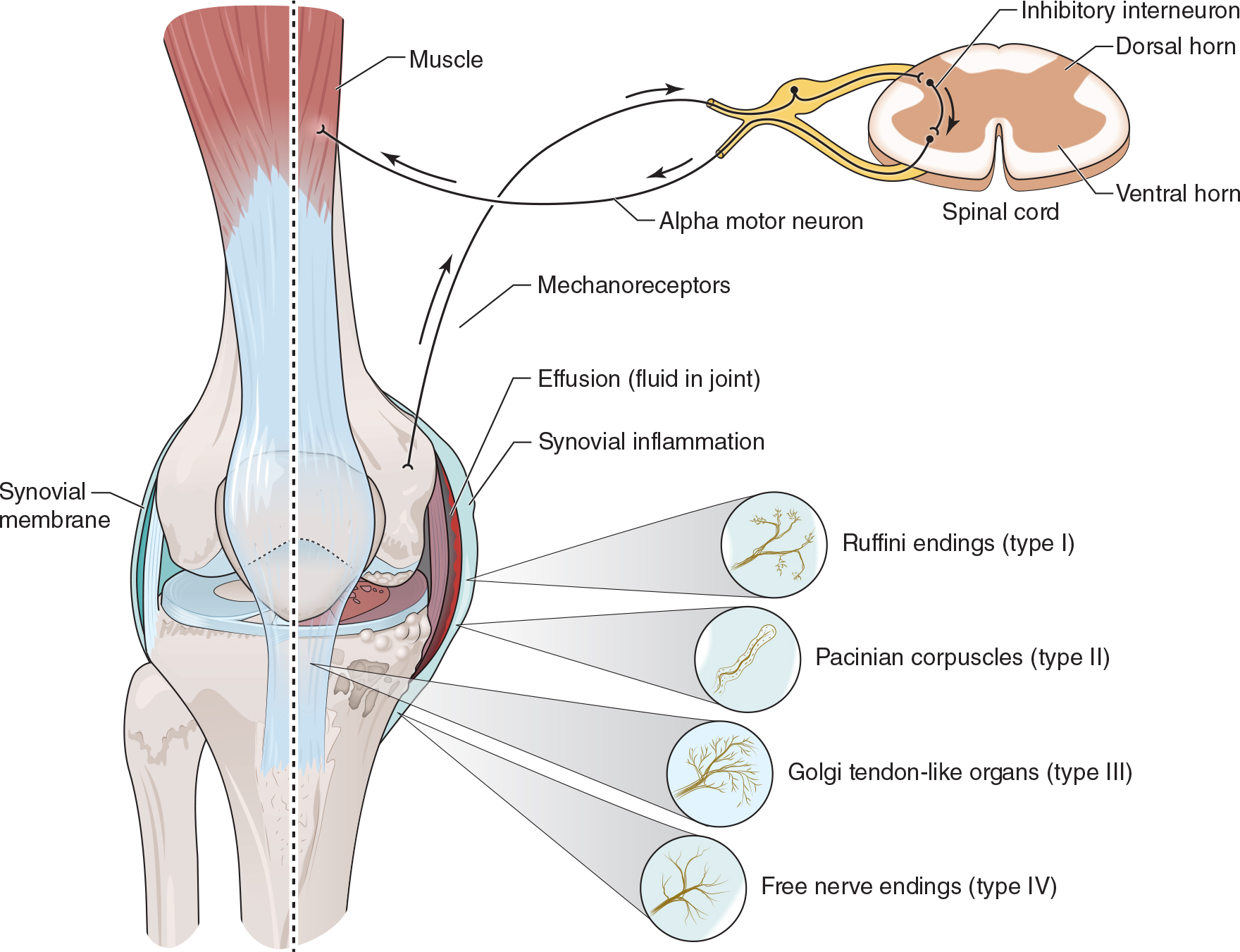
Joint mechanoreceptors
Low-activation threshold:
Ruffini endings
Pacinian corpuscles
High-activation threshold:
Golgi-tendon organ
Free nerve endings
Slow-adapting
Ruffini
Golgi-tendon
Free nerve
Fast-adapting
Pacinian

Deafferentiation
Loss of sensory input. One of many mechanisms of muscle inhibition
Ensemble coding
Since somatosensory system is very plastic, damage to receptor can be overcame and healed
Clinical strength testing modes
Manual muscle testing
Can possibly be inaccurate after injury since both sides can weaken
Dynamometers
Clinical strength testing limitaitons
Isometric strength carryover is limited for isotonic and isokinetic testing. Useful for peak force (rate of force development) but not much else
Reasons for muscle atrophy
Structural impairment
Fibrotic tissue, fat
Disuse atrophy
Stopping exercise for long period of time
Posttraumatic atrophy
Atrophy after injury or post-surgery
Neural
Deafferentation degrades tissue quality
Muscular
Re-engaging the muscle after injury is important but doesn’t always directly improve its size and quality
Body relies on slower twitch fibers (Type I) over quick twitch (Type II, IIx) after injury
Cellular
Excess myostatin = catabolic
Inflammatory cytokines, fibroadipogenic progenitors, less satellite cells = catabolic
Assessing muscle atrophy
Girth measurement (Somewhat accurate)
Diagnostic ultrasound
Dynamic systems theory
How factors related to environment, task, and body interact to inform/influence movement
The intrinsic ability of a person to coordinate movement depends on..
Individual constraints
Strength
Proprioception
Neuromuscular control
Define proprioception and neuromuscular control. Why are these important?
Proprioception: Sensory input from proprioceptors that contribute to posture, joint stability, and muscle senses
Neuromuscular control: Unconscious activation of dynamic restraints that control motion and loading (aka ability to produce controlled movement through coordinated muscle action)
Important because these “sub-systems” interact with one another