Chapter4
 Call Kai
 Learn
Learn Practice Test
 Spaced Repetition
 Match
Match Flashcards
 Knowt Play
1/16

Earn XP
Name | Mastery | Learn | Test | Matching | Spaced | Call with Kai | Chat |
|---|
No analytics yet
Send a link to your students to track their progress
17 Terms
Cell Morphology
The study of the shape and size of cells, including various forms such as cocci, bacilli, and spirilla.
Peptidoglycan
A rigid structural layer found in bacterial cell walls, composed of alternating N-acetylglucosamine and N-acetylmuramic acid.
Cytoplasmic Membrane
A biological membrane that separates and protects the interior of a cell from the external environment, involved in transport and energy conservation.
Gram-positive Bacteria
Bacteria with a thick peptidoglycan layer in their cell wall, which retains the crystal violet stain used in Gram staining.
Gram-negative Bacteria
Bacteria characterized by a thin peptidoglycan layer and an outer membrane containing lipopolysaccharides, which do not retain the crystal violet stain.
Lipopolysaccharide (LPS)
A major component of the outer membrane of Gram-negative bacteria, consisting of a lipid portion and a polysaccharide portion, often associated with pathogenicity.
Transport Systems
Mechanisms that require transmembrane proteins to move solutes across the cytoplasmic membrane, including simple transport, group translocation, and ABC transporters.
Endospores
Highly resistant structures formed by certain bacteria (e.g., Bacillus and Clostridium) that allow survival in extreme conditions, not for reproduction.
Flagella
Long, whip-like structures that enable motility in bacteria, with different arrangements such as peritrichous and polar.
Fimbriae
Short, hair-like structures on the surface of bacteria that assist in attachment to surfaces.
Pili
Similar to fimbriae but longer, involved in attachment and genetic exchange (conjugation) between bacterial cells.
Gas Vesicles
Protein structures that provide buoyancy to certain bacteria, allowing them to float in aquatic environments.
Microbial Taxis
The movement of microorganisms in response to environmental stimuli, such as chemotaxis (chemical) and phototaxis (light).
Binary Fission
A method of asexual reproduction in bacteria where a single cell divides into two identical daughter cells.
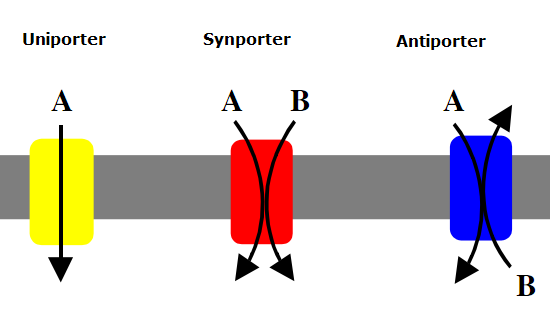
Uniport
A solute moves in one direction or unidirectional
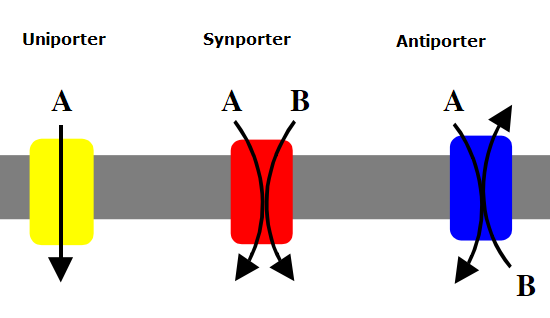
Antiport
A solute move across the membrane while a second substance moves in opposite direction
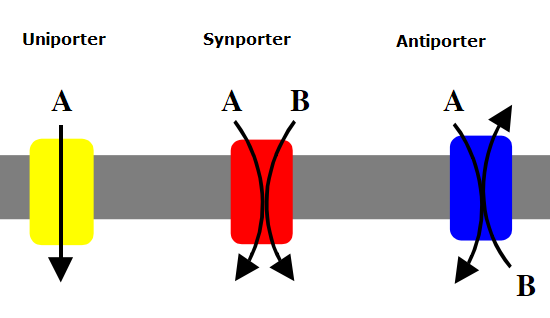
Symport
A solute moves along with other substance