Metabolic Processes Quiz 2
 Call Kai
 Learn
 Practice Test
 Spaced Repetition
 Match
 Flashcards
 Knowt Play
1/114

There's no tags or description
Looks like no tags are added yet.
115 Terms
Why respire without oxygen?
No oxygen: the electron transport chain stops, so the link reaction and the Krebs cycle stop too. Glycolysis does not need oxygen. It still makes 2 pyruvate, 2 ATP (net) and 2 reduced NAD per glucose. But glycolysis needs NAD. Without a way to turn reduced NAD back into NAD, it soon runs out and glycolysis stops as well. So the cell needs another way to regenerate NAD. (Anaerobic respiration)
What is anaerobic respiration?
Releases energy from glucose through glycolysis, producing a net yield of 2 ATP per glucose. The steps after glycolysis regenerate NAD⁺, which is required for glycolysis to continue. Different organisms do this in different ways.
What happens during anaerobic respiration in humans?
Lactic acid fermentation:
Occurs in humans, other animals and some bacteria.
Pyruvate is converted into lactate in one step, using one enzyme (lactate dehydrogenase) in the cytoplasm.
No CO₂ is released.
Allows glycolysis to produce ATP quickly, making it useful during intense activities such as sprinting and weightlifting.
Not a long-term solution because it produces only 2 net ATP per glucose, which is a low energy yield.
What happens during lactate fermentation? Draw it!
Pyruvate is reduced to lactate by accepting hydrogen/electrons from NADH. NADH is oxidised back to NAD⁺, which returns to glycolysis.
Reaction to memorize:
Pyruvate + NADH → Lactate + NAD⁺
Pyruvate = Reduction
NADH = Oxidation

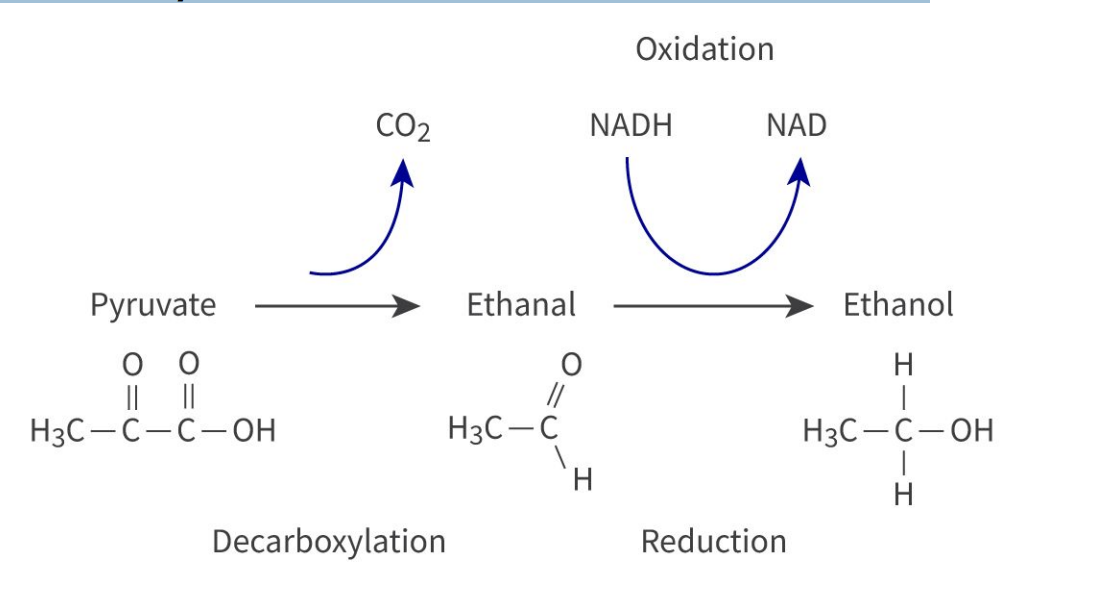
What happens during anaerobic respiration in yeast? Draw it!
Yeast undergoes alcohol fermentation, where pyruvate is converted into ethanol in two steps:
Step 1: Decarboxylation
Pyruvate is decarboxylated (loses CO₂).
Pyruvate becomes ethanal.
CO₂ is released.
Step 2: Reduction
Ethanal is reduced by NADH, which donates hydrogen/electrons.
Ethanal becomes ethanol.
NADH is oxidised back to NAD⁺, regenerating NAD⁺ for glycolysis.
Each step uses a different enzyme.
What are the real-world applications of alcohol fermentation?
Baking (bread):
Yeast uses available oxygen and then respires anaerobically.
Produces CO₂ and ethanol.
CO₂ forms bubbles trapped in the dough, causing it to rise.
Ethanol evaporates during baking.
Brewing (beer and wine):
Yeast ferments sugars anaerobically in a sealed container.
Beer uses sugars from barley; wine uses sugars from grapes.
Ethanol is produced, and CO₂ can contribute to carbonation.
Humans (and other animals) | Yeast | |
Name | ||
Pyruvate becomes | ||
Steps after glycolysis | ||
CO₂ released? | ||
ATP per glucose | ||
NAD regenerated? |
Humans (and other animals) | Yeast | |
Name | Lactic acid fermentation | Alcohol fermentation |
Pyruvate becomes | Lactate | Ethanal, then ethanol |
Steps after glycolysis | One | Two |
CO₂ released? | No | Yes |
ATP per glucose | 2 (from glycolysis) | 2 (from glycolysis) |
NAD regenerated? | Yes | Yes |
Aerobic | Anaerobic | |
Oxygen needed? | ||
Where in the cell | ||
Stages | ||
ATP per glucose | ||
Products | ||
Speed |
Aerobic | Anaerobic | |
Oxygen needed? | Yes | Np |
Where in the cell | Cytoplasm and mitochondria | Cytoplasm only |
Stages | Glycolysis, link reaction, Krebs cycle, ETC | Glycolysis, then NAD regenerated |
ATP per glucose | About 30 to 38 | 2 |
Products | CO₂ and water | Lactate, or ethanol and CO₂ |
Speed | Slower | Faster |
In lactic acid fermentation, which molecule is reduced and which is oxidised?
Pyruvate is reduced. Reduced NAD is oxidised.
Explain why glycolysis would stop if pyruvate was not converted to lactate.
Reduced NAD would not be turned back into NAD. Glycolysis needs NAD, so it would run out and glycolysis would stop.
How many CO₂ does yeast release from one glucose in anaerobic respiration?
Two. One from each pyruvate.
Bread is made with yeast. Explain why bread rises but does not contain alcohol.
Yeast releases CO₂, which forms bubbles in the dough. The ethanol evaporates during baking.
Describe how anaerobic respiration allows glycolysis to continue in a muscle cell.
Pyruvate is reduced to lactate by reduced NAD. This oxidises reduced NAD back to NAD. NAD goes back to glycolysis, so glycolysis continues and makes 2 ATP per glucose.
What is a respiratory substrate? What are the three different types?
Any molecule that can be broken down during cellular respiration to release energy. They all end up in the same pathway, but they join it at different points.
Carbohydrates
Fats (lipids)
Proteins
Explain how carbohydrates are used as respiratory substrates in cellular respiration
Carbohydrates are generally the first respiratory substrate used by cells.
They are broken down into glucose, which enters glycolysis.
Glycolysis breaks glucose down into pyruvate and produces a net gain of 2 ATP and 2 NADH per glucose.
Carbohydrates can provide energy without oxygen because glycolysis is anaerobic.
They release less energy per gram than fats because they contain fewer hydrogen atoms relative to carbon.
They are generally quicker to access and use than fats.
Important comparison: Unlike fats, carbohydrates can supply ATP through glycolysis even when oxygen is unavailable.
Explain how fats are used as respiratory substrates in cellular respiration.
Fats are the body's main long-term energy store.
A triglyceride consists of one glycerol molecule and three fatty acid chains.
During breakdown:
Glycerol enters glycolysis.
Fatty acids are broken into 2-carbon units, which become acetyl-CoA and enter the Krebs cycle.
Fatty acid breakdown also produces NADH and FADH₂, which carry electrons to the electron transport chain.
Fats release more than twice as much energy per gram as carbohydrates because they contain more hydrogen relative to oxygen.
They require oxygen for further energy production because fatty acid breakdown depends on the Krebs cycle and electron transport chain.
They are generally slower to mobilize and use than carbohydrates.
Important comparison: Unlike carbohydrates, fats cannot provide ATP through anaerobic glycolysis because their fatty acids enter respiration as acetyl-CoA rather than glucose.
Explain how proteins are used as respiratory substrates.
Back:
Proteins are generally used as respiratory substrates when carbohydrates and fats are insufficient, or when excess protein is available.
Proteins are broken down into amino acids.
Before amino acids can enter cellular respiration, their amine group (containing nitrogen) must be removed. This process is called deamination.
What happens during deamination?
The amine group is removed from the amino acid.
This produces ammonia, which is toxic.
The liver converts ammonia into urea, which is transported to the kidneys and removed in urine.
The remaining part of the amino acid is called its carbon skeleton.
What happens to the carbon skeleton?
It can enter cellular respiration at different points:
As pyruvate.
As acetyl-CoA.
As an intermediate in the Krebs cycle.
Some carbon skeletons can also be used to make glucose.
What four factors affect the rate of cellular respiration?
Temperature
Substrate availability
Oxygen availability
The organism
Where in the cell does anaerobic respiration happen?
The cytoplasm.
What is produced by anaerobic respiration in human muscle?
Lactate
What are the products of anaerobic respiration in yeast?
Ethanol and carbon dioxide.
Why must reduced NAD be converted back to NAD in anaerobic respiration?
So that glycolysis can continue: NAD is needed to accept hydrogen from G3P.
How many ATP (net) are made per glucose in anaerobic respiration?
2
Define ATP
the molecule that distributes energy within cells
Define chloroplasts, thylakoids, and stroma
Chloroplasts: a double membrane; inside, stacks of flattened sacs called thylakoids (where light is absorbed), surrounded by a fluid called the stroma.
What are enzymes affected by
Enzymes are affected by temperature, pH and substrate concentration.
How is energy transformed and transferred through photosynthesis and cellular respiration?
Photosynthesis converts light energy from the Sun into chemical energy, which is stored in glucose and other carbon compounds.
Cellular respiration breaks down glucose and releases its stored chemical energy to produce ATP.
Energy flows through ecosystems: it enters as sunlight and eventually leaves as heat. Energy is not recycled.
Carbon and oxygen cycle: they are continually reused through photosynthesis and cellular respiration.
Trace the energy in a hamburger back to its source.
Light from the sun → chemical energy in grass (photosynthesis) → the cow eats the grass → beef → you.
Photosynthesis and respiration are often called opposites. In what way are they opposites, and in what way are they not?
Opposite equations: photosynthesis uses CO, and water and makes glucose and oxygen; respiration does the reverse. But they are not simply reversed: they use different enzymes, happen in different organelles, and photosynthesis needs light.
Why is hydrogen needed to produce glucose during photosynthesis?
Glucose (C₆H₁₂O₆) contains carbon, hydrogen and oxygen.
Carbon dioxide (CO₂) provides carbon but contains no hydrogen.
Plants therefore use water (H₂O) as their source of hydrogen.
First, the hydrogen must be removed from water. This happens through a process called photolysis.
What is photolysis, and what happens during this process?
Photolysis means splitting (lysis) using light (photo). It is the process of splitting water using light energy (photons).
Light energy splits water molecules into:
Hydrogen ions (H⁺): used in later stages of photosynthesis.
Electrons (e⁻): replace electrons lost by chlorophyll and help transfer energy.
Oxygen (O₂): released as a by-product.
The oxygen we breathe comes from water (H₂O), not carbon dioxide (CO₂).
Equation: 2H2O + photons → 4H+ + O2 + 4e-
What are the two sets of reactions in photosynthesis? Explain what they are, where they happen, whether they need light, what happens during them, and their products.
1. Light-dependent reactions
Where: Thylakoids of the chloroplast.
Need light? Yes, directly.
What happens:
Light energy is absorbed.
Photolysis splits water into hydrogen ions (H⁺), electrons (e⁻), and oxygen (O₂).
Energy from the electrons is used to make ATP.
Products: ATP and hydrogen (carried by NADPH) are passed to the next set of reactions. Oxygen is released as waste.
2. Light-independent reactions
Where: Stroma of the chloroplast.
Need light? Not directly.
What happens:
Carbon fixation occurs: CO₂ is incorporated into carbon compounds.
ATP and hydrogen from the light-dependent reactions are used to help produce glucose and other carbohydrates.
Products: Glucose and other carbon compounds.
What is carbon fixation?
Carbon fixation is the process of converting inorganic carbon (CO₂ from the air) into organic carbon compounds, such as glucose.
It occurs during the light-independent reactions in the stroma of the chloroplast.
It uses ATP and hydrogen (carried by NADPH) produced during the light-dependent reactions.
The two sets of reactions depend on each other:
Light-dependent reactions produce ATP and NADPH.
Light-independent reactions use them to help convert CO₂ into carbohydrates.
What is the overall equation for photosynthesis? Identify the reactants and products.
Carbon dioxide + water → glucose + oxygen (light energy, chlorophyll)
6CO2 + 6H2O → C6H12O6 +6O2
Reactants: 6 carbon dioxide molecules and 6 water molecules.
Products: 1 glucose molecule and 6 oxygen molecules.
Light energy, absorbed by chlorophyll, powers the process.
How are the overall equations for photosynthesis and aerobic respiration connected?
Photosynthesis: 6CO2 + 6H2O → C6H12O6 +6O2
Aerobic respiration: C6H12O6 +6O2 → 6CO2 + 6H2O
Both equations contain the same molecules but run in opposite directions.
Photosynthesis uses CO₂ and water to produce glucose and oxygen. Aerobic respiration uses glucose and oxygen to produce CO₂ and water.
Photosynthesis stores light energy as chemical energy in glucose. Aerobic respiration releases that stored energy to produce ATP.
State the products of photolysis.
Hydrogen ions (H*), electrons and oxygen (O2).
Identify the molecule that is the source of hydrogen in photosynthesis.
water
Explain why the light-independent reactions stop soon after a plant is put in the dark, even though they do not need light.
They need the ATP and hydrogen made by the light-dependent reactions. In the dark these run out, so carbon fixation stops.
How does the release of oxygen by photosynthesis affect the atmosphere?
It increases oxygen
It increases carbon dioxide
It decreases carbon dioxide
It converts carbon dioxide into oxygen
A
In a plant cell during the day, how is oxygen transported, and in which direction?
Diffusion, from cytoplasm to chloroplast
Active transport, from chloroplast to cytoplasm
Active transport, from cytoplasm to chloroplast
Diffusion, from chloroplast to cytoplasm
Diffusion, from chloroplast to cytoplasm Oxygen is made in the chloroplast, so its concentration is higher there, and it diffuses out down its gradient.
What is a pigment? Explain how chlorophyll absorbs light and how this contributes to photosynthesis.
Pigment: A substance that absorbs certain wavelengths (colours) of light and reflects the rest.
Chlorophyll: The main photosynthetic pigment in plants.
Absorbs mainly blue and red light.
Reflects green light, which is why leaves appear green.
Excited electrons: When chlorophyll absorbs light, its electrons gain energy.
This is how light energy enters the photosynthesis process and is converted into chemical energy.
What is an absorption spectrum and an action spectrum?
Absorption spectrum: Shows how much light a pigment absorbs at each wavelength.
Action spectrum: Shows the rate of photosynthesis at each wavelength.
Relationship: They match closely because absorbed light drives photosynthesis.
Why does photosynthesis happen slowly in green light?
Chlorophyll absorbs very little green light (it reflects it), so little energy is captured.
The action spectrum is higher than chlorophyll’s absorption between 450 and 500 nm. Explain why.
Other pigments (carotenoids) absorb those wavelengths and pass the energy to chlorophyll a.
What is a limiting factor in photosynthesis, and what are the three main limiting factors?
Limiting factor: A factor in shortest supply that limits the rate of photosynthesis.
Three main limiting factors:
Light intensity
Carbon dioxide concentration
Temperature
Increasing the limiting factor increases the rate of photosynthesis. Increasing other factors has no effect on the rate.
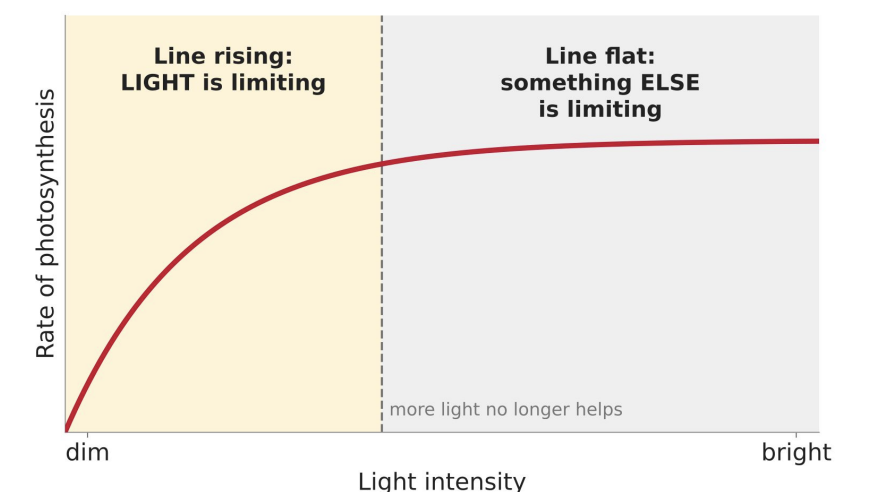
How does light intensity affect the rate of photosynthesis? Draw the graph
In dim light, increasing light intensity increases the rate of photosynthesis.
Once the rate reaches a plateau, light is no longer the limiting factor; another factor is limiting the rate.
How does carbon dioxide concentration affect the rate of photosynthesis?
CO₂ is a raw material used to make sugars during photosynthesis.
Increasing CO₂ concentration can increase the rate of photosynthesis.
CO₂ often limits photosynthesis in outdoor plants, which is why greenhouses add extra CO₂.

How does temperature affect the rate of photosynthesis?
Photosynthesis involves enzyme-controlled reactions.
Increasing temperature increases the rate up to an optimum temperature.
Above the optimum, enzymes denature and the rate of photosynthesis decreases.

How can you identify the limiting factor on a photosynthesis graph?
Rising line: The factor on the x-axis is limiting.
Flat line (plateau): Another factor is limiting.
Comparing two lines: At the same x-axis value, the factor that differs between the lines is limiting if it explains the higher rate.
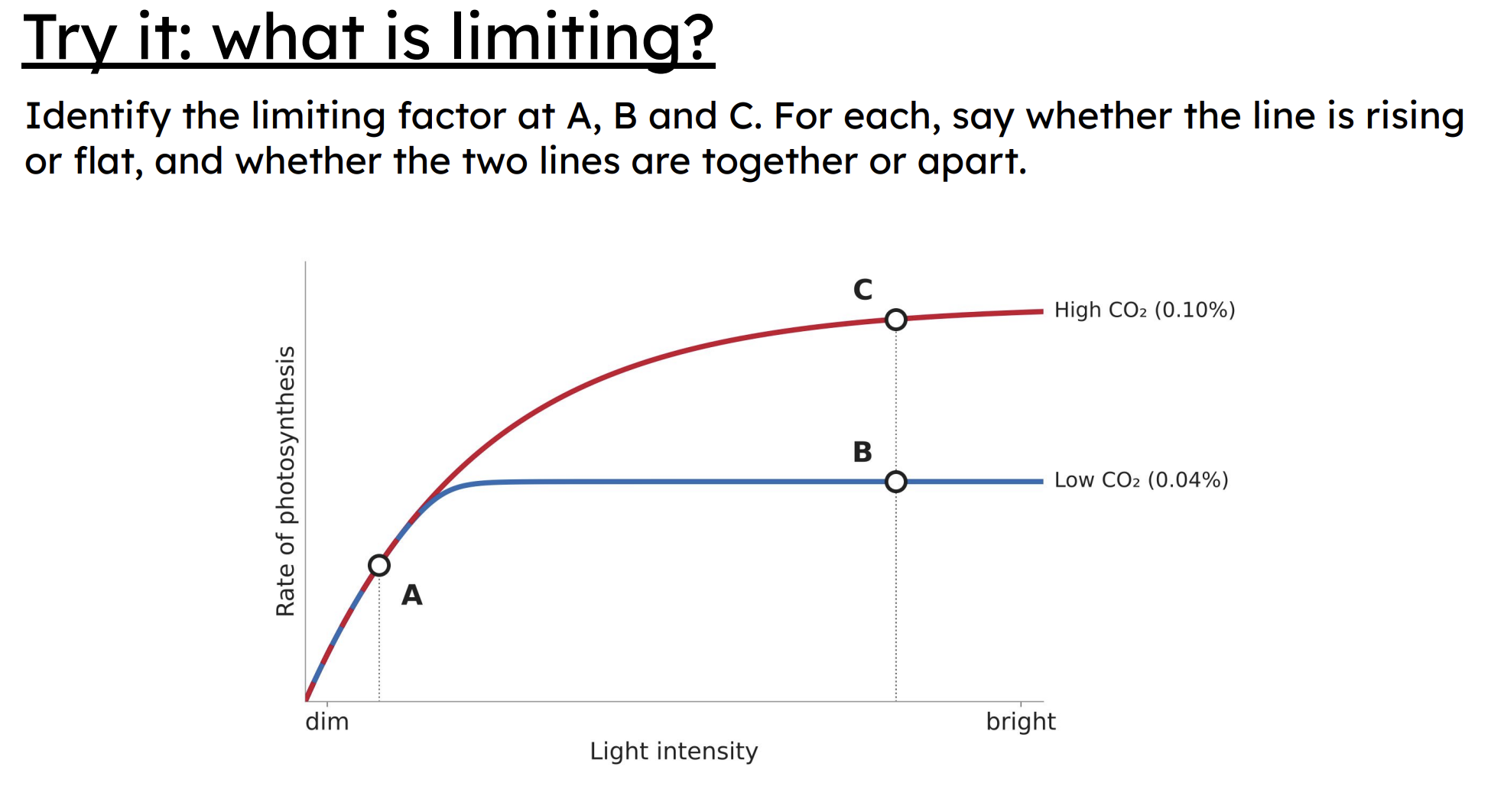
A: light intensity. The line is still rising, and both lines are together, so extra CO₂ makes no difference here.
B: CO₂ concentration. The blue line is flat, but the red line (more CO₂) is higher at the same light intensity. So more CO₂ would raise the rate.
C: something else, e.g. temperature. The red line is flat even with high light and high CO₂, so neither of those is limiting now.
How can we change each limiting factor in an experiment?
Light intensity: Move an LED lamp closer or further away, or use dimmer settings/filters.
CO₂ concentration: Dissolve different amounts of sodium hydrogen carbonate (baking soda) in water to release CO₂.
Temperature: Place the plant or leaf discs in water baths at different temperatures.
You’re experts at this now. You want to find out how CO₂ concentration affects the rate of photosynthesis, using floating leaf discs.
1. State the independent and dependent variables.
2. Describe how you would change the independent variable.
3. List three variables you would control, and how.
4. Explain why using a hot incandescent lamp would be a problem.
1. IV: CO₂ concentration (concentration of sodium hydrogen carbonate). DV: rate of photosynthesis, e.g. time for 5 discs to float.
2. Use a range of sodium hydrogen carbonate solutions, e.g. 0%, 0.25%, 0.5%, 0.75%, 1.0%.
3. Any three: light intensity (same lamp, same distance); temperature (water bath or room temperature, check with a thermometer); leaf type and age (same plant); disc size (same hole punch); number of discs; volume of solution.
4. The lamp heats the water, so temperature changes as well as light. You could not tell which factor caused the change.
Why do scientists study CO₂ enrichment in plants?
Atmospheric CO₂ has increased from about 280 ppm before the Industrial Revolution to around 430 ppm today.
Since CO₂ is often a limiting factor in photosynthesis, scientists investigate whether rising CO₂ will increase plant growth.
Scientists add extra CO₂ to plants to predict how they may grow in the future.
Compare the two methods scientists use to study CO₂ enrichment, including their advantages and disadvantages.
1. Enclosed greenhouses
Plants grow in closed greenhouses or chambers with extra CO₂ pumped in.
Advantage: CO₂, light, temperature and water can be controlled.
Disadvantage: Conditions are not like real fields or forests, so results may not reflect natural environments.
2. FACE experiments (Free-Air CO₂ Enrichment)
Rings of pipes release extra CO₂ over real fields or forests.
Advantage: Plants grow under natural conditions, over large areas and for many years.
Disadvantage: Wind, rain, sunlight and temperature cannot be controlled.

In high-nitrogen soil, enriched CO₂ raised dry mass from 140 to 176 g per m² (about 26% more). In low-nitrogen soil it only rose from 100 to 104.
With little nitrogen, nitrogen became the limiting factor: plants need it to make proteins (including enzymes like Rubisco). Extra CO₂ can’t help if something else is limiting.
So enrichment experiments suggest crops may not all grow faster as CO₂ rises: it depends on what else limits them
Explain what is meant by a limiting factor, using light intensity as an example.
The factor in shortest supply sets the rate. In dim light, increasing light raises the rate; once the rate levels off, light is no longer limiting and more light has no effect.
Explain why the rate of photosynthesis falls at high temperatures.
The reactions are controlled by enzymes. Above the optimum, enzymes denature (their active sites change shape), so fewer reactions happen.
Define limiting factor.
The factor in shortest supply, which sets the rate.
On a graph of rate vs light intensity, what does the flat part of the line tell you?
Light is no longer limiting: something else (CO₂ or temperature) is.
In the electron transport chain, where are protons pumped to?
Into the intermembrane space, building a proton gradient.
What does ATP synthase use to make ATP?
The flow of protons back down their gradient (chemiosmosis).
What is the final electron acceptor in respiration?
Oxygen, which becomes water.
What is a photosystem, and how does it carry out photoactivation?
A photosystem is an array of chlorophyll and accessory pigments held in a protein complex within the thylakoid membrane.
Pigments absorb light energy and pass it from pigment to pigment to the reaction centre (a special chlorophyll a).
The reaction centre releases an excited electron to the primary electron acceptor.
This process is called photoactivation.
Draw a photosystem

Why do photosystems contain many pigment molecules instead of just one chlorophyll?
Collect more light: Many pigments capture light over a larger area and funnel energy to one reaction centre.
Absorb more wavelengths: Different pigments absorb different wavelengths, allowing more light to be used.
Efficient electron transfer: The reaction centre is beside the primary electron acceptor, allowing the excited electron to be passed on rather than lost.
Satellite dish analogy: The whole dish collects the signal and focuses it on one receiver, just as the pigments collect light energy and funnel it to the reaction centre.
1. What is the main job of a photosystem?
(A) make reduced NADP
(B) absorb light energy and use it to excite electrons
(C) make oxygen
(D) make ATP
B
2. Which best describes a photosystem?
(A) proteins in a membrane
(B) electrons in protein complexes
(C) pigments in protein complexes
(D) electrons in membranes
C
3. Six water molecules are split by photolysis. How many O₂, H⁺ and electrons are made?
3 O₂, 12 H⁺ and 12 electrons (2H₂O → 4H⁺ + 4e⁻ + O₂, times 3)
How are electrons excited and transferred during the light-dependent reactions? Draw the diagram
Light excites electrons in Photosystem II (PSII).
Electrons pass through the electron transport chain (ETC).
Light excites the electrons again in Photosystem I (PSI).

Explain the light-dependent reactions, from Photosystem II and photolysis to the production of ATP and reduced NADP.
1. Photosystem II and photolysis
Light excites electrons in Photosystem II (PSII). They leave the reaction centre and enter the electron transport chain.
Having lost electrons, the reaction centre becomes a powerful oxidising agent. It pulls electrons from water, splitting it through photolysis:
2H₂O → 4H⁺ + 4e⁻ + O₂- The electrons replace those lost from PSII. The protons (H⁺) remain inside the thylakoid, and oxygen is released from the leaf as a waste product.
2. The electron transport chain pumps protons
As electrons pass along the chain of carriers, they release energy.
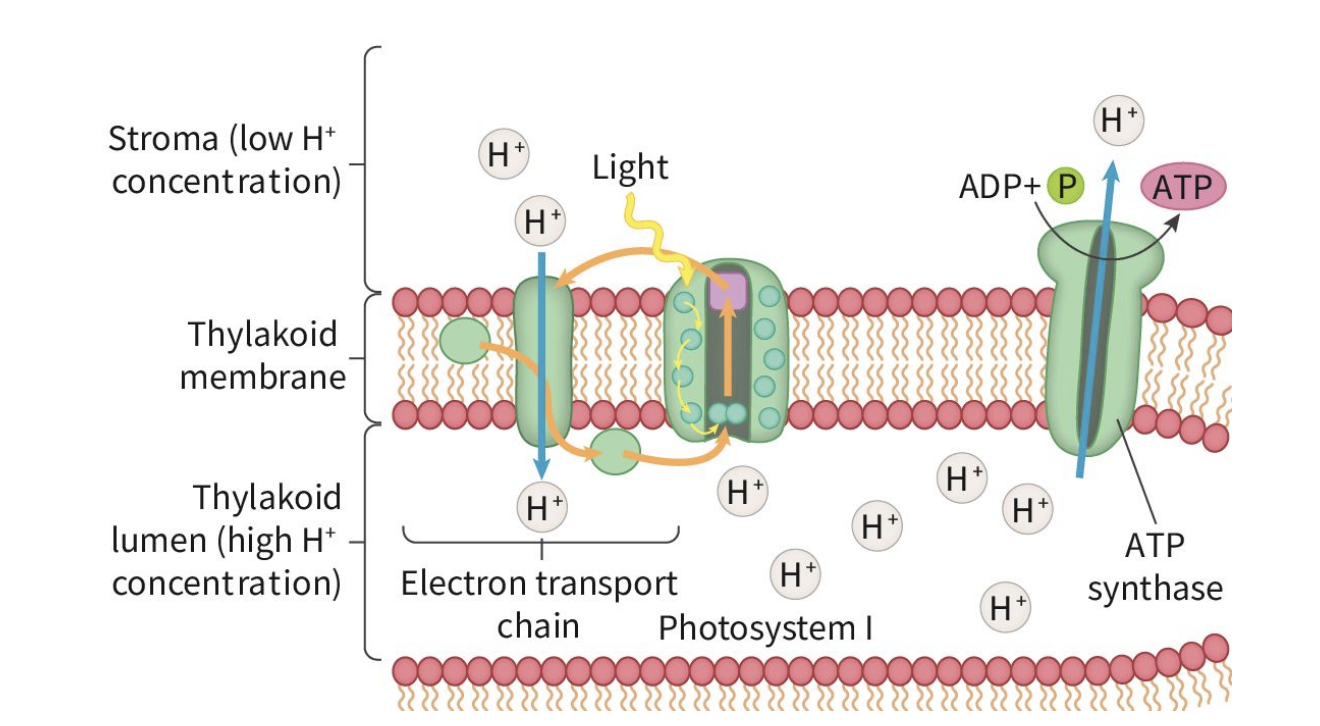
This energy is used to pump protons (H⁺) from the stroma into the thylakoid space (lumen).
The lumen is tiny, so protons build up quickly, creating a steep proton gradient. Photolysis adds even more protons to the lumen.
3. ATP synthase makes ATP
Protons flow back out of the lumen into the stroma through ATP synthase.
This flow drives ATP synthase to join ADP and inorganic phosphate (Pi) to produce ATP.
This process is called chemiosmosis, just as in the mitochondrion. Because the energy originally came from light, it is called photophosphorylation.
The ATP ends up in the stroma, exactly where the Calvin cycle needs it.
4. Photosystem I reduces NADP
Light excites the electrons again in Photosystem I (PSI).
Two excited electrons, plus a proton (H⁺) from the stroma, are passed to NADP⁺ to form reduced NADP:
NADP⁺ + 2e⁻ + H⁺ → reduced NADP- Reduced NADP carries the electrons and their energy to the Calvin cycle.
What is non-cyclic photophosphorylation?
Non-cyclic photophosphorylation takes place in the thylakoid membrane.
Electrons move from water, through Photosystem II (PSII), the electron transport chain (ETC), and Photosystem I (PSI), to NADP⁺.
NADP⁺ accepts the electrons and becomes reduced NADP (NADPH).
The electron pathway is non-cyclic because the electrons do not return to their original photosystem.
Draw and label non-cyclic photophosphorylation in the thylakoid membrane.

What is cyclic photophosphorylation, and what happens during the process?
Cyclic photophosphorylation involves only Photosystem I (PSI).
Light excites electrons in PSI. The excited electrons pass along the electron transport chain, releasing energy that is used to pump protons into the thylakoid lumen.
The proton gradient drives ATP synthase to produce ATP.
The electrons then return to Photosystem I, completing a cycle.
No water is split, so no oxygen is released, and NADP⁺ is not reduced.
The main product is ATP.
Draw and label cyclic photophosphorylation.
Two ways to make ATP | Non-cyclic | Cyclic |
Photosystems used | ||
Electrons come from | ||
Oxygen released? | ||
Products | ||
When |
Two ways to make ATP | Non-cyclic | Cyclic |
Photosystems used | II and I | I only |
Electrons come from | Water (photolysis) | Photosystem I, and loop back to it |
Oxygen released? | Yes | No |
Products | ATP and reduced NADP | ATP only |
When | Normally | When the cell needs extra ATP, or NADP runs out |
Compare and contrast mitochondria and chloroplasts in their electron transport chains and ATP production
Similarities:
Both use an electron transport chain (ETC).
Both create a proton gradient across a membrane.
Both use ATP synthase to produce ATP through chemiosmosis.
Differences:
Feature | Chloroplast | Mitochondrion |
|---|---|---|
Electron source | Water (photolysis) | NADH and FADH₂ |
Proton movement | Stroma → thylakoid lumen | Matrix → intermembrane space |
Proton buildup | Thylakoid lumen | Intermembrane space |
Proton flow through ATP synthase | Lumen → stroma | Intermembrane space → matrix |
ATP produced in | Stroma | Matrix |
How is the thylakoid system adapted for the light-dependent reactions?
Photolysis: Occurs inside the thylakoid lumen, at Photosystem II.
ATP synthesis: ATP synthase faces the stroma, where ATP is produced as protons flow from the lumen into the stroma.
NADP reduction: Occurs at Photosystem I, facing the stroma.
Thylakoid membrane: Keeps protons inside the lumen, allowing a proton gradient to form.
Small lumen: Allows protons to build up quickly, creating a steep proton gradient.
Grana: Stacks of thylakoids provide a large surface area for photosystems and ATP synthase.
How did oxygen produced by cyanobacteria change Earth's atmosphere and support the development of complex life?
For about the first billion years of life, there was almost no oxygen in the atmosphere.
Cyanobacteria began splitting water through photosynthesis, releasing oxygen as a by-product.
Oxygen gradually built up in the atmosphere, leading to the Great Oxidation Event about 2.4 billion years ago.
Iron in the oceans reacted with oxygen and formed iron oxides, creating banded iron rock.
An ozone layer formed, helping protect Earth from harmful UV radiation.
Aerobic respiration became possible, supporting the development of larger, more complex life.
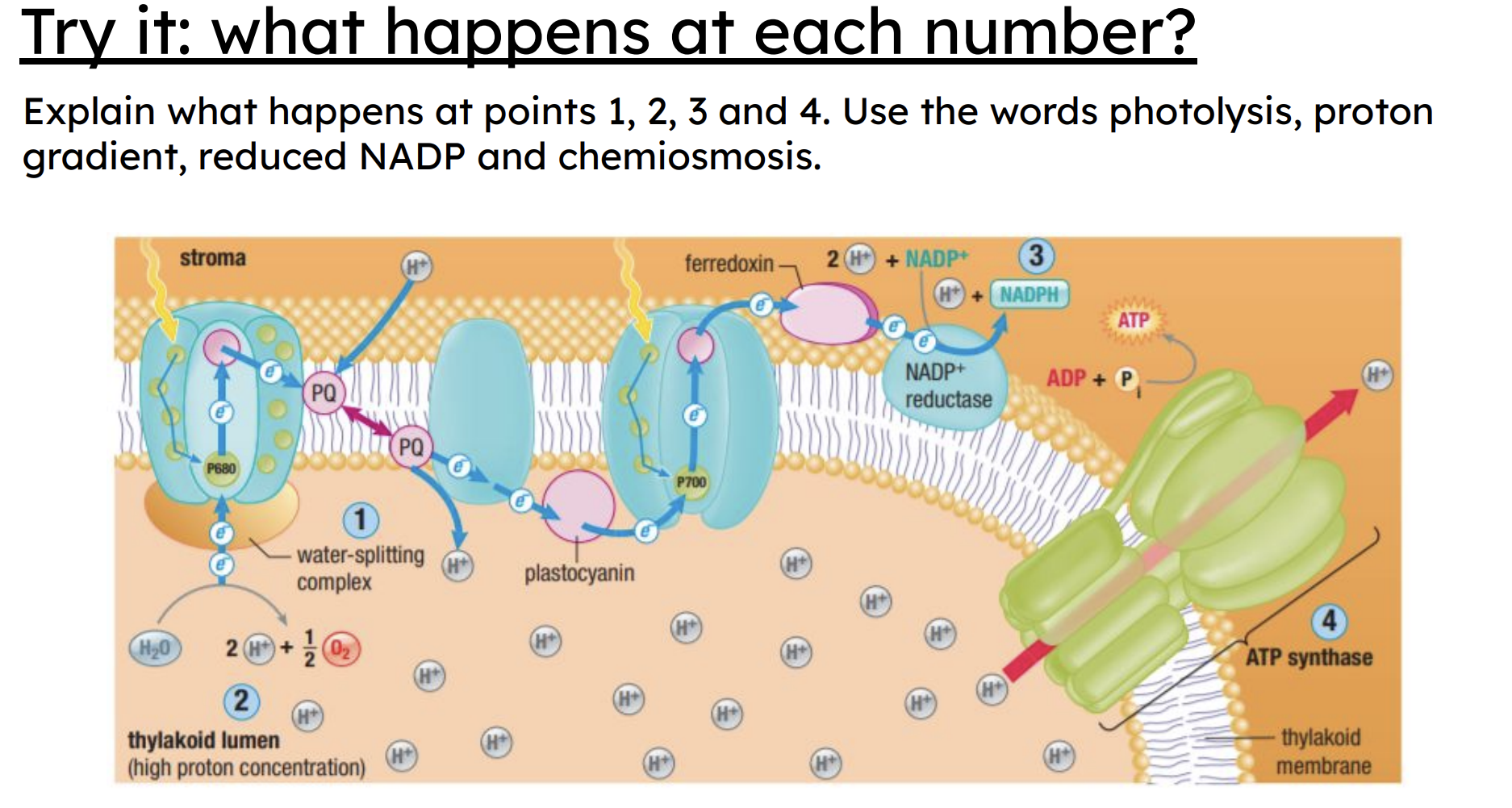
Water is split at photosystem II (photolysis): electrons replace those lost, protons stay in the lumen, oxygen is released.
Protons build up in the thylakoid lumen (pumped by the chain, and from photolysis): a proton gradient.
At photosystem I, NADP accepts two excited electrons and a proton from the stroma: reduced NADP.
Protons flow back to the stroma through ATP synthase, which makes ATP (chemiosmosis, photophosphorylation).
The weedkiller DCMU blocks electrons from leaving photosystem II.
1. Predict what happens to oxygen release. Explain.
2. Predict what happens to ATP and reduced NADP production. Explain.
3. Suggest why the plant eventually dies.
Oxygen release stops: photosystem II can’t pass electrons on, so water is no longer split.
Both stop (or nearly): no electron flow means no proton pumping (little ATP) and no electrons reach NADP.
Without ATP and reduced NADP, the Calvin cycle can’t make sugar, so the plant runs out of energy and building materials.
Explain the advantages of having many pigment molecules in a photosystem.
Many pigments catch more light over a bigger area, and absorb a wider range of wavelengths. They funnel the energy to one reaction centre, which sits next to its electron acceptor, so excited electrons are passed on
Explain how ATP is produced in the light-dependent reactions.
Electrons pass along the chain, which pumps protons into the thylakoid lumen; photolysis adds more. Protons flow back to the stroma through ATP synthase, which makes ATP (chemiosmosis).
Compare and contrast ATP production in mitochondria and chloroplasts.
Both: electron transport chain, proton gradient, ATP synthase, chemiosmosis. Differences: light vs food as energy source; water vs reduced NAD as electron source; protons pumped into the lumen vs the intermembrane space; NADP vs oxygen as final acceptor.
Name the two products of the light-dependent reactions that the plant uses next.
ATP and reduced NADP
Where in the chloroplast are they released?
The stroma, where the Calvin cycle happens.
Which molecule is split to replace the electrons lost from photosystem II?
Water (photolysis).
Where does most of a tree's mass come from, and how does the Calvin cycle contribute to its growth?
Most of a plant's dry mass comes from carbon obtained from CO₂ in the air, rather than from the soil.
Jan van Helmont's willow experiment showed that the tree gained about 74 kg in mass while the soil lost only about 57 g over five years.
The Calvin cycle fixes carbon from CO₂ into organic molecules that are used to make sugars and other substances needed for plant growth, such as wood and proteins.
What is the Calvin cycle, and where does it occur?
The Calvin cycle is the light-independent stage of photosynthesis.
It occurs in the stroma of the chloroplast.
It uses CO₂, ATP and reduced NADP to produce triose phosphate (TP).
TP is used to make glucose and other organic compounds.
Explain the three stages of the Calvin cycle.
1. Carbon fixation
CO₂ combines with RuBP (a 5-carbon compound).
Rubisco catalyses the reaction.
The unstable 6-carbon compound immediately splits into two molecules of GP (3 carbons each).
2. Reduction to triose phosphate (TP)
Each GP is converted into TP.
ATP provides energy, while reduced NADP provides hydrogen and electrons.
ADP, phosphate and NADP return to the thylakoids to be recharged.
3. Regeneration of RuBP
Five-sixths of TP is used to regenerate RuBP.
Five TP molecules (15 carbons) are rearranged into three RuBP molecules (15 carbons).
This requires ATP.
One-sixth of TP leaves the cycle to make sugars and other organic compounds.
Two TP molecules can combine to form one glucose molecule.
What is Rubisco, and why is it important?
Rubisco is the enzyme that catalyses carbon fixation.
It is the most abundant enzyme on Earth.
It works slowly, fixing only a few CO₂ molecules per second.
Oxygen competes with CO₂ for its active site, reducing its efficiency.
Increasing CO₂ concentration can improve photosynthesis by reducing this competition.
Draw and label the Calvin cycle.

Step | Molecules | Carbon atoms |
|---|---|---|
In | 6 CO₂ + 6 RuBP | |
Fixation | 12 GP | |
Reduction | 12 triose phosphate (TP) | |
Back into the cycle | 10 TP → 6 RuBP | |
Out | 2 TP (one glucose) |
Step | Molecules | Carbon atoms |
|---|---|---|
In | 6 CO₂ + 6 RuBP | 6 + 30 = 36 |
Fixation | 12 GP | 36 |
Reduction | 12 triose phosphate (TP) | 36 |
Back into the cycle | 10 TP → 6 RuBP | 30 |
Out | 2 TP (one glucose) | 6 |
What does the Calvin cycle require to produce one glucose molecule?
6 turns of the cycle
6 CO₂
18 ATP (12 for reduction, 6 for RuBP regeneration)
12 reduced NADP
Why is cyclic photophosphorylation needed during photosynthesis?
The Calvin cycle requires more ATP than reduced NADP.
Cyclic photophosphorylation produces extra ATP without producing reduced NADP.
This supplies the additional ATP needed by the Calvin cycle.
How many CO₂ must be fixed for one triose phosphate to leave the cycle?
3 CO₂ (one-sixth of 6 TP made from 3 CO₂ is 1)
For those CO₂, how many ATP and reduced NADP are used?
9 ATP (6 + 3) and 6 reduced NADP.
How many CO₂, ATP and reduced NADP are needed to regenerate 12 RuBP?
12 CO₂, 36 ATP and 24 reduced NADP
A plant makes 3 glucose. How many triose phosphates were regenerated into RuBP?
30 (36 made, 6 leave to make 3 glucose).
What does triose phosphate (TP) become, and how is it used to make other molecules in plants?
Carbohydrates: TP is used to make glucose, which can then form:
Sucrose – transported around the plant.
Starch – stored for later use.
Cellulose – forms plant cell walls.
Lipids: TP is used to make fatty acids and glycerol, which form lipids.
Proteins: Plants absorb nitrate from the soil to make amino acids, which are joined to form proteins.
Nucleotides and phospholipids: Plants absorb phosphate from the soil to make nucleotides (used in DNA, RNA and ATP) and phospholipids.
Why might extra CO₂ not always increase plant growth?
Extra CO₂ can increase photosynthesis and the production of triose phosphate.
However, plants also need enough nitrogen from the soil to make amino acids and proteins.
If nitrogen is limited, it can restrict plant growth even when CO₂ is abundant.