BIOL 307 Chp 12
 Call Kai
 Learn
Learn Practice Test
 Spaced Repetition
 Match
Match Flashcards
 Knowt Play
1/18

There's no tags or description
Looks like no tags are added yet.
Name | Mastery | Learn | Test | Matching | Spaced | Call with Kai | Chat |
|---|
No analytics yet
Send a link to your students to track their progress
19 Terms
Somatic Motor Pathway
Controls the skeletal muscles (voluntary movement); Single neuron originates in central nervous system, and projects its axon to target tissue.
Autonomic
"Self-governing," nervous system that controls the involuntary functions of smooth and cardiac muscle.
Sympathetic
Active under stressful situations ("flight-or-flight.")
Parasympathetic
Active under "rest and digest," situations.
Ganglion
Nerve cell cluster outside of CNS.
Adrenal Medulla
Modifies sympathetic ganglion; the inner portion of the adrenal gland that produces catecholamines.
Neuromuscular Junction
Synapse of a somatic motor neuron on a muscle fiber.
Acetylcholinesterase
Enzyme that rapidly deactivates acetylcholine by degrading it into acetyl and choline.
Vasoconstriction
Constriction of circular vascular smooth muscle that narrows lumen of the blood vessel.
Vasodilation
Relaxation of circular vascular smooth muscle that widens lumen of blood vessel.
Distinguish between the actions of the somatic motor and autonomic systems.
Somatic:
Central nervous system to nicotinic receptors on target skeletal muscle.
Excitatory action.
Controls breathing.
Autonomic:
Central nervous system to nicotinic receptor on ganglion to muscarinic receptor on target tissue.
Excitatory or inhibitory action.
Broken down into parasympathetic and sympathetic.
Predict the effect of activation of either the sympathetic or parasympathetic nervous system on any major body system (e.g., “Would activation of the sympathetic nervous system increase or decrease heart rate? Increase or decrease activity of the kidney?) (*Remember Leupen’s Rule of the Autonomic Nervous System: If you need the body system in question for running away from a jaguar (e.g. the skeletal muscles), then it’s activated by the sympathetic nervous system; if you don’t (e.g. intestines), it’s activated by the parasympathetic nervous system).
Parasympathetic Pathway:
CNS → nicotinic receptor on ganglion → muscarinic receptor on target tissue.
Rest/digest.
Decreases heart rate.
Sympathetic Pathway:
CNS → nicotinic receptor on ganglion → adrenergic receptor on target tissue.
Fight/flight.
Increases heart rate.
Give examples of body systems/organs that are activated by the sympathetic and parasympathetic systems, respectively.

Apply your understanding from the above two goals to real-life (including clinical) situations, such as what happens when you are exercising, or to a person whose symp. or parasymp. nerves are damaged.
Sympathetic damage makes exercise unsafe or difficult.
Parasympathetic damage mostly affects recovery and resting function.
Explain or identify how autonomic commands generally operate under the principle of antagonistic control, giving examples.
Most organs receive input from both sympathetic and parasympathetic branches, which have opposite effects.
One branch is excitatory, and one is inhibitory.
Allows for precise regulation of organ function.
Ex: Sympathetic innervation increases the heart rate, while parasympathetic innervation decreases it.
Recognize that every autonomic circuit is a chain of two neurons ending at the target tissue, with the two neurons synapsing at a ganglion (Fig 12.4).
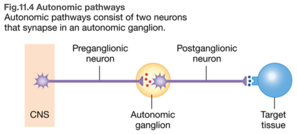
Identify the neurotransmitter and receptor type used by the sympathetic and parasympathetic nervous system at the ganglion and the target organ (Fig 12.6), and apply that information to clinical situations.
At the ganglion, both sympathetic and parasympathetic use acetylcholine to bind to nicotinic ACh receptors.
At the target tissue, sympathetic uses norepinephrine to bind to adrenergic receptors (Short preganglionic and lost postganglionic neurons), and parasympathetic uses ACh to bind to muscarinic receptors (long preganglionic and short postganglionic neurons).
Recognize that many different receptor subtypes exist for autonomic neurotransmitters, allowing drugs to target specific tissues and the same neurotransmitter to have different effects at different tissues.
Different subtypes can have different sensitivities to various molecules, as well as second messenger pathways.
Recognize that somatic motor pathways are single-neuron, exclusively excitatory pathways.