test 2 physics (combined flashcards)
 Call Kai
 Learn
 Practice Test
 Spaced Repetition
 Match
 Flashcards
 Knowt Play
1/194

There's no tags or description
Looks like no tags are added yet.
195 Terms
who developed the first battery (voltaic pile) or steady source of electric charge
Italian physicist questioned if electric current can be produced when two different metals are brought into contact
Alessandro Volta
this is the ability to move electric charges through a circuit (makes current possible). any device that converts some form of energy into electric energy is a source of this. (ex battery takes chemical energy and makes it electrical.)
electric potential
electric potential is measured in units of ____ per ____ or _____
joules per coulomb or volt
one volt is equal to one joule of energy for every coulomb. ____ volt means more push to move electric charge through a circuit
higher
who was the first to discover a link between electric and magnetic forces. he proved that any charge in motion created a magnetic field. (can induce magnetic field via electricity) current moved through wire and made compass needle move to point to wire
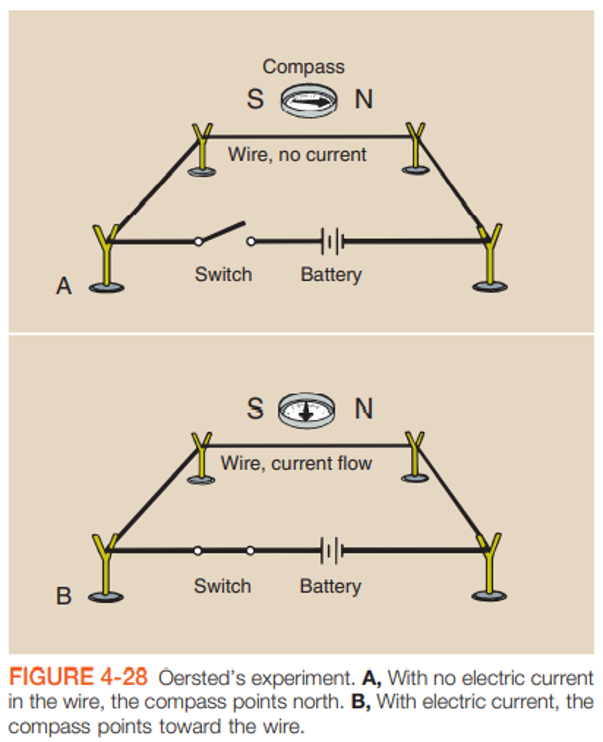
Hans oersted
flow of ______ can create a magnetic field
electrons
electrons flow through a wire produce a magnetic field that are _____ circles around the wire. curving the wire causes lines to overlap causing _____ intensity
concentric, greater
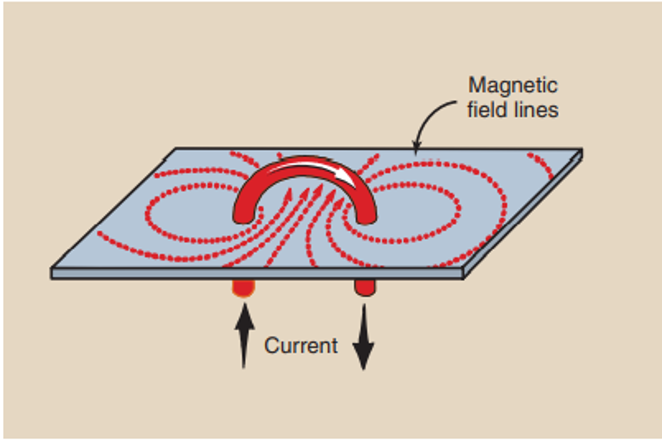
this is what a coil of wire is called. the overlap creates a stronger overlapping magnetic field. the magnetic field concentrates in the center of the coil so more coils gives more intensity, and closer coils also does.
Solenoid
this is a current carrying coil of wire wrapped around an iron core. this intensifies the induced magnetic field. the magnetic field can be adjusted by varying current through wire.

electromagnet
electromagnets are useful due to being able to strengthen or weaken magnetic field by
-
-
-
increasing or decreasing electric current through wires
increasing or decreasing number of coils
increasing or decreasing size of iron core
this is when an electric current or electromotive force (emf) is induced in a circuit if some part of that circuit is in a changing magnetic field.
electromagnetic induction

this is a device for measuring an electric current through a wire in amps
ammeter
Faraday discovered that if a circuit is placed in region with ______ magnetic field we can produce an electromotive force that pushes charges through a conductor “induction”
changing (magnetic field)
if a magnetic field was static could it induce an electric current?
no it must be a changing magnetic field
Faraday’s law
magnitude of induced current depends
strength of magnetic field
velocity of magnetic field as it cuts through conductor (how fast is magnet moving)
angle of conductor to magnetic field (if conductor 90 degrees crosses max field lines)
number of turns of the conductor (coils)
_____ and ____ are practical applications of Oersted and Faraday’s experiments
motors and generators
in one experiment the electric current produces a mechanical motion (the compass needle) via a magnetic field this is the basis for the Electric motor who’s experiment? (electric —→ mechanical)
Oersted
in one experiment mechanical motion (magnet near coil of wire) induces electricity in a coil of wire this is the principle of electric generators. (mechanical ——> electrical) who’s experiment?
Faraday
the stator and rotor of the x-ray tube are a type of _____ _____
induction motor

this is part of induction motor of x-ray tube it is a shaft made of bars of copper and soft iron fabricated into one mass. this is internal moving part within glass envelope(soft iron is ferromagnetic, can be temporarily strongly magnetized)
rotor
this is part of induction motor of x-ray tube it is outside the glass envelope and several fixed electromagnets that supply external magnetic field.
stators
how does the stator and rotor work
electromagnets (stator) are energized in sequence this makes a changing magnetic field. the rotor rotates since it is trying to bring its magnetic field into alignment.
this is another device that uses interacting magnetic fields produced by a changing electric current. does not make motion like a motor though
transformer
______ ______is supplied to stator coil which creates a magnetic field
alternating current
this changes the intensity or magnitude of the alternating voltage and current (only works with alternating current) this does not convert energy into another form but transforms electric potential and current into a higher or lower intensity
transformer
three types of transformers
-closed core
-auto
-shell type
this type of transformer produces a closed magnetic field that is confined to the core of the laminated layers of iron. electricity gets sent through the primary coil, magnetic field is produced and induces electricity in the secondary coil via induction
closed core transformer

in closed core transformer _____ is sent through the primary coil which then produces a magnetic field. This magnetic field induces ______ in the secondary coil by induction
electric current, electricity
this transformer has an iron core with a winding wire about it. the single winding acts as a primary and secondary coil. connections are made at different points on the coil for both primary and secondary sides. does not provide electrical isolation like closed core allows for voltage control by tapping into different points along winding.
auto transformer

____ transformer in an x-ray tube acts as kVp selector lets us adjust line voltage to provide desired voltage. more voltage choose more coils, less tap into less coils
AUTO

this transformer is more efficient than closed core. it confines the magnetic field lines of primary winding because secondary is wrapped around it. so magnetic field passes from primary to secondary with minimal loss.
shell type transformer

a transformer will operate only with _____ _____ a direct current applied to primary coil would not induce current in the secondary coil since that would make a steady magnetic field which would not induce electric current in secondary coil
alternating current
the change in voltage is directly proportional to the ratio of number of turns in the secondary coil to the number of turns in the primary coil. or Vs/Vp = Ns/Np
transformer law
voltage change across a transformer is proportional to the _____ ratio Ns/Np. so if there were 10 turns on secondary coil for every single turn on primary voltage generated by secondary will be 10x greater
turns ratio
a transformer with a turns ratio greater than one is a _____ ____ transformer. since the voltage is increased from the primary to the secondary side
step up transformer
a transformer with a turns ratio less than 1 is a ____ ____ transformer
step down
transformers don’t create or destroy energy they convert it. so when voltage changes current must change in the opposite direction to keep power balanced (remember P=IV) this is expressed by ____ ____
current law
what is the equation for current law
Is/Ip = Np/Ns
it is flipped since when you increase voltage current must decrease and vice versa
this law in simple turns is that voltage increases with more turns
voltage law
in simple terms this law is that current decreases when voltage increases and vice versa
current law
voltage law and current law ensure that transformers ___ ___ ___ and deliver the correct voltage and current to each part of the x-ray system
conserve electrical energy
x-ray imaging converts _______ into ________ energy
electricity, into electromagnetic energy.
in an x-ray tube the x-ray ______ are the electromagnetic energy
photons
electric charge comes in discrete units that are _____ or _______
positive or negative
this electrical charge is associated with electrons that orbit the nucleus. electrons are free to travel of one atom to another. electron is equal to one unit of ____ charge.
negative charge
this is associated with protons. these protons are subatomic particles that are fixed inside the nucleus of an atom and not free to move. one proton has one unit of ______ charge
positive charge
if something is said to have a positive charge it is actually just less ______. it does not gain protons it just has less electrons.
negative
this is the study of stationary or resting electric charges and the forces between them. ex static electricity. charges don’t flow in a current they build up then discharge.
electrostatics
just like protons these are fixed inside the nucleus but unlike protons they do not have a charge
neutrons
a ______ atom has the same number of electrons and protons
neutral atom
an object is said to be _____ if it has too few or too many electrons
electrified
all discussions dealing with electric charge deal with ______ electric charges since electrons are free to travel
negative
this is an atom or molecule that’s total number of electrons are not equal to the number of protons, so it has a net positive or negative charge. (taking away an electron, like during ionization makes atom positive)
ion
this is the moving or shifting or electrons. we need this to make x-rays
electricity
what are the five laws of electrostatics
-like charges repel, unlike charges attract
-concentration of charges on curved surfaces of a conductor is greatest where curvature is greatest.
-electric charges reside on the external surface of conductors (it is uniform due to attraction/repulsion)
-electrostatic force between two charges is proportional to the product of their quantities but inverse to the square distance between them.
-only negative charges can move in solid conductors.

what law of electrostatics does this diagram show?
the first. like charges repel and unlike charges attract.
this is a tiny imaginary charge used to probe the electric field, it is almost always positive.
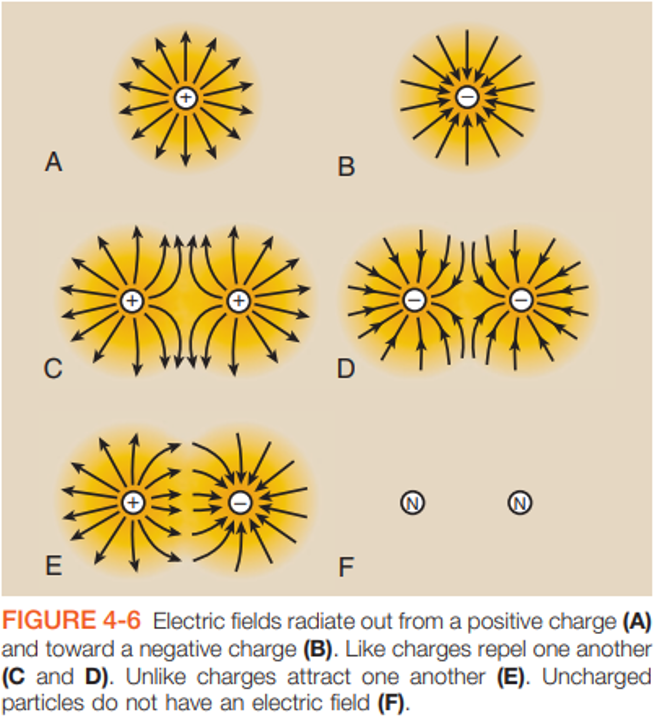
it is why in this diagram the electric fields radiate out from the positive but in to the negative.
test charge

electric charges on a conductor concentrate at the sharpest curve since the negative charges repel each other. this can cause undesirable discharge in x-ray tube or ______ radiation as well
extrafocal
an object that can accept electric charges from an electrified object. earth is an example. good for when you have excess negative charge since all the electrons are trying to repel each other.
electric ground

what electrostatic law does this demonstrate
electric charges reside on the external surface of a conductor. (if it is a non conductor book says charges are uniform throughout)
the force of attraction between unlike charges or repulsion between like charges is due to electric field. it is called ______ _____
electrostatic force
electrostatic force between two charges is proportional to the product of their quantities. ex if charge is greater than the repelling or attracting force will also be greater
Coulomb’s Law
electrostatic force is inversely proportional to the square of the distance between charges
inverse square law
only negative charges can move freely in solid conductors this is because protons are _____ bound
tightly bound within the nucleus
this is adding or removing electrons from a body of matter (not just an atom) meaning it ends up with an excess or deficiency of electrons. process of giving an object charge.
electrification
this is a material in which electrons move freely. like silver, gold, copper, or aluminum. allows electrification to occur.
conductor
tungsten is a _____ conductor which is why it is good as filament
poor
this is any material that does not allow electron flow. it resists the flow of electric current or heat. examples are rubber, glass, ceramic, plastic. it can block or reduce conduction
insulator
this is a material that does not conduct electricity at all. most material conducts some current if voltage is high enough. so this is moreso a synonym for the perfect insulator. examples are wood and wool (electrons are tightly bound to atom)
non-conductor
this is three ways that electrification (process of giving an object charge) can be created
friction (simplest most fundamental)
contact
induction
The removal of electrons from one object by rubbing with another of a different kind. ex you walk on a carpet the electrons from it rub off onto your socks. now you are move negatively charged. these excess electrons want to discharge
friction
in this when an object is charged and it touches an uncharged object the uncharged object will be left with that charge. for example a negative charged object touches a neutral object, an electron goes to neutral object making it negative. or positively charged object touches neutral object it will get an electron from the neutral which is now left positive.
contact
charged objects confer or exchange some kind of charge on any ______ object it comes in contact with
uncharged.
if net positive object comes into contact with a neutral object the neutral object will become ______
positive
if net negative object comes into contact with neutral object it will make neutral object ______
negative
An uncharged metallic object experiences a shift of electrons when brought into the electric field of a charged object.
induction
If a neutral metallic body is brought into the field of a negatively charged object (not in contact with) The excessive negative charge will cause the negative electrons in the neutral body to repel and move away from the negatively charged body (shift). the once neutral body will stay positive if there is a ground. once it is removed the neutral object will be _______
positive
in induction the charged body exchanges the ______ charge to the metallic (neutral) body
opposite
grounding prevents…
shock, fire, electrical damage
electric charges have ____ ____ or the ability to do work when they fly apart.
potential energy
this is the unit of electric potential. the higher this is the greater the potential to do work in US it is 110 ____ x ray requires 220 __ or higher (kind of like how much push is available to move electrons)
voltage (V)
this is the study of electric charges in motion. without this we would not have current for x-rays
electrodynamics
electrons moving in the same direction is called ______ _______
electric current
this is usually used in MRI. it is a substance that exhibits no resistance to electron flow below a critical temperature (Tc) (niobium, titanium). at room temp all material resist flow of electrons as temp decreases so does resistance.
superconductor
material that can act as a conductor in some conditions or as an insulator under other conditions. (CT and DR use this) silicon, germanium
semiconductor
the _____ ______ acts as an insulator in the x-ray tube
glass envelope
three ways to increase resistance in an electric circuit
smaller diameter conducting wire (wire gauge)
insert different material (circuit elements) like rubber
increase length of wire
when resistance is controlled and a conductor is made into a closed path this is the result
electric circuit
increasing resistance leads to a ______ electric current
reduced
this is proportional to the number of electrons flowing in the electric circuit. it is measured in amperes. 1 ampere equals 1C flowing through the conductor each second. affected by resistance and voltage.
Current
there is always something to slow electrons down (current) this is the opposition to the flow of electrons. measured in ohm’s
resistance
electric potential measured in volts. electrons that have a high potential energy have a high capacity to do work. if this is higher in a tube it means we get higher energy and faster electrons.
Voltage
what is the formula for voltage across a circuit
V=IR
the manner in which electric currents behave in an electric circuit is described by _____ ____. the voltage across circuit is equal to the current times the resistance.
ohm’s law
resistance and current (amperes) have an ______ relationship
inverse
voltage and amperes have a _____ relationship
direct
name the two basic types of electrical circuits
series and parallel
this circuit is designed to send electrons through various resistance devices by linking them one after the other. ex old christmas lights one goes out so do the rest.
series circuit

this type of circuit is designed by giving each component an individual branch ex new christmas lights have their own path to the power source
parallel circuit
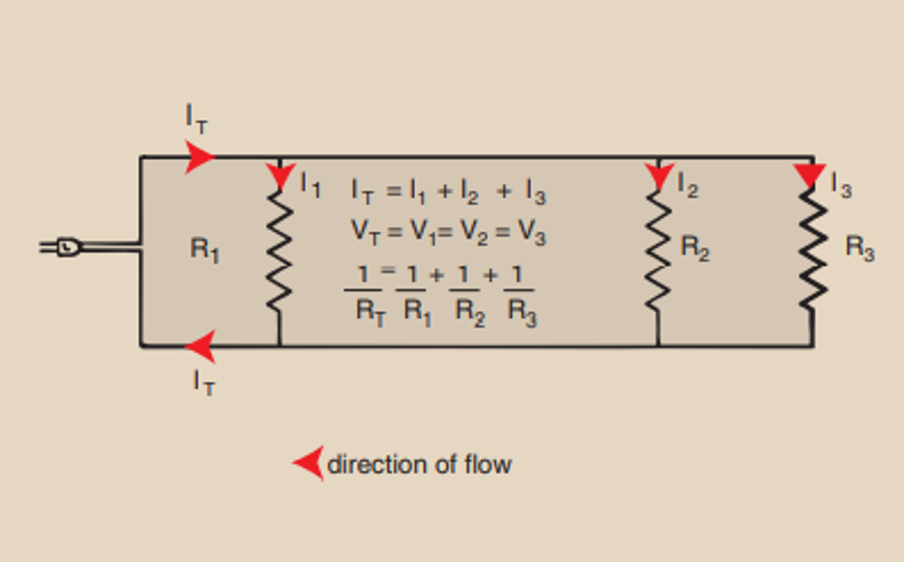
how do you find resistance (ohm’s) in a series circuit?
you add all of them together. R1 + R2 etc.