L9 - Magmatic Framework for porphyry, skarn & epithermal deposits
 Call Kai
 Learn
Learn Practice Test
 Spaced Repetition
 Match
Match Flashcards
 Knowt Play
1/48

There's no tags or description
Looks like no tags are added yet.
Name | Mastery | Learn | Test | Matching | Spaced | Call with Kai | Chat |
|---|
No analytics yet
Send a link to your students to track their progress
49 Terms
What are the 5 main fluid reservoirs in the crust?
Connate (sedimentary basin)
Meteoric (surficial)
Magmatic hydrothermal
Sea water
Metamorphic

What fluid reservior is responsible for skarn, porphyry, and epithermal deposits?
Magmatic hydrothermal
Define metasomatism
A process where the chemical composition of a rock is altered in a solid state through the introduction or removal of chemical components by hydrothermal and other reactive fluids
What elements are water soluble?
LILE (Large Ion Lithophile Elements)
What is a LILE?
Large Ion Lithophile Elements (LILE) are cations with large ionic radii that preferentially partition into fluids or melts.
How does a convergent margin lead to the genesis of magmatic-hydrothermal mineral deposits?
Subducting slab dehydrates (vis metamorphism), producing fluids
Fluids become enriched in incompatible, water-soluble elements
Fluids rise and metasomatize (changes the composition) of the overlying asthenospheric mantle wedge
When fluids interact with the mantle/host rock, is the country rock reduced or oxidized?
Oxidized
Are metasomatized rocks oxidized or reduced?
oxidized
What minerals are being altered to dehydrate the oceanic crust during subduction?
Amphiboles (hbl, ziosite, chlorotoid etc) due to lower stability of hydrous minerals
Amphibolite → eclogite metamorphic facies transition

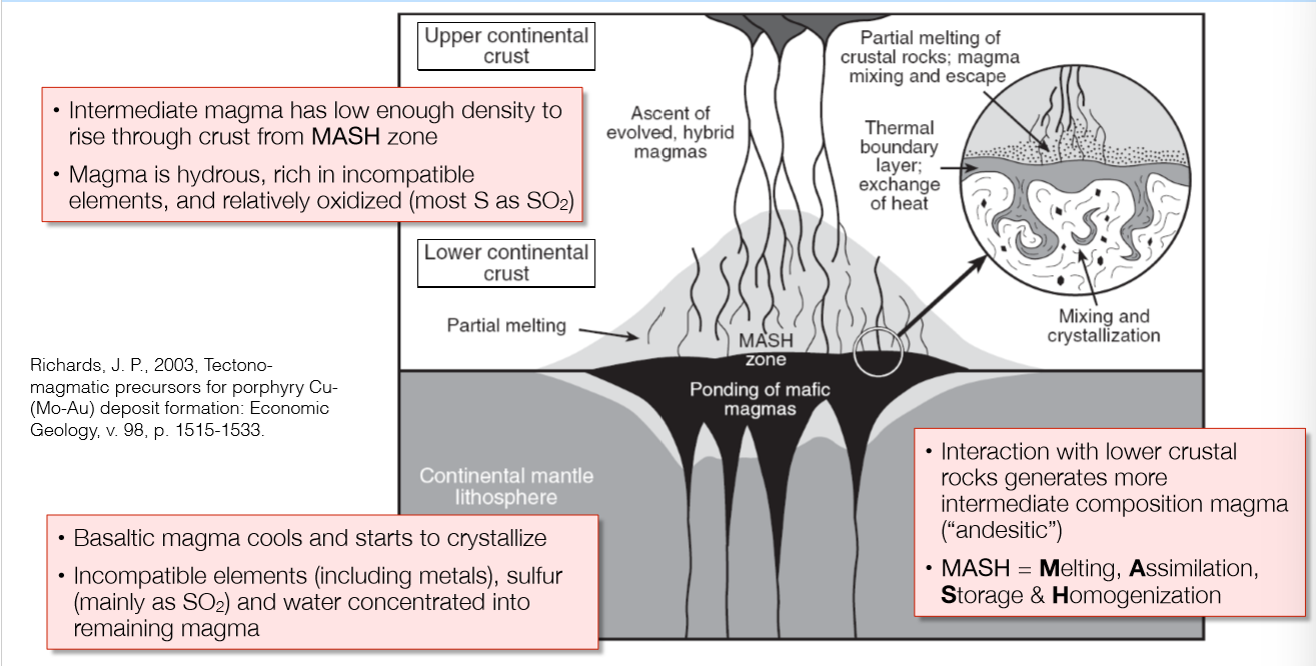
Why does magma stalling/ underplating/MASH occur?
The basaltic magmas from the mantle wedge are more dense than most continental rocks

How does the underplated basaltic magma start to move through the continental crust? What process is occuring?
Basaltic magmas start to crystallize, differentiate, and interact with the lower continental crustal rocks.
MASH process begins

What does MASH stand for?
M = melting
A = assimilation
S = storage
H = homogenization
How do these basaltic magmas generate intermediate to felsic magma?
M = melting (partial melting of crustal rocks in the path of ascent)
A = assimilation (incorporates incompatible elements into hydrous magma and becomes enriched)
S = storage (incompatible elements and water are concentrated and stored in remaining magma)
H = homogenization (as melt becomes homogeneous with surrounding crustal rock, the magma will continue to ascend as it becomes more bouyant/felsic)
What fluid reservoir is responsible for Orogenic gold deposits?
Metamorphic fluid reservoir
Where do fuilds com from in VMS deposits?
ocean (circulation)
What type of fluid reservoir is responsible for Epithermal and carlin type deposits
Meteoric
What fluid reservior is resposible for a SEDEX, MVT, and Sedimentary Cu deposit?
Connate (sedimentary basin) fluid source
What structure might magma form to ascend through the upper continental crust?
dikes
At what depth might a ascending dike pool to form a batholithic magma chamber?
At a depth of 5-10 km
Where do I-type magmas form?
either in MASH zone or at the base of crust
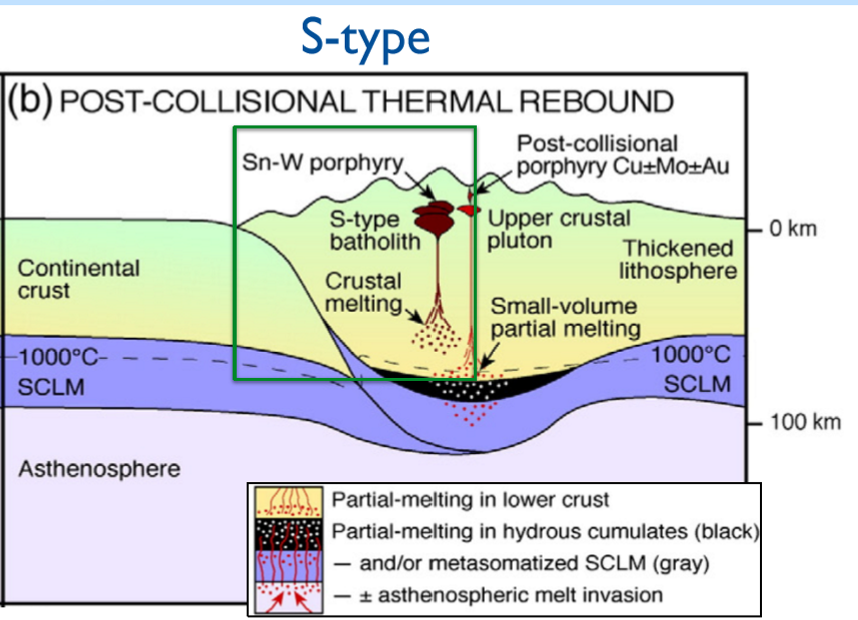
Where do S-type magmas form?
zone of partial melting within the lower crust
What structures form when magma begins to accumulate within the crust?
horizontal lenses/sills
What tectonic regime do S-type magmas form?
collisional margins/orogens
Partial melting of pelitic protoliths occurs during crustal thickening in the deep crust
Do S-type melts tend to be enriched in Chalcophile, or Lithophile elements? Why?
S-type granit melts tend to be enriched in lithophile elements more then chalcophile
Depleted in Chalcophile elements because they do not partition efficiently into silicate melt (leave behind sulphides during partial melting)
Enriched in lithophile elements since they inherit enriched crustal nature
Rank the following magmatic systems from least enriched (in incompatible E) to most enriched:
pegmatite
basaltic magma
residual melt of basaltic magma (co-genetic)
basaltic magma → residual melt of basaltic magma → pegmatite
What do miarolitic cavities indicate?
evidence of fluid in magma
How does pressure dropping (from magma rising) affect water solubility in melt?
pressure drop = reduced water solubility in melt
water exsolves from melt while magma rises

What is 1st boiling?
1st boiling - exsolution of separate fluid phase due to depressurization
Saturation of silicate melt with respect to its volatile components
What is 2nd boiling?
fluid exsolution from a melt that reaches fluid saturation due to mineral crystallization
lower mol% H2O than the residual melt
need crystallization to reach H2O saturation at upper crustal depths
Free volatile phase generation during cooling depends on what 3 factors?
Initial volatile content (H2O, CO2, Cl-, S, etc)
Confining Pressure
Degree of crystallization
As more anhydrous minerals crystallize, how does the pressure of H2O saturation react?
as more anhydrous minerals crystallize, pressure needed to saturate the melt decreases
higher fluid content = more pressure to prevent fluid saturation
lower fluid content = less pressure to prevent fluid saturation

Where do volatile phases partition into?
Volatile phases partition into co-existing fluid rather than magma
What elements can be carried in highly saline (Cl-) fluids at high Temp?
Cu, Au, Zn, Fe


Based on this graph, which elements are incompatible in the fluids? How do you know?
Elements larger than D=1 are incompatible with the melt and incorporated into the fluid
How does an Ore deposit form with an ore fluid?
If ore fluids (enriched in ore elements) escape the magma chamber, they are in chemical and thermal disequilibrium with the surrounding rock
Physicochemical disequilibrium between hydrothermal fluids and surrounding rock results in an exchange of heat and chemical components between the ore fluid and the rock
ppt of metal

Why might chlorinity of a fluid change the metal-carrying capacity?
Based on charge balance
Cl- or H3O+ ions can carry metals with -/+ charge
higher [Cl-] = higher [Cu +] - and other ore elements
If the melt is oxidized, will Cu stay in the melt or be incorporated into forming crystal?
Oxidized magma (Loss of electron) = S- incorporated into crystal (loss of e-) → traps Cu in crystal. BAD
Reduced magma (gain of electron) = S- remains in melt (gains e-) → traps Cu in melt. GOOD
What is the relative tonnage and grade of a porphyry deposit?
Porphyry deposits have a very high tonnage and a relatively low grade deposit
porphyry deposits are the world’s primary source of which ore elements?
Cu
Mo
Sn (tin) -W (tungsten)
+ Au
What type of magmatic structure are porphyry deposits, and what is their composition?
associated with:
shallow crustal intrusions
intermediate to felsic composition (52-77wt% SiO2)
What depth do Porphyry deposits typically appear?
2-4 km depth, but as deep as 8km
how do porphyry deposits typically form? What type of fluid do they use?
Formation involves the exsolution of metalliferous and S-rich SALINE (NaCl) hydrothermal fluids from a silicate melt
What does co-genetic mean?
Separate batches of molten rock that share a common parental source or are derived from one another through magmatic evolution
typically identified by trace elements
What are the typical host rocks for porphyry deposits?
typically intermediate -felsic PORPHYRITIC intrusive rocks (commonly co-genetic), volcanic rocks (sometimes co-genetic) and lesser sedimentary rocks
Define hypogene
Formed from beneath
Mineralization that formed directly from magma upwelling hydrothermal solutions derived from magma, metamorphic rocks, pore fluids, meteoric water, seawater.
primary mineralization
Define supergene
Formed from above
Mineralization that formed from a pre-existing hypogene deposit via interaction with surface waters
secondary mineralization
How much wt% H2O is in a typical andesitic melt?
3-6wt% H2O
How are subtypes of porphyry deposits defined?
Defined by the metals that are essential to the economics of the deposits
ordered from most wt% to least
examples, grade, tonnage, and value of different deposit furthur explained in slide