nuclear materials midterm
 Call Kai
 Learn
 Practice Test
 Spaced Repetition
 Match
 Flashcards
 Knowt Play
1/104

Earn XP
Description and Tags
1, 2, 3
105 Terms
Materials
metals
ceramics
polymers /plastics
composites
nuclear materials
metals
strong & ductile
high thermal and electrical conductivity
opaque & reflective
ductile meaning
-material can be stretched/deformed without breaking
-ability to undergo plastic deformation (permanent) without breaking
opaque meaning
light does not pass through the material (not see-through)
ceramics
ionic bonding (refactory)
oxides, carbides, nitrides, silfides
brittle, glassy, elastic
non-conducting (insulators)
examples: building brick, glass vase, a teacup
ionic bonding
bonding of oppositely charged ions
refactory meaning
refactory = heat resistant
material is able to withstand very high temps without melting or breaking down
brittle meaning
material breaks with little deformation
elastic
returns to its original shape after deformation
polymers / plastics
covalent bonding
soft, ductile, low strength, low density
thermal & electrical insulators
translucent or transparent (see-through)
covalent bonding
sharing of electrons between atoms
insulators
does not conduct heat or electricity very easily
composite materials
materials composed of two or more individual materials (metals + polymers + ceramics)
composite purpose
to achieve a combination of properties that a single material cannot provide and combine the best characteristics of its components
naturally occurring composites
wood and bone
composite materials Examples
fiberglass & CFRP (carbon fiber-reinforced polymer)
fiberglass: glass fiber + polymer (epoxy) = strong, stiff, and flexible
CFRP: carbon fiber + polymer (epoxy) = Stronger and stiffer but expensive
stiff meaning
resists deformation
what does the nuclear reactor do?
nuclear reactions produce a large amount of thermal energy through fission CHAIN REACTIONS
nuclear reactors are simply heat-generating units
nuclear reactor process
reactor —> heat —>(produces steam)—> turbine rotates —> generator rotates —> electricity
what is the purpose of steam
steam is needed to rotate the turbines
what is the purpose of turbines
to rotate electrical generators which produces electricity
nuclear reactor primary loop
reactor side
contains components responsible for generating and managing heat
components:
-fuel: material where nuclear fission occurs
-neutron source
-moderator: slows down neutrons
-reflector: redirects escaping neutrons towards reactor
-control rods: controls the chain reaction
-coolant: removes heat
-shield: protection from radiation
-supporting structure
nuclear reactor secondary loop
power generation side
contains components responsible for converting heat into electrical power
components:
-heat exchanger: transfers heat between fluids
-turbines
-electrical generators
-condenser: converts steam back into liquid water
-cooling tower
material selection
general consideration
-Fabricability
-dimensional stability
-corrosion resistance
-design
-heat transfer
-availability and cost
fabricability
a) definition
b) why is it important?
a) how easily the material can be made into the required shape/component (forming, welding, machining)
b) if fabricability issues are not dealt with during the first stage, it may cause problems at later stages.
dimensional stability definition
the material should keep its shape and properties over time, especially at high temperatures
corrosion resistance definition
corrosion: electrochemical process that causes metals/alloys to degrade in a chemical environment
corrosion resistance: the ability to resist corrosion degradation
design definition
components designs’ should avoid stress concentration shapes such as sharp corners or holes.
heat transfer definition
in a reactor, heat must move safely from the fuel through the cladding
high thermal conductivity is important
material selection
special consideration
-neutronic properties
-susceptibility to induced radioactivity
-radiation stability
neutronic properties
how the material interacts with neutrons
fuel cladding materials should have low neutron absorption cross section - so that is why zirconium alloys are used in LWR (light water reactor)
control materials need high neutron absorption to control the chain reaction
susceptibility to induced radioactivity
when some materials absorb neutrons, they become radioactive themselves. which produces radioactive isotopes that can emit alpha, beta, or gamma radiation.
radiation stability
how well a material withstands radiation damage
fast neutrons can displace atoms from their positions, creating defects inside the material.
fuel cladding
material that surrounds and contains the nuclear fuel
zirconium-based materials are suitable for fuel cladding in LWR
advantages of zirconium-based materials for fuel cladding
low neutron absorption cross section
corrosion resistance
thermal conductivity
high melting point
high-temp strength
ductility
fuel compatibility
fabricability
abundance
cost
semiconductors
material whose electrical properties are intermediate between conductors and insulators
doping
adding impure atoms to a semiconductor
adding even a tiny amount of another element to a semiconductor can greatly change how well it conducts electricity
types of doped semiconductors
-N-type (extra electrons)
example: Si doped with phosphorus (P) leaves one extra electron which conducts more electricity
-P-type (missing electrons=creates holes)
example: Si doped with boron (B) leaves us with one electron missing which creates a hole.
semiconductors advantages
reliability
compactness
low cost
controlled electrical conduction
applications of semiconductors
transistors
diodes
photosensors
superconductors
allows current to flow unimpeded (without being opposed/obstructed)
has zero electrical resistance
biomaterials
materials used in components which are implanted into the human body to replace diseased/damaged body parts
must be non-toxic and biocompatible (compatible with body tissues and doesn’t cause opposing biological reactions)
biomaterials materials
metals
ceramics
polymers
composites
semiconductors
crystalline materials
materials whose atoms are arranged in a regular, repeating three-dimensional pattern over large atomic distances.
this is called long-range order
examples: metals, many ceramics, some polymers
noncrystalline materials
also called amorphus
materials whose atoms dont have a periodic arrangement over large distances
noncrystalline arrangements can occur in complex structures or with rapid cooling
unit cell
the basic repeating block of a a crystal structure

lattice
a periodic arrangement of points in 3D space
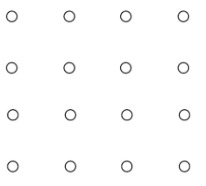
basis
atom or group of atoms associated with each lattice point

crystal structure
the way atoms are arranged in a space
lattice + basis = crystal structure

crystal system
crystal system classifies lattice geometry (edge lengths: a,b,c) and symmetry (angles: alpha, beta, gamma)
primative unit cell
contains one lattice point

non-primative unit cell
contains more than one lattice point

SC
simple cubic
-atoms at the 8 corners
-1 atom per unit cell (N=1)
-coordination number = 6
-a = 2R
-APF=0.52

SC
simple cubic
-atoms at the 8 corners
-1 atom per unit cell (N=1)
-coordination number = 6
-a = 2R
-APF=0.52

BCC
body-centered cubic
-atoms at the 8 corners + 1 body center
-2 atom per unit cell (N=2)
-coordination number = 8
-a = 4R/root(3)
-APF=0.68

FCC
Face-centered cubic
-atoms at the 8 corners + 6 face centers
-4 atom per unit cell (N=4)
-coordination number = 12
-a = 2root(2)R
-APF=0.74

how to count atoms (N)
corner atomic position —> 1/8
face center —> ½
body center —> 1

coordination number
number of nearest-neighbor atoms surrounding a given atom
drawing FCC
1- draw a cube
2- put one atom at each of the eight corners
3- put one atom at the center of each of the six faces, including the hidden faces

which of the three structures (SC, FCC, BCC) is the most efficient
FCC has the highest atomic packing factor of the three structures
so its atoms are packed most efficiently
HCP
hexagonal close-packed structure
-atoms at the 12 corners + 2 face centers + 3 body centers
(N = 12×1/6 + 2×1/2 + 3) = 6
-6 atoms per unit cell (N=6)
-coordination number = 12
-APF=0.74

Diamond
N=8
coordination number = 4
HCP stacking sequence
ABABAB…

miller indices
miller indices are used to identify crystallographic directions and planes in a crystal
miller indices notations
(x, y , z) — coordinates of a point
[uvw] — one crystal direction
〈uvw〉 — family of equivalent directions
(hkl) — one crystal plane
{hkl} — family of equivalent planes
family of directions
directions that are equivalent due to crystal symmetry
example:
in a cubic crystal: [100], [010], and [001] belong to the same family — 〈100〉
how to calculate miller indices for directions
identify the starting point (tail) and the ending point (head)
subtract head by tail (head-tail)
if necessary, convert coordinates to unit-cell length by dividing x by a, y by b, and z by c.
if we have a fraction, divide all components by the same number to get the smallest whole number.
if we have a negative number, replace the negative symbol with a bar (line) above it in the final answer
write the results in square brackets [uvw]
what if direction doesnt pass through the origin (0, 0, 0)
draw a straight line through the origin
two parallel arrows pointing the same way have the same direction indices. meaning translating an arrow without rotating, doesnt change its direction.
Bragg’s law
n: order of reflection
Lamda: x-ray wavelength
d: distance between parallel crystal planes
Theta: angle between x-ray beam and crystal plane

What causes constructive interference
Path difference equals an integer number of wavelengths
BBC reflection rule
h+k+l must be even
FFC reflection rule
h, k, l must all be odd or all even
Crystal defects
An irregularity or imperfections in the normal crystal lattice
Some defects help improve material properties
Defect types
Point defects
Line defects
Interfacial defects
Volume (bulk) defects
Line defects
1D
Examples:
Dislocations (edge, screw, mixed)
Line defects
1D
Examples:
Dislocations (edge, screw, mixed)
Interfacial defects
2D
Examples:
Grain boundaries, phase boundaries
Volume defects
3D
Examples:
Cavities, voids, precipitates
Vacancy
An unoccupied lattice site where an atom should normally exist
Vacancies increase entropy which can lower free energy of the crystal

Self insistial
A host atom occupies an interstitial space instead of a normal lattice site
Self interstitials produce large lattice distortions because the atom is crowded into a small space

Divacancy and binding energy
A pair if neighboring vacancies
BE: the energy required to separate a divacancy into two isolated vacancies

Frenkel defects
An ion moves from its normal position into an interstitial site, creating a vacancy-interstitial pair
-vacancy + interstitial
Volume, mass, density = unchanged
Important for ionic crystals and nuclear materials exposed to radiation damage
Schottky defect
A positive ion (cation) and a negative (anion) leave their lattice sites, creating paired vacancies
-two vacancies = mass+volume increase = density decreases
Frenkel and schottky defect
Both defects preserve electrical neutrality
Temperature effect on vacancy
As temp increases, vacancy concentration increases
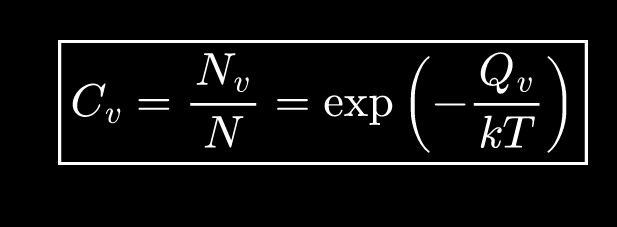
Vacancy concentration formula
N(v): number of vacancies
N: number of atomic sites (per m³)
Q(v): vacancy formation energy (J/mol or eV/atom)
K: boltzmann constat
T: temp in kelvin

Vacancy fraction
The ratio of vacancies to total atomic sites
Number of atomic sites (or number of atoms)
p: density
N(A): avogadro’s number (6.022E23)
A: atomic weight

Celsius to kelvin
T(k)=T(C)+273
Scattering
The change in direction of a wave when it interacts with an obstacle such as atoms in a crystal
Diffraction
Waves scatter by regularly spaced obstacles interfere with one another, producing reinforcement under suitable conditions
Edge-dislocation Burgers-vector relationship
The burger vector is perpendicular to the dislocation line
Screw-dislocation
Burger-vector
Relationship
The vector is parallel to the dislocation line
mixed dislocation
Burgers-vector
Relationship
The burger vector is at an oblique angle to the dislocation line
Grain boundary
A boundary separating two neighboring crystals with different orientations
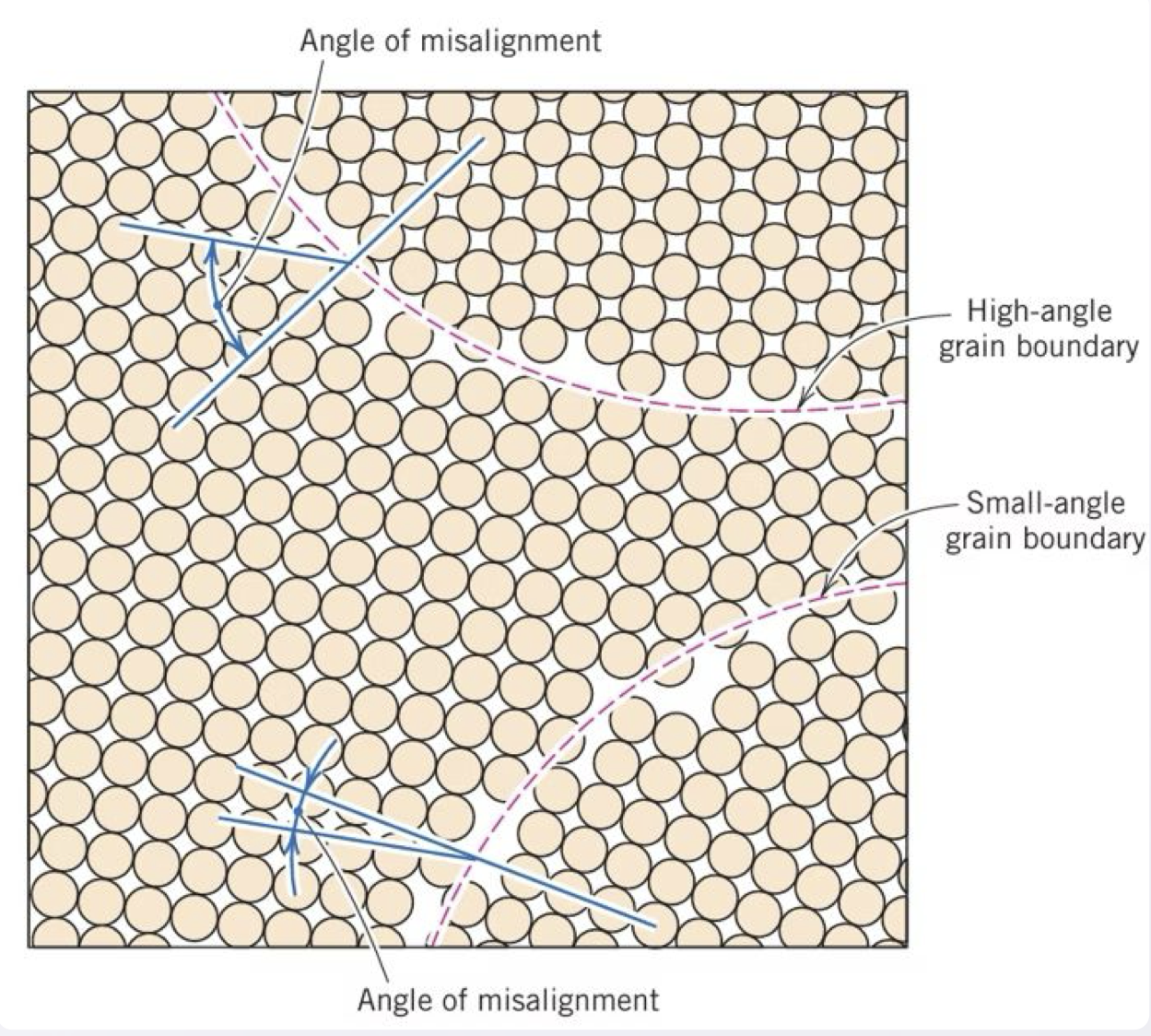
Low angle grain boundary
Boundary with small misorientation angle
Modeled as an array of dislocations
High angle grain boundary
A boundary with large misorientation angle and greater atomic mismatch
Grain size effects
Smaller grains provide more grain-boundary area and generally increases yield strength
Hall-patch Strengthening
The strengthing effect cause by grain boundaries
Cause of screw dislocation
A shear stress that displaced one part of the crystal relative to another