Clinical Pharmacy (PSMA)
 Call Kai
 Learn
 Practice Test
 Spaced Repetition
 Match
 Flashcards
 Knowt Play
1/278

There's no tags or description
Looks like no tags are added yet.
279 Terms
Clinical Pharmacy
A practice in which the pharmacist utilizes his professional judgment in the application of pharmaceutical sciences to foster the safe and appropriate use of drugs, in or by patients, while working with members of the health care team (Francke 1969)
Goal: Educate the patient on how to properly use their medications
General Clinical Pharmacist Functions
Providing drug information to physicians and other health professionals
Medication history taking by conducting interviews regarding medication reviews and reconciliation
Medication profile preparation
Drug therapy monitoring
Disease screening
Monitor and maintain care for patients, especially with chronic diseases
Participate in the management of Emergency Medical Care (EMC), especially in drug use review and patient audits
Patient Counseling
Provision of oral or written information about drugs and other health related information to a patient or his or her representative during the dispensing process or stay in hospital
reduces the chances of medication errors and motivates patient to adhere to the medication regimen
Stop talking
Get rid of distractions
React to the ideas, NOT to the person
Read non verbal messages
Listen to how something is said
Provide feedback to clarify any message
Attending and active listening skills examples
Build the trust and respect among patients
Enable the patient and pharmacist to release their emotions and reduce tension
Create a safe environment that is conducive to collaboration and problem solving
Purposes of active listening examples
Reflecting
Paraphrasing
Focusing
Empathy
Empathic Responding skills
Reflecting
concentrating on the emotional meaning
Paraphrasing
conveying the essence of what was said
Focusing
getting back to the topic of conversation
Empathy
ability to project oneself into the personality of another person
Patient Care Process
A systematic, cyclical process, and comprehensive method that is employed basically to identify, solve, and prevent drug therapy problem
Collect
Assess
Plan
Implement
Follow-up: Monitor and Evaluate
What is the process of Patient Care Process
Problem identification
Problem prioritization
Selection of the patient specific drug and nondrug interventions
Development of integrated monitoring plan
Steps in therapeutic planning
Therapeutic planning
Facilitates the selection of appropriate drug and nondrug interventions for specific patient problems
Provides a framework for monitoring a patient’s response to the drug and nondrug interventions
It incorporates a well thought out alternative regimens
Problem identification
Step 1: Obtain patient data
Step 2: Group related data
Step 3: Determine each problem
Step 4: Assess each problem
Step 1: Obtain Patient Data
History of the patient
Physical examination findings
Results of laboratory and diagnostic tests
Medication history, including herbal and alternative medications
Relevant data resources: Data from the current patient chart and past chart, data obtained from patient interview or interviews with relatives or significant others
Subjective Data
Objective Data
two types of Subdivision of Data
Subjective Data
these are describable but cannot be precisely measured or quantified (e.g., thirst, confusion, blood-tinged sputum, decreased apetite, chills) ; symptoms
Objective Data
data that can be precisely measure or quantified (e.g., diarrhea, weight, vital signs, pH, hematocrit, total protein, peak expiratory flow rate, RBC count) ; signs
Step 2: Group Related Data
It only takes one piece of data to to identify a patient problem
Evaluate the list of objective and subjective data for possible relationships among the data
This step requires comprehensive knowledge of the signs and symptoms of disease and pharmacotherapy
Step 3: Determine Each Problem
Evaluate each group of related and subjective data items to determine the specific patient problem or issue, that should be available to the pharmacist, such as the past and current
medical problems, past surgeries, cases of non-adherence, cases of drug abuse, and patient’s allergies to drugs
The problem is not always the specific diagnosis but may be a preliminary identification of the issue pending acquisition of additional data (e.g., acute diarrhea, not shigellosis)
Step 4: Assess Each Problem
Acuity (acute or chronic)
Severity (mild, moderate, and severe)
Symptom level (symptomatic or asymptomatic)
Treatment status ( treated or untreated)
Degree of control (controlled and uncontrolled)
Classification (staging of disease)
Acuity
(acute or chronic)
Severity
(mild, moderate, and severe)
Symptom level
(symptomatic or asymptomatic)
Treatment status
(treated or untreated)
Degree of control
(controlled and uncontrolled)
Classification
(staging of disease)
Problem Prioritization
Step 1: Identify the active problems
Step 2: Identify the inactive problems
Step 3: Rank the problems
Step 1: Identify the Active Problems
Health professionals interacts with patients in ambulatory setting
Are problems that require some kind of drug or nondrug intervention to resolve or manage the problem
includes pneumonia, asthma, CHF, dyslipidemia, osteoporosis, and DM
Step 2: Identify the Inactive Problems
Problems that do not require any kind of drug or nondrug intervention and are of historical interest only
includes a history of an appendectomy at age 12, a history of pneumonia 2 years ago, and history of smoking two packs of cigarettes per day until quitting 10 years ago
Step 3: Rank of Problems
Rank order the active patient problems
One approach is to identify the problem that needs the most immediate attention and then rank the remaining active problems in order of need for intervention. The number one problem is the problem that if left untreated will cause the most harm to the patient in the shortest amount of time
Patient specific factors
External factors
Two factors to be considered in Selection of Patient-Specific Drug and Nondrug Interventions
Selection of Patient-Specific Drug and Nondrug Interventions
This step requires the willingness and commitment of the patient
Step 1 : Determine short term and long term goals of therapy
Step 2 : Create a list of options
Step 3 : Eliminate options based on patient specific and external factors
Step 4 : Select appropriate drug and nondrug interventions
Step 5 : Identify alternative interventions
Step 1: Determine Short-Term and Long-Term Goals of Therapy
All drug and nondrug interventions should be in the context of the specific short-term and long-term goals of therapy, which may or many not be the same depending on the specific patient problem
Step 2: Create a List of Options
Identify all classes of drugs and possible therapeutic approaches for each problem ; do not eliminate any option at this stage of planning
As the member of the health care team with the most knowledge of pharmacotherapy, it is the pharmacist’s responsibility to identify all possible drug therapy options. This step becomes easier and more time efficient with practice and experience
Step 3: Eliminate Options Based on Patient Specific and External Factors
Once all therapeutic options are identified, eliminate options based on:
The comparative effectiveness of the drugs
The suitability of the drug for the patient given the other patient medical conditions and drug therapies
The ability of the patien to adhere to the proposed regimen
Other factors such as the effectiveness of previous treatment regimens and cost
Step 4: Select the Appropriate Drug and Nondrug Interventions
Determine the best drug and nondrug regimen, including each specific drug to be used, dosage, route, duration, and rationale (must be specific based on current evidences) for the selection of each drug and nondrug component of the regimen
Step 5: Identify Alternative Inteventions
An important part of the planning process is anticipation of potential problems witn the prescribed and/or recommended drug and nondrug interventions
A well thought-out plan always include an alternative medication regimens
Develop a Monitoring Plan
Step 1: Determine specific monitoring parameters
Select specific target outcomes
Select monitoring intervals for each parameter
Step 2 : Integrate the monitoring plan
Step 3 : Obtain data
Step 4 : Assess the response to therapy
Communication skills
Skill/ability to communicate clearly and effectively with patients, significant others (SO/relative or family), physicians, nurses, pharmacists, and other health care team
Patient Counseling
It is the provision of verbal or written information about drugs and other health related information by a pharmacist to a patient representative of the patient
Patient Care Process
This is a systematic and comprehensive method that is employed to identify, solve, and prevent drug therapy problems
Documentation
required to record pertinent facts, findings, and observation, about a patient’s health history, including past and present illnesses, examinations, tests, treatments, and outcomes
derived from patient care process
Documentation
To document and plan patient immediate treatment
Collect the data that may be useful for research and education
Components of Documentation
A complete and legible record;
Documentation for each encounter with a rationale for the encounter, physical findings, prior test results, assessment, clinical impression/ diagnosis and plan for care;
Identified health risk factors, and an easily inferred rationale for ordering diagnostic tests or ancillary services; and
The patient’s progress, response to and changes in treatment, and revision of the original diagnosis/assessment
Pharmaceutical Care
Responsible provision of drug therapy for the purpose of achieving definite outcomes that improves a patient’s quality of life (Hepler and Strand 1990)
A patient centered practice in which the practitioner assumes responsibility for a patient’s drug related needs and is held accountable for this commitment (Cipolle 1998)
Hepler and Strand 1990
“Responsible provision of drug therapy for the purpose of achieving definite outcomes that improves a patient’s quality of life” - this definition is by?
Cipolle 1998
“A patient centered practice in which the practitioner assumes responsibility for a patient’s drug related needs and is held accountable for this commitment” - this definition is by?
C - cure of the disease
E - elimination or reduction of symptoms
A - arrest or slow down disease progression
P - prevention of disease and symptoms
What are the Expected outcomes for Pharmaceutical Care
Pharmaceutical Care Plan
Assessment: a review of the medical conditions and symptoms to determine the need for drug therapy
Plan: a decision of an appropriate drug therapy based on the assessment of the patient
Monitoring: a review of the outcomes of drug therapy (goals and endpoints) to determine if the patient is obtaining the desired outcomes
Assessment
a review of the medical conditions and symptoms to determine the need for drug therapy
Plan
a decision of an appropriate drug therapy based on the assessment of the patient
Monitoring
a review of the outcomes of drug therapy (goals and endpoints) to determine if the patient is obtaining the desired outcomes
Medication Therapy Management
A distinct service or group of services that optimize therapeutic outcomes for individual patients
Patient centered assessment and evaluation of the patient’s full medication regimen and not only individual medications
Medication Therapy Management
Optimize medication use
Improve collaboration
Enhance communication
Empower the patients
Medication Therapy Review (MTR)
Personal Medication Record (PMR)
Medication-related Action Plan (MAP)
Intervention and/or referral
Documentation and follow-up
What are the Core Elements of an MTM Service
Medication Therapy Review (MTR)
A systematic process of collecting patient specific information, assessing medication therapies to identify medication related problems, developing a prioritized list of medication related problems, and creating a plan to resolve them
Goal: Make the patient more knowledgeable about their drugs
Personal Medication Record (PMR)
A comprehensive record of the patient’s medications (prescription and non-prescription medications, herbal products, and other dietary supplements)
Either electronic or written
It is important that the pharmacist provides the PMR with appropriate level of literacy and easily understood by the patient
Medication-related Action Plan (MAP)
patient centric document containing a list of actions for the patient to use in tracking progress for self management
Documentation and Follow-up
MTM services are documented in a consistent manner, and a follow up MTM visit is scheduled based on the patient’s medication related needs, or the patient is transitioned from one care setting to another
Documentation is an essential element of the MTM service model. The pharmacist documents services andintervention(s) performed in a manner appropriate for evaluating patient progress and sufficient for billing purposes
Patient demographics
Basic information: address, phone, email, gender, age, ethnicity, education status, patient’s special needs, health plan benefit/insurance coverage
Subjective observations
Pertinent patient reported information: previous medical history, family history, social history, chief complaints, allergies, previous adverse drug reactions
Objective observations
Laboratory results, vital signs, diagnostic signs, physical exam results, review of systems
Assessment
Problem list, assessment of medication related problems
Plan
A care plan is the healthcare professional’s course of action for helping a patient achieve specific health goals
Education
Goal setting and instruction provided to the patient with verification of understanding
Collaboration
Communication with other healthcare professionals: recommendations, referrals, and correspondence with other professionals (cover letter, SOAP note)
PMR
A record of all medications, including prescription and nonprescription medications, herbal products, and other dietary supplements
MAP
Patient centric document containing a list of actions to use in tracking progress for self management
Follow-up
Transition plan or scheduling of next follow up visit
Billing
Amount of time spent on patient care, level of complexity, amount charged
MTM flowchart
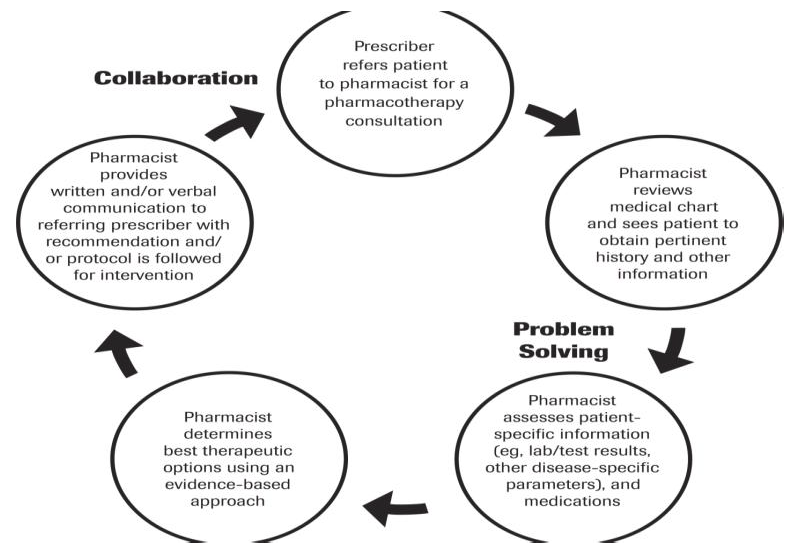
Collaborative medication therapy management
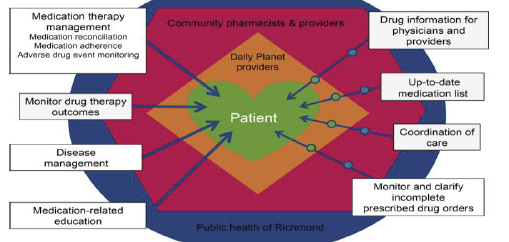
Pharmaceutical Care
including pharmaceutical care plan process
(PRIME and FARM/SOAP) is a systematic method for recording
the pharmacist’s examination of patient pharmacotherapy and
subsequent modification of medication related problems
Soap note
Highly structured format for documenting the progress of a patient during treatment and is only one of many possible formats that could be used by a health professional
S - Subjective
(e.g., CC of the patient ; records of present illness)
O - Objective
(e.g., results of lab tests)
A - Assessment
the analysis or conclusion on the patient current status or behavior
P - Plan
action taken in response to assessment
Farm note
an alternative approach to documenting drug related problems and plan which is a pharmacist equivalent of a physician progress note in a systematized approach
It actually includes provisions for identification and assessment of actual or potential medication related problems, description of a therapeutic plan and appropriate follow up monitoring of problems
F - Findings
patient specific information
A - Assessment
evaluation of findings (e.g) severity duration
R - Resolution
(including prevention) rationale for the intervention should be mentioned
M - Monitoring
(and follow up) assess efficacy, safety and outcome of the intervention
Assessment
It contains pharmacist evaluation of the present situation
It should delineate the thought process that led to the conclusion on problem whether it did or did not exist and active intervention either was or was not necessary
The severity or urgency of the problem should be indicated by stating whether the interventions should be made immediately or within one day, one week or longer
Therapeutic endpoint or outcome stated may be short term goals or long term goals
Resolution
It highlights the actions proposed to resolve drug related problem based upon preceding analysis
Common recommendations include non-pharmacologic therapy like dietary modifications or assisting devices
Rationale for selecting a particular therapy should be clearly depicted. Alternative therapy in case of emergency switching of of drugs must be enlightened
Patient counseling provided must be elaborated
(PRIME)
P
Pharmaceutical based problems
(PRIME)
R
Risks to the patient
(PRIME)
I
Interactions
(PRIME)
M
Mismatch between medication and condition or patient needs
(PRIME)
E
Efficacy issues
Medication Therapy Review
A systematic process of collecting patient specific information, assessing medication therapies to identify medication related problems, developing a prioritized list of medication related problems, and creating a plan to resolve them
Personal Medication Record
A comprehensive record of the patient’s medications (prescription and non prescription medications, herbal products, and other dietary supplements)
Soap note
A highly structured format for documenting the progress of a patient during treatment and is only one of many possible formats that could be used by a health professional
Anemia
It is a condition characterized by a decrease in hemoglobin or RBC mass which results to decreased oxygen carrying capacity of the blood
It may decrease due to blood loss, increased destruction of RBCs or decreased production of RBCs
Hemoglobin
is a protein within RBC that carries oxygen from the lungs to body tissues
Hemoglobinopathies
Thalassemias
Enzyme abnormalities of the glycolytic pathways
Defects of the RBC cytoskeleton
Congenital dyserythropoietic anemia
Rh null disease
Hereditary xerocytosis
Abetalipoproteinemia
Fanconi anemia
Genetic Etiology of anemia
Thalassemias
inherited and a blood disorder related to the body’s inability to produce hemoglobin
Rh null disease or Rh null syndrome
lack of Rh antigens present in RBC