Describe the selection of agents and route of admin in providing neuraxial analgesia for labour and delivery
 Call Kai
 Learn
 Practice Test
 Spaced Repetition
 Match
 Flashcards
 Knowt Play
1/13

There's no tags or description
Looks like no tags are added yet.
14 Terms
Describe selection for labour
Typically low dose LA with opioid adjunct
Ropi 0.2% with fent 2 mcg/ml
Loaded with 10-15 mil
PIEB if present
PCEA 5 ml with 15 min lockout

Describe selection for delivery
If requiring urgent epidural top up in existing / working epidural consider 0.75% ropivacaine or 2% lignocaine with adrenaline – up to total dose of 15-20mls will be adequate for LUSCS or forceps delivery
Bupivacaine may be preferred for spinal anaesthetic due to longer duration of action and more conc block
Describe the urgency of emergency delivery with regard to the threat to maternal or foetal wellbeing in accordance with
established guidelines (RANZCOG and ANZCA)
There is a four-grade RANZCOG endorsed classification system for emergency caesarean section which are:
o Category 1 = Urgent threat to life of a woman or foetus
o Category 2 = maternal or foetal compromise but not immediately life threatening
o Category 3 = needing earlier than planned delivery but without currently evident maternal or foetal compromise
o Category 4 = at a time acceptable to both the woman and the caesarean section team, understanding that this can be affected by a number of factors
Are there time limits
RANZCOG recommend that there should be no specific time attached to the various types of LUSCS and each case managed according to the clinical evidence of urgency – on a case by case basis
(Note that earlier recommendations would sat Cat 1 – DDI up to 30mins, Cat 2 – DDI up to 1 hour, Cat 3 – DDI up to 24hrs, Cat 4 – no urgency / elective)
When do RANZCOG recommend a dedicated obs OT
1 OT for every 4000 births. Should be available at all times
Why regional?
Less
More
Safer for mother? baby?
Less blood loss
Less risk of anaphylaxis
Avoids difficult airway risk - 10 x higher in obstetric pts (1 in 300 vs 1 in 3000)
Less neonate depression
Better early post op analgesia
Clear-headed recovery, early BF if required
May offer some protection
BUT
More PONV
More shivering
From ‘why mothers die’ UK enquiries into deaths
Safer for mother
Other factors that may confound - blood transfusions, abx, uterotonics
PROBS safer for baby
data looking at association between anaesthetic and baby. Number of babies born via GA with low apgar is HIGH. BUT could also be related to the reasons for a GA in first place. Pt could be sick
Evaluate the role of epidural, spinal and combined spinal epidural techniques for caesarean birth
SPINAL
usual dose
rapid sequence spinal
Spinal anaesthetic is the most commonly used technique for LUSCS, using small pencil point spinal needle with a mixture of 2.4mls heavy 0.5% bupivacaine and 20mcg fentanyl or morphine (100mcg) – usually total volume 2.5mls to get a block to T3/4 in patient of average height
‘Rapid sequence’ spinal = due to improved safety profile of spinal > GA, in some centres for emergency (cat 1) LUSCS can do IV access, monitoring, mask, sterile gloves, prep back, no LA, spinal inserted (single attempt) if this fails move on to GA (note usual contraindications apply e.g. severe haemorrhage)
Single shot spinal
where
dose
testing
chance of not being high enough
risks of ITM

Epi top up
Assess
Dose
test
Proceed
Failure?

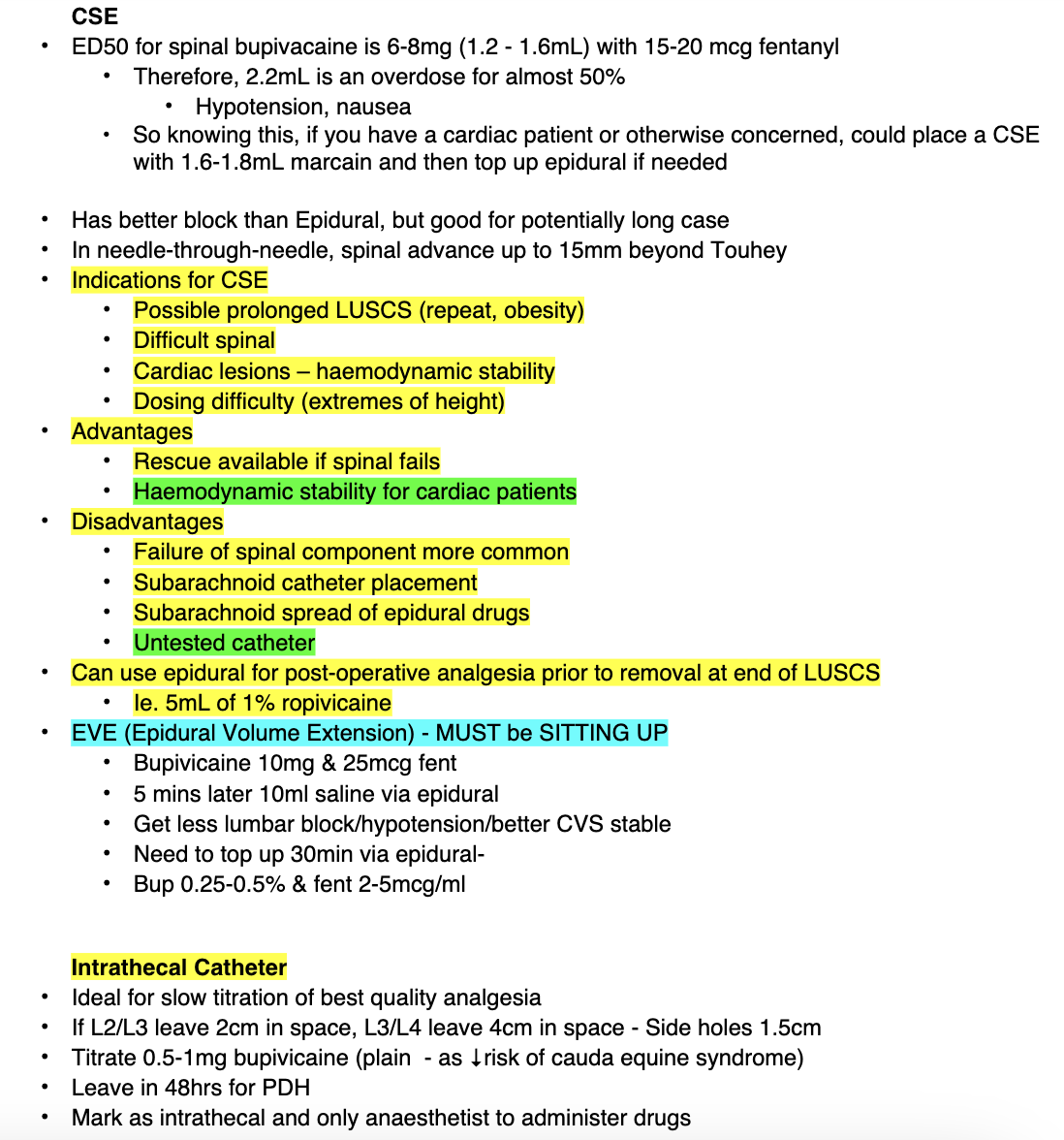
CSE
ED50 for spinal
Indications
Adv
Disadv
If regional fails or suboptimal block
Preop
Intraop
Dosing
Preop
Position
Testing
If failure
Repear
Inhalational
Epi (if present from CSE)
IV
GA
GA for LUSCS
Indications
Technique
Problems
Indications
35% Urgency - melb study, speed for GA vs epi top up not st signif (DDI) mean 17 mins GA and 19 mins epi top up. Use of spinal assoc with longer DDI 26 mins
22% Inadequate regional
20% refusal of regional
6% with regional contraindications/spinal abnormalities
Technique
AMPLE
Airway assessment
IV ranitidine/PPI
LL and airway positioning
PreO2
RSI with CMAC (SOAP ME, DA equipment, surgeon scrubbed and ready)
BIS
Paeds
Prop 3-5 mg/kg and Sux 1.5 mg/kg
Prior to delivery 50/50 N2O and O2 and over pressure
Post delivery increase N20 and reduce Sevo
Consider Prop TIVA if uterine atony
Analgesia
Morphine 20 mg or Fent 500 mcg post delivery
Condider OGT to decompress if not fasted
Full reversal
Extubate awake
Potential problems with GA for LUSCS
Things reduced with GA
Aortocaval compression
Aspiration
Failed intubation
Increased Blood loss
VTE risk
Awareness
Fetal sedation and resp depression
Less PONV
Less shivering

When would you be asked for a tocolytic?
How to draw up
Indeterminate lie
High head
obstructed labour
breech
GTN 50 mg in 10 ml
Draw up 1 ml which is 5 mg
Then can put this 5 mg into 100 ml of NSaline → 50 mcg/ml
OR put this 5 mg into 20 ml → 250 mcg/ml