Lecture 43: FA Anesthesia
 Call Kai
 Learn
 Practice Test
 Spaced Repetition
 Match
 Flashcards
 Knowt Play
1/34

There's no tags or description
Looks like no tags are added yet.
35 Terms
what are general considerations for farm animal anesthesia?
- standing vs general anesthesia
- diagnostics to include in patient work up
- fasting requirements
- placement of IVC
- equipment and personnel
- drugs on hand
- challenging intubation
- species-species complications
- monitoring of P
- recovery process
- management of pain and stress
- withdrawal for meat and milk
What are considerations for standing procedures vs vs general anesthesia in farm animals?
- rumen is like a bag of fluid stuff can move or come out
- standing might be better for rumen and other anatomy
How long would you recommend fasting a small ruminant prior to anesthesia?
- 12-18 hours
(neonates less long or if emergency might not have to)
What is a common complication of ruminant anesthesia?
- hypoventilation = big abdomens and large rumens makes it harder to breath
What is a common standing anesthesia method for small ruminants? How long can it last?
- ketamine stun = ketamine, xylazine and butorphanol
- gives 45 mins sedation IM or 15-20 mins IV
What are procedures you can use a ketamine stun for in small ruminants?
- castration, tube cystotomy, biopsy, joint flush, casting fracture, flank laparotomy
What is a good analgesic for castration, biopsy, joint flush, casting fracture, flank laparotomy?
- lidocaine
What are good induction agents for small ruminants?
- ketamine and benzodiazepine (midazolam)
What are poor induction agents are good for small ruminants?
- mask induction with iso
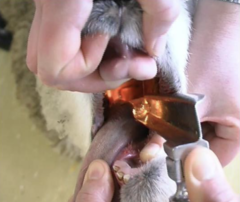
What equipment is needed for small ruminant intubation?
- Assistant to properly position body (keep sternal), neck, and head
- Laryngoscope of adequate length
- Stylet does help
- several appropriately sized ETT
- Rope, gauze, or leash to open the mouth
- Dry gauze to hold the tongue
- Suction equipment available
- Extra induction drugs available
- Capnograph to confirm placement of ETT in trachea (ideally)
- lidocaine to spray on arytenoids if possible
How might xylazine impact sheep?
- can cause hypoxemia and pulmonary edema
- need to use a lower dose or JUST AVOID in general
_________ are more sensitive to xylazine than other ruminants and camelids
- goats
How do you restrain a pig for anesthesia since they can be aggressive and are smart?
- have an escape route
- keep stress slow since become hyperthermic
- use restraint devices
- can use benzodiazepines (midaz) in food to calm prior to IM injection
If you are having trouble giving anesthetics to a pig IM, what is another method that can be used?
- can give rectally
What are oral methods of chemical restraint for pigs?
- trazodone
- gabapentin
What are parenternal methods of chemical restraint for pigs?
- midazolam (IM or IN)
- midazolam + butorphanol + alpha-2-agonist
How can you obtain venous access in a pig?
- auricular vein = easiest place
- cephalic vein or SQ abdominal vein = plan B
What makes intubating pigs hard?
- limited visibility = can't open mouths wide, narrow mouth, and a large tongue
- laryngotracheal junction at an angle = ETT can get caught in the middle
- prone to laryngospasms since obligate nose breathers (use lidocaine)
- over extending the head may occluded airway

What do you want to make sure you do not do why you are intubating a pig?
- not advance past the thoracic inlet due to risking bypass ventilation of the accessory right lung lobe

What are the common ETT sizes used in pigs?
- 5-7 mm = 10-15 kg
- 8-10 mm = 20-50 kg
How long would you fast an adult pig prior to anesthesia?
- 6-12 hours
What is the most effective premedication in pigs, but is not readily available?
- azaperone
What premedication in pigs are not effective alone for sedation?
- acepromazine
- xylazine
What are good premedications used in pigs?
- demedatomide
- diazepam or midazolam
What is triple drip, which works well in pigs for short term anesthesia?
- xylazine-ketamine-guaifenesin
You have a pig that is going to undergo a quick C-section. What is your protocol of choice?
- triple drip (xylazine-ketamine-guaifenesin)
What is commonly used for maintenance of anesthesia in pigs?
- inhalant = iso and sevo (most commonly)
- propofol CRI
- triple drip
What are options for analgesia in pigs?
- buprenorphine
- butorphanol
- morphine
- fentanyl CRI
- carprofen
- meloxicam
- flunixin meglumine
How do you monitor pigs under anesthesia?
- monitor jaw tone for depth (eyes are hard)
- ear pulse (HR = 60-80ish)
- ETCO2
- SPO2, ECG, temp, esophageal stethoscope
What is recovery like for pigs?
- commonly become nauseous
- calm during recovery
- make sure to keep warm
- stay in sternal recumbency
- maintain patent airways (esp. in pot-bellied pigs)
- keep O2 on as long as possible
who gets malignant hyperthermia?
- most commonly seen in pigs
- often those with high ratio of muscle to body mass and rapid growth
What is the cause of malignant hyperthermia?
- mutation in RYR1 gene that controls the Ca channel in skeletal muscle leading to large Ca release leading to excessive skeletal muscle contraction
What does malignant hyperthermia look like?
- signs shortly after exposure to inhalen
- signs could be delayed if acepromazine used
- rapidly increased ETCO2
What is the treatment for malignant hyperthermia?
- Dantrolene
What are anesthetics agents that are less likely to cause malignant hyperthermia, since prevention is ideal?
- propofol
- detomidine
- epidural anesthesia
- alfaxalone?