Physics D#3 Optimize Sonographic Images - 26%
 Call Kai
 Learn
 Practice Test
 Spaced Repetition
 Match
 Flashcards
 Knowt Play
1/146

There's no tags or description
Looks like no tags are added yet.
147 Terms
The __________ control has the greatest effect upon signal-to-noise ratio?
receiver gain
output power
overall gain
time gain compensation
The correct answer is:
output power
2. Adjusting the focus at a given depth in the image optimizes the _______________ resolution at that point.
axial
elevational
axial, lateral, and elevational
lateral
Remember: Focusing primarily impacts beam width.
The correct answer is:
lateral
3. The appearance of acoustic speckle is associated with __________.
elimination of low level noise
a brighter image
granular appearing and created by interference effects
a darker image
Remember: Speckle is caused by a scattering of waves from the surface of small structures.
The correct answer is:
granular appearing and created by interference effects

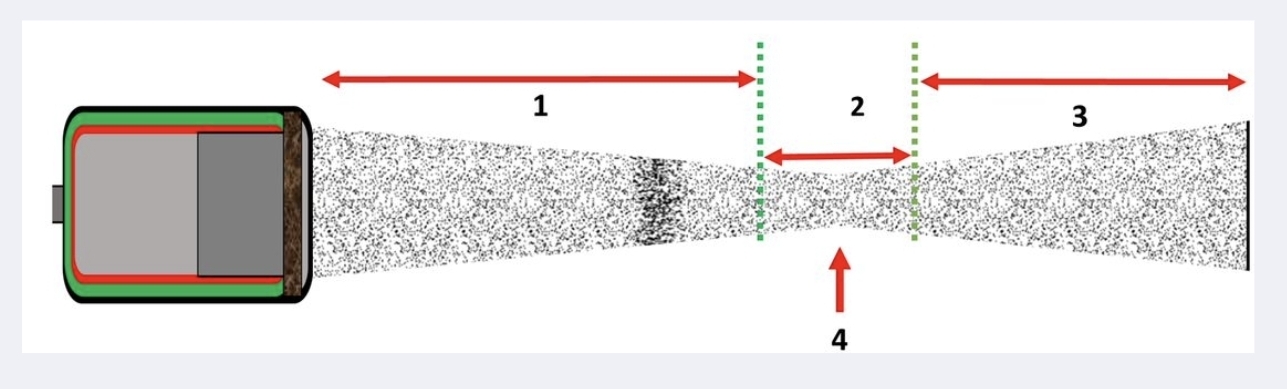
4. In the image, what are the terms used to describe #3?
Focus
Focal Zone
Fresnel Zone
Fraunhofer Zone
Remember: Remember the basic zones and regions that describe the US energy
The correct answer is:
Fraunhofer Zone
*This is also referred to as the Far Zone
5. M-mode is particularly useful to ___________________.
appreciate the movement of structures over time
assess the amplitude of a reflected sound beam
All of these measure the dimension of structures along the line of sight
measure the dimension of structures along the line of sight and appreciate their movement over time
Remember: While a single line of sight, this mode does allow a highly accurate assessment of motion.
The correct answer is:
measure the dimension of structures along the line of sight and appreciate their movement over time
6. The duty factor in 2-D imaging is typically _________ .
1-10%
100%
10-50%
< 1%
Remember: Duty factor is the percentage of time the instrument is actively transmitting.
The correct answer is: < 1%
7. The shape of an ultrasound beam traveling through a tissue medium has a ___________________ shape.
circular
flat
rectangular
hourglass
Remember: Of course, this can now be controlled to some degree with electronic focusing and other techniques but remains true.
The correct answer is:
hourglass
*This is the basic shape of the beam leaving the transducer.

8. In the image, what are the terms used to describe #2?
Fraunhofer Zone
Focal Zone
Focus
Fresnel Zone
Remember: Remember the basic zones and regions that describe the US energy
The correct answer is:
Focal Zone

9. Functions of the receiver include ________________.
amplification and compensation of the returning signals.
amplification, compensation, compression, demodulation, reject
switching between the transmit and receive function
creating the image from the returning electrical signals
The correct answer is:
amplification, compensation, compression, demodulation, reject
10. A stenosis that results in a decrease in flow volume and pressure distal to that obstruction is referred to as a _______________.
hemodynamically significant stenosis
critical stenosis
clinical stenosis
measurable stenosis.
The correct answer is:
hemodynamically significant stenosis
11. Harmonic imaging is primarily a __________________
second transmitted frequency
signal processing technique
phenomenon of a wide bandwith
use of varied transmitted frequencies
Remember: Changes in the medium due to the passage of the US wave result variations in the propagation velocity which ultimately generate a harmonic frequency
The correct answer is:
signal processing technique
*This processes an additional frequency generated as the energy moves through the tissues.
12. The pixel or picture element is __________________.
the smallest controllable element of an image represented on the display screen
best represented by scan line density
largely dependent upon depth
a measure beam thickness
The correct answer is:
the smallest controllable element of an image represented on the display screen
13. Which of the following imaging condition would result in a high signal-to-noise ratio?
High time gain compensation (TGC) and low output power
High output power, low amplification
Little or no reject and time gain compensation (TGC)
Low output power, high amplification
Remember: Output power has minimal effect of signal to noise ratio, Amplification increases the amplitude of noise.
The correct answer is:
High output power, low amplification
14. High (or wide) dynamic range means ___________.
high spatial resolution
good temporal resolution
many shades of gray
few gray shades
The correct answer is:
many shades of gray
15. An A-mode displays the _________ of the returning signal.
amplitude and depth
strength
amplitude
depth
Remember: Know the various modes of operation of your instrument
The correct answer is:
amplitude and depth
*A (or "amplitude") mode shows a graph of the returning amplitudes.

16. In the diagram, C refers to ___________.
PRP
Pulse Duration
SPL
PRF
Remember: A short pulse is good as it results in a shorter spatial pulse length.
The correct answer is:
Pulse Duration
*Pulse duration is a measure of TIME

17. Decreasing the maximum imaging depth from 15 cm to 10 cm will NOT alter the ____________.
pulse repetition frequency
listening time
pulse repetition period
pulse duration
Remember: Imaging depth greatly impacts the PRF but not the duration of the pulse!
The correct answer is:
pulse duration
*A short pulse can is not impacted by depth of field.
18. When using a Read Zoom, in the Region of Interest (ROI), the system:
changes the color write priority
displays a smaller pixel size
uses post processing for the acquired data
acquires new data in the ROI
Remember: This makes the ROI larger - basically a magnification without increased data.
The correct answer is:
uses post processing for the acquired data

19. What control could be used to optimize this image?
Time Gain Compensation (TGC)
Output power
Frequency
PRF
Remember: The overly bright echoes in the near field and rather dark echoes in the far field. TCG can “compensate” for the attenuation at various depths.
The correct answer is:
Time Gain Compensation (TGC)

20. To increase the temporal resolution, the first thing you should do is _____________.
decrease the depth of field
increase the number of focal zones
change transducers
increase the frequency
Remember: There are numerous controls that impact frame rate but using the minimum depth necessary is probably your first choice.
The correct answer is:
decrease the depth of field
21. __________ compounding and _____________ compounding are methods of combining multiple images into a single image.
Spatial, frequency
Spatial, wavelength
Frequency, spectral
Image, Doppler
Remember: Compounding has several variations.
The correct answer is:
Spatial, frequency
22. What would be the optimal way for the sonographer to increase the lateral resolution?
Decrease the pulse repetition frequency
Increase the depth of the field of view
Add a focal point
Increase output powert
Lateral resolution can be controlled with beam focusing techniques.
The correct answer is:
Add a focal point
*Adding a focal point narrows the beam further, which can help optimize the image by improving the lateral resolution

23. In the diagram, list the “types” of resolution indicated by 1, 2, & 3.
1. Axial, 2. Lateral, 3. Elevational
1. Axial, 2. Elevational, 3. Lateral
1. Elevational, 2. Axial, 3. Lateral
1. Lateral, 2. Axial, 3. Elevational
Remember: Know these three types of resolution
The correct answer is:
1. Axial, 2. Lateral, 3. Elevational

24. ___________ is a technique that obtains multiple images and combines them into a single image.
Image enhancement
Harmonics
Interpolation
Compounding
Remember: Compounding has several variations and uses but is bascially a technique that combines data in various ways.
The correct answer is:
Compounding
25. What does the gain control do?
Automatically adjusts the high amplitude signals
Adjusts the degree of amplification of the returning signals
Adjusts the degree of amplification of the transmitted signals
Adjusts the intensity of the US beam
The gain control is a fundamental feature in ultrasound imaging that allows the sonographer to fine-tune the brightness and contrast of the image. By adjusting the gain, the operator can highlight or suppress different structures and tissue characteristics within the ultrasound image, ultimately improving diagnostic quality. It's important to use gain judiciously to avoid over-amplification, which can result in image noise or artifacts, and to ensure that subtle details are visible without compromising image clarity.
The correct answer is:
Adjusts the degree of amplification of the returning signals

26. What setting could improve the image of this vessel?
Change imaging frequency
Increase the PRF
Adjust the focus at the area of interest
Decrease imaging depth
The correct answer is:
Adjust the focus at the area of interest
*Note the the focus is placed near the bottom of the field of view.

27. Dynamic frequency tuning utilizes the bandwidth of the emitted pulse by __________________.
decreasing the dynamic range at both extremes
using the upper range of the bandwidth for superficial structures and the lower range for deeper structures
compressing the bandwidth
rejecting the upper and lower frequencies
The correct answer is:
using the upper range of the bandwidth for superficial structures and the lower range for deeper structures

28. An US pulse travels into the tissue and strikes a reflector located 5 centimeters from the transducer and returns. How long will it take for the energy to return to the transducer?
130 microseconds
Cannot be determined by the provided information
13 microseconds
65 microseconds
Remember: Remember the 13 microseconds rule. At 1540 m/s, it takes the US energy 13 microseconds to travel two (2) centimeters or 1 centimeter in and 1 centimeter back.
The correct answer is:
65 microseconds
*13 ms x 5 cm depth (10 cm round trip) = 65 ms
29. Read magnification is a “zoom” function that occurs _______________.
upon retrieval of the data from a storage device
prior to storage
during processing
during data acquisition
Remember: Read magnification simply enlarges the data already acquired acquires increased data from the region of interest (ROI)
The correct answer is:
upon retrieval of the data from a storage device
30. What is a benefit of spatial compounding?
Improves temporal resolution
Reduces image artifacts
Increases penetration depth
Enhances color Doppler imaging
Spatial compounding is a technique used to reduce image artifacts and enhance the quality of ultrasound images. It is particularly effective in producing clearer and more detailed images by combining multiple perspectives to create a final composite image.
The correct answer is:
Reduces image artifacts
31. The gain control _________________.
adjusts the degree of amplification of the returning signals
adjusts the intensity of the US beam
adjusts the degree of amplification of the transmitted signals
automatically adjusts the high amplitude signals
Remember: Gain affects the returning signal
The correct answer is:
adjusts the degree of amplification of the returning signals
32. When using a Write Zoom, in the Region of Interest (ROI), the system:
acquires new data
displays a larger pixel size
changes the color priority
uses post processing for the acquired data
Remember: Write zoom acquires additional information from the ROI.
The correct answer is:
acquires new data
33. The Output Power control _______________.
changes the PRF
adjusts the amount of power contained within the ultrasound beam
adjusts the number of pulse listen cycles
allows for amplification of returning signals
Remember: This is important as increaseing the power output, increases the energy exposure to the patient.
The correct answer is:
adjusts the amount of power contained within the ultrasound beam

34. In the image, what is the term used to describe #1?
Fresnel Zone
Focal Zone
Fraunhofer Zone
Focus
Remember: Remember the basic zones and regions that describe the US energy
The correct answer is:
Fresnel Zone
*This is also referred to as the Near Zone.

35. An increase in the number of pixels on the display monitor will improve _____________.
spatial resolution
contrast resolution
temporal resolution
brightness
Remember: A pixel is a display of the ultrasound data. The more pixels displayed, the more data is displayed improving resolution.
The correct answer is:
spatial resolution

36. In the diagram, A refers to _____________.
PRF
SPL
Pulse Duration
PRP
Remember: PRF is described in Hertz (Hz) or cycles per second.
The correct answer is:
PRF
*Note "A" designates numerous pulses

37. Write magnification is a “zoom” function that occurs _______________.
upon retrieval of the data from a storage device
during data acquisition but after digital storage
during data acquisition and prior to storage
during processing allowing amplitude changes
The correct answer is:
during data acquisition and prior to storage
38. What is a pre-processing function in ultrasound imaging?
A setting that changes the image after it's saved
A setting that adjusts the brightness of the monitor
A setting that improves image quality while acquiring the data
A setting that manipulates colorization of the image
ultrasound imaging, pre-processing functions are settings or techniques applied during data acquisition, before the "freeze" button is activated.
The correct answer is:
A setting that improves image quality while acquiring the data
*A pre-processing function in ultrasound imaging refers to a setting or technique that is applied to the data during acquisition to improve image quality.

39. What setting can the sonographer change to improve the spatial resolution of the vessel displayed in this image?
Decrease the gain
Move the focus
Decrease imaging depth
Increase the pulse repetition period
The focus is at the bottom of the image. It should be placed at or just below the area of interest (the vessel).
The correct answer is:
Move the focus
*Moving the focus to the area of interest improves the lateral resolution.

40. Two closely spaced parallel structures along the axis of the ultrasound beam are not differentiated as separate but displayed as a single structure would be referred to as _____________________.
range ambiguity artifact
grating lobes
comet tail
resolution artifact
Remember: This may be difficult to discern as an artifact but importantly know it could happen. Increasing the frequency would improve axial resolution.
The correct answer is:
resolution artifact
41. Time gain compensation (TGC) allows adjustment of ______________.
low-level signals
high amplitude signals
the number of shades of gray displayed
gain settings for various depths
Remember: Remember time is distance or depth.
The correct answer is:
gain settings for various depths
42. Compression is a mechanism that allows adjustment of ______________.
the number of shades of gray displayed
the wide range of received amplitudes
signal strength due to attenuation
very low-level signals.
Remember: The # of retruning amplitudes is too great to display so the range of signals is compressed.
The correct answer is:
the number of shades of gray displayed
43. The pulser is responsible for ___________________.
increasing the amplitude of the pulse
isolating the transducer
producing the voltage applied to the PZT crystal
providing timing delays
Remember: The pulser generates the electrical pulses.
The correct answer is:
producing the voltage applied to the PZT crystal
44. What would be the optimal way for the sonographer to increase the lateral resolution?
Increase output power
Increase the frequency
Decrease the PRF
Adjust the focus
Remember: Lateral resolution can be controlled with beam focusing techniques.
The correct answer is:
Adjust the focus
* focusing primarily impacts lateral resolution
45. Low dynamic range means ___________.
few shades of gray
high spatial resolution
many gray shades
good temporal resolution
The correct answer is:
few shades of gray
46. A ultrasound receiver performs numerous functions that can be characterized as preprocessing or postprocessing.
Which of the following best describes a preprocessing function?
occurs prior to reception by the transducer
is always the first receiver operation to occur
occurs prior to storage in the scan converter
occurs after the signal is stored in the archiving device
The correct answer is:
occurs prior to storage in the scan converter
47. An increase in the number of pixels on the display monitor will improve ______________.
contrast resolution
frequency
temporal resolution
spatial resolution
Remember: A pixel is a display of the ultrasound data. The more pixels displayed, the more data is displayed improving resolution.
The correct answer is:
spatial resolution
48. Compression of the returning signals is necessary due to __________.
the range of outpower settings
computerized control of the gain settings
the wide range of amplitudes
numerous diagnostic criteria requirements
Remember: The very wide range of signal amplitudes is too great to display.
The correct answer is:
the wide range of amplitudes

49. If presented with this image, what is the first control you would adjust?
Output power
Transducer Frequency
Time gain compensation (TGC)
Overall gain
Remember: The deeper the structure, the greater the attenuation. TGC allows increased gain for deeper structures.
The correct answer is:
Time gain compensation (TGC)

50. Beam divergence is due to _____________
Battin’s principle
Poiseuille’s principle
Huygen’s principle
Bernoulli’s principle
Remember: Every point on a wavefront becomes a source of additional speherical wavelets, and theses secondary wavelets interfere resulting in a new wavefront.
The correct answer is:
Huygen’s principle
51. The smaller the diameter of the crystal, the _________ the focal depth.
shorter
deeper
more variable
wider
Remember: While still true, todays modern transducers allow significant control over the location of the fical depth.
The correct answer is:
shorter
52. If an image is too bright, the first control the sonographer should adjust is the _______.
TGC
Reject
overall gain.
output power
Remember: Decreasing the power will also decrease patient exposure. Always remember ALARA
The correct answer is:
output power
53. The listening time is typically ________________ the pulse duration.
100 times shorter than
100 – 1000 times shorter than
100-1000 times longer than
100 times longer than
Remember: Typically the pulse is very short and most of the time is spent in the receive mode waiting for the energy to travel to the structure and the reflected energy to return.
The correct answer is:
100-1000 times longer than
*The pulse is short and the lsitening time long.
54. Reject is a mechanism that allows adjustment of ______________.
the wide range of received amplitudes
the number of shades of gray displayed
signal strength due to attenuation.
very low-level signals
The correct answer is:
very low-level signals
55. During an imaging exam, decreasing the depth of field will _________.
decrease the PRF.
increase the “listening time.”
decrease the pulse duration.
decrease the “listening time.”
Remember: The deeper the structure, the longer the listening time.
The correct answer is:
decrease the “listening time.”
*Less travel time to a shallow structure, the receive time is decreased.
56. What would be the optimal way for the sonographer to increase the axial resolution?
Decrease the depth of the field of view
Increase the frequency
Increase line density
Increase the PRF
Axial resolution is dependent largely upon the frequency of the US.
The correct answer is:
Increase the frequency
*Axial resolution is dependent on the frequency of the ultrasound (US) wave. Increasing the frequency improves axial resolution.
57. What setting can a sonographer change to improve the spatial resolution in an image?
Increase gain
Increase line density
Increase pulses per frame
Increase pulse repetition frequency
Spatial resolution refers to the ability to distinguish fine details in an image, so anything that improves axial or lateral resolution improves spatial resolution.
The correct answer is:
Increase line density
*Increasing line density can improve spatial resolution by increasing the number of scan lines and enhancing the detail captured in the image.
58. What is important about the region of interest (ROI) box when using write zoom?
The pixels in the ROI are larger in size
The system uses post-processing techniques to enlarge the ROI
The system acquires all new scan data in the ROI
The ROI has reduced line density compared to the full image
The region of interest (ROI) box in ultrasound imaging, when using write zoom, allows the system to acquire all new scan data in the defined area, which is important for focusing on specific regions of interest and obtaining high-resolution images for those areas.
The correct answer is:
The system acquires all new scan data in the ROI
59. When creating a short pulse that has an inherently wider bandwidth, what process can allow an increased resolution?
decrease the PRF
dynamic frequency tuning
optimize the outpower and gain settings
change the center frequency
The correct answer is:
dynamic frequency tuning
60. The component that isolates the voltage applied to the PZT crystal from a voltage generated by a returning echo is the ________.
power output control
transmit-receive switch
pre-amplifier
amplifier
Remember: The instrument switches between a transmit and receive function.
The correct answer is:
transmit-receive switch
61. If an image is too dark, the first control the sonographer should adjust is the _______.
output power
gain
reject
TGC
Remember: While an increase in power would brighten the image, it also exposes the patient to increased power and intensity. Always remember ALARA
The correct answer is:
gain
62. Which of the following will improve temporal resolution?
Decrease imaging depth
Increase focal points
Decrease spatial pulse length
Increase frequency
Due to the propagation speed of sound, shallow imaging means less time waiting for a pulse to return to the transducer.
The correct answer is:
Decrease imaging depth
63. Elevational resolution is dependent upon the ____________.
beam thickness
spatial pulse length (SPL)
frequency
aperture
Remember: Elevational is sometimes referred to as azimuthal resolution or slice thickness.
The correct answer is:
beam thickness
64. If an image is too bright, the first control the sonographer should adjust is _______.
gain
reject
the TGC
output power
Remember: Remember ALARA!
The correct answer is:
output power
65. If an ultrasound image's borders are difficult to distinguish, what can a sonographer do to improve the situation?
Increase edge enhancement
Increasing the dynamic range
Turn off harmonic imaging
Decrease spatial compounding
There are many things a sonographer can adjust to improve visualization of borders such as edge enhancement, using B-mode colorization, decreasing dynamic range, increasing rejection, and anything that improves spatial resolution.
The correct answer is:
Increase edge enhancement
*Increasing edge enhancement intensifies the borders, making them easier to see.
66. Which of the following scenarios will produce a sound beam with the shallowest focus?
High frequency
Low frequency
High frequency and small diameter active element
Low frequency and small diameter active element
The correct answer is:
Low frequency and small diameter active element
*Both the small element and the low frequency serve to create a more shallow
67. Lateral resolution is the ability to accurately distinguish two closely spaced objects ______________.
lying perpendicular to the beam axis of the beam (side by side)
lying parallel along the line of sight
and is largely dependent upon the frequency
while exhibiting motion
Remember: Lateral resolution is dependent upon beam shape and therefore varies throughout the image
The correct answer is:
lying perpendicular to the beam axis of the beam (side by side)
*This can be improved with focusing
68. Which transducer will have the best axial resolution?
7.5 MHz frequency that creates pulses with 4 cycles.
10 MHz frequency that creates pulses with 2 cycles.
7.5 MHz frequency that creates pulses with 2 cycles.
10 MHz frequency that creates pulses with 4 cycles.
Higher imaging frequency, with its shorter wavelength, leads to improved axial resolution in ultrasound imaging.
The correct answer is:
10 MHz frequency that creates pulses with 2 cycles.
69. What is the general rule for adjusting power and gain?
If the image is too dark, first increase power, and if still too dark, increase the gain
If the image is too bright, first decrease gain, and if still too bright, decrease power
If the image is too dark, first increase receiver gain. If the image is still too dark, then adjust power.
If the image is too bright, first increase the gain, and then adjust the power
Remember: ALARA
The correct answer is:
If the image is too dark, first increase receiver gain. If the image is still too dark, then adjust power.
70. Processing of the data can be divided into _____________.
preprocessing or post processing
processing and display
compression and processing
amplification and rectification
The correct answer is:
preprocessing or post processing
*This is an important designation.
71. An advantage of tissue harmonic imaging (THI) is
it increases frame rate
the returning sound beam is narrower in all planes
it creates a higher amplitude signal
it has a lower frequency
Remember: The main beam distortion (side lobes and grating lobes) are elminated as those signals are not processed.
The correct answer is:
the returning sound beam is narrower in all planes
*This improves resolution
72. Pulse repetition frequency (PRF) is defined as the ___________________.
amount of listening time
number of pulses per unit time
amount of time a pulse lasts
physical distance a pulse occupies
Remember: PRF is an important consideration in imaging and especially Doppler applications
The correct answer is:
number of pulses per unit time
73. What resolution concept deals with the machine's ability to display moving anatomy in real-time?
Elevational Resolution
Axial resolution
Temporal resolution
Lateral Resolution
Temporal resolution deals with the machine's ability to display moving anatomy in real-time. Axial, lateral, and elevational resolutions are more about the detail or spatial resolution.
The correct answer is:
Temporal resolution
*Temporal resolution is how accurately we can see moving objects.
74. The focal depth is primarily determined by the _________________.
near and far fields
length of the focal zone
crystal diameter and the frequency of the ultrasound transducer
distance between the transducer and the far field
Remember: Todays modern transducers allow significant control over the location of the focal depth.
The correct answer is:
crystal diameter and the frequency of the ultrasound transducer
75. Spatial compounding __________________.
uses a single line of sight to optimize data accuracy
can only be accomplished in a linear array as it requires beam steering
uses multiple lines of sight to create an image
is best suited for optimizing data from deep structures
The correct answer is:
uses multiple lines of sight to create an image
76. What is the general rule for adjusting power and gain?
Always increase both power and gain simultaneously to improve image quality.
If the image is too dark, first increase receiver gain. If the image is still too dark, then adjust power.
If the image is too dark, first increase power, and if still too dark, increase the gain.
If the image is too bright, first decrease gain, and if still too bright, decrease power.
The general rule for adjusting power and gain is crucial in ultrasound imaging. It aims to achieve the best image quality while avoiding over-amplification or excessive noise. Using the minimum output power necessary for the safety of the patient - always be thinking of ALARA.
The correct answer is:
If the image is too dark, first increase receiver gain. If the image is still too dark, then adjust power.
77. A signal-to-noise ratio is ____________.
improved with increased gain
a comparison between the ultrasound signal and background reflections and considered good if low
a comparison between the ultrasound signal and background reflections and considered good if it is high
independent of gain settings
Remember: We want a large difference between the signal and background noise to detect poor reflectors.
The correct answer is:
a comparison between the ultrasound signal and background reflections and considered good if it is high
78. ___________ refers to the use of lower frequency sound as reflections from deeper structures.
Dynamic frequency tuning
Harmonic imaging
Phased array
Narrow bandwidth imaging
Remember: Lower frequency has less attenuation and provides a stronger reflection from deep structures.
The correct answer is:
Dynamic frequency tuning
79. A monitor made with more pixels per inch (PPI) will improve:
Brightness
Spatial resolution
Refresh rate
Frames per second
Increasing the number of pixels per inch (PPI) on a monitor will indeed improve spatial resolution, resulting in a higher level of detail and image quality.
The correct answer is:
Spatial resolution
80. What function allows the sonographer to adjust the brightness of an image at different depths?
Amplification gain
Rejection
Time gain compensation
Dynamic range
In ultrasound, time equals depth. So the longer it takes for the signal to return, the deeper the reflector. Deeper reflectors tend to be dark because of attenuation.
The correct answer is:
Time gain compensation
*It compensates for the attenuation of the ultrasound signal as it travels through different tissues, allowing for uniform image brightness.

81. In the diagram, D refers to ___________.
SPL
PRP
Pulse Duration
PRF
Remember: This is the amount of time for the pulse and the waiting time.
The correct answer is:
PRP
*The amount of time from the beginning of one pulse to the beginning of the next.


82. What is indicated by the white triangle along the depth scale on this image?
The maximum accurate depth measurement
The location of the measurement listed on the bottom
The sonographer adjusted focus.
An alert for a possible critical finding
Remember: This can be adjusted by the sonographer to optimize the resolution at that depth based on clinical need.
The correct answer is:
The sonographer adjusted focus.

Which of the following would provide the highest axial resolution?
Question 83Answer
Adjust the PRF
7.5 MHz imaging frequency
3.0 MHz imaging frequency
Use of multiple focal zones
Remember: The higher the frequency, the smaller the wavelength and the better the axial resolution.
The correct answer is: 7.5 MHz imaging frequency
What is the primary function of the Output Power control in ultrasound?
Question 84Answer
Modifies the Pulse Repetition Frequency (PRF) for Doppler imaging.
Adjusts the amount of power contained within the ultrasound beam.
Alters the number of pulse listen cycles in each cycle.
Amplifies returning signals without effect on the signal to noise ratio.
Understanding the role of the Output Power control is crucial for optimizing the ultrasound image and ensuring safe and effective scanning. Proper adjustment of this control allows sonographers to balance image quality with patient safety by controlling the energy output of the ultrasound beam.
The correct answer is: Adjusts the amount of power contained within the ultrasound beam.
*The Output Power control regulates the energy level within the ultrasound beam, affecting the intensity of the transmitted sound waves.
The focal depth can be described as the distance between the _________________.
Question 85Answer
distance between the transducer and the far field
transducer and the focal zone
length of the focal zone
near and far fields
Remember: Remember the basic zones and regions that describe the US energy
The correct answer is: transducer and the focal zone
A ___________is the smallest amount of computer memory and has a value of either 1 or 0.
Question 86Answer
byte
word
bit
voxel
The correct answer is: bit
What would be the optimal way to adequately evaluate a deep structure?
Question 87Answer
Increase the duty factor.
Increase the pulse repetition frequency.
Increase the sector width.
Decrease the frequency.
The lower the frequency, the less attenuation allowing increased penetration of the US energy.
The correct answer is: Decrease the frequency.
During an US exam, which of the following statement is most correct when describing the pulsed wave characteristics of the system?
Question 88Answer
The pulse repetition period is similar to the period
The transmit time may be 1000 times shorter than the listen time
The pulse duration is similar to the listening time
The pulse duration is longer than the pulse repetition period
Remember: Typically the pulse is very short and most of the time is spent in the receive mode waiting for the energy to travel to the structure and the reflected energy to return.
The correct answer is: The transmit time may be 1000 times shorter than the listen time
Preprocessing refers to a manipulation of the data prior to _______________.
Question 89Answer
amplification
storage
enhancement
display
Remember: Pre-processing refers to manipulation of the signal before it is received and stored.
The correct answer is: storage
___________ is a technique that identifies sharp or distinct boundaries and increases the image contrast of these boundaries.
Question 90Answer
Edge enhancement
Border highlight
Boundary distinction
Contrast boost
Remember: Edge enhancement makes the “edges” of reflectors more distinct.
The correct answer is: Edge enhancement
Which of these sonographer adjustable controls is NOT considered postprocessing?
Question 91Answer
Write magnification
Image freeze
Rendering
B-mode colorization
Remember: Write magnification acquires increased data from the region of interest (ROI).
The correct answer is: Write magnification

This is an example of a ____________ display.
color Doppler
M-mode
real time B-mode
B-mode
Remember: Useful for measurements of size, diameter, and accurate depiction of the motion of tissues.
The correct answer is: M-mode
*This a single scan line with time displayed on the horizontal axis in real time.

Lateral resolution ______________.
Question 93Answer
is superior in the near field
varies throughout the image
is superior in the far field
remains constant throughout the image
Remember: This can be improved with focusing
The correct answer is: varies throughout the image
*Beam shape will varying throughout the image due to divergence.
To increase image quality, the sonographer can _______________.
Question 94Answer
use a lower frequency transducer
adjust image gain
decrease the PRF
increase line density
Remember: Line density refers to how closely packed the scan lines are positioned.
The correct answer is: increase line density
Adjusting the maximum imaging depth from 12 cm to 8 cm will result in a change of the ______________.
Question 95Answer
wavelength
pulse repetition period
spatial pulse length
pulse duration
Remember: The amount of time between pulses is the PRP and changes in response to the necessary listening time.
The correct answer is: pulse repetition period
*The amount of time between pulses is the only parameter that will change due to decreasing the listening time.
What characteristics would be closely associated with the best longitudinal resolution?
Question 96Answer
7 MHz, 3 cycles/pulse
3 MHz, 3 cycles/pulse
7 MHz, 6 cycles/pulse
2 MHz, 6 cycles/pulse
Remember: Remember the axial and longitudinal both describes the resolution parallel along the line of sight.
The correct answer is: 7 MHz, 3 cycles/pulse
Time gain compensation______________________.
Question 97Answer
changes the timing sequence of crystal activation
adjusts the spectral time scale
adjusts the frequency automatically
allows adjustments to the receive gain of signals returning at different times therefore from different depths
Remember: In US, time equals depth. So the longer it takes for the signal to return, the deeper the reflector.
The correct answer is: allows adjustments to the receive gain of signals returning at different times therefore from different depths
Post-processing refers to a manipulation of the data following _______________.
Question 98Answer
display
storage
amplification
enhancement
Remember: Post - processing refers to manipulation of the data after it is received.
The correct answer is: storage
Demodulation of the returning electrical signals is a process that ________.
Question 99Answer
adjusts the bandwidth
removes low level noise
compresses the range of signal amplitudes
modifies them in order to be displayed
Remember: It includes rectification and smoothing.
The correct answer is: modifies them in order to be displayed

Which image will have the higher frame rate?
B
Need more information
A
Remember: Incresed focal zones require more pulse listen cycles.
The correct answer is: A
*Note the increased focal zones on B which will result in a slower frame rate.
