Thrombosis and its Management in Small Animals
 Call Kai
 Learn
 Practice Test
 Spaced Repetition
 Match
 Flashcards
 Knowt Play
1/19

There's no tags or description
Looks like no tags are added yet.
20 Terms
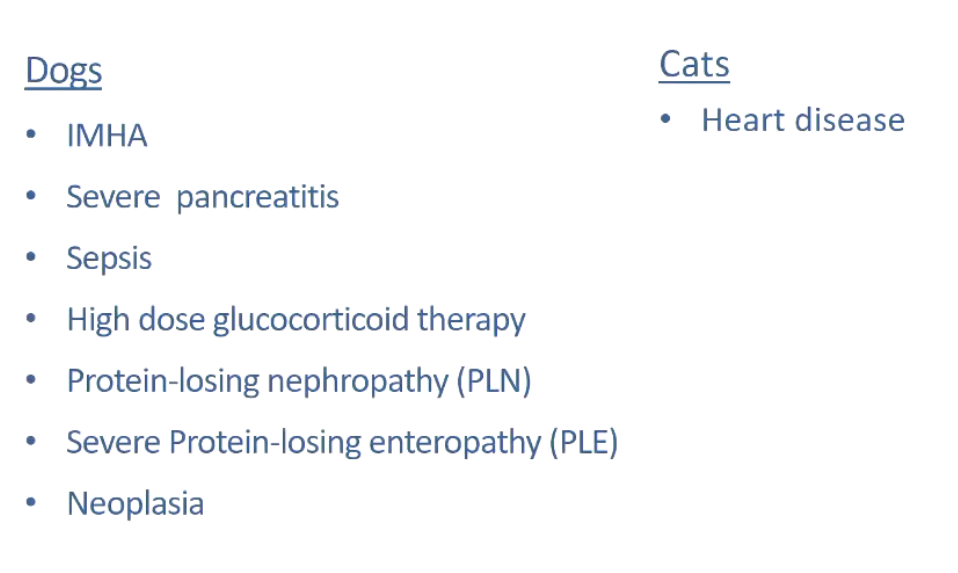
Which patients or populations (In Cats and Dogs) are most at risk for thrombosis?
Dogs
• ІМНА
Due to inflammation and agglutination of the RBCs
• Severe pancreatitis
• Sepsis
• High dose glucocorticoid therapy
Used with dogs which have IMHA and cushing syndrome
• Protein-losing nephropathy (PLN)
• Severe Protein-losing enteropathy (PLE)
• Neoplasia
Cats
• Heart disease (HCM)
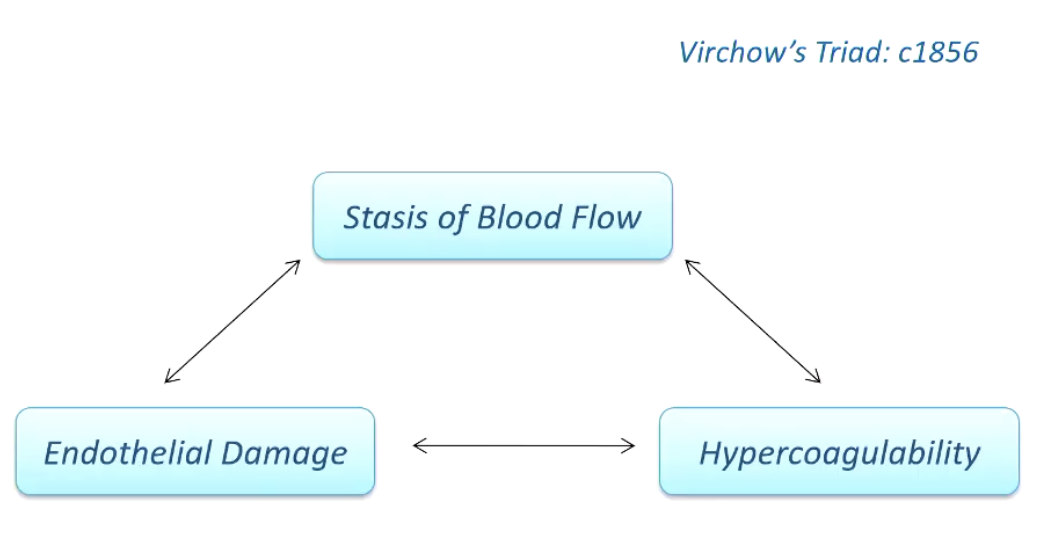
Reminder: What factors contribute to the development of thrombosis?
IMHA - agglutination of RBCs, hyper coagulability - damaged the endothelium which disrupts blood flow leading to clots
How can we measure if a patient has hyper coagulability?
TEG analyzers - evaluation of hemostasis, evaluates whole blood clotting information
Information about speed of clot formation, integrity of the clot, strength of the clot, and how quickly it undergoes fibrinolysis

In what ways does thrombosis manifest clinically?
• Pulmonary Thromboembolism
Respiratory distress - most common presentation
• Arterial Thrombosis - most common in cats, can be seen acutely in cats or chronic in dogs (Hindlimb weakness - determine by pulse strength and temperature difference)
Aortic thrombosis/thromboembolism
Ischaemic Brain Injury - clot in the brain = acute neurological event
• Venous Thrombosis
Portal Vein Thrombosis - can see due to liver disease, portal hypertension, oedema, ascities, or shunts
Splenic Vein Thrombosis
When presented with a patient which has a thrombus, what questions do we need to ask?
• Investigation of underlying disease process
Can we resolve that condition and will likelihood of thrombosis occurance decrease?
Screen for hyper coagulable diseases
• Management of acute thrombotic event
Prevent further thrombotic events
Prevent extension of the clot
Reliant on natural fibrinolytic pathways and adaptation (e.g. collateral blood flow) to alleviate clinical signs
• Chronic anti-thrombotic therapy
What conditions are associated with thrombosis?
**Common to find no overt cause - but still look for it

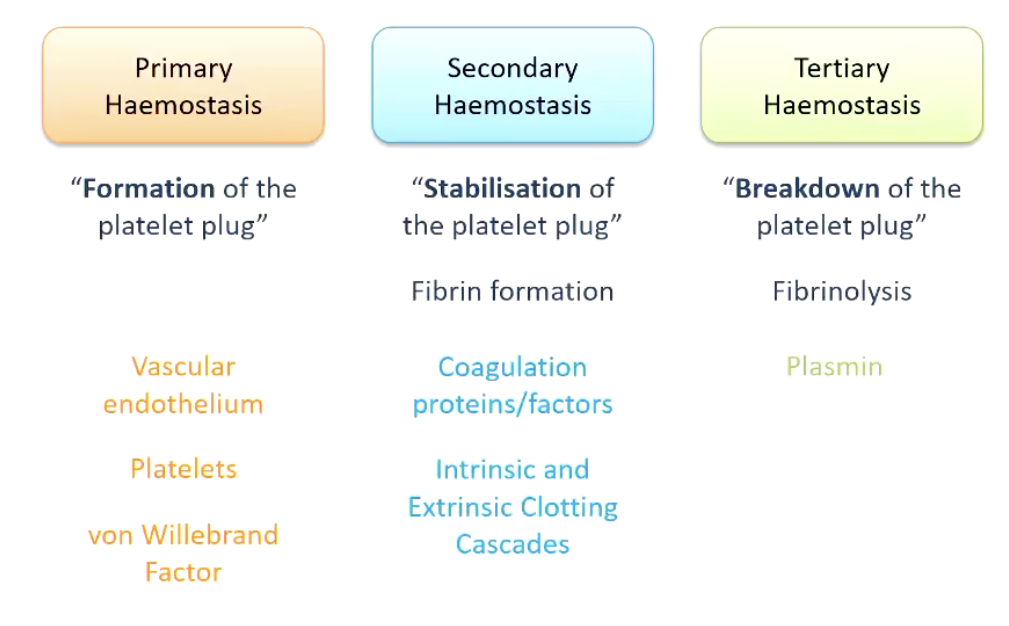
Reminder: What are the three stages of clotting and the factors associated?
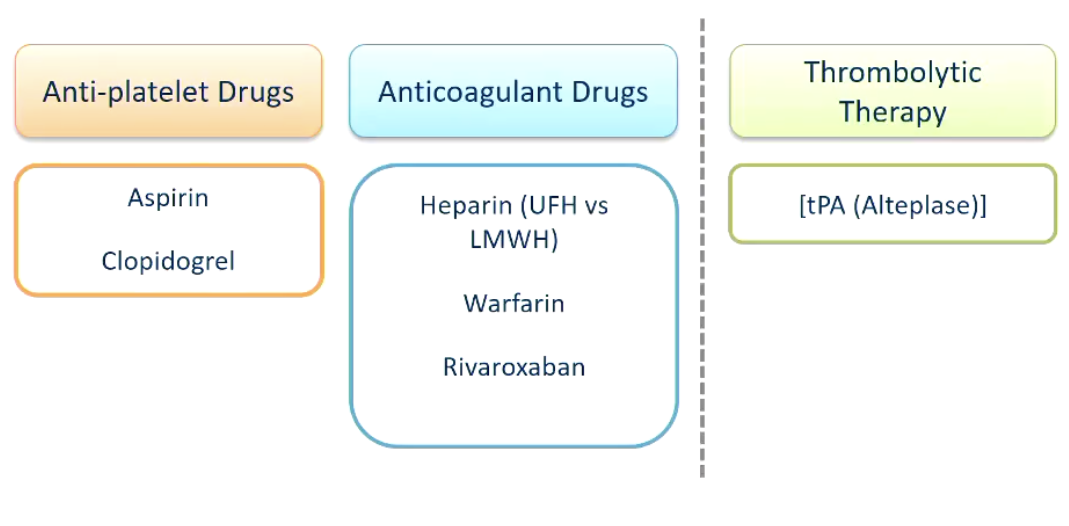
What drugs target each stage of clot formation?
Describe the main features of Aspirin - used for anti-platelet therapy.
* Irreversible inhibitor of PLT COX-1- Inhibits production of PLT TXA, and thus inhibits platelet aggregation
* Various dose recommendations in dogs ranging from 0.5mg/kg q 24hrs ("ultra low-dose") to 15mg/kg q 24 hours
• Efficacy in experimental models
• Potential for GI side-effects at higher doses
• Up to 40% of humans are refractory to ASA therapy

Describe the main features of Clopidogrel - used for anti-platelet therapy.
• Pro-drug activated by CYP enzymes in the liver
• Selectively inhibits binding of ADP to its PLT P2Y 12 receptor thereby inhibiting platelet aggregation
• Various dose recommendations, including loading doses* followed by more long-term, chronic doses
• Non-responders also reported
• Alternative PLT activation pathways
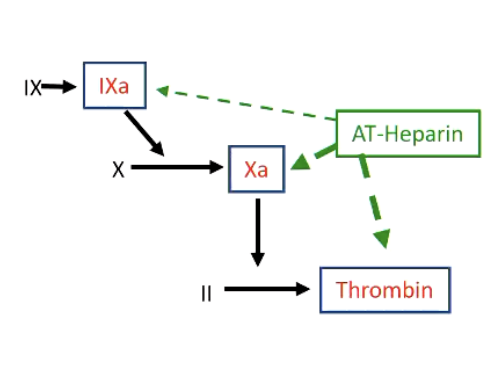
Describe the main features of Unfractionated Heparin- used for anticoagulant therapy.
• Unfractionated Heparin (UFH)
> Potentiates or enhances the anticoagulant properties of antithrombin
• Mainly inhibits FXa and Flla
* IV or SQ protocols e.g. 150-300U/kg SQ q 6 hours in dogs
Unpredictable biological effects therefore TDM recommended
TDM advisable: target extension of aPTT by 1.5 - 2.5 times baseline
Monitoring Treatment: Looking at APPT - aiming for prolongation
Describe the main features of Low Molecular Weight Heparin- used for anticoagulant therapy.
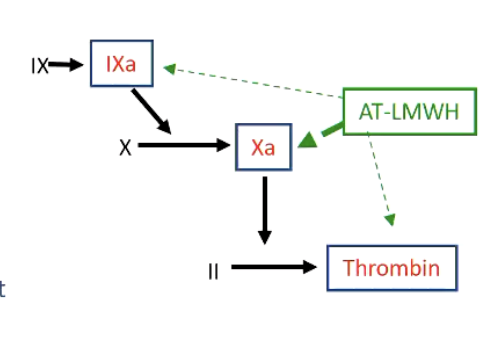
• Low Molecular Weight Heparin
> Dalteparin (Fragmin) or Enoxaparin
> Smaller size means that is has greater selectivity for inhibition of FXa
• More predictable bioavailability & pharmacokinetics
> Administered by SQ injection q 6-8 hours
• More difficult to monitor anticoagulant effect as anti-FXa assay not widely available
Monitoring Treatment: not as easy to do
Describe the main features of Warfarin used for anticoagulant therapy.
• Vitamin-K antagonist (FII, VII, IX, X)
• Also inhibits Vit-K dependent anticoagulant proteins C and S: concurrent heparinization required initially
* Narrow therapeutic index & variable bioavailability
Use not recommended in dogs or cats: CURATIVE (Domain 3)
TDM with target prolongation of PT by 1.5 -2.0 times baseline (or PTINR of 2 - 3)
NO LONGER RECOMMENDED IN DOGS OR CATS
Describe the main features of Rivaroxaban used for anticoagulant therapy.

What factors influence the therapeutic of choice for thrombotic events?
Factors influencing therapeutic choice:
• High risk of more thrombotic events
• Proximity to renal artery
• No identifiable predisposing condition
Consider if short term or long term treatments are needed which are guided by the predisposing condition if you can find one.
• Anti-platelet drug(s) or anticoagulant(s)?
• Single vs dual-platelet therapy?
• Single vs dual pathway inhibition?
• Route of administration: parenteral vs oral?
• Starting dose?
Describe the cell based model of coagulation.

How do we monitor the efficacy of therapy?
• Platelet function analysis
• Rivaroxaban-standardized anti-FXa assay
• Thrombin-generation assay
In practice
• Buccal Mucosal Bleeding Time
• Prothrombin Time
What diseases require thromboprophylaxis?
Difficult to know risk for the individual patient.

What is the risk of thrombosis in PLN (Protein-Losing Nephropathy)?
> 89% were hypercoagulable.
* Hypercoagulability could not be predicted based on
Degree of proteinuria
Hypertension
Albumin
Low AT activity
> 7% developed thrombosis
**Majority - prescribe anti-thrombotic therapy/prophylaxis
What do the CURATIVE Guidelines say about conditions defined as HIGH RISK?
• Conditions defined as HIGH RISK
Dogs with IMHA and PLN
Cats with cardiomyopathy and associated risk factors (left atrial dilation, spontaneous echocontrast)
Dogs or Cats with › 1 disease or risk factor for TE (e.g. pancreatitis with sepsis
Routine prophylactic anti-thrombotic therapy recommended for dogs with IMHA and PLN
In other hypercoagulable conditions, other risk factors should be taken into consideration when deciding whether to institute therapy
IV catheterisation
Prolonged recumbency
Prothrombotic medications e.g. glucocorticoids
Recent surgery