Gross Anatomy of the Brain and Cranial Nerves
 Call Kai
 Learn
 Practice Test
 Spaced Repetition
 Match
 Flashcards
 Knowt Play
1/72

There's no tags or description
Looks like no tags are added yet.
73 Terms
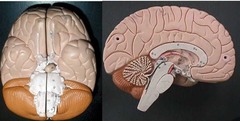
frontal lobe
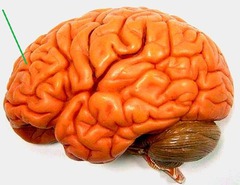
parietal lobe

temporal lobe

occipital lobe

gyrus
*the gyrus before the central sulcus is the precentral gyrus and the gyrus closer to the occipital lobe (behind the central sulcus) is the postcentral gyrus
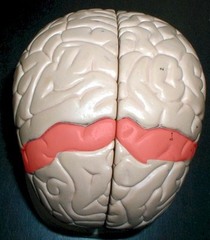
sulcus
(the line/fold/furrow thingy)

cerebellum

medulla oblongata

pons

cerebral aqueduct

cerebral peduncle

choroid plexus

corpora quadrigemina

corpus callosum

fornix

fourth ventricle

hypothalamus

intermediate mass

mammillary bodies

optic chiasma

pineal gland

pituitary gland

septum pellucidem

thalamus

In which cerebral lobe is the auditory cortex located?
temporal
In which cerebral lobe is the primary motor cortex located?
frontal
In which cerebral lobe is the primary sensory located?
parietal
In which cerebral lobe is the olfactory cortex located?
frontal
In which cerebral lobe is the visual located?
occipital
In which cerebral lobe is Broca's area located?
frontal
What does Broca's area do?
controls speech
Which of the following structures re not part of the brain stem?
central hemispheres
pons
midbrain
cerebellum
medulla
diencephalon
central hemispheres, midbrain, and diencephalon
function of hypothalamus?
the site of regulation of body temp and water balance (the most important autonomic center?)
Function of the cerebral hemisphere?
regulates consciousness
Function of the corpora quadrigemina?
located in the midbrain; contains reflex centers for vision and audition
Function of the cerebellum?
Responsible for regulation of posture and coordination of complex muscular movements
Function of the thalamus?
Important synapse site for afferent fibers traveling to the sensory cortex
Function of the medulla oblongata?
Contains autonomic centers regulating blood pressure. heart rate, and respiratory rhythm, as well as coughing, sneezing, and swallowing centers
Function of the corpus callosum?
large commissure connecting the cerebral hemispheres
What is the function of the fornix?
it is a fiber tract involved with olfaction (smell)
What is the function of the cerebral aqueduct?
it connects the 3rd and 4th ventricles
What is the function of the thalamus?
it encloses the 3rd ventricle
Where are the diencephalon, thalamus, optic chiasma, and hypothalamus located?
the forebrain
Where are the medulla oblongata, the pons, and the cerebellum located?
the hindbrain
Where are the cerebral hemispheres located?
the forebrain
Why is the left side of the body paralyzed when there is a brain hemorrhage in the region of the right internal capsule, as opposed to the right side?
most of the motor fibers cross over to the opposite side of the brain at the level of the medulla oblongata
Why is trauma to the base of the brain often more dangerous than trauma to the frontal lobes?
Trauma to the base could damage the medulla oblongata, which contains autonomic centers for regulating respiratory, cardiac, and vasomotor systems. The reticular activating system, which regulates consciousness, is also located in the brain stem.
In split brain experiments, the main commissure, the ___________ ____________ is cut.
corpus callosum
What happens when the corpus callosum is is cut in split brain experiments?
the disconnection of verbal naming and mathematical functions from the left side from spatial recognitions of the right side (connecting names to faces). Dreaming and speech can also be affected and left side paralysis can be evident. Coordination is lessened.
dura mater
outermost meninx covering the brain; composed of tough fibrous connective tissue, its outer layer forms the periosteum of the skull
pia mater
innermost meninx covering the brain; delicate and highly vascular
arachnoid villi
structures instrumental in returning cerebrospinal fluid to the venous blood in the dural sinuses
choroid plexus
structure that forms the cerebrospinal fluid
arachnoid mater
middle meninx; like a cobweb in structure
falx cerebri
a dural fold that attached the cerebrum to the crista galli of the skull
tentorium cerebelli
a dural fold separating the cerebrum from the cerebellum
later ventricle

interventricular foramen

third ventricle

fourth ventricle

lateral aperture

cerebrospinal fluid flows from the 4th ventricle into the central canal of the spinal chord and the 1. ___________ space surrounds the brain and spinal chord. From this space it drains through the 2. _______ _________ into the ________ _______
1. subarachnoid
2. arachnoid villi
3. dural sinuses
olfactory bulbs
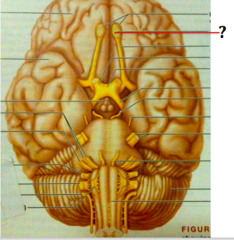
olfactory tracts

optic nerves

infundibulum

epithalamus

pineal body
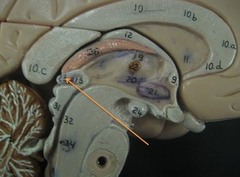
midbrain

cerebral peduncles
corpora quadrigemina

colliculi
`

arbor vitae
