AP Human Geography Unit 2 Review
 Call Kai
 Learn
 Practice Test
 Spaced Repetition
 Match
 Flashcards
 Knowt Play
1/116

There's no tags or description
Looks like no tags are added yet.
117 Terms
What is population distribution?
The pattern in which humans are spread out on Earth's surface
Where are people not likely to settle?
in the 5 too's: too hot, too cold, too wet, too dry, or too hilly
Where are people likely to settle?
low elevation, fertile soil, temperate climates, near a body of water-also economic, social, and political factors affect settlement
What are population clusters?
heavily populated areas that illustrate the unevenness in global population distribution
What are the four population clusters?
East Asia, South Asia, Southeast Asia, Europe
What are metacities?
cities with more than 20 million residents
What are megacities?
cities with more than 10 million residents
What are the ten most populous countries in order as of 2022?
China, India, United States, Indonesia, Pakistan, Nigeria, Brazil, Bangladesh, Russia, Mexico
What are the ten most populous countries in order estimated to be in 2050?
India, China, United States, Nigeria, Pakistan, Indonesia, Brazil, Democratic Republic of the Congo, Ethiopia, Bangladesh
What are developed countries?
countries with advanced economics and high standards of living
What are developing countries?
countries that are of relatively poor income or economically poorer than developed countries
What is the Snow Belt?
states located in the northern and midwestern parts of the U.S.
What is the Sun Belt?
states in the coastal areas and the South and Southwest of the U.S.
What factors affect population?
Physical factors (elevation and bodies of water), climate, culture, economic development, and disease
How do physical factors, such as elevation and bodies of water, affect population?
Humans prefer lower elevations for living to avoid colder weather in the middle and higher latitudes and to escape heat in the tropics. Humans live near the sea to take advantage of trade and fishing, and avoid climatic extremes.
How does climate affect population?
Humans tend to avoid places of extreme climate. For example, extreme cold or desert areas.
How does culture affect population?
Living in crowded settlements may have a deep root in nature and culture. Different cultures have different perceptions of the physical environment and where they should settle.
How does economic development affect population?
As technology increases, more jobs can open up in places that were invaluable before and many people may move there for jobs. For example, coal areas.
How does disease affect population?
Populations can thin out because of a fatal disease. Also, necessary animals may have an infectious disease, so people may move to another area.
What are the methods for calculating population density?
Arithmetic (crude) density, physiological density, and agricultural density.
What is Arithmetic (crude) Density?
The total number of people per unit of land area (usually per square mile or kilometer); shows all lands equal, even when nobody lives; total population/total land area (sq. mi)
What is physiological density?
The average number of people per unit area (a square mile of kilometer) of arable land; reveals food insecurities and how much pressure people place on land; total population/arable land (sq. mi)
What is agricultural density?
The number of farmers per unit of arable land; reveals mechanization levels; farmers/arable land (sq. mi)
What are the consequences of population distribution and density?
can affect economic development, political power distribution, the environment, and human health and vulnerability to natural disasters
What is age structure?
the breakdown of a population into different age groups or cohorts
What is a dependent?
A person who relies on the working-age people for support
What is a dependency ratio?
The number of dependents in the population that every 100 working-age people (ages 15 to 64 years) must support
What is youth dependency ratio?
The number of young dependents (younger than 15 years) in a population that 100 working age people must support
What is elderly dependency ratio?
The number of elderly dependents (older than 64 years) in a population that 100 working age people must support
What are the 5 different dependency categories?
High child dependency, moderate child dependency, double dependency, high elderly dependency, low overall dependency
What are the 5 most recognized generational groups?
Silent Generation/Greatest Generation, Baby Boomers, Generation X, Millennials, and Generation Z (zennials)
Give the dates and major population characteristics of the silent generation/greatest generation.
Consist of people born between 1928 and 1945 (end of WWII); politically cautious; lived through great depression and WWII; "waste not, want not"; relatively small
Give the dates and major population characteristics of the Baby Boomers
Born from 1946 to 1964 during the post WWII uptick in birth rate; huge generation (69 million in 2022); re-shaped lifestyles and social norms
Give the dates and major population characteristics of Generation X
People born between 1965 and 1980; in prime working years now; tolerant of cultural, religious, and ethnic differences; 65 million as of 2022; will outnumber baby boomers in 2028
Give the dates and major population characteristics of Millennials
People born between 1981 and 1996; a.k.a. generation Y; 72 million members-largest generation in US; more diverse; best educated; financial crisis, including great recession; "American dream"; grew up with Internet and smartphones
Give the dates and major population characteristics of Generation Z (zennials)
People born between 1997 and 2012; current high-schoolers; COVID-19 pandemic experiencers/online school; worst educated generation; even more diverse ethnically and racially; "digital natives"
Give the dates and major population characteristics of Generation Alpha
People born after 2012; too early to determine traits
How might gender ratios become unbalanced?
war, insufficient healthcare for women, migration, gendercide/gender-selective abortions (gvt. policies), women live longer than men
What are two examples of Androcentrism?
In both India and China, male babies are strongly preferred, and in China, newly married women traditionally would move into their in-law's house. Also, in both countries, female specific abortions or infanticide, neglect, and inadequate nutrition of girls are some practices.
What are some characteristics of a rapid growth population pyramid?
Occurs in developing countries; high birth rates and large young population; people live shorter; problem of educating the young and creating jobs; momentum for future growth.

What are some characteristics of a slow growth population pyramid?
Birth rate is just over death rate; challenge of meeting healthcare needs of elderly; population gradually aging

What are some characteristics of a stability population pyramid?
Countries population is stable; birth rate and death rate are similar; fairly even distribution across all cohorts; male side narrower than women side due to women living longer

What are some characteristics of a decline population pyramid?
Low birth rate; countries experiencing population aging, labor shortage, or declining demands for consumer goods and services.
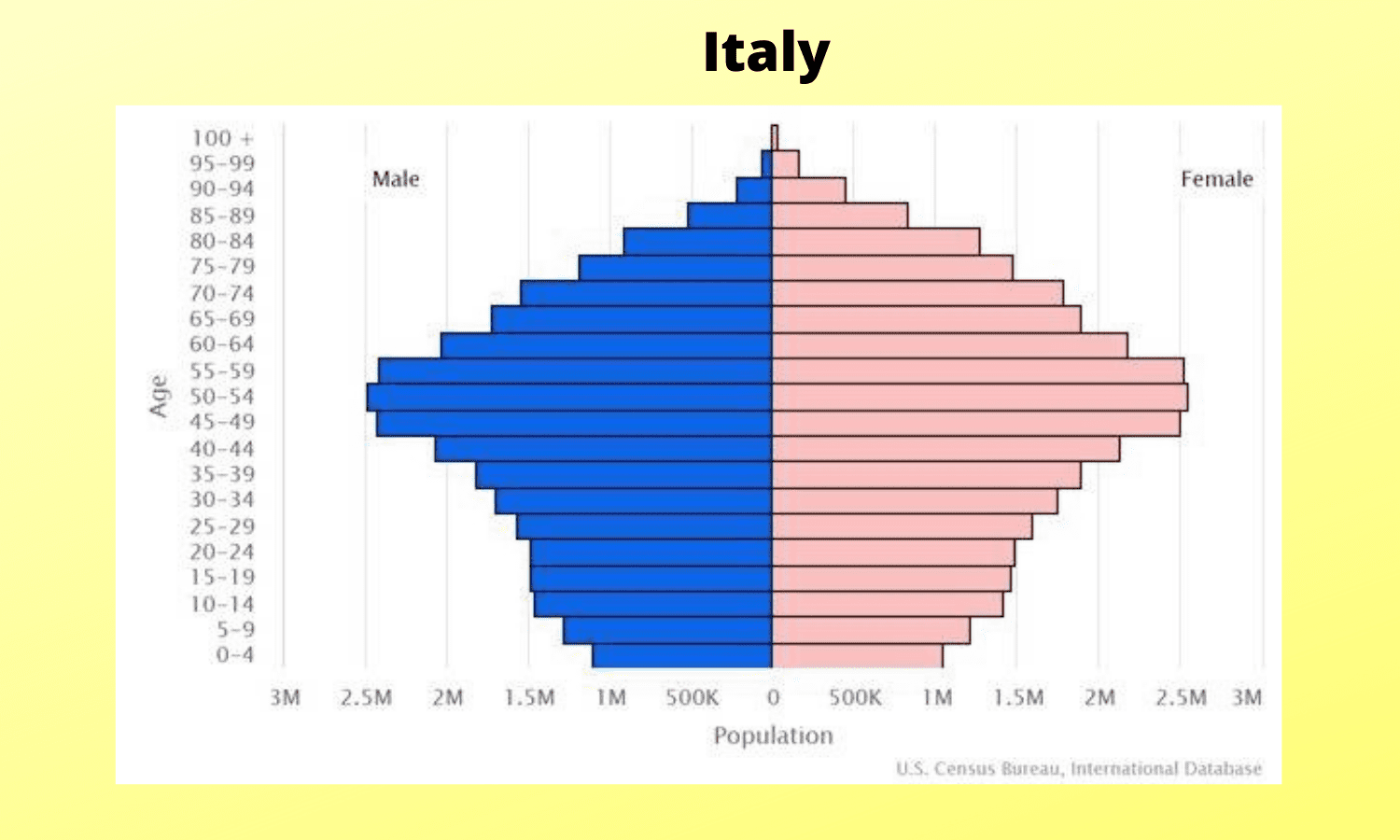
What can you learn from a population pyramid?
dependency ratio, fertility, mortality, gender balance, population projections, and growth or decline
How has the Earth's population grown over time?
It remained small for a long time, but grew exponentially after the Industrial Revolution; expected to reach around 9.7 billion by 2050 and 110.4 billion by 2100 from today's just over 8 billion; much of this growth will occur in developing countries, especially sub-Saharan African Countries
How is natural increase of a population found?
(Crude Birth Rate-Crude Death Rate)÷10
What is Crude Birth Rate?
The average number of births per 1000 people
What is Crude Death Rate?
The number of deaths per year per 1000 people
What is total fertility rate?
the average number of children born per woman during her reproductive lifetime, considered to be from 15 to 49 years of age
Which is more accurate CBR or TFR? Why?
Total fertility rate because it is more specific and reveals child having encouragements or discouragements in an area
What are the factors affecting fertility rates?
Economic development, religious and cultural influences, education and women's employment, gender roles, and population policies
How has economic development affected fertility rates?
Fertility rates are lower in developed countries than in developing countries because of the need for farm labor in developing countries and developed countries have access to birth control.
How has religious and cultural influences affected fertility rates?
Some religions, such as Catholicism and Islam, encourage large families and ban artificial birth control. Confucianism also encourages large families because it sees the ideal as multiple generations living under one roof.
How has education and women's employment affected fertility rates?
Women working out of the home is reducing fertility rates; "more books, fewer babies"; challenges such as a work-life balance and expenses for reaching a child discourage women from having many children.
How have gender roles affected fertility rates?
In many cultures, men and women are seen as more masculine/feminine when they parent more children.
How have population policies affected fertility rates?
Some governments try to curtail population growth either by having strict birth control policies, or by offering financial incentives and longer maternity leaves to boost fertility rates.
What are death spiral demographics?
This means that a country's population is shrinking rapidly due to low birth rates
What is replacement level fertility?
The average number of children needed to replace both parents and stabilize population over time
What is the total fertility rate that is at replacement level?
2.1
What is infant mortality rate (IMR)?
the number of how many infants die within the first year of their life per 1000 live births
What is the Rate of Natural Increase (RNI)?
The difference between the number of births and deaths in a given year, when expressed as a percentage of total population.
What is the difference between RNI and population growth?
RNI only takes into account births and deaths in the country, but population growth includes emigration and immigration
What is zero population growth?
when a country has the same number of births and deaths in a given year; its RNI is zero
How do birth and death rates change over time?
the DTM shows that countries will change from a situation where birth and death rates are both high to a situation where both rates are low as the countries modernize.
What is the Demographic Transition Model (DTM)?
a model that conceptualizes of CBR and CDR as well as the resulting RNI change over time as countries go through industrialization and urbanization
Depict the DTM.
--->

What are the 5 stages of the DTM?
High Stationary Stage, Early Expanding Stage, Late Expanding Stage, Low Stationary Stage, and Natural Decrease (Declining) Stage
What is happening in the High Stationary Stage (Stage 1) of the DTM? Also include the social situation, economic situation, demographic trends, and population pyramid relating to this stage.
CBR and CDR are both high before transition starts; slow population growth; ss: hunters and gatherers; es: relying on agriculture; dt: large youth population; pp: wide base, narrow top
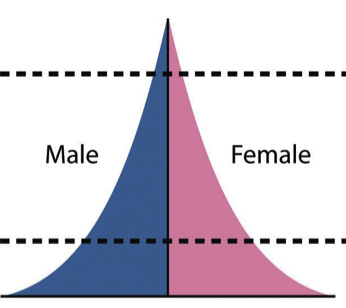
What is happening in the Early Expanding Stage (Stage 2) of the DTM? Also include the social situation, economic situation, demographic trends, and population pyramid relating to this stage.
CDR drops rapidly and there is rapid population growth; ss: more pressure on the work force to provide; es: largely agricultural; dt: large youth population compared to elderly and working age; pp: wide base, symmetrical

What is happening in the Late Expanding Stage (Stage 3) of the DTM? Also include the social situation, economic situation, demographic trends, and population pyramid relating to this stage.
CBR declines as well as RNI; ss: moving from farms to cities, urbanizing; es: decreased dependency ratio, more focus on economic development, economic growth; dt: working age people (ages 15-64) population is greater then elderly and youth, still many young people; pp: wider middle, still wide base, people surviving longer

What is happening in the Low Stationary Stage (Stage 4) of the DTM? Also include the social situation, economic situation, demographic trends, and population pyramid relating to this stage.
CBR and CDR are similar but at lower levels; population grows slowly; amount of people 65+ increases; ss: highly developed; es: elderly dependency, urbanized; dt: elderly population increases; pp: low growth, more even throughout, balanced throughout ages

What is happening in the Declining Stage (Stage 5) of the DTM? Also include the social situation, economic situation, demographic trends, and population pyramid relating to this stage.
additional stage for rich, industrialized countries; CBR is persistently lower than CDR; natural decrease of population over time; ss: highly developed; es: highly developed, urbanized; dt: large elderly population; pp: top heavy pyramid

Does the DTM still apply today?
The DTM is based on the historical experience of northern European countries. The situation in today's developing countries may not fit the model closely.
Why might there be a high Crude Birth Rate in a country?
need for child labor, possibly on farms
Why might there be a high Crude Death Rate in a country?
famine, disease, etc.
Why might there be a low Crude Birth Rate in a country?
urbanization may take away some of the need for child labor
Why might there be a low Crude Death Rate in a country?
advancements in technology, healthcare, and medicine
What is the Epidemiological Transition Model (ETM)?
a model that seeks to explain how changes in health services and living standards affect patterns of disease
What are the 5 stages of the ETM?
The Age of Pestilence and Famine, The Age of Receding Pandemics, The Age of Degenerative and Human-Made Diseases, Age of Delayed Degenerative Diseases, and The Reemergence of Infectious Diseases
What is happening in The Age of Pestilence and Famine (Stage 1) of the ETM?
Infectious diseases such as Cholera and Tuberculosis; Pandemics and Epidemics; Animal attacks and accidents; malnutrition
What is happening in The Age of Receding Pandemics (Stage 2) of the ETM?
Pandemics and Infectious diseases decline due to new medical advances, sanitation, and improved nutrition
What is happening in The Age of Degenerative and Human-Made Diseases (Stage 3) of the ETM?
Diseases associated with aging and lifestyle choices. Ex. Heart Disease, Cancer
What is happening in Age of Delayed Degenerative Diseases (Stage 4) of the ETM?
Diseases associated with aging and lifestyle choices can be delayed with medical advancements. Ex. Dementia, Alzheimer's
What is happening in The Reemergence of Infectious Diseases (Stage 5) of the ETM?
Bacteria and parasites become resistant to antibiotics and vaccines. Ex. Ebola, Covid-19
What is the Malthusian Theory of population?
he believed that while population is growing exponentially, food output is only growing arithmetically, so the Earth would eventually not be able to support the population growth spurred by the Industrial Revolution

Who are cornucopians?
people who reject the Malthusian view of population and resources
What are some criticisms of the Mathusian Theory?
there are factors that slow population growth: contraceptives, women's advancement in education; there are factors that increase farming efficiency: mechanized farming, hybrid seeds, chemical fertilizers; there are new technologies and inventions: refrigeration in trucks, tin cans preserve food, efficient and healthy food delivery
Who are Neo-Mathusians?
People who still continue to believe that the Earth will reach its maximum carrying capacity soon; believe that there is a strain on natural resources and overconsumption
What is the carrying capacity of the Earth?
estimates range from 500 million to over a trillion; difficult to determine because it is affected by factors such as natural resources, standards of living, and technology
What are anti-natalist policies and some examples?
policies designed to curtail population growth by reducing fertility rates; China: "one couple, one child", gvt. put in place incentives such as free contraceptives, free paternal care, paid maternity leave, and monetary rewards, and penalties such as fines and demotions; India: emphasized health care, education for girls, and nutrition, but forced people into sterilization
What are pro-natalist policies and some examples?
policies designed to boost fertility rates and ultimately population growth; Russia: increased child care benefits and length of maternity leave, "Day of Conception" with awards , "Mother Heroine" award for mothers with 10+ children, $16,500 gifted when 10th child turns 1; Denmark: "Do it for Denmark" campaign
What is the concept of women's status?
the degree of equality between men and women with respect to access to and control over both physical and social resources in the family, community, or society at large
How does women's status affect fertility, mortality rates, and migration?
less fertility because of staying in school longer, having access to family planning, and delayed marriage because of economic participation; lowers child and mother mortality rates because women are more educated on nutrients and hygiene; in some countries, men migrate and women stay, but in others, women migrate for better jobs and send money home
What are the measures of population aging in the world?
Median Age: the age that divides a population into two halves so that one have is younger and the other is older; Percentage of People Who are at Least 65 Years Old: proportion or number of elderly people in a population
What are the trends of population aging in the world?
developed countries are usually super-aged (elderly people make up more than 20% of population); in most developing countries less than 10% of population in 65+, but will age in the next three decades; rural populations are usually much older than urban areas
What are the causes/consequences of population aging?
causes: low fertility rates, longer life expectancies, and age-selective migration; consequences: labor force shortage, rising elderly dependency ration, a changing economy, and population decline
Can countries adapt to aging populations?
yes by boosting fertility, coping with labor shortage with guest workers or robots, and by adapting to aging society with improvements in social safety net, training more doctors for elderly, and making accessible infrastructure
Describe migration.
the long-term or permanent relocation of individuals, families, or entire communities from one place to another
Depict Lee's Model of Migration
---->

What is the difference between in, out, and net migration
In-migration (immigration): the act of a migrant arriving at their destination country; Out-migration (emigration): the act of a migrant leaving their place (country) of origin; net migration: the difference between the number of immigrants and emigrants