Midterm Exam - Human Development
 Call Kai
 Learn
 Practice Test
 Spaced Repetition
 Match
 Flashcards
 Knowt Play
1/250

There's no tags or description
Looks like no tags are added yet.
251 Terms
Prenatal Period
conception until birth
when a tremendous amount of rapid growth and organ development takes place
infancy
birth to 2 years
encompassing significant gains in sensorimotor and cognitive development.
Toddlerhood
2-3 years
further develop their language skills and begin mastering such tasks as potty training and feeding and dressing themselves.
early childhood
3-6 years
refine their gross and fine motor skills and make gains in independence, self-control, language, and memory
middle childhood
6-12 years
think more logically and concretely in the structured educational environment they now inhabit.
They experience incredible gains in language and learning.
Peer relationships increase in importance
adolescence
12-19 years
experience substantial changes, including puberty, the capacity to think abstractly, and the search for identity
Mental disorders often begin in adolescence.
early adolescence - (about 12 to 14 years)
middle adolescence (about 15 to 18 years)
later adolescence (about 19 to 22 years)
young adulthood
19-30 years
individuals face the challenges of establishing a career and seeking out intimate relationships
Often the end of young adulthood is marked by marriage and starting a family
middle adulthood
longest, 30-60 years
many adults either experience career success or reeval-uate and change their careers
Family obligations are extremely important for those who choose to have children
the responsibility of caring for both children and aging parents may be stressful.
late adulthood
60-75 years
most individuals are nearing the end of their career and are launching children, if they have not already done so.
These substantial life changes may cause individuals in late adulthood to reflect on their lives and the impact they have made.
old age
75+ years
face challenges such as retirement and loss of a spouse. As physical health and cognitive abilities gradually decline
the support of close relationships and the search for life’s meaning become quite important
discontinuous development
believe that children go through relatively stable periods of development that culminate in abrupt transformations as they transition to the next stage of functioning
progress through them in a fixed order
long plateaus in growth followed by dramatic spurts where the child learns and grows a great deal in a short period of time, leaping to the next level of more advanced functioning

continuous development
developmental change is continually occurring at a gradual, steady pace
smooth upward progress

continuity-discontinuity
development is characterized by both continuity and discontinuity.
The continuity–discontinuity issue is also related to perceptions of whether or not the personality traits of a young child and the effects of early experiences will persist across time
nature
biological characteristics and predispositions that an individual inherits
heredity, universal maturational processes, biological predispositions, and hormones
nurture
refers to environmental influences and experiences
nteractions among a child’s family members, peers, school, neighborhood, government, and culture, to the internal environment of their genes and cells
nature versus nurture
nature and nurture interacting together. He insists that nature and
nurture must be viewed as unified and continually influencing one another.
intelligence, temperament, and personality are the result of the complicated interaction of biological and environmental forces.
Passive Genotype-Environment Correlation (Scarr and McCartney)
An interaction where biological parents provide both the genetic makeup and the rearing environment that shapes the child's development.
Evocative Genotype-Environment Correlation (Scarr and McCartney)
An interaction where a child's genetically influenced characteristics elicit specific environmental responses from others.
Active Genotype-Environment Correlation (Scarr and McCartney)
An interaction where an individual seeks out and selects environments consistent with their genetic makeup, reinforcing inherent qualities.
gets stronger with age because children are increasingly able to select their own environmental niches
genotype-environment interactions (Scarr and McCartney)
Genes and environments can interact to restrict the range of attribute expression, or they can combine when the genes of children and their parents elicit various environments.
Genes influence, rather than determine, environments.
epigenesis
idea that environments shape our genetic expressions, which in turn further shape our environments.
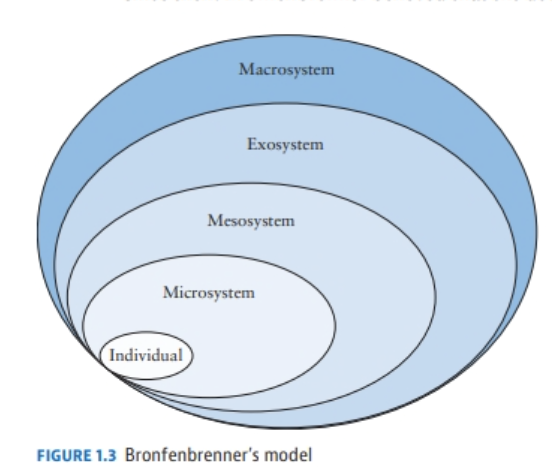
Bronfrenbrenner’s Ecological model of child development
believed that the developing child is continually influenced by the
systems within which the child is embedded
child interact with these various systems, but the systems also
interact with each other to influence the child’s development.an individual child in the center surrounded by concentric circles which increase in size
proximal processes
reciprocal, enduring interactions between the developing child and
environment
Microsystem - Bronfenbrenner
The innermost ecological tier consisting of direct activities, social roles, and interpersonal relations in immediate face-to-face settings.
Mesosystem - Bronfenbrenner
The ecological tier consisting of linkages and relationships between two or more microsystems, such as home and school.
Exosystem - Bronfenbrenner
The ecological level involving settings that the developing child does not experience directly, but which indirectly influence their development.
Macrosystem - Bronfenbrenner
The outermost ecological system encompassing overarching cultural values, beliefs, customs, lifestyles, and societal institutions.
Chronosystem - Bronfenbrenner
The ecological dimension capturing the cumulative effects of time, historical events, and developmental transitions across the lifespan.
Longitudinal Designs
researchers follow one group, or cohort, of participants over an extended period of time in order to repeatedly measure different aspects of development
eliminate sources of individual variability in data collection
researchers can be confident that the changes observed are the result of the passage of time rather than individual differences
cohort - longitudinal
group of individuals born at about the same time who experience similar cultural and historical events as they grow up
Choosing a Longitudinal Design
chart developmental trajectories, which illuminate developmental patterns over time
examine the stability of personality traits or abilities over time
tracking long-term effects of events experienced in early childhood
Pros and Cons - Longitudinal design
designs are by nature extremely time consuming and expensive.
mortality or attrition is a potential problem; that is, researchers may lose participants due to death, relocation, or a loss of interest in such a long-term undertaking.
researcher cannot be sure that the observed changes will generalize to other age cohorts
historical events may affect development and cannot e comparable to other cohorts
Blank Slate - John Locke and Tabula Rasa
we are born without innate ideas and knowledge is determined by experience and perception
Psychoanalytic Theory - Freud Psychosocial
focuses on childhood experiences, characterological change, the unconscious, insight
goal - make unconscious conscious by gaining insight into current patterns with goal of changing personality, resolving underlying conflicts, attaining freedom from past
Personality Structure - Freud Psychosocial
id ego, super ego
people have inherent pathologies, spurred unconscious drives, which they need to address and overcome
id
pleasure and instinct (pleasure principle)
ego
reality and logic (reality principle)
superego
society and morality (morality priniciple)
Psychosexual stages - frued psychosocial
oral (birth-18 months)
anal (18 months - 3 years)
phallic (3-5 years)
latent (5 - puberty)
genital (puberty and on)
Oral (birth -18 months)
pleasure of sucking and eating. Trust and security are major concerns
Anal (18 months - 3 years)
pleasure received from controlling one’s excretory functions
Phallic (3-5 years)
attends to children’s fascination with their genitalia and other bodily functions
electra complex
oedipal complex
electra complex
girls unconsciously yearn for their fathers
oedipus complex
boys unconsciously yearn for their mothers
latent stage (5 - puberty)
calm after torment of previous years
genital stage (puberty and on)
conscious and unconscious behaviors manifest as a result of the culmination of early childhood experiences
Psychosocial Stages - Erik Erikson
people who successfully address these central goals move forward in a healthy and fulfilled manner while those who do not are at risk for remaining stuck or regressing
trust vs mistrust
autonomy vs. shame
initiative vs. guilt
industry vs. inferiority
identity vs. role confusino
intimacy vs. isolation
generativity vs. stagnation
integrity vs. despair
Trust vs. Mistrust - Infancy (Erikson)
Infants develop trust within secure caregiver relationships when their basic needs are met
If physical and emotional needs are not meet, the child may develop a mistrusting attitude toward others.
Autonomy vs. Shame and Doubt - 1-3yrs Toddlerhood (Erikson)
children explore the world and experiment
If parents or caregivers do not promote autonomy, children may lack self-reliance as they develop
initiative vs. guilt - 3-6yrs Preschool (Erikson)
focus is a basic sense of competence
If others monopolize decision-making on behalf of these children, they become guilty and reluctant to make their own decisions.
industry vs. inferiority - 6-12yrs school age (Erikson)
focus is on goal-setting and achievement
Without success at this task, feelings of inadequacy may develop.
identity vs. role confusion - adolscence/puberty (Erikson)
individuals explore limits, boundaries, meaning, identity, and goals
Failure to achieve a coherent identity may yield confusion
intimacy vs. isolation - 18-35 yrs young adulthood (Erikson)
the major task is the development of and security within intimate relationships
Without these, alienation and isolation may persist
Generativity vs. Stagnation - 35-60yrs middle adulthood (Erikson)
focus is on transcending self and family and focusing on the next generation
People in this stage must reconcile differences between their aspirations/dreams and their actual accomplishments
integrity vs. despair - 60+yrs (Erikson)
coming to terms with one’s life
People look back either with a sense of pride and contentment, or perhaps with feelings of failure, guilt, and despair.
Lev Vygotsky
examined social processes occurring around children
Zone of proximal development
scaffolding
private speech
developmental problems occur when external support is insufficient or lacking
Zone of proximal development - Lev Vygotsky
the difference or distance between what children can achieve individually versus what they can achieve with adult guidance and support
Scaffolding - Lev Vygotsky
the process that helps children move from apposition of an inability to complete challenging tasks to a position where they can eventually complete the tasks independently
Private Speech - Lev Vygotsky
when an individual talks aloud to oneself and not to others for the purpose of self-guidance; aids in mental processing of challenging tasks
Ecological Model of Child Development - Uri Brofenbrenner
Individuals do not exist in a vacuum, but in a vast, complex, interwoven net of social structures including families, communities, local and global economies, political organizations, and historical eras.
Different system levels include: microsystem, mesosystem,
exosystem, macrosystem, and chronosystem
ethological Theory
study of the adaptive and evolutionary basis of animal behavior, particularly behaviors of species that promote their survival
species have inborn/instinctual responses shared by all members of that species, and these instincts guide individuals to similar developmental paths
methodology for studying human behaviors and a theory to explain instinctive behavior
attachment theory
an emotional connection with important people in one’s life.
Attachment leads to a sense of security and gives people pleasure as they interact with other people to whom they are attached
Development of Attachment Theory - John Bowlby
The first to apply the concepts of ethology to the infant-caregiver relationship.
While working in a home for maladjusted boys, he observed that disruptions in the mother-child relationship could lead to later child psychopathology
Bowlby’s Attachment Theory
infants are pre-adapted to respond to their caregiver and to exhibit behaviors that enhance the infant’s chances of survival
attachment behavioral theory
sensitive period
attachment behavioral system
cognitive component whereby individuals construct, at the subconscious level, mental representations of the attachment figure, the self, and the environment
Phase 1 - Non-focused responsiveness (Bowlby)
the infants cry, smile, and make eye contact with anyone with
whom they come into contact
Phase 2 - Discriminating Attention (Bowlby)
babies begin to focus their social responsiveness to fewer people
Phase 3 - Proximity-Seeking Behavior (Bowlby)
the attached figure becomes a base for the infant/toddler to explore
Phase 4 - Reciprocal Relationship (Bowlby)
child begins to develop an internal model of the attachment relationship
sensitive period (Bowlby attachment theory)
6 month - 24 months
when attachment relationships will develop more readily
Mary Ainsworth
believes that individuals feel a strong attachment to each other
proximity seeking system engages and individuals and individuals will want to be with the attachment object no matter the cost
The strange situation - Mary Ainsworth
Ainsworth recorded how children responded to their mother and a stranger as each entered and left the room
20 minutes while mother and a stranger left and entered the room
secure attachment - Ainsworth
signs of missing the parent, the child easily separates from the mother and becomes engaged in exploration
When the parent returns, the child greets parent actively and then returns to play
The child demonstrates a clear preference for the mother over the stranger
insecure: Anxious-avoidant attachment - Ainsworth
child does not cry at separation but rather continues to play
When the parent returns, the infant actively avoids and ignores the parent but does not resist the mother’s efforts at contact
The child demonstrates no preference for the mother over the stranger.
insecure: anxious-ambivalent attachment - Ainsworth
child is preoccupied with the parent throughout the procedure
The child demonstrates little exploration and is wary of the stranger
The child both seeks and resists contact with the mother
The child resists both comfort and contact with the stranger.
insecure: disorganized-disoriented attachment - Ainsworth
child appears confused and displays contradictory behaviors in the presence of the parent
For example, the child may cry unexpectedly after having settled down, or display odd postures
social learning theory
learning occurs through observation, imitation, or modeling
attention
retention
reproduction
behavior
reciprocal determinism
mutual relationships between the psychological processes of the individual, the environment, and the behavior
Albert Bandura - Bobo Doll
effects of models of aggression on preschool children’s aggressive behaviors and demonstrated that may be acquired through observational learning
self-efficacy (Bandura)
children receive feedback about their behaviors
they become more selective of their behaviors
they begin to develop beliefs about their capabilities and their ability to influence events that affect their lives.
Social learning perspective - bandura
child develops morals by learning what is and is notaccepted by society and its members
Piaget’s Stages of Development
process of adaptation, or how the human mind constructs knowledge
humans encounter new things (by experiencing them, hearing them, etc.) they
assimilate this new informationaccommodation, more sophisticated cognitive structures formed
sensorimotor (birth-2)
pre-operational (2-7)
concrete operational (7-11)
formal operational (12+)
assimilate
fitting it into the already existing cognitive structures, so that it can be learned and understood in context along with everything else the person already knows
accommodation
new information does affect a person, and the addition of this information may require that more sophisticated cognitive structures be formed and organized
adaptation
Together, assimilation and accommodation
Piaget’s Theory of Moral Development
observing children of various ages engage in games of marbles, and after interviewing the children about concepts such as justice and ethics,
pre-moral
heteronomous morality
autonomous morality
Pre-moral - Piaget Moral Development
children are not concerned with rules and have little to no sense of morality
birth - 4
motor - egocentric - on his own
Heteronomous Morality - Piaget Moral Development
children adopt rules from authorities without question.
5-8
cooperation, follow rules
autonomous morality - Piaget Moral Development
children learn that the rules are set by society, including their peers, in a cooperative fashion
8-12
codification
Kohlberg’s - Theory of Moral Development
developed through moral dilemmas
pre-conventional
conventional
post-conventional
Punishment and obedience orientation - Pre-conventional Level (Kohlberg)
Children obey the rules simply to avoid punishment, and they obey those in power simply because they are in power
instrumental relativist orientation - Pre-conventional Level (kohlberg)
Children obey the rules, but only for self-satisfaction
reward for one person might not be a reward for anothe
interpersonal concordance - conventional level (Kohlberg)
Children or teens seek the approval of society and begin to appreciate good intentions
A sense of caring for humanity emerges, and actions motivated by empathy and caring, rather than individual greed, are valued
Genetics
field of study of how inheritance operates.
Inheritance involves the transmission of genetic characteristics from parents to offspring
cell, smallest, independent
cytoplasm
cellular fluid that prevents the cell wall from collapsing
nucleus
the command or activity center, which houses the chromosomes
nucleoplasm
fluid within the nucleus
protoplasm
bodily fluids, comprising much of the body’s cells
both nucleoplasm and cytoplasm
Ribosomes
small particles in the cytoplasm that help produce products necessary for cellular functions
cellular replication
DNA
Inheritance of genetic information is contained in the form of a double helix of DNA
Adenine (A)
Thymine (T)
Guanine (G)
Cytosine (C)