Physics Exam 4
 Call Kai
 Learn
 Practice Test
 Spaced Repetition
 Match
 Flashcards
 Knowt Play
1/19

There's no tags or description
Looks like no tags are added yet.
20 Terms
An electromagnetic wave is traveling through free space. The amplitudes of the wave’s electric and magnetic fields are E0 and B0 respectively. The wave then passes through a filter that reduces the amplitude of the electric field by half (E0/2). What is the amplitude of the magnetic field after the wave passes through the filter?
B=B0/2
B=B0
B=B0/root(2)
B=B0/2
What is the correct ordering of the bands of the electromagnetic spectrum, from least to greatest, in terms of the wavelengths in the bands?
UV < Visible Light < IR
Radio waves < Microwaves < IR
IR < X Rays < Gamma rays
UV < Visible light < IR
Which of the bands of the electromagnetic spectrum has the highest frequencies?
radio waves
X Rays
Green Light
X-Rays
An electromagnetic wave carries an average energy density u and has an average intensity S. How will the average energy density and intensity of the wave change, if at all, when the amplitude of the magnetic field decreases by half?
u and S both increase by a factor of 2
u and S both increase by a factor of 4
u and S both decrease by a factor of 2
u and S both decrease by a factor of 4
u decreases and S increases
u increases and S decreases
u and S both decrease by a factor of 4
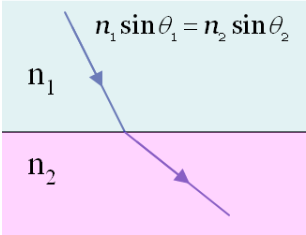
Light traveling through a material with index of refraction n1 refracts as it enters a medium with index of refraction n2, as shown.
Based on the figure, what can be inferred about the index of refraction of the two materials?
n1 > n2
n1 = n2
n1 < n2
n1 > n2
A flash of white light containing all the colors of the visible spectrum in the air shines straight down on the surface of a pool.
Which color of light from the flash reaches the bottom of the pool first?
the blue light
the yellow light
the red light
all colors arrive simultaneously
the red light
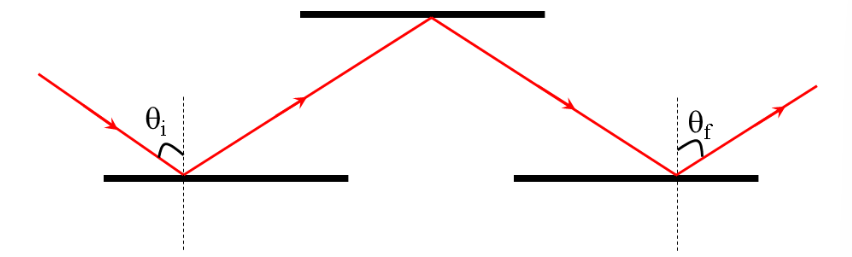
A laser beam is reflected by 3 parallel surfaces, as shown in the figure.
How does the incident angle compare with the angle after the final reflection?
incident = final
incident > final
incident < final
incident = final
A laser beam travels from medium A to medium B.
Which statement could be true as the laser beam enters medium B?
The velocity of propagation of the beam decreases and the wavelength of the beam decreases
The frequency of the beam increases and the wavelength of the beam decrease
The velocity of propagation of the beam decreases and the frequency of the beam decreases
The velocity of propagation of the beam decreases and the wavelength of the beam decreases
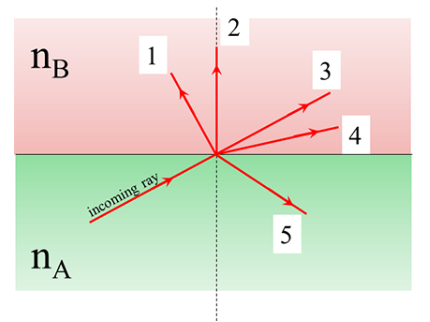
A laser beam travels from medium A to medium B, as shown.
Which statement is true for the rays shown in the figure?
Ray 2 is possible only when nB < nA
Rays 1, 2, and 5 are possible only when nB > nA
Ray 4 is possible only when nB > nA
Ray 3 is possible only when nA = nB
Ray 3 is possible only when nA = nB
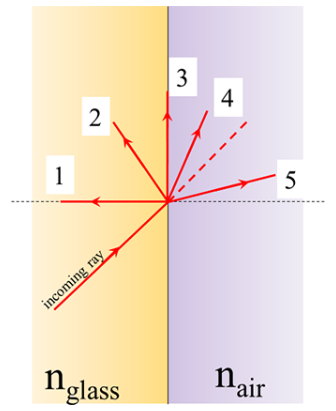
A laser beam traveling through glass is incident upon a boundary with the air . (n glass > n air)
If the incident angle is less than the critical angle for total internal reflection, which ray represents that path the light takes after striking the boundary?
Ray 5
Ray 3
Ray 2
Ray 4
Ray 1
Ray 4
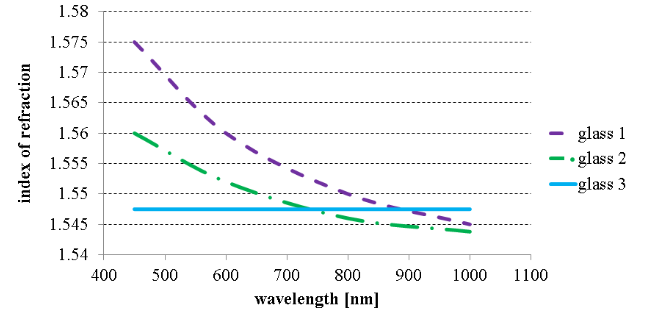
A beam of white light shines at an incident angle of 30 degrees on three separate, rectangular glass slabs. Each glass slab is unique, and the index of refraction for each glass is dependent upon the vacuum wavelength of light, as shown in the plot.
Which type of glass causes the red light to be farthest apart form the blue light when the light leaves the glass?
glass 1
glass 2
glass 3
glass 1
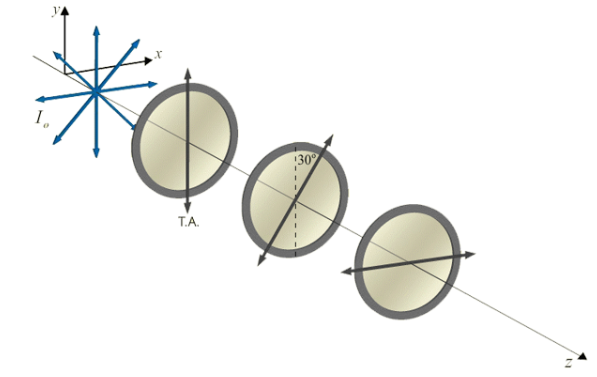
Unpolarized light of intensity I0 is incident on a set of three linear polarizers oriented at 0 degrees, 30 degrees, and 90 degrees with respect to vertical, as shown.
If the middle polarizer is removed, how does I final change?
I final increases
I final remains the same
I final decreases
I final decrease

The photographs in the figure show the diffraction patterns created by red laser light when it passes through narrow, single slits. The wavelength of the light is the same in all three photographs, but the widths of the slits are different.
Order the photographs according to the width of the slit used to create the diffraction patter, from widest to narrowest.
c, b, a
b, c, a
a, c, b
a, b, c
b, c, a
A beam of light of fixed intensity is directed at a linear polarizing filter whose transmission axis is at an angle of 45degree above the positive x-axis
For which incident polarization does the filter reduce light intensity the most
The incident light is polarized parallel to the x-axis
The incident light is unpolarized
The incident light is polarized at an angle of 45degree below the positive x-axis
The incident light is polarized at an angle of 45degree below the positive x-axis
A beam of monochromatic light illuminates a slit of width and forms a diffraction pattern on screen located a distance > w from the slit
For which colour of the incident light is the width of the central band greater?
a) blue
b) yellow
c) both are equal
yellow
When white light shines on a thin film soap, light is reflected from
a) the back surface of the film only
b) both the front and the back surfaces of the film
c) the front surface of the film only
both the front and the back surfaces of the film
Thin Film Interference results in
a) refraction of the reflected light rays
b) interference between the reflected light rays
c) a Doppler shift in frequency of the reflected light
interference between the reflected light rays
Colours are seen in the soap film because certain wavelengths of the reflected light...
a) are absorbed by pigments in the soap
b) are refracted at different angles
c) are cancelled due to the destructive interference
are cancelled due to the destructive interference
A thin later of gasoline floating on water appears brightly covered in sunlight. From where do colours come?
a) interference of light waves reflect from the opposite surfaces of the gasoline film
b) interference of light waves refracted by the opposite surfaces of the gasoline film
c) interference of the various wavelengths of sunlight reflected at the air-gasoline boundary
d) interference of light waves of similar frequencies created by the dispersion of the sunlight by the gasoline
interference of light waves reflect from the opposite surfaces of the gasoline film
A monochromatic light passes through a narrow slit and forms a diffraction pattern on a screen behind the slit.
As slit width increases, the diffraction pattern
a) remains unchanged
b) shrinks with all the fringes getting narrow
c) spreads out with all the fringes getting wider
d) becomes dimmer
shrinks with all the fringes getting narrow