Mutational Investigation of lac operon Induction
 Call Kai
 Learn
 Practice Test
 Spaced Repetition
 Match
 Flashcards
 Knowt Play
1/32

There's no tags or description
Looks like no tags are added yet.
33 Terms
Genotype: P+, O+, Z+, Y+
(lacZ) - non-induced = WHAT
(lacZ) - induced = WHAT
(lacY) - non-induced = WHAT
(lacY) - induced = WHAT
Genotype: P+, O+, Z+, Y+
(lacZ) - non-induced = -
(lacZ) - induced = +
(lacY) - non-induced = -
(lacY) - induced = +

Genotype: P-, O+, Z+, Y+
(lacZ) - non-induced = WHAT
(lacZ) - induced = WHAT
(lacY) - non-induced = WHAT
(lacY) - induced = WHAT
Genotype: P-, O+, Z+, Y+
(lacZ) - non-induced = -
(lacZ) - induced = -
(lacY) - non-induced = -
(lacY) - induced = -

Genotype: P+, O+, Z-, Y+
(lacZ) - non-induced = WHAT
(lacZ) - induced = WHAT
(lacY) - non-induced = WHAT
(lacY) - induced = WHAT
Genotype: P+, O+, Z-, Y+
(lacZ) - non-induced = -
(lacZ) - induced = -
(lacY) - non-induced = -
(lacY) - induced = +

Genotype: P+, O+, Z+, Y-
(lacZ) - non-induced = WHAT
(lacZ) - induced = WHAT
(lacY) - non-induced = WHAT
(lacY) - induced = WHAT
Genotype: P+, O+, Z+, Y-
(lacZ) - non-induced = -
(lacZ) - induced = +
(lacY) - non-induced = -
(lacY) - induced = -

O^c: the WHAT sequences changes so that the repressor cannot WHAT
O^c : the OPERATOR sequences changes so that the repressor cannot BIND
O^c is a WHAT mutation becuase the result is that operon expression is always WHAT
O^c is a CONSTITUTIVE mutation becuase the result is that operon expression is always ON
Genotype: P+, O^c, Z+, Y+
(lacZ) - non-induced = WHAT
(lacZ) - induced = WHAT
(lacY) - non-induced = WHAT
(lacY) - induced = WHAT
Genotype: P+, O^c, Z+, Y+
(lacZ) - non-induced = +
(lacZ) - induced = +
(lacY) - non-induced = +
(lacY) - induced = +

I- makes WHAT inactive therefore it is a WHAT mutation
I- makes REPRESSOR inactive therefore it is a CONSTITUTIVE mutation
Genotype: I-, P+, O+, Z+, Y+
(lacZ) - non-induced = WHAT
(lacZ) - induced = WHAT
(lacY) - non-induced = WHAT
(lacY) - induced = WHAT
Genotype: I-, P+, O+, Z+, Y+
(lacZ) - non-induced = +
(lacZ) - induced = +
(lacY) - non-induced = +
(lacY) - induced = +

I^s superrepressor mutation does not allow for the allosteric effector (inducer) to chnage the WHAT (so not WHAT)
I^s superrepressor mutation does not allow for the allosteric effector (inducer) to chnage the DNA BINDING SITE (so not PROMOTER)
Genotype: I^s, P+, O+, Z+, Y+
(lacZ) - non-induced = WHAT
(lacZ) - induced = WHAT
(lacY) - non-induced = WHAT
(lacY) - induced = WHAT
Genotype: I^s, P+, O+, Z+, Y+
(lacZ) - non-induced = -
(lacZ) - induced = -
(lacY) - non-induced = -
(lacY) - induced = -

Genotype: I^s, P+, O^c, Z+, Y+
(lacZ) - non-induced = WHAT
(lacZ) - induced = WHAT
(lacY) - non-induced = WHAT
(lacY) - induced = WHAT
Genotype: I^s, P+, O^c, Z+, Y+
(lacZ) - non-induced = +
(lacZ) - induced = +
(lacY) - non-induced = +
(lacY) - induced = +
because O^c MASKS the effects of I^s

F’ plasmid
Plasmid containing F factor and genomic DNA

F’ plasmids containing the WHAT can be used to create partially WHAT bacterial cells - diploid for the WHAT
F’ plasmids containing the LAC OPERON can be used to create partially DIPLOID bacterial cells - diploid for the LAC OPERON

Such partially diploid cells are called WHAT
Such partially diploid cells are called MEROZYGOTES
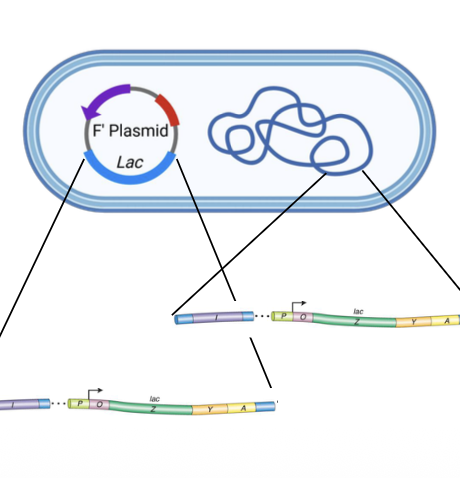
Cis-acting elements
Affects the expression of only proximate genes (genes on the same operon)
Example
DNA sequence elements

Trans-acting elements
Affects the expression of distal genes (genes on same and different chromosomes)
Example
Proteins


Image for genotype
(lacZ) - non-induced = -
(lacZ) - induced = +
(lacY) - non-induced = -
(lacY) - induced = +
Z+ is WHAT over Z- same for (Y)
Z+ is DOMINANT over Z- same for (Y)

Image for genotypes
(lacZ) - non-induced = +
(lacZ) - induced = +
(lacY) - non-induced = -
(lacY) - induced = +
O^C is WHAT-acting
O^C is CIS-acting

Image for genotype
(lacZ) - non-induced = -
(lacZ) - induced = +
(lacY) - non-induced = -
(lacY) - induced = +
I+ is WHAT over I-
I+ os WHAT-acting
I+ is DOMINANT over I-
I+ os TRANS-acting

Image for genotype
(lacZ) - non-induced = -
(lacZ) - induced = -
(lacY) - non-induced = -
(lacY) - induced = -
I^s is WHAT over I+
I^s is WHAT-acting
I^s is DOMINANT over I+
I^s is TRANS-acting
Positive regulation of the lac operon
The presence of glucose WHAT the conversion of ATP to WHAT
Positive regulation of the lac operon
The presence of glucose INHIBITS the conversion of ATP to CYCLIC AMP (cAMP)

Positive regulation of the lac operon
The activator for the lac operon is the WHAT
Positive regulation of the lac operon
The activator for the lac operon is the CATABOLITE ACTIVATOR PROTEIN (CAP)

Positive regulation of the lac operon
cAMP acts as the WHAT for CAP
Positive regulation of the lac operon
cAMP acts as the ALLOSTERIC EFFECTOR for CAP

Positive regulation of the lac operon
The presence of cAMP allows CAP-cAMP to bind to the WHAT and WHAT expression
Positive regulation of the lac operon
The presence of cAMP allows CAP-cAMP to bind to the ACTIVATOR BINDING SITE and ENHANCE expression

Expression of the lac operon under different growth conditions
No lactose = WHAT
Lactose and high glucose = WHAT
Lactose and low glucose = WHAT
Expression of the lac operon under different growth conditions
No lactose = -
Lactose and high glucose = +
Lactose and low glucose = ++


Image for genotype
(lacZ) lactose only = WHAT
(lacZ) lactose and glucose = WHAT
(lacY) lactose only = WHAT
(lacY) lactose and glucose = WHAT
Image for genotype
(lacZ) lactose only = +
(lacZ) lactose and glucose = +
(lacY) lactose only = +
(lacY) lactose and glucose = +

Image for genotype
(lacZ) lactose only = WHAT
(lacZ) lactose and glucose = WHAT
(lacY) lactose only = WHAT
(lacY) lactose and glucose = WHAT
Image for genotype
(lacZ) lactose only = ++
(lacZ) lactose and glucose = +
(lacY) lactose only = ++
(lacY) lactose and glucose = +
