chapter 7: Carbohydrates and the Glycoconjugates of Cell Surfaces
 Call Kai
 Learn
 Practice Test
 Spaced Repetition
 Match
 Flashcards
 Knowt Play
1/34

There's no tags or description
Looks like no tags are added yet.
35 Terms
How Are Carbohydrates Named?
Carbohydrates are hydrates of carbon with the general formula (CH2O)n
Monosaccharides (simple sugars) - cannot be broken down into simpler sugars under mild conditions
Oligosaccharides (oligo = "a few“) - usually 2 to 10 simple sugar residues
Polysaccharides - are polymers of the simple sugars
Carbohydrate Classification

Aldose vs. Ketose
Monosaccharides are either aldoses or ketoses
C3H6O3
ketone- middle C double O
aldone- end C double O (ALl the way to the end)

Carbons Give Naming

Numbering the Carbons
Carbonyl (C=O) gets preference as lowest number

Stereochemistry of sugars
Fischer Projection: linear representation
D=OH to the right L=OH to the left of highest # carbon
ex. D- and L-Forms of a Monosaccharide are Mirror Images


Unique D-Forms of a Monosaccharide are given different names
All distinct monosaccharides with the same #C’s are DIASTEREOMERS
Diastereomers that differ at only 1 chiral center are EPIMERS

Stereochemistry: Putting it together
D,L designation refers to the configuration of the highest-numbered asymmetric center
D,L DO NOT specify the sign of rotation of plane- polarized light
D-sugars predominate in nature
Stereoisomers that are mirror images of each other are enantiomers
Pairs of isomers that have opposite configurations at one or more chiral centers but are NOT mirror images are diastereomers
Two sugars that differ in configuration at only one chiral center are epimers
Cyclic Monosaccharides
Sugars generally cyclize for stability

Hemiacetal and Hemiketal

Formation of Pyranoses
Anomeric carbon: the chiral (formerly achiral) carbon created due sugar cyclization
Anomer: epimeric, cyclic monosaccharide
Note α and β designations. α: points “down” WRT Haworth & trans to C6; β :
points “up” WRT Haworth & cis to C6

Fischer vs. Haworth
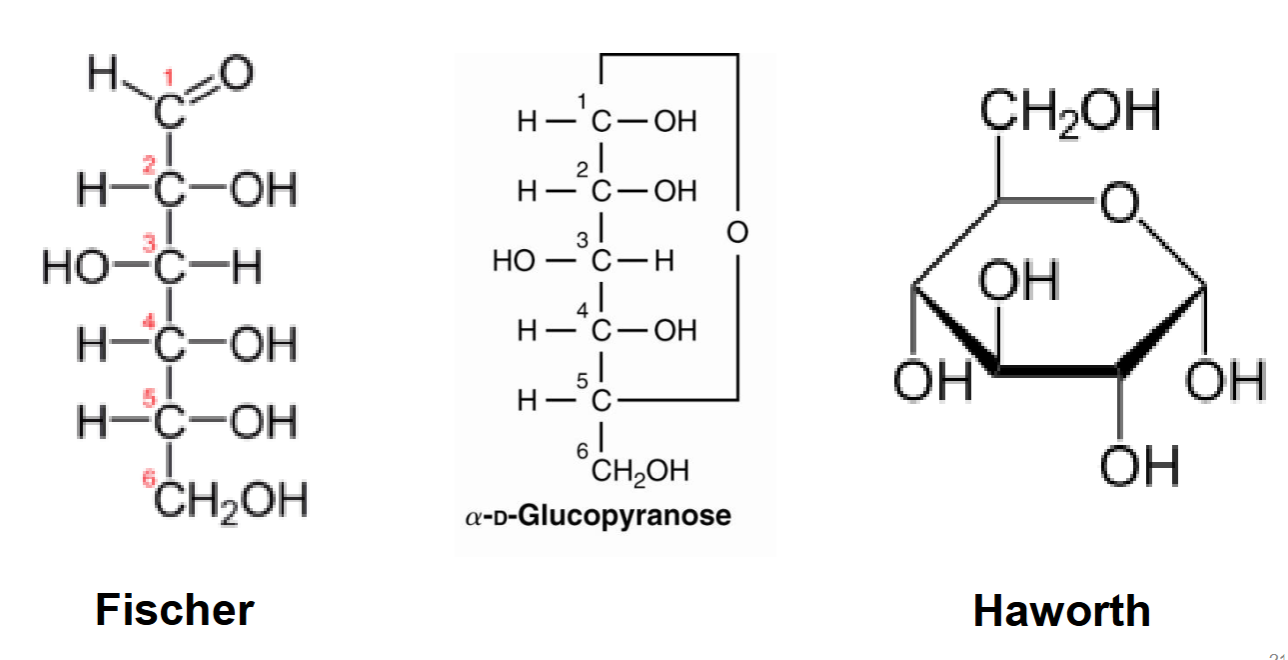
Pyranose vs. Furanose
F for five
P for six?
Fru- 5 attacks 2
Pyr-5 attacks 1

Formation of Furanoses

Pyranose Structures: Boat vs. Chair
Chair conformation: generally, more stable

Anomers: directionality matters!
A simple rule:
For D-sugars, α has OH down, β up in the customary Haworth drawing
For L-sugars, the reverse is true
alpha down D-sugar
Anomeric carbon: the chiral (formerly achiral) carbon created due sugar cyclization
Anomer: epimeric, cyclic monosaccharide

Monosaccharides Can Be Converted to Several Derivative Forms
Some of the most common are:
– Sugar acids
– Sugar alcohols
– Deoxy sugars
– Sugar esters
– Amino sugars
– Acetals, ketals, and glycosides
Sally Sucked D**k And Got Killed After
Sugar acids: sugars with carboxylic acid group
at least one COOH (acid)

Sugar acids: formation via Fehling’s Test
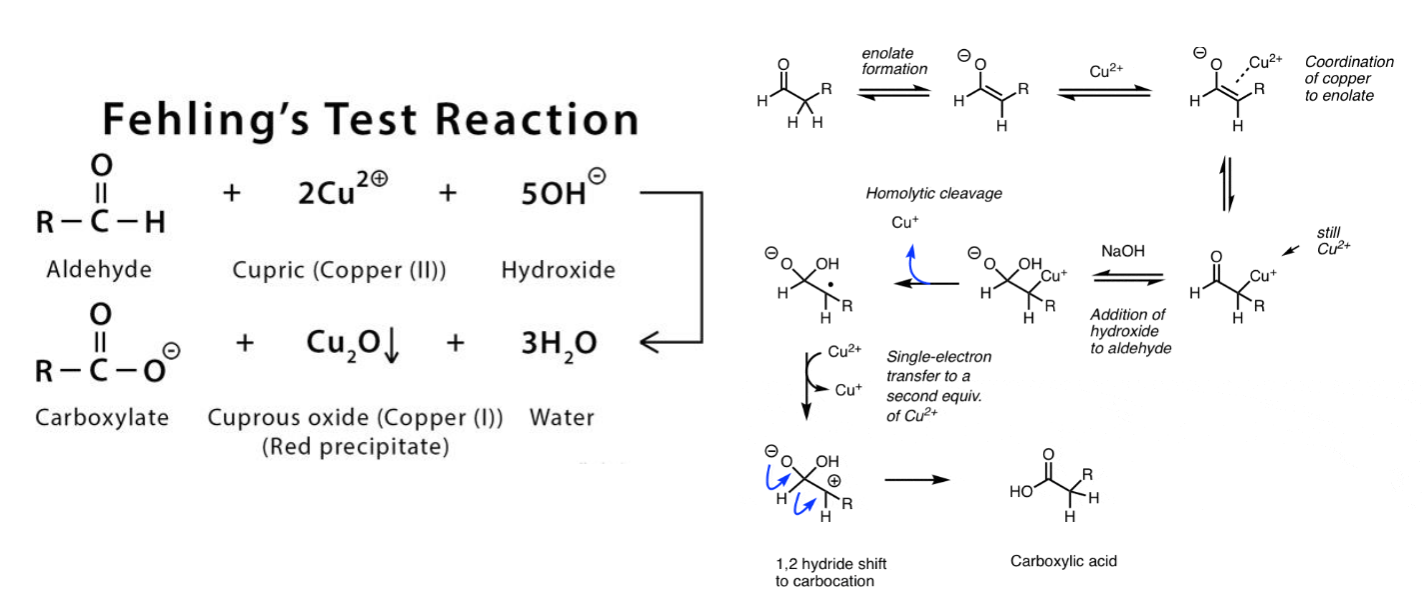

Reducing Sugars
Reducing sugars are generally aldoses with a free aldehyde
In polysaccharides, must have a free anomeric carbon to be reducing sugar

Sugar alcohols: sugars with reduced R=O groups
Linear molecules; formed via mild reductions

Sugar Alcohol Formation

Deoxy Sugars: sugars with lost ROH groups

DNA vs. RNA

Sugar Esters: sugars that have ester bonds
most common type of sugar ester: phosphoester!
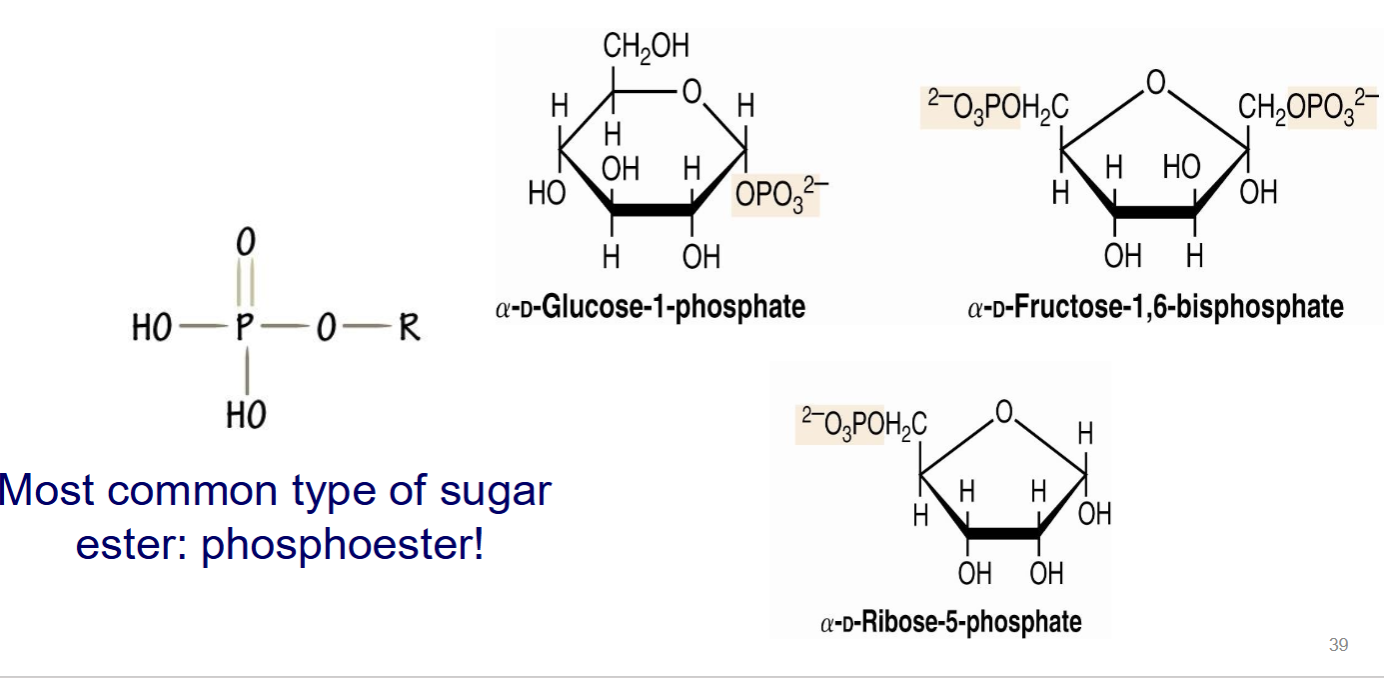
Amino Sugars: sugars with amino groups
Amino groups most commonly found at the C2 position

Muramic and Sialic acids: highly modified sugars
Have multiple types of derivatizations; important for cell-surface recognition

Acetals, Ketals and Gylcosidic Bonds
Glycosidic bonds are the keys to making complex di/poly-saccharides

Glycosides: sugars bound to another functional group
the pyranose and furanose forms of monosaccharides react with alcohols in dehydration synthesis reactions to form glycosides, with retention of the α- or β-
configuration at the C-1 carbon.The new bond formed is called a glycosidic bond.
This is the process by which oligosaccharides are formed


Glycosidic Bonds
Numbering and type of linkage related to anomeric carbon:
Retention of a/B designations
Numbers related to monosaccharide numbering (must be specified)
Stereochemistry of all anomeric carbons must be specified!
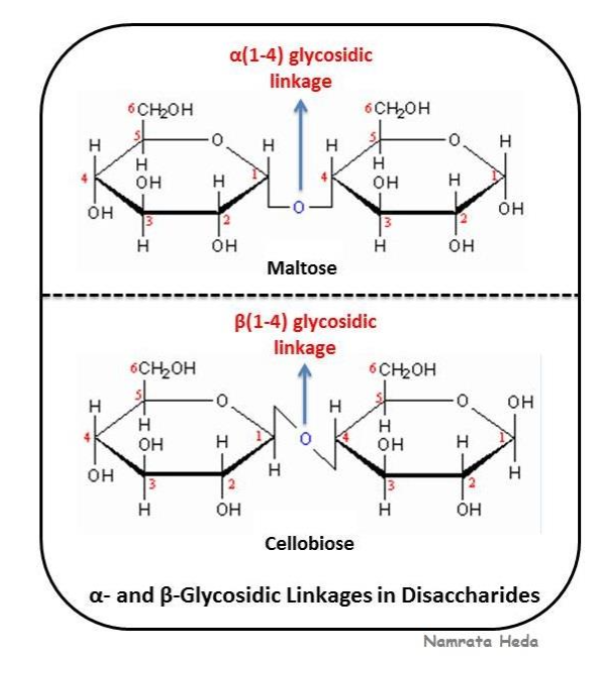
Disaccharides
Disaccharides are the simplest oligosaccharides!

Reducing Sugars: Reminder
Provides directionality of the oligosaccharide (like proteins)

Sucrose: a tricky example
When two anomeric carbons are involved, you must name both!

Trehalose: another tricky example
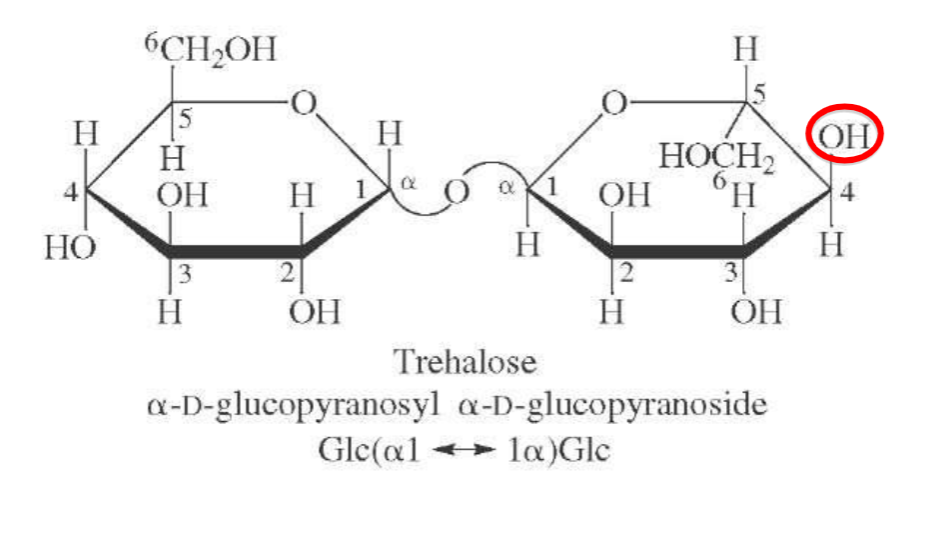
What is the difference between the structure and reactivity of
reducing and non-reducing sugars?
In polysaccharides, must have a free anomeric carbon to be reducing sugar
chat:
Reducing sugars: Have a free anomeric carbon (can open into a linear form with a reactive carbonyl group), so they can be oxidized and give positive Benedict’s or Tollens’ tests. Examples: glucose, fructose.
Non-reducing sugars: Have their anomeric carbon(s) locked in a glycosidic bond, so they cannot open into a reactive carbonyl form and do not give positive reducing-sugar tests. Example: sucrose.
