psych of personality MIDTERM 2
 Call Kai
 Learn
 Practice Test
 Spaced Repetition
 Match
 Flashcards
 Knowt Play
1/88

Earn XP
Description and Tags
10/06-10/22 class notes
89 Terms
Carl Jung
The man and historical context
Jung was Freud’s main protégé, his “crown prince”
But then Jung went his own way, they had a “break-up”
They were opposite types
Jung was an IN
And Freud was an ES
They were both Thinking types
How does Jung’s theory differ from Freud’s?
Freud was more literal
Most of his ideas had a physical form
E.g. believed Id/ego could be found in specific areas of the brain
Jung’s theory of consciousness (how it works in brief)
The principle of equivalence (more of an hourglass, powerful conscious and unconscious – they’re opposites)
Whatever your conscious is, your unconscious was the opposite
If you are INT consciously, you are ESF unconsciously
We are attracted to people who stimulate our unconsciousness (Opposites Attract)
This also helps us grow, as it stimulates part of our unconscious that is like that, and brings us into conscious awareness, facilitating the Individuation process.
Different Parts of Unconscious in Jung’s Model (personal unconscious & collective unconscious)
1. Personal Unconscious
All of your memories of your own life
Including repressed material
Jung thought it was more easy to access that Freud did
Especially for IN people (greater access to their unconscious bc they were introverted and energy flowed inward)
2. Collective Unconscious
A repository of ancestral human experiences
You inherit memories from your ancestors
We now see in genetic material that there is “inherited trauma” (epigenetics)
But at the time Jung proposed this idea he wasn’t taken seriously as a scientist because of it.
What are Archetypes?
Clusters of energy around certain types of symbols in our collective unconscious (thought unconscious was more permiterable i.e through art)
minds/dreams
These symbols are not arbitrary
They come from our human experience
They are cross-cultural
Archetypes are universal patterns of behavior
We know how a good mother, or a hero/heroine in a story behaves
It’s similar across all cultures
How we use these archetypes in fantasy and to label and understand people is part of our inherited memories
Archetypes reside in the unconscious– feels like you know something or its familiar (bc its in collective architypes)
Four Major Archetypes (persona, the shadow, anima/animus, the self)
1. Persona
social mask
allows us to adapt to the world and fit in
if we identify with it too closely, we can lose our true selves
2. The Shadow
the darker side of the psyche representing wildness, chaos, and the unknown
latent (or hidden) predisposition are present in everyone
people often deny these qualities and project them onto others
3. Anima / Animus
gender specific archetypes
Anima (feminine)
Animus (masculine)
Basis of our gender and sexual desires
Everyone has a male/female side of their personality
Sexual attraction is one way to integrate them
Jung’s model of attraction and heterosexual model of sexual desire
For women (biological females)
Her unconscious is her animus
So, she dreams of man with exaggerated masculine characteristics
She is attracted to a man because he stimulates her animus
For men (biological males)
His unconscious is his anima
So, he dreams of a mysterious hyper-feminine woman
He is attracted to a woman because she stimulates his anima
4. The Self
represents the unified unconsciousness and consciousness of an individual
often represented the self as a circle, square, or mandala
occurs through individuation
in which the various aspects of personality are integrated
disharmony between unconscious/conscious mind can lead to psychological problems
bringing conflicts into awareness and accommodating them in conscious awareness
Jo-Hari Window
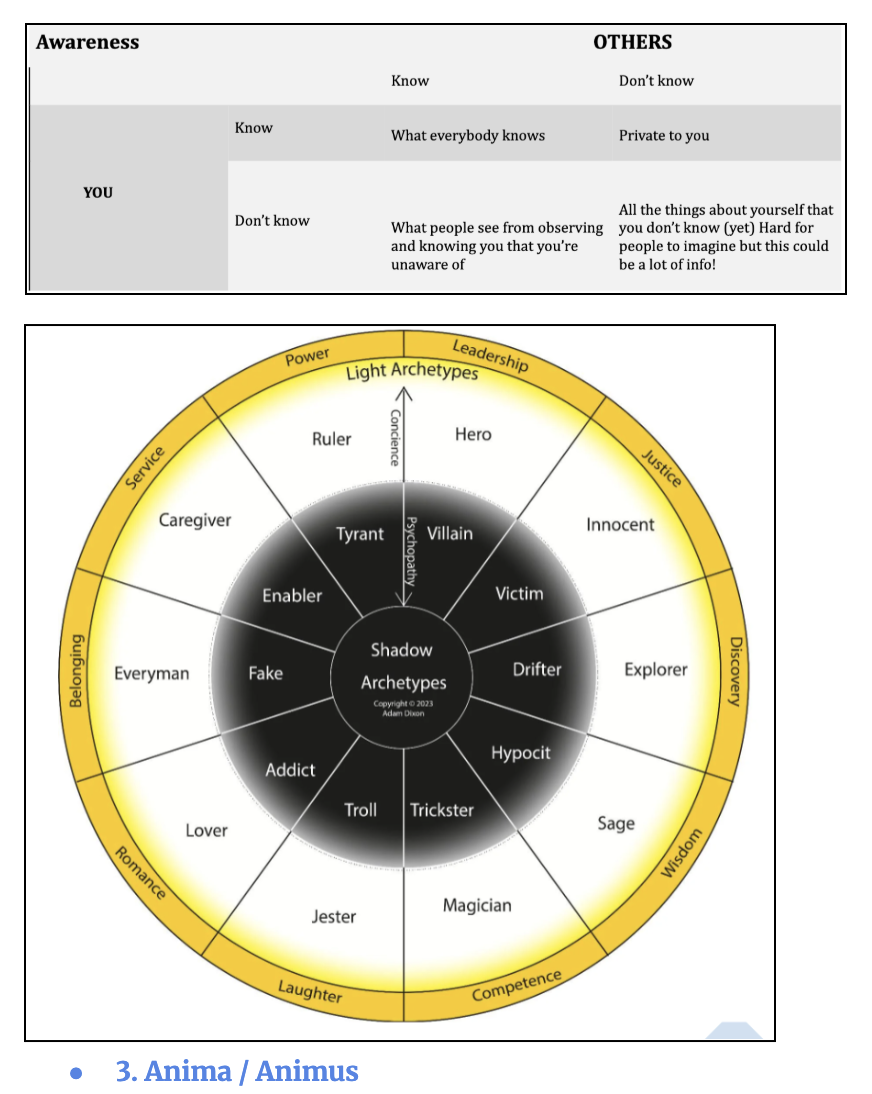
How did Jung use artwork, dreams, mandalas in his analytic work with individuals?
Mandalas -- symbol of the Individuation process (symbolizes the integration process of individuation: consciousness and unconsciousness)
When you become whole
Integrate conscious and unconscious
Look at what is inside the mandala
Made mandalas that symbolized individuation process
More intricate and balanced is more balanced inside
Also related to chakras
Jung’s Personality Types

Introversion – Extroversion (I/E)
Jung was one of first to observe the I/E difference in people and put a name to it
Did this before there was empirical evidence for the biological basis of Introversion-Extroversion
Introversion
Introverts - energy flows inward
Can lose energy with too much social contact
Introverts try to reduce stimulation
Withdraws libido from a social object (exhausted giving energy to others)
Focused inward, so poor social skills
Must control social stimulation (e.g. a workspace with a door)
Extroversion
Extroverts - energy flows out
Gain energy in social situations
Extroverts have a lower set point for stimulation, and are always trying to get stimulation
Wants to be involved, affirmed by contact with outside environment
Well-adjusted and popular because they want to be connected to other people
Plan for enough social stimulation (e.g. don’t take a job that requires long hours without social contact)
Introversion - Extroversion
These dispositions are innate
Solid evidence for the biological basis of I/E
Demographic differences:
Western culture -- Higher in extroversion
People in general -- Higher in extroversion
But, basically normally distributed tests
Sensing vs. Intuiting
Sensing (S)
Basic information on 5 senses, facts
here and now, literal interpretations
Intuition (N)
Knowing about things in a non-factual way
Imaginative of deeper meaning and facts
Hidden essence of things
Artistic, creative
Can tolerate the unknown and being speculative
Example: The piano
Sensing
How did it get into room? Is it in tune? Who made it? Who owns it?
Intuiting
Reminds me of Chopin. what kind of music will come out of it? it seems dark and sad, what if it could tell a story
Demographic differences:
Sensing is more common
Jung was an IN and Freud was an ES
IN have greater access to collective unconscious
Feeling vs. Thinking
Feeling (F)
Into relationships and values about people
Behavior guided towards effect it will have on other people and their sense of belonging
Be in a relationship with people who respect your feelings
Thinking (T)
Follow rules, principles, logic, order
Sense of fairness
Demographic differences:
More Men are thinking
More Women are feeling
Judging / Perceiving
Judging (J)
Plan things out, have things set (lets get it settled)
Perceiving (P)
Go with the flow (lets keep it open)
Reliability and Validity of MBTI and other measures
Ispsative or “forced-choice” test versus Likert-scale personality tests
Example: 60-item Jung personality test
If you’re in the middle the test is less diagnostic for you– for Jung and his model this is a good thing (integrating opposites)
Normal distribution = most people are in the middle (see extremes less as much)
Usually pretty flattering like a horoscope but more validity than a horoscope
Jung Types, Anxiety & Coping Mechanisms
Extraverted Sensing, ES
experiencing the immediate context
taking action in the physical world
noticing changes and opportunities for action
accumulating experiences; recognizing "what is."
Introverted Sensing, IS
reviewing past experiences
seeking detailed information and links to what is known
recalling stored impressions
accumulating data
recognizing the way things have always been
Extraverted INtuiting, EN
Interpreting situations and relationships
Picking up meanings and interconnections
Being drawn to change "what is" for "what could possibly be”
Noticing what is not said and threads of meaning emerging across multiple contexts.
Introverted Intuiting, IN
foreseeing implications and likely effects without external data
realizing "what will be"
conceptualizing new ways of seeing things
envisioning transformations
getting an image of profound meaning or far- reaching symbols
Extrovert Thinking, ET
segmenting; organizing for efficiency
systematizing; applying logic; structuring
checking for consequences
monitoring for standards or specifications being met
setting boundaries, guidelines, and parameters
deciding if something is working or not
Introverted Thinking IT
analyzing; categorizing
evaluating according to principles and
whether something fits the framework or model
figuring out the principles on which something works
checking for inconsistencies
clarifying definitions to get more precision
Extraverted Feeling, EF
connecting; considering others and the group-organizing to meet their needs and honor their values and feelings
maintaining societal, organizational, or group values; adjusting to and accommodating others
deciding if something is appropriate or acceptable to others
Introverted Feeling, IF
valuing; considering importance and worth
reviewing for incongruity; evaluating something based on the truths on which it is based
clarifying values to achieve accord
deciding if something is of significance and worth standing up for
Clear sense of your values and your truths (do I want to get involved?/ pick battles)
Research Methods: Prospective vs. Concurrent
Prospective = predict the future
Give everybody a test at time 1 (e.g. a leadership test).
In 5 years, look at who is a successful as a leader.
If test has validity in prospective design, score at time 1 should be reflective of actual success as a leader.
Give everyone the MBTI at time 1.
In 5 years, see how many are still in that career – what type tends to stay/go from a particular occupation.
Concurrent = look at people at same time
Give everybody in a management position a dominance test and compare to general population.
See if dominance score is higher than general population the test predicts or differentiates leadership behavior.
Give professionals in a certain occupation (surgeons, managers, therapists) the MBTI and see which type is most represented in the group
Research Methods: Cohert Effects, Longitudinal Method, Cross-sectional study
Cohort Effects
describe how studying populations in different “cohorts”
having been born in a different time or region or having different life experiences can alter the outcomes of studies
Examples:
People who became parents in the same year (2001, 2020)
People who began college at a specific time history (2001, 2020) same time
All of the students who went to a particular school during a certain time period
Longitudinal Method
A single cohort is studied over time.
Example: studying the effect of social media exposure in the same group of individuals from ages 20 to 50.
So, the longitudinal study would take 30 years to conduct.
Cross-sectional study
looking at the same effects on different groups at the same time
Example:
investigating the effect of social media exposure on anxiety/attention from people in different age groups at the same time.
Jonathan Haidt
The Coddling of the American Mind (2018)
The Untruth of Fragility: What doesn't kill you makes you weaker.
The Untruth of Emotional Reasoning: Always trust your feelings.
The Untruth of Us Versus Them: Life is a battle between good people and evil people.
The Anxious Generation (2024)
The Decline of the Play-Based Childhood: depriving children of play and role-models, damages attachment systems, and obscures any clear path from childhood to adulthood.
The Rise of the Phone-Based Childhood: the hidden harms that result from the new phone- based childhood
Suggestions to help
Give children far more time playing with other children. This play should ideally be outdoors, in mixed age groups, with little or no adult supervision (which is the way most parents grew up, at least until the 1980s).
Look for more ways to embed children in stable real- world communities. Online networks are not nearly as binding or satisfying.
Don’t give a smartphones young children.
Delay the opening of accounts on social media platforms.
The Negativity Bias
is a cognitive bias that results in adverse events having a more significant impact on our psychological state than positive events
when adverse events and positive events are of the same magnitude, we feel negative events more intensely
can lead to hyper-vigilance – being alert/ heightened awareness of negative aspects of the social environment.
8 Cognitive Distortions that Contribute to Anxiety and Depression
flashcards below
1. All-or-Nothing Thinking
AKA black-and-white thinking or polarized thinking.
Viewing things in absolute terms: Situations are always black or white, everything or nothing, good or bad, success or failure.
Example: dwelling on mistakes and assuming you will never be able to do well, instead of acknowledging the error and trying to move past it.
2. Overgeneralization
When you make a rule after a single event or a series of coincidences.
Using words like "always" or "never.”
Because you have experience with one event playing out a certain way, you assume that all future events will have the same outcome.
Example: you made a suggestion about a work project that wasn't adopted in the final work. You might overgeneralize this and assume that no one at work ever listens to you or takes you seriously.
3. Mental Filters
the opposite of overgeneralization, but with the same negative outcome.
Instead of taking one small event and generalizing it inappropriately, the mental filter takes one small event and focuses on it exclusively, filtering out anything else.
Example: you focus on all of the negative or hurtful things that your partner has said or done in your relationship, but filters all the kind and thoughtful things your partner does. Journaling is one strategy that might help overcome mental filtering. Make an effort to intentionally shift your focus from the negative and look for more neutral or positive aspects of a situation
4. Jumping to Conclusions
There are two ways of jumping to conclusions:
Mind reading: When you think someone is going to react in a particular way, or you believe someone is thinking things that they aren't
Fortune telling: When you predict events will unfold in a particular way, often to avoid trying something difficult
5. Emotional reasoning
a way of judging yourself or your circumstances based on your emotions.
assumes that because you are experiencing a negative emotion, it must accurately reflect reality.
If you feel experience feelings of guilt, for example, emotional reasoning would lead you to conclude that you are a bad person.
Common in most people, especially those who have anxiety and depression. Cognitive behavior therapy (CBT) can help people recognize the signs of emotional reasoning and realize that feelings are not facts.
6. "Should" Statements
involve always thinking about things that you think you "should" or "must" do.
These types of statements can make you feel worried or anxious.
They can also cause you to experience guilt or a sense of failure.
Because you always think you "should" be doing something, you end up feeling as if you are constantly Failing.
Remedy: Self-compassion
7. Labeling
making a judgment about yourself or someone else as a person, rather than seeing the behavior as something the person did that doesn't define them as an individual.
8. Personalization and Blame
A cognitive distortion whereby you entirely blame yourself, or someone else, for a situation that, in reality, involved many factors that were out of your control.
Example: a mother blames herself for her daughter's bad grade in school. Instead of trying to find out why her daughter is struggling and exploring ways to help, she assumes it is a sign that she is a bad mother.
Catharsis
The term itself comes from the Greek katharsis meaning "purification" or "cleansing."
The purpose of catharsis is to bring about some form of positive change in the individual's life.
Two components:
Emotional – strong feelings felt and expressed
Cognitive – gaining insights
Physical release: hitting, punching,
Emotional release: crying, screaming
Emotional/Cognitive release: Journaling, Talking w/ therapist or friend
The Therapeutic Effects of Journaling
As for the health benefits of journaling, they've been scientifically proven.
Research shows that journaling:
decreases the symptoms of asthma, arthritis, and other health conditions.
improves cognitive functioning
can strengthen immune system response.
can counteract many of the negative effects of stress
Early Attachment Theory & Research
John Bowlby’s Attachment Theory
Child psychologist, also expert in animal behavior
Considered an evolutionary theory
Observed across (mammals) species
Infants/babies have a biological drive to seek proximity to a protective adult
When we are stressed, our attachment system is activated, and we seek comfort from caregiver
The goal of the drive to seek proximity is to feel safe, secure and protected
Attachment Behaviors
Seeking proximity to adult/caregiver
Tender physical contact
Attract attention positively (e.g., smiling or calling out)
Aversive attachment behaviors seeking soothing (e.g., crying)
Attachment behaviors are most evident when the infant is threatened, endangered, stressed.
Caregiver’s Role
to be tuned in to the signals of the infant
to respond in an accurate and timely way
to be interested in the child’s experience
capacity to take the child’s perspective
empathy for the child
to respond by meeting the child’s needs
sending clear signals of the caregiver’s availability
Empirical Test of Infant Attachment: Ainsworth’s Strange Situation
A research paradigm to observe attachment behaviors in real time
Infant age: 9 to 30 months
1. Mother and infant are together
2. Stranger comes in
3. Mother leaves and stranger remains with infant
4. Mother returns
Key Question: How does infant react to these changes?
Behavioral observation measure to infants categorize different attachment types
Summary of Behavioral Scoring Categories
1. Proximity and contacting seeking
2. Contact maintaining
3. Avoidance of proximity and contact
4. Resistance to contact and comforting
5. Exploratory behaviors
6. Search behaviors
7. Affect Displays
Three Types: A-Babies, B-Babies, C-Babies
A-Baby: Avoidant (15%)
No sign of distress when mother leaves
Pretended they didn’t care when mother left, and then ignored her when she came back
Infant is okay with the stranger and plays normally when the stranger is present
The mother and stranger are able to comfort the infant equally well
Infant shows little interest when the mother returns
Act autonomous but not developed enough to be as independent as they appear to be
Looking Unbothered Does Not Mean Feeling Unbothered
Avoidant infants may show relatively little outward distress
But physiological measures show that they can still experience substantial arousal
Their behavior may reflect minimizing the expression of distress rather than an absence of distress
What we can see from the outside may reveal only part of what someone is experiencing
B-Baby: Secure (70%)
A little distressed when mother leaves
Avoid stranger when alone, but friendly when the mother is present
Positive and happy reunion when mother returns
They feel secure when their mother is around
Using mother as a “secure base” to explore the room
Child travels around, then looks back to make sure mom is watching
C Baby: Anxious/Ambivalent/Resistant (15%)
Intense distress when the mother leaves
The infant avoids the stranger - shows fear of the stranger
The infant approaches the mother, but resists contact, may even push her away
The infant cries more and explores less than the other two types
Disorganized Attachment (D Babies)
Added later to Ainsworth’s original three categories
Infant does not show a consistent strategy for dealing with stress
May approach caregiver, then suddenly stop, freeze, turn away, or appear confused
May show contradictory approach and avoidance behaviors
Caregiver may be both a source of comfort and a source of fear (Main & Solomon, 1990)
Correlated with more serious mental health challenges later in life
Attachment and Being Seen
Attachment teaches children something about how safe it is to make their needs visible
When distress reliably brings comfort, reaching out becomes easier
When care is inconsistent, children may become more vigilant about whether the caregiver is available
When expressions of need are repeatedly ignored or rejected, hiding those needs can become an adaptation
Children begin learning: What happens when another person sees that I need them?
Research Summary on Mothers of Anxious Infants (C-Babies)
Inconsistent caregiving
Intermittent reinforcement
More likely to give mixed signals
May have difficulty reading baby’s cues
May give their infant lots of attention that’s not attuned to infant needs baby
Baby’s temperament can play a role
Babies high in negative reactivity are harder to soothe
They need extra sensitivity to avoid being anxious
Research Summary on Mothers of Secure Infants (B-Babies)
More sensitive to infant cues
Able to know what infant wants, and give them that
Held babies tenderly and for longer
Had synchrony in breathing between mother and baby
These are skills that can be taught, though it comes more naturally to moms who were raised with a secure attachment style
Securely-attached moms tend to have secure babies.
Research Summary on Mothers of Avoidant Infants (15%)
Mother does not respond to infant’s proximity seeking behaviors
Example: letting infant cry without attempting to comfort them
Infant learn that their attempts to reach out to the caregiver to soothe anxiety and feel secure and close are not met – over and over.
So they stop reaching out and actually start to avoid the caregiver then they are feeling vulnerable and in need of support.
Research Summary on Mothers of Disorganized Infants (D-Babies)
Caregiver may behave in frightened, frightening, or highly unpredictable ways
May appear afraid of the infant, or may behave in ways that frighten the infant
More likely to have unresolved trauma or loss
May show sudden withdrawal, dissociation, or contradictory responses to the infant
Maltreatment and severe family stress increase the risk, but disorganized attachment does not necessarily mean abuse occurred
Infant has no consistent strategy for getting comfort because the caregiver can be both a source of safety and a source of fear (Main & Hesse, 1990; Madigan et al., 2006)
How Does Disorganized Attachment Develop?
Infant is biologically driven to approach caregiver when frightened
But the caregiver may also be a source of fear
The infant faces an approach–avoidance conflict
No consistent attachment strategy successfully reduces distress
Behavior may therefore appear contradictory, confused, or disorganized
This has been described as “fright without solution” (Main & Hesse, 1990)
Attachment or Temperament?
Some babies are naturally more fearful, reactive, or difficult to soothe
Temperament can affect how much distress a baby shows during the Strange Situation
But temperament alone does not determine whether an infant is securely or insecurely attached
Attachment describes the infant’s relationship with a particular caregiver (Sroufe, 1985; Vaughn et al., 1989)
Development of Trust
plays an important role in attachment
Secure babies are better able to deal with strange situation because they have learned to trust the parent and the environment
Anxious and avoidant babies do not learn to trust the environment
Anxious can’t let go
Avoidant can’t hold on
Attachment Is Relationship-Specific
Attachment is not simply a personality trait inside the child
A child may have a secure attachment with one caregiver and an insecure attachment with another
Different relationships provide different experiences of responsiveness and security
Over time, repeated experiences contribute to broader expectations about relationships (Sroufe, 1985; Main & Weston, 1981)
Are Early Attachment Patterns Permanent?
Early attachment experiences help create expectations about relationships (called Working Models)
These expectations can show some continuity over time
But attachment is not permanently fixed in infancy
Later relationships and experiences can modify earlier expectations
Both stability and change are possible (Fraley, 2002)
Adult Attachment Theory and Research
Predictive Validity Study (Fonagy, et al, 1991)
Asked pregnant mothers to tell narratives about their relationship with their own mothers via Adult
Attachment Interview
Content analysis of their responses
Secure: had a lot of deep stories, balanced positive and negative, complex about their mom
Anxious: had many crazy, dramatic and exaggerated stories about their mom
Avoidant: had very few stories and did not seem to remember much about their mom
When babies old enough to go through Strange Situation, results showed Infant-Mother attachment patterns matched 75% of the time.
Attachment in Adults
“Working models” Bowlby term for the cognitive representation of how a person understands relationships based his/her early experience
You have a working model of how relationships should be – your expectations
This is developed in your first relationship, and follow you through life
Carried out in friendships, and romantic relationships
Working Models
Secure: you can trust people, relationships associated with good feelings and satisfaction
Avoidant: you don’t need other people, close relationships have no value
Anxious: you see people as unpredictable, they may reject or abandon you any minute
Adult Attachment Hazan & Shaver (1987)
Applied attachment theory to adult romantic relationships
Proposed three adult attachment patterns:
Secure: Comfortable with closeness and depending on others
Anxious/Ambivalent: Wants closeness but worries about rejection and abandonment
Avoidant: Uncomfortable with closeness and depending on others & Romantic partners can function as attachment figures
Adult Attachment Scale Hazan & Shaver (1987)
Took out an ad in the paper to ask about relationships
A short questionnaire that sorted people into 4 attachment categories
1. Secure “I am comfortable relying on others and letting them rely on me”
2. Anxious “I want close relationships, but worry that people don’t like me as much as I like them.”
3. Avoidant “I have difficulty trusting people, feel I’ll be hurt if I’m too close to others.”
4. Dismissing “I am comfortable without close emotional relationships.” (new possibility: People who are healthy, but don’t value relationships)
Two Dimensions of Adult Attachment
Later research found that adult attachment is better described along two dimensions:
Attachment Anxiety
How much do I worry about rejection or abandonment?
How much reassurance do I need that the relationship is secure?
Attachment Avoidance
How uncomfortable am I with closeness and dependence?
How much do I avoid vulnerability or relying on other people?
(Brennan, Clark, & Shaver, 1998)
Four Adult Attachment Patterns
Low Anxiety + Low Avoidance = SECURE
Comfortable with closeness and independence
High Anxiety + Low Avoidance = PREOCCUPIED / ANXIOUS
Wants closeness but fears rejection
Low Anxiety + High Avoidance = DISMISSING / AVOIDANT
Values independence and minimizes need for closeness
High Anxiety + High Avoidance = FEARFUL-AVOIDANT
Wants closeness but fears being hurt
Romantic Relationships: Anxious Attachment
Fear abandonment
On again-off again relationship
Feel like people don’t like them
Suspicious about unfaithfulness
Unhappy when not in a relationship
Plays games to keep partner’s attention
Let’s other person set the tone of relationship
Tries to be what/who their partner wants
Have difficulty expressing their needs
Best relationship advice: Get together with someone secure!
Romantic Relationships: Avoidant Attachment
Fear of people getting too close
Pulls away from partner when there is a disagreement
Does not want to be seen as vulnerable and needing anything
Feel like they don’t need relationships,
Don’t want to be bogged down by others’ needs
Can idealize past partners
Overrepresented on dating sites because they become attached and unattached very quickly
How does THREAT activate the attachment system in adulthood?
May not see a person’s attachment style until they are in a stressful situation
At this point, they follow innate instinct to seek out a helper
Secure adults (estimated 50% of population)
Reach out for help
Axious & avoidant → behavior is reflective
Attachment and Ambiguity
Secure attachment makes temporary lapses in attention easier to tolerate
Attachment anxiety makes ambiguity harder to tolerate
Small changes in tone, affection, contact, or plans may become highly noticeable
The underlying question may be: “Am I still secure with you?”
But uncertainty is not always imagined — sometimes another person really is behaving inconsistently
How does threat activate the attachment system in avoidant adults?
Estimated 25% of adults
Develop Deactivation Strategy of their attachment system
Reflectively shut off ability to make contact with other people
Withdraw from contact with other people when they are stressed
May “forget” about a stressful event
How does threat activate the attachment system in anxious adults?
Estimated 25% of adults
Develop Hyper-activation of their attachment system
Amping up distress signal to others
Cling on very tightly to people
Hypervigilance in monitoring partner’s behavior
Fear of abandonment is heightened
Minimize physical and emotional distance from partner
Protest Behaviors
When the attachment system is strongly activated, an anxiously attached person may try to restore closeness indirectly:
Repeatedly calling or texting
Becoming angry when a partner does not respond
Withdrawing to see whether the partner will pursue them
Threatening to leave
Trying to make the partner jealous
The goal of the behavior may be to reestablish connection rather than to create distance.
(Levine & Heller, 2010)
The Anxious–Avoidant Trap
Anxious partner senses distance
↓
Seeks reassurance, contact, or closeness
↓
Avoidant partner feels pressured
↓
Creates more distance
↓
Anxious partner feels even less secure
↓
Increases pursuit
Each person’s response can strengthen the other person’s attachment strategy.
Question: What does each person think the problem is?
Anxious person: no matter what I do it’s not good enough (meets brick wall)
Avoidant: I can’t give them what they want (doesn’t want the other to suffer= more likely to break up)
Both People Can Feel Unseen
In the same conflict:
The person seeking closeness may feel: “My need for reassurance is being treated as excessive.”
The person seeking space may feel: “My need for autonomy is being interpreted as rejection.”
A disagreement about texting, plans, or time alone can become a larger question about:
Do I matter to you?
Am I allowed to have space?
Secure Attachment in Adulthood
Can maturely discuss needs, reactions and problems
Feel secure giving and receiving help
Interconnections between family, friends, work colleagues
Secure buffering effect
Attachment Style or What Is Actually Happening?
Wanting reassurance doesn’t automatically mean someone is anxiously attached
Wanting time alone doesn’t automatically mean someone is avoidant
A relationship may feel uncertain because a partner is actually behaving inconsistently
Privacy and commitment can coexist
Attachment is a pattern across situations — not a diagnosis based on one behavior
Relationships Can Change Attachment
Attachment patterns are tendencies, not fixed identities
The same person can feel more secure in one relationship than another
The behavior of the current partner matters (BUT childhood= creates expectations)
People who experience their partners as responsive tend to feel more secure in that particular relationship
Consistent responsiveness can make vulnerability and dependence feel safer over time
Limerence
Psychologist Dorothy Tennov coined the term in her book, Love and Limerence: The Experience of Being in Love, (1979) an obsessive attachment to a particular person or “limerent object” (LO) can be so intense that interferes with daily functioning and the formation and maintenance of healthy relationships
Symptoms of Limerence
Consistent and intrusive thoughts about the LO
Idealization of the LO e.g. “they are perfect.”
Constantly being reminded of the LO by places, people, objects, and situations
Intense fear of being rejected by the LO
Fluctuations of mood depending on whether the LO seems to reciprocate feelings or not
Overwhelming emotions ranging from euphoria to distress and guilt
Being awkward, shy, and clumsy around LO
Spending excessive amounts of time grooming to impress the LO
Attention Is Not the Same as Knowing Someone
Limerence involves intense attention, idealization, and longing for reciprocation
Small interactions can take on enormous significance
A delayed reply, smile, or casual comment may be repeatedly analyzed for meaning
Someone may feel that they know another person deeply even when relatively little is actually known
Intense attention doesn’t necessarily produce accurate perception
Treatment for Limerence
CBT (cognitive behavioral therapy)
Understanding your attachment needs
Self-compassion and self-acceptance
Reality-check – reduce uncertainty
How do Attachment Styles Relate to The Self?
From Mirror Meditation (Well, 2022)
Anxious Self-Attachment
Can’t focus on self
Always thinking of others and what they think
Mind wandering
Avoidant Self-Attachment
Avoids feelings and emotions
Mental Distractions and intense physical activity
Can’t remember stressful/emotional events
The Big 5 Personality Factors
What is a trait?
Stable, internal disposition that we have that transcends time and situation
Bipolar – each trait is a high and a low
Examples: introversion vs. extroversion & low vs. high agreeableness
What is the Big 5?
Not based on theory
Lexical approach (using every word in the dictionary to describe a person)
Then factor analysis to see how items group together
The Big Five Personality Factors
Big 5 are normally distributed but we tend to talk about being high or low on traits
Socioemotional categories
Preferences, characteristics
E.g. extrovert, conscientious
NOT skill/ability based
E.g. SAT, math aptitude
OCEAN
Openness to Experience
Conscientiousness
Extraversion
Agreeableness
Neuroticism
(1) Extraversion vs. Introversion
Sociable vs. Retiring
Fun-loving vs. Sober
Affectionate vs. Reserved
Two Sub-factors:
Social Dominance (leader, influence with opinion, be seen socially)
Enthusiasm (get in the mix, meet new people)
Factor E: Relevant Research Summary
Extroverts tend to:
Be good at sales jobs
Take more risks
Have higher level of sexual activity
Prefer pleasant types of experiences
Report having good feelings
Less sensitive to punishment
Have a positive affect bias (doesn’t mean introverts have negative affect)
Remember more positive memories
Main Finding in Neuroscience
Reticular activating system (RAS)
System in your brain that regulates arousal set point
Extroverts have a low arousal set point
So, they always look for stimulation
Introverts have a high arousal set point
So, they try to avoid more stimulation
(2) Neuroticism: High versus Low
Worried vs. Calm
Insecure vs. Secure
Self-pitying versus Self-Satisfied
Two Sub-factors:
--Volatility (emotions go up and down a lot)
—Withdrawal (things get tough you give up)
Factor N: Relevant Research
Related to negative affect (positive correlation)
Most questions on scale have to do with symptoms
E.g. difficulty sleeping, heart palpitations, always upset
Sub scale within N – negative reactivity – “touchiness” strong reactions to threat, pain, discomfort (may have a biological basis)
Research Findings on High Neuroticism
High N people:
objectively have more bad things happen in their lives
have a stronger reaction to those negative events
worse coping mechanisms
greater difficulty picking up social cues
have less supportive social networks
Research Findings on Low Neuroticism
Low N People:
less self-focus, so less social anxiety
don’t get stressed out easily
are less volatile
have fewer physical symptoms and illnesses
Predictive Validity Studies:
One of main correlates of professional success is Low N
Relationship success correlates negatively with N
Why?
Being low on neuroticism:
Can control their negative affect
Positive bias toward their partners, and people generally
Always see the good in them
If you aren’t low on N:
Structure your life so you don’t get stressed out
If you are an introvert high on neuroticism, you have to structure your life differently than an extrovert low on neuroticism if you want a happy life
The Four Temperaments
Important Point
Extraversion is positively correlated with Positive Affect
Neuroticism is positively correlated with Negative Affect

The Positive Affect and Negative Affect Scale (PANAS)
Developed in 1988 by psychologists David Watson, Lee Anna Clark, and Auke Tellegen
Stable over time.
Show significant convergent and discriminate validity when correlated with peer-judgments.
Highly correlated with corresponding measures of aggregated state affect.
Strongly and systematically related to measures of personality and emotionality.
Participants utilizing PANAS use a 5-point scale in which they determine if a concept applies
5-point ratings on each affect item
Very Slightly or Not at All
A Little
Moderately
Quite a Bit
Extremely
But time interval can vary:
Today
Over the past few weeks
Usually
When you are at school/work
PANAS Items
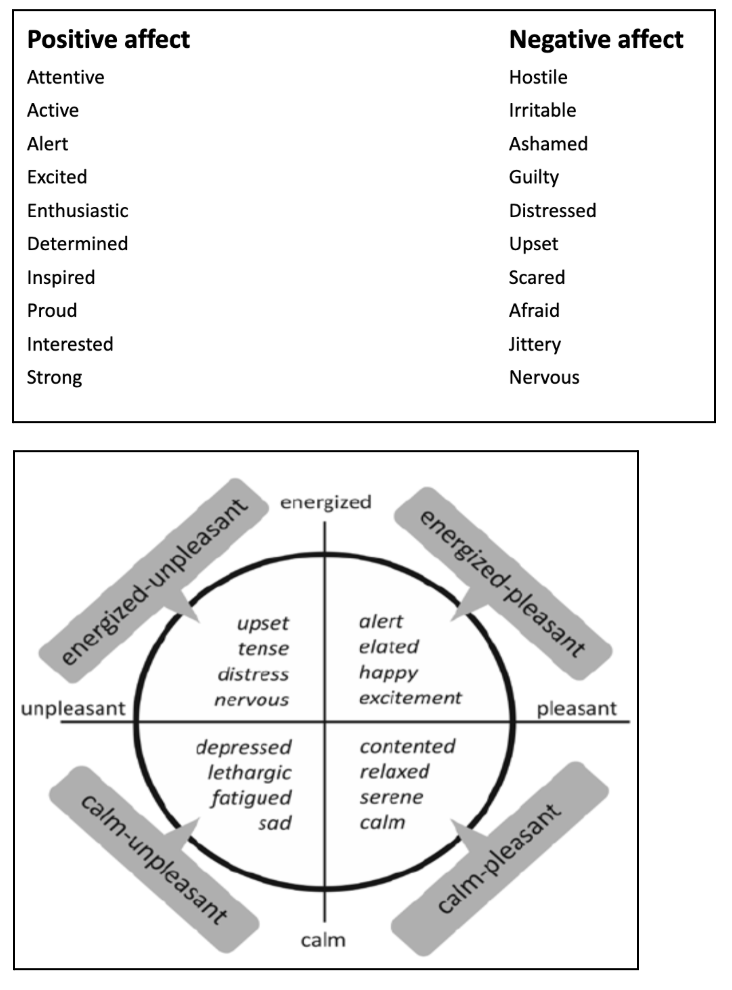
(3) Factor A: Agreeableness
Soft-hearted vs. Ruthless
Trusting versus Suspicious
Helpful versus Uncooperative
Two Sub- Factors:
Politeness (understand the rules, say please and thank you)
Compassion (understand and feel for people)
Research Findings on Agreeableness
About loving, social, being liked by others
Women tend scored higher on A than men
Related to traditional femininity, tolerance, sociability, wanting to be nice and friendly
Positively related to being in relationships
Concern about what others think of you (can be Achilles heel)
Agreeableness at Work
High A People:
Limited success in leadership positions
At first, people like them, so at first people support them
But, as they rise in leadership, they must make tough decisions, in conflict with their desire to be liked by others
Agreeableness is negatively correlated with income
Low A People:
Scornful, rude, harsh, but also frank
Conclusion: It’s best to be a little high on agreeableness, but not too high
(4) Factor C: Conscientiousness
Well organized versus Disorganized
Careful versus Careless
Self-disciplined versus Weak willed
Two Sub-Factors:
Industriousness (how much you like to work/get things done)
Order (organization, step by step)
Research Findings on Conscientiousness
High C People:
Like to Work
Achievement-oriented, well organized, efficient, dependable, self-disciplined, careful with planning
Positively related to longevity
Take care of themselves
Don’t do stupid things
Good trait to have in a work setting
Low C People:
Lazy, disorganized, make bad decisions, risky, erratic behavior
Combining Factors A and C
High Agreeableness (A) and High Conscientiousness C = Good leader, good partner
Low Agreeableness (A) and High Conscientiousness C = Tough-minded Leader, but honest
High Agreeableness (A) and Low Conscientiousness C = Nice but not very reliable
Lo Agreeableness (A) and Low Conscientiousness C = May indicate Psychopathy
(5) Factor O: Openness to Experience
Unconventional vs. conventional
Imaginative vs. down to earth
Creative vs. traditional
Two Sub-Factors:
Intellect (liking to read, intellectual arguments, classes)
Aesthetics (appreciation of beauty, music, art)
Research Findings on Openness to Experience
High O People:
Have more liberal views
More job changes and anticipated life changes
Get bored and want to do new things
Open to different cultures and ideas
Imagination and Creativity
Low O People:
Conservative values, down to earth, stick routines, traditional
Absorption
A sub-group of questions in the O factor scale
The ability to go into alternate states of consciousness
Correlated with hypnotic susceptibility
Helps with meditation
Flow states
Combining Factors O and N
High N (neuroticism) and High O:
You see so many options of what you can do, it can become overwhelming
No evidence that people who are very creative are more neurotic than less creative people
This is actually counterintuitive, as you would never be able to finish things if you were neurotic
O Extroverts = Explore, travel, meet new people
O Introverts = Be a writer/painter, read, go on retreats
Do the Big 5 Factors Change over Time?
Generally traits are relatively slow to change because they are rooted in genetics
But there are some exceptions:
Age-related changes
Traumatic events
Age Related Changes
Studies after age 30 (because personality is more mutable before 30)
Based on large samples to detect small changes
Agreeableness and Conscientiousness
INCREASE with age
Neuroticism, Extraversion, and Openness DECREASE with age
Traumatic Events: Did the pandemic change people’s personalities?
YES!
According to Sutin, et al (2022)
“Strikingly, younger adults showed disrupted maturity in that they increased in neuroticism and declined in agreeableness and conscientiousness.
Current evidence suggests the slight decrease in neuroticism early in the pandemic was short-lived and detrimental changes in the other traits emerged over time.
If these changes are enduring, this evidence suggests population-wide stressful events can slightly bend the trajectory of personality, especially in younger adults.”
How to “improve” your personality?
Reduce Neuroticism
Manage physiological symptoms with exercise, meditation
Manage negative thinking with CBT techniques
Increase Agreeableness
Lovingkindness Meditation, Gratitude Journaling
Increase Conscientiousness
Set goals, work with coach/mentor, accountability partner
Trait Research Issues
Fundamental Attribution Error
When someone else does something, we attribute it to their personality
But, when we do something, we attribute it to the situation
E.g. professor seems like an extrovert because you always see them teaching and talking a lot
In reality, they may be introverts who talk because they are in a specific social role that requires talking
Understanding the Michel’s Critique of the Trait Approach
The Situation vs. Trait Controversy
Repeated finding of low correlation between traits and behavior
Related to the fundamental attribution error
There is a stronger correlation between situation and behavior
People change their behavior in different situations
We see internal personality traits when situation is more ambiguous
Person by Situation Approach
Design experiments that predict interactions
Example:
Personality variable: Extroversion vs. Introversion
Situation variable: Party vs. one-on-one conversation.
DV: preference, ratings of enjoyment, time spent there
Moderator variables
If you don’t get a high correlation when you think you should there could be a third variable – called a moderator variable
E.g. we may think that extroversion is correlated with popularity (or well-liked by peers), but there isn’t a very strong correlation
But, there is a higher correlation between extroversion and social competence, and between a higher correlation between social competence and popularity
In reality, social competence that causes being popularity, and extroverts spend more time around people, giving them practice and increasing their social competence
Meta-Traits
Some people have these traits, and others don’t
Not everybody is traited for every concept
E.g. Zaniness
If someone just doesn’t have zaniness, and you give a zaniness survey, you won’t get high correlations with zany behavior
Some people have high zaniness, others low, and many others don’t care
Aggregated Behavior
We look at behavior across a whole set of circumstances
Not just one
You must take multiple samples of behavior to get an accurate sense of the correlation between the trait and behavior
E.g. you won’t only ask “do you want to go to a party” to determine if they are introverts and extroverts
DV: act frequency measures, how many parties did you go to in one year? How many people did you talk to at the party?